“The liberty of the press is essential to the security of the state.”
—John Adams (2nd President of the United States)
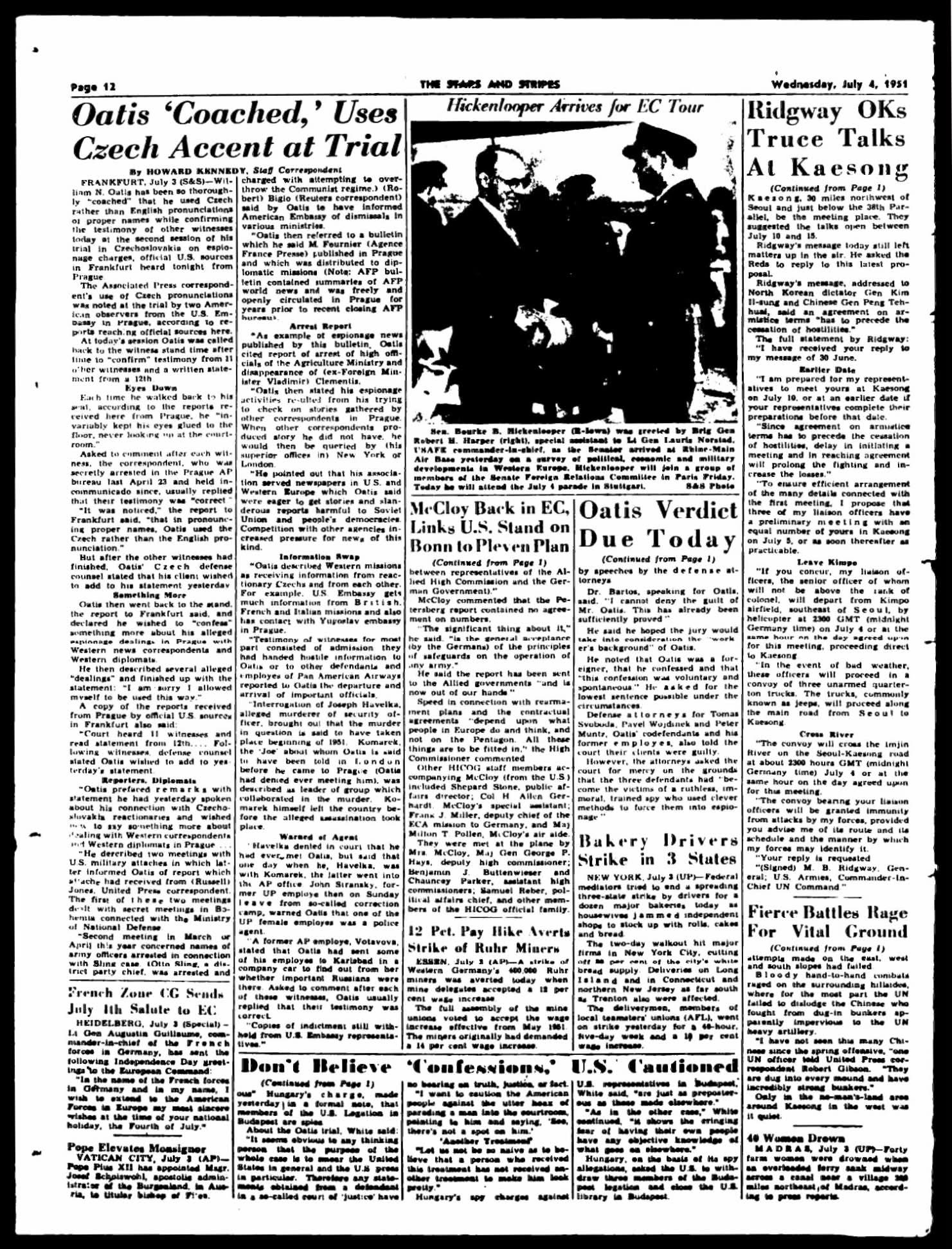
On July 4, 1951, the front page of Stars and Stripes did not pause for fireworks. It led with coverage of the trial of Associated Press bureau chief William Oatis in Prague, truce talks in Korea and labor unrest back home. The Independence Day date at the top of the page underscored the point: for American troops overseas, freedom was not an abstraction. It was something you read about in black ink while war and politics pressed in on every side.
That tension has defined Stars and Stripes since its earliest days. The title first appeared in 1861, when Union soldiers in Bloomfield, Missouri, briefly took over a local press to publish a four‑page newspaper for fellow volunteers. Their “camp paper” mixed battlefield updates with jokes and gossip. It was both a morale booster and a sign that even in wartime, American troops expected to read about their world in their own language, not just through official orders.
The name went dormant after the Civil War, then returned in force during World War I. In 1918, Gen. John J. Pershing ordered an official soldiers’ paper for the American Expeditionary Forces in France. The new Stars and Stripes was edited and largely written by servicemen, some of them seasoned journalists in uniform, others young writers who would later make their names in civilian newsrooms. Its pages carried dispatches from the front, letters, satire and cartoons, and its editors told readers they were trying to give “the most homesick army on earth” a paper of its own.
When that wartime edition shut down in 1919, the editorial staff looked back with a mix of pride and exhaustion. They described hauling type and plates across France, dodging shells and censors, and doing their best to keep a sense of humor alive alongside casualty lists. Already, the basic formula was clear: an American military newspaper had to be close enough to the troops to feel like home and independent enough from authority to be believed.
The formula was tested again in World War II. In 1942, Stars and Stripes restarted in London and quickly multiplied into separate editions for European and Mediterranean theaters. Reporters filed from North Africa, Italy, France and Germany; presses were set up close to the front; distribution trucks followed the armies forward. By the end of the war, daily circulation ran into the millions. Alongside battle coverage and news from the States, the paper introduced readers to cartoon infantrymen Willie and Joe, who grumbled their way through the mud and became unofficial mascots of enlisted perspective.
In the Pacific, another edition followed island‑hopping campaigns across vast distances. The masthead was the same; the weather, terrain and tone were not. That regional flexibility—one paper, many voices—became part of the brand. Troops could pick up Stars and Stripes in England, Italy or the Philippines and find both the local war and the larger American story inside.
After 1945, Stars and Stripes did something unusual for a wartime institution: it stayed. European and later Pacific editions continued as the United States built permanent alliances and bases. During the Korean War, the paper moved into a new conflict zone, and that July 4, 1951 page you are featuring reflects the moment exactly. While civilians at home watched parades, service members overseas were reading about armistice negotiations at Kaesong, Cold War show trials and the everyday grind of a divided peninsula.
In Vietnam, the paper followed American forces into jungle bases and coastal cities, printing stories that ranged from small‑unit patrols to antiwar protests. Its coverage sometimes irritated commanders who wanted a more upbeat tone, but the staff argued that honest reporting was better for morale than spin. In later decades, Stars and Stripes would send reporters and photographers to Iraq, Afghanistan and other deployments, continuing the pattern of a semi‑independent newsroom operating within the Defense Department’s orbit.
Today, the newspaper is part of the Defense Media Activity, funded largely by congressional appropriation and advertising, but governed by editorial policies that promise independence. It publishes print editions in Europe and the Pacific and runs a robust digital operation that reaches service members, veterans and interested civilians. Its beats look much like those of a big metropolitan daily—politics, policy, investigations, sports, culture—except that almost every story bends back toward the lives of people in uniform.
Stars and Stripes is not the only example of military media. Throughout the 20th century, units, bases and commands produced their own newspapers and newsletters, from mimeographed sheets on shipboard to sizable weeklies on large installations. Many were purely local, filled with promotion lists, chapel schedules and bowling‑league scores. Some, especially in wartime, carried sharp frontline reporting and photography that later found its way into archives and history books.
Parallel to that print tradition is the broadcast arm of American public diplomacy. Voice of America, created in World War II, began as a shortwave radio service beamed into territories under Axis control. On early broadcasts, announcers promised listeners, “The news may be good or bad. We will tell you the truth.” Over time, VOA expanded into a multilingual radio, television and digital network, overseen by a civilian agency rather than the Pentagon and aimed primarily at audiences outside the United States.
The missions of these outlets overlap but are not identical. Stars and Stripes speaks first to American troops and their families, explaining the wars they fight, the commands they serve under and the policies that shape their daily lives. Voice of America speaks to foreign publics, trying to offer a reliable account of world events and American society. Both are funded by Washington, and both sit at arm’s length from the administrations of the day through charters that stress accuracy, balance and independence.
That arm’s‑length stance matters because it rests on a deeper American argument about the press. From the First Amendment onward, the country has gradually moved toward the idea that a free press—even a critical one—is not a luxury but part of the system. Episodes such as the Civil War crackdowns on reporters, World War I sedition prosecutions, and the fight over the Pentagon Papers all pushed courts and public opinion toward stronger protection for journalists, even when they embarrass the government.
Military and government‑funded media live in the hardest corner of that argument. Their paychecks ultimately come from the institutions they cover. Yet over time, editors at Stars and Stripes and Voice of America have insisted that credibility requires the right to run stories that commanders or officials may not enjoy. Those tensions occasionally erupt into headlines about budget cuts or attempted interference, but the underlying expectation remains: if the work is not honest, troops and global audiences will tune it out.
The people doing that work often pay a price that never appears in mastheads. In every major conflict since 1918, reporters and photographers working for Stars and Stripes have gone forward with units, shared their hardships and, in some cases, been wounded or killed. Voice of America and other U.S. international broadcasters have lost journalists to reprisals and violence in the countries they cover. When their work wins awards—from military photo contests to international press prizes—it is usually for the most difficult assignments: documenting combat, corruption or human‑rights abuses.
The ecosystem has changed shape in the digital age. Stars and Stripes now offers e‑papers, a responsive website and social feeds. Voice of America streams video, runs podcasts and posts in real time on social platforms. Independent veterans’ news sites, nonprofit outlets and individual reporters on Substack or similar platforms cover defense and foreign policy with niche expertise. Yet even with more voices than ever, the core need remains the same as it was for that first Civil War camp paper: people in dangerous, far‑flung places want news they can trust.
That is why the July 4, 1951 Stars and Stripes page is such a fitting artifact for a 250 YEARS OF AMERICA issue. It shows a country willing to let its own troops see the world as it is, even on a day devoted to patriotic celebration. The trials, negotiations and strikes in those columns were not side stories to the American experiment; they were the experiment in motion.
A quarter of a millennium after the Declaration of Independence, the existence of military and government‑funded media that routinely carry uncomfortable truths is itself a quiet measure of how far that experiment has come. Soldiers reading Stars and Stripes in a tent, and listeners catching a VOA bulletin over a shaky connection, are participating in a tradition that runs deeper than any single war or administration.
For LIKE® Magazine readers, the lesson is straightforward. The press freedom Americans celebrate on July 4 does not live only in big city newsrooms or on cable sets. It also lives in the pages of a soldiers’ paper printed near the front and in the voices that cross borders on shortwave and streaming. As long as those outlets keep telling service members and the world what is really happening, the American laugh, the American argument and the American promise remain very much alive.
(Michael de la Force, LIKE® Magazine, 7.1.2026)
Source post: https://facebook.com/674873899/posts/pfbid02goTCXJejRQtu4UCNEyCFyiD3BViXgmhSaCQvWZedCcSmh9j52CaUa4QypTpsybk1l/