“For, having begun to build their Tower of Babel without us, they will end in anthropophagy. And it is then that the beast will come crawling to us…”
—Fyodor Dostoyevskyy (In The Brothers Karamazov)
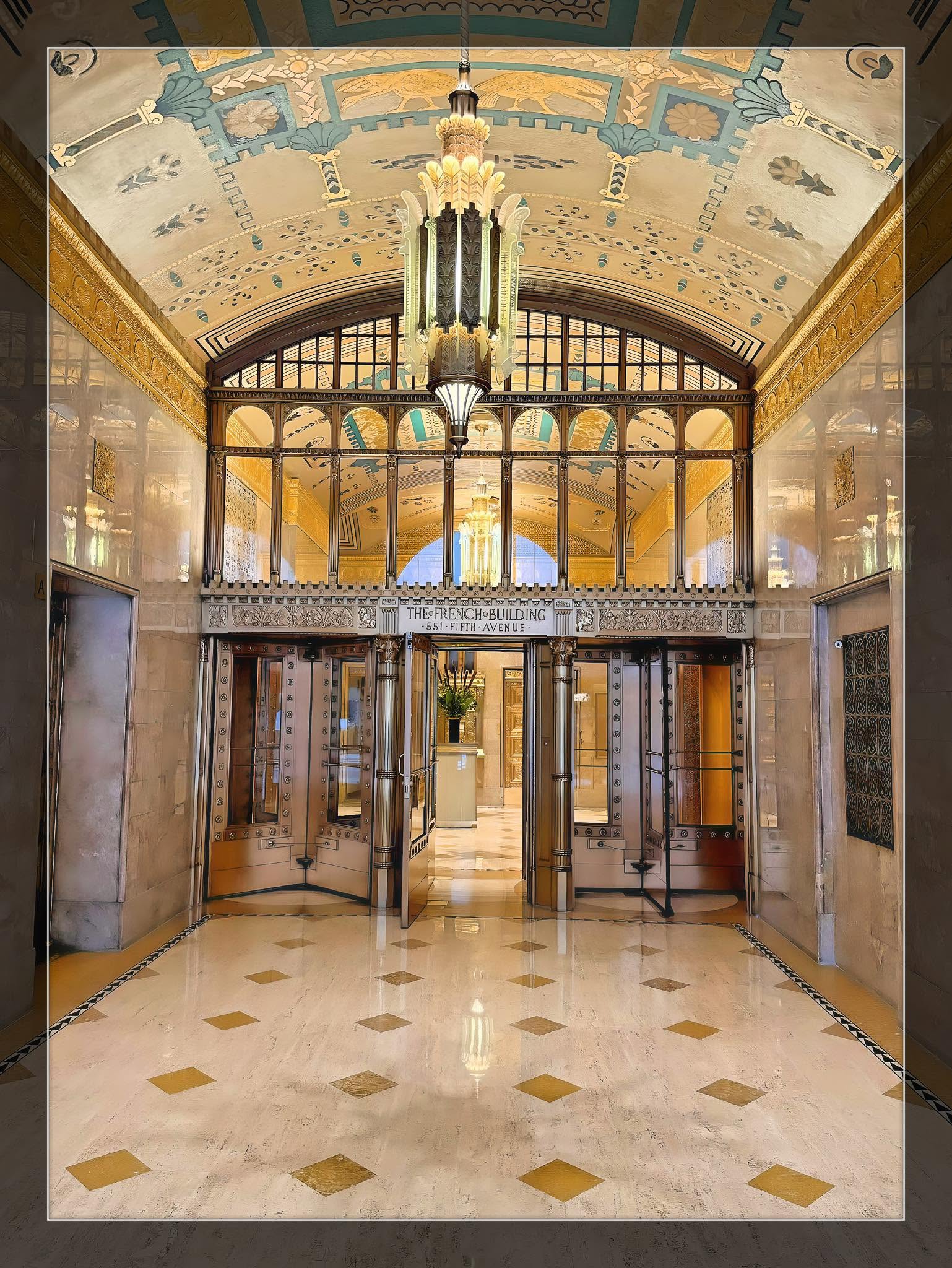
The Fred F. French Building, completed in 1927 at 551 Fifth Avenue and 45th Street in Midtown Manhattan, exemplifies the Art Deco movement, blending Babylonian and Near Eastern influences with modern skyscraper engineering. Designed by H. Douglas Ives of Sloan & Robertson, this 38-story, 426-foot structure was commissioned as the headquarters for the Fred F. French Companies, notable for projects like Tudor City and Knickerbocker Village.
ARCHITECTURAL DISTINCTION
The building’s façade features bold orange brickwork and limestone trim, contrasted by striking setbacks dictated by the 1916 Zoning Resolution. Ornamental elements—polychrome friezes, terracotta décor with black trim, and bronze details—adorn both base and crown. Its “Mesopotamian skyscraper” label comes from motifs inspired by ancient Near Eastern architecture, including ziggurat-like forms and colored, glazed symbolic panels at the top, designed to evoke the legendary Tower of Babel.
Inside, the lobby is landmarked for its period detail: Roman travertine floors, St. Genevieve marble walls, cast bronze elevator doors, and original patterned glass chandeliers. Technologically advanced for its time, the building boasted automatic self-leveling elevators and sophisticated lighting, plumbing, and ventilation systems.
THE “GOLD” AND PERIOD EXCELLENCE
The French Building’s “gold period” can be traced to its early decades when it defined Midtown’s skyline. Its innovative lobby and exterior design received industry acclaim, and it regularly commanded top rental rates on Fifth Avenue. The 1920s marked a time in Manhattan when development along Fifth Avenue was described as “the seventh wonder of twentieth-century commerce,” and the French Building stood at the forefront of that transformation.
RENOWNED TENANTS AND MODERN ERA
The building, always targeted for premium office space, has housed a spectrum of notable tenants over its history. Among them is the law firm Wolf, Kaplan, Kleinberg & Cohen, paid homage in public directories and legal publications, reflecting the building’s continued prestige in legal and professional circles. Other distinguished tenants over the decades have included financial services, real estate companies, and luxury retailers, all attracted by its prime location and architectural pedigree.
PRESERVATION AND LEGACY
A comprehensive restoration in the 1980s renewed the French Building’s façade and interior, and today, it retains not only its landmark status but also a reputation for combining historic grandeur with modern amenities. Its lobby is officially designated an interior landmark and the entire building is listed on the National Register of Historic Places - NPS.
THE TOWER OF BABEL: HUMANITY’S SKY-HIGH AMBITIONS AND THE ORIGIN OF BABBLING
The story of the Tower of Babel, famously echoed in the architectural details of Manhattan’s Fred F. French Building, comes from Genesis 11:1–9. Traditionally attributed to Moses, the tale is set shortly after the Great Flood on the plains of Shinar—today’s northeastern Syria and northern Iraq near the Sinjar Mountains in ancient Mesopotamia.
While Jewish and Christian traditions credit Moses with writing Genesis as part of the Torah, modern biblical scholarship views the book as a composite work, edited over centuries and likely completed during the Babylonian Exile in the 6th century B.C. Many scholars attribute this passage to the “Yahwist” source, known for particular linguistic styles and theological themes. The story offers a religious explanation for the spread of languages and peoples, drawing from the region’s culture, including its monumental ziggurat temples.
According to the Bible, humanity once spoke a single language and united to build a city crowned by a towering structure reaching the heavens — a symbol of ambition and pride. God disrupted this effort by confusing their language, resulting in incoherent “babbling” and scattering people across the earth. The exact original language is not named but is often thought by scholars to be an early form of Hebrew or a proto-Semitic tongue, reflecting the Hebrew Bible’s cultural roots.
The narrative likely draws inspiration from the massive ziggurats constructed by ancient Mesopotamian civilizations—Sumerians, Akkadians, Babylonians, and Assyrians—as religious centers and political symbols.
Tracing their lineage back thousands of years, the Assyrians remain an ethnic group largely based in northern Iraq, Syria, and neighboring regions, preserving a culture rooted in ancient Mesopotamia.
The Israelites have a different origin story, rooted in biblical tradition. They trace their beginnings to Abraham, who migrated from Mesopotamia to Canaan—the modern area of Israel, Palestine, and nearby lands. After slavery in Egypt and a dramatic exodus led by Moses, the Israelites settled in Canaan around the 13th century B.C., evolving from scattered hill tribes to a consolidated kingdom.
These two peoples come from distinct backgrounds. The Assyrians descend from ancient Mesopotamian civilizations in the north, while the Israelites originate from Bronze Age Semitic inhabitants of Canaan linked to Abraham. The Israelites are the ancestors of the Jewish people, who maintain strong religious and historical ties to Israel.
Assyrian civilization began around 2600 B.C. in Assur and continued through phases including the powerful Neo-Assyrian Empire (911–609 B.C.), a dominant force of the ancient world. The Israelite kingdom formed much later, around 1000 B.C. under Kings David and Solomon—making Assyrians more than a millennium older as a distinct civilization.
Differences extend beyond timeline. Assyrians come from Semitic-speaking peoples native to northern Mesopotamia; Israelis descend from Israelites in the southern Levant. The languages differ: ancient Assyrians spoke Akkadian and later Aramaic dialects, while Israelites spoke Hebrew. Today, Assyrians speak Neo-Aramaic dialects; most modern Israelis speak Hebrew.
Religion also divides them. Assyrians are primarily Christian, belonging to Eastern churches like the Assyrian Church of the East and Syriac Orthodox. Ancient Israelites practiced early Judaism, which evolved into Rabbinic Judaism, still practiced worldwide.
Historically, Assyrians built one of Mesopotamia’s earliest and largest empires, ruling vast lands from the 14th to the 7th centuries B.C. The Israelite kingdom was localized in the Levant, existing from roughly 1000 to 600 B.C. before division and exile.
Though both are Semitic peoples of the ancient Near East, Assyrians and Israelites have distinct ethnic, linguistic, religious, and geopolitical origins—setting their histories apart by many centuries.
The Fred F. French Building remains an indelible piece of New York City’s architectural history—a standout for its visual opulence and its fusion of past and future in the very heart of Manhattan.
(Photographer: Michael de la Force, LIKE Magazine, 8.5.2025)
(Michael de la Force, LIKE® Magazine, 8.5.2025)
Source post: https://facebook.com/674873899/posts/pfbid02HS9wvCPcMaKpSxMAMsp7vovC18RgatXJtREUk82iCjW8CS9jMdskgvea4mCwcRXrl/