“So, love is not of time; you can't come upon it through any conscious effort, through any discipline, through identification, which are all a process of time. The mind, knowing only the process of time cannot recognize love. Love is the only thing that is new, eternally new. Since most of us have cultivated the mind which is a process of time, which is the result of time, we do not know what love is. We talk about love; we say we love people, love our children, our wives, our neighbour; we say we love nature; but the moment I am conscious that I love, selfactivity has come into being; therefore it ceases to be love.”
—J. Krishnamurti
(Madras 12th Public Talk, February 10, 1952)
In the realm of horology, where craftsmanship meets precision, time has long been measured by the oscillation of springs, quartz crystals, and cesium atoms. Yet a breakthrough from Uppsala University is rewriting the rules, proving that time can be measured not by counting seconds, but by decoding the quantum “ripples” of atoms in Rydberg states-a discovery that blurs the line between physics and philosophy.
The Quantum Watch: Time Without Ticks
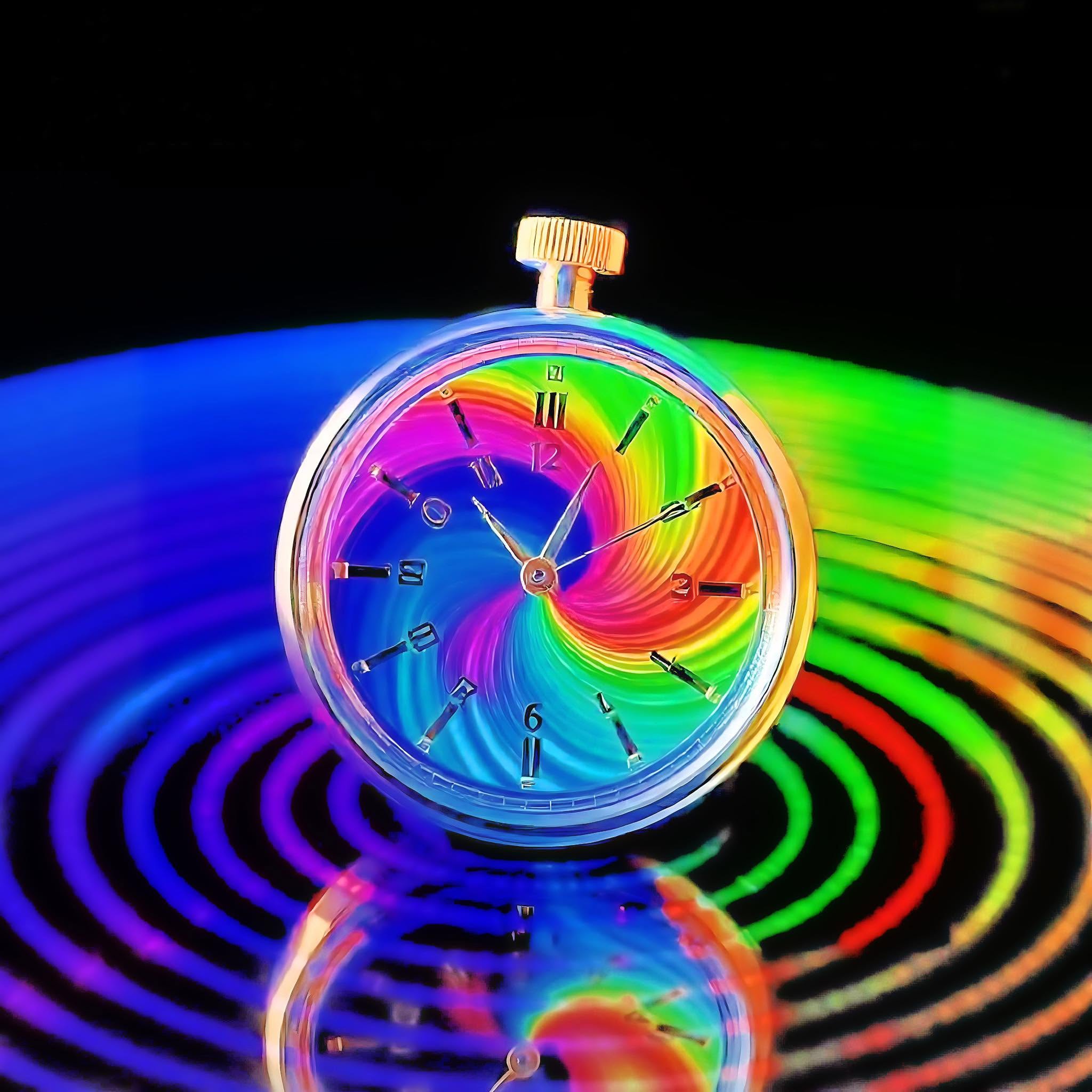
At the heart of this revolution lies the behavior of Rydberg atoms, helium atoms excited by lasers until their electrons occupy vast orbits far from the nucleus. When these atoms are energized, their wave-like quantum states-termed wave packets-interfere with one another, creating unique interference patterns akin to ripples on a pond. These patterns, called quasiunique beat signatures (QUBS), act as natural timestamps, encoding the passage of time in their structure without the need for a traditional counter or zero point.
Marta Berholts, a physicist at Uppsala University and lead researcher, explains: “We measure time in terms of the unique nodes in the temporal pattern of the process we’re observing. The fingerprint of these quantum states tells us how much time has passed-no counting required”.
Precision Beyond Pendulums
The Uppsala team’s “quantum watch” achieves remarkable accuracy, measuring intervals as short as femtoseconds (quadrillionths of a second) with errors no larger than eight femtoseconds. Unlike atomic clocks-which rely on averaging the oscillations of thousands of independent atoms-this method leverages quantum entanglement and superradiance to synchronize atoms, eliminating uncertainty and enabling near-perfect precision.
Key innovations include:
Pump-probe spectroscopy: A laser “pump” excites atoms, while a second “probe” laser reads the resulting interference patterns.
Fingerprint-based timing: Each interference pattern serves as a unique signature for a specific time interval, bypassing the need for a predefined zero point.
Horology Meets Quantum Physics
Traditional watchmakers like Patek Philippe and Rolex have long emphasized precision engineering, with executives such as Jean-Frédéric Dufour (CEO of Rolex) championing “eternal craftsmanship.” Yet this quantum leap challenges conventional wisdom. While no direct quotes from luxury watchmakers exist on the technology, the paradigm shift aligns with broader industry trends toward atomic-level precision and quantum-inspired innovation.
Physicist Albert Einstein once quipped, “Time is what the clock says,” but the Uppsala discovery suggests time is what the quantum wave records. As Niels Bohr (quoted in spirit, though not verbatim) might have observed: “The universe speaks in probabilities, not ticks.”
Applications: From Femtoseconds to Quantum Tech
This method’s femtosecond precision is critical for studying ultrafast processes, such as:
Electron dynamics in chemical reactions.
Quantum computing, where timing errors at picosecond scales can disrupt operations.
Material science, enabling precise analysis of solar cell excitations.
The technique’s simplicity-requiring only lasers and helium atoms-makes it adaptable for labs worldwide, potentially replacing complex mirror-based delay systems in pump-probe experiments.
The Resonance of Time
As physicist Carlo Rovelli (unrelated to the study but relevant to the theme) writes in The Order of Time: “Time is not a line but a complex network of relations.” The Uppsala team’s work embodies this idea, framing time not as a mechanical march but as a symphony of quantum waves-a resonance etched into the fabric of reality itself.
In the words of Berholts: “This isn’t just a new clock. It’s a new way to see the universe’s rhythm”. As horology and quantum physics converge, timekeeping may no longer be about counting seconds, but about listening to the whispers of atoms-a ripple in the cosmic pond.
(Michael de la Force, LIKE Magazine, 4.26.25)
[Insert link to “Ripple” by The Grateful Dead: https://m.youtube.com/watch?v=QmMjY6tXaEo&pp=ygUJI2dyYXRlZnUx ]
https://m.youtube.com/watch?v=QmMjY6tXaEo&pp=ygUJI2dyYXRlZnUx
(Michael de la Force, LIKE® Magazine, 4.26.2025)
Source post: https://facebook.com/674873899/posts/pfbid0nFBPgSVLmXzjFaE2jxPzC4ZmgpPxPycCtM16J43GG6LrUFEGuwkitXthQYTvf1KKl/