NEW YORK, July 4, 2026 — Leadership Media™
"The purpose of life is to live it, to taste experience to the utmost, to reach out eagerly and without fear for newer and richer experience."
— Eleanor Roosevelt
Some photographs earn their keep slowly. A frame that once seemed ordinary — three men in good suits, leaning toward the camera — turns out to hold a small map of a certain kind of American life: the kind built on trust, good work and the friendships that grow between people who never expected to know one another.
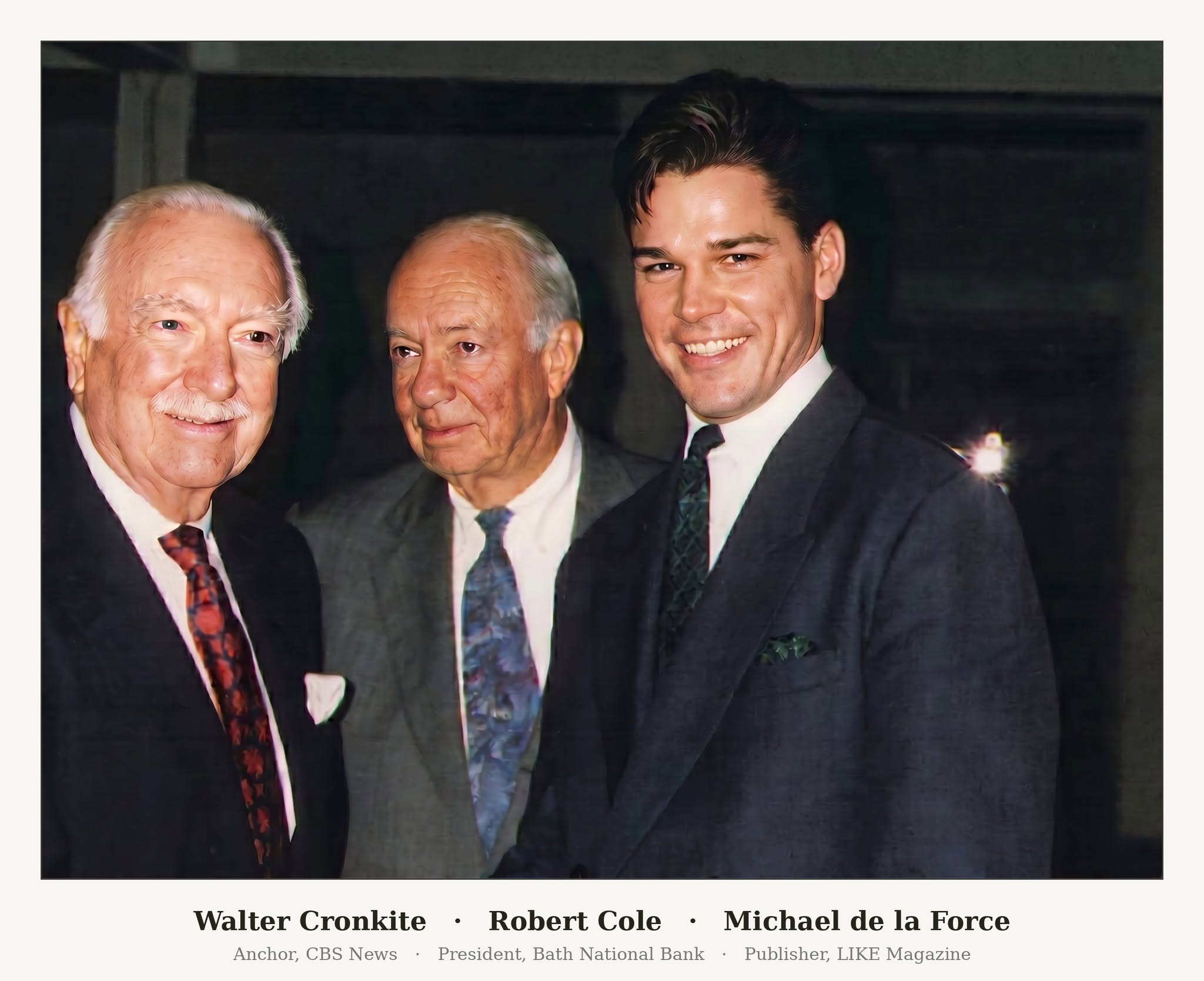
Such is the case with a portrait that has resurfaced in the archives of LIKE Magazine. In it stand three men across three generations and three worlds. There is Walter Cronkite, the CBS News anchor once called "the most trusted man in America." There is Robert "Bob" Cole, the longtime president of Bath National Bank in New York's Southern Tier. And, on the right, there is a young Michael de la Force, then early in the publishing career that would carry him across society, media and civic life in New York and to visit more than fifty countries and territories around the world. The photograph is the reason for this account. But the men in it are the story.
The most trusted man in America
Walter Cronkite anchored the "CBS Evening News" from 1962 to 1981, guiding American living rooms through the assassination of President John F. Kennedy, the space race and the war in Vietnam. His sign-off — "And that's the way it is" — became a national fixture, and his authority was such that a president was said to have measured public opinion by whether he still had Cronkite.
Long before the anchor desk, though, Cronkite had made his name in the field, and the field was the world. As a wire-service and then network correspondent he reported from across several continents and from many countries and territories — the North African campaign, the invasion of Sicily, the D-Day landings and the drive across France and Germany; the Nuremberg trials; two years posted in Moscow at the dawn of the Cold War; the war in Vietnam; and later travels that took him to China and the Soviet Union with President Nixon and to the Middle East for the Egyptian-Israeli peace. Few journalists of his century saw as much of it firsthand.
Away from the anchor desk, Cronkite kept company he rarely discussed on air. Among those affiliations was the Bohemian Grove, the secluded Northern California encampment of the Bohemian Club, whose summer gatherings have drawn presidents, industrialists, artists and journalists for more than a century. Cronkite's tie to the Grove is among the best documented of any member: for years his voice served as "the Owl" in the club's opening ceremony, the ritual known as the Cremation of Care. Contemporary reporting placed him in the "Hill Billies" camp alongside George H.W. Bush and William F. Buckley Jr. It was that world — private, elite and easy to miss from the outside — that would eventually bring the newsman into the same circle as a banker from a small city few of his colleagues could have found on a map.
A banker from Bath
Robert Cole, the man at the center of the photograph, belonged to a quieter America — the world of Main Street banking that once anchored small cities and rural counties across New York. As president of Bath National Bank, a community institution headquartered in Bath, in Steuben County, Cole occupied the sort of role that in an earlier era made a banker one of the most consequential figures in his region: the person who decided which farms expanded, which storefronts opened and which families kept their footing through hard years. De La Force always enjoyed his conversations with Cole, whom he remembers as hilarious in a low-key way.
By De La Force's account, banking was the family trade — Cole's father had served as president of the same institution before him, making the Coles a two-generation fixture of the Southern Tier's financial life.
Bath National Bank was no small concern. By the end of 1997, the bank held roughly $272 million in total assets, including about $163 million in loans — the bulk of them residential and agricultural. It was, in other words, precisely the kind of well-capitalized, deeply rooted community bank that gave its president real standing far beyond Steuben County.
What Cole shared with Cronkite, though, was more than an acquaintance: it was the fellowship of the Bohemian Grove, the bond that helped bring a small-city banker and a national newsman into the same circle, and eventually into the same photograph. Cole told De La Force directly of his time at the Grove, and it was through that shared world that the two men came to know each other.
The publisher
The third man, Michael de la Force, was the youngest in the frame and, at the time, the least known. He would go on to a long career as a publisher and editor in media and social work, moving among the events, institutions and personalities that fill cultural and creative life. That he found himself photographed alongside Cronkite and Cole says something about the reach of a well-made introduction — and about the way the Grove, and friendships like Cole's, could open doors between generations.
It also says something about how De La Force kept those doors open. Over the years his friendships spanned the wealthy and the working, the famous and the unknown, the homeless, the downtrodden and the billionaire class. He said that had been the goal since he was a freshman in high school on the Cherokee Nation reservation in Oklahoma: to deeply understand all walks of life. De La Force has been plain about why the friendships and connections stood the test of time. He meets people where they are and shares, in an open and honest manner, and he never asked a friend for anything, no matter how much or how little that friend had. Friendship — the trading of knowledge and laughter — was the whole of it, and nothing more. It is a simple accounting, and it explains a photograph in which three men from three different worlds could stand together as equals.
The pilot who flew to the anchorman's door
No account of Cronkite's later years is complete without the friends who came to him — sometimes, quite literally, by air.
Chief among them was Jimmy Buffett, the singer, songwriter and businessman whose 1977 hit "Margaritaville" turned an easygoing island philosophy into an American empire of music, restaurants, resorts and merchandise. Buffett, who died in 2023, was also a devoted and accomplished aviator — a licensed seaplane pilot who over the years owned a small fleet of flying boats, among them a Lake Renegade, a Grumman G-44 Widgeon and a Grumman HU-16 Albatross he christened the "Hemisphere Dancer." For Buffett, the seaplane was not a novelty but a way of life, of a piece with the barefoot, saltwater ease that "Margaritaville" had made famous.
Cronkite and Buffett were genuine friends, a bond of shared love for the water and for sailing; when Cronkite died at age 92, Buffett was among those who paid tribute at his memorial. Cronkite himself told the story to Michael: Buffett, he recounted, would pilot his seaplane up the East River and set it down near Cronkite's home to call on the anchorman and his wife, Mary Elizabeth "Betsy" Maxwell Cronkite — as Michael recalls her name — an image as vivid as any in the Cronkite legend, of a barefoot troubadour taxiing to the door of the most trusted man in America. Betsy was Cronkite's wife of 64 years.
During the summers, Martha's Vineyard transformed into a playground for an elite, fascinatingly eclectic group of friends. Buffett and Cronkite were the core crew there. They were frequently joined by Ed Bradley and Grateful Dead percussionist Mickey Hart. Hart actually shared that Cronkite loved the Grateful Dead and would famously jam out on the floor tom drums with them during casual gatherings.
Buffett is not pictured in the photograph at the heart of this story. But he belongs to its spirit — one more thread in the wide, improbable weave of friendships that gathered around Walter Cronkite, and that a single frame from the LIKE Magazine archive still manages to hold.
When Cronkite's own time came, his funeral was held at St. Bartholomew's Episcopal Church on Park Avenue in Manhattan, the parish the Cronkite family had attended for decades. The service drew the giants of American broadcasting — Tom Brokaw, Dan Rather, Katie Couric, Barbara Walters and others — but St. Bart's also opened its doors to the public who wished to pay respects. Among those in the pews were De La Force and his son, there to say goodbye to the man in the photograph.
Today that photograph sits in the LIKE Magazine archive, restored via AI technology and framed — a reminder that history is often held not in monuments but in the ordinary confidence of three men who trusted one another enough to stand still for a moment and share conversation in public, on airplanes, in the bank or at the farm.
(Photograph by Mary Agnes Whitford von Hagn, First Lady of Bath, New York)
(Michael de la Force, LIKE® Magazine, 7.5.2026)
Source post: https://facebook.com/674873899/posts/pfbid02RcZepaxbCD6HiB3QPENxKDKcJR2hrZQ2Y9BNC6BBkeNViGDCH3fRbmoaPFNN4UDQl/