"The real voyage of discovery consists not in seeking new landscapes, but in having new eyes." — Marcel Proust (paraphrased from In Search of Lost Time)
A LIKE® Magazine journey through the harbour, the hillsides, and the streets of Hong Kong after dark
There is a particular quality of light in these photographs. It is the warm, slightly imperfect glow of film shot on the streets and waterways of Hong Kong Free in the closing decades of the twentieth century. A sampan pushing a bow-wave through magenta water. A shop of gilded Buddhas lit like a stage set. A steel bank tower that had just announced the future. Roast ducks in a market window; a neon storefront blazing against the night; a floating palace of a restaurant flying its dragons over Aberdeen.
They are not museum pieces. They are invitations.
Hong Kong has always been a city of arrival — a harbour that turns strangers into residents and residents into locals within a single generation. In the years since these frames were exposed, the skyline has multiplied, the trams have been rebuilt, museums have risen from reclaimed harbour, neon has dimmed, and a floating landmark has slipped beneath the waves. And yet the essential proposition is unchanged. As President Xi Jinping told the city on the 25th anniversary of its return, Hong Kong remains "one of the most liberal and open economies in the world" — a place, in the words of Chief Executive John Lee, where it is now the "perfect time for tourists, investors, entrepreneurs and innovators to come and experience the vibrancy of the city".
So let us go, as the old slide caption had it, en route to The Peak — and everywhere in between. Here is what each of these images shows, and here is what has changed.
The Harbour at Dusk
Begin on the water, because Hong Kong began on the water.
A fishing boat pushes across the harbour at the violet end of the day, its rig and canopy thrown into black silhouette against a far shore stacked with towers, the hills rising soft behind. Victoria Harbour has been the defining geographical feature of Hong Kong since 1841, its deep, sheltered waters making it one of the great natural harbours of Asia — and for more than a century it was alive with exactly this kind of working craft. The very shape of the city grew from this waterway: trade, migration, and industry all arrived by sea, and the harbour remains the stage on which Hong Kong still performs its nightly light show.
Round the island's southern shore, a small motorised sampan — hung with tyres for fenders and heaped with a life's worth of cargo — cuts a white wake through water turned rose-gold by the falling sun. This is Aberdeen (香港仔, literally "Little Hong Kong"), an important fishing port since the 19th century. There is a lovely circularity here: the settlement of Heung Kong Tsuen ("fragrant harbour village"), which appears on a Ming-dynasty map dated to 1595, is widely believed to have lent its name — 香港, "fragrant harbour" — to the entire territory. The fragrance is thought to have come from the incense wood once shipped through these waters. In other words, the whole of Hong Kong is named, in effect, after this modest fishing inlet. The English name honours George Hamilton-Gordon, the 4th Earl of Aberdeen, who was British Foreign Secretary when the area was surveyed in the 1840s.
What has changed. The great live-aboard fleets have thinned — the population of Hong Kong's boat dwellers fell from around 150,000 at its 1963 peak to roughly 40,000 by 1982 as government resettlement moved families ashore — but Aberdeen is no ghost harbour. It remains the only fishing port in the Southern District, over a third of all fish caught in Hong Kong are still processed here, and as of 2025 some 600 junks are moored in the port with around 6,000 people living in the vicinity. The scene in these photographs is still findable — quieter, but alive.
If You Go — Aberdeen. Take a limo or a taxi, or alternatively take the MTR South Island Line to Wong Chuk Hang, or buses 70, 72, 72A. Sampan rides can be hired from local boatwomen along the Aberdeen Promenade — a 20-to-30-minute circuit costs roughly HK$50–80. The operator Aberdeen 1773 runs a guided tour (around HK$175) that circles the harbour's landmarks before visiting a preserved houseboat.
The People of the Water
The harbour's true subject was never the boats. It was the people who lived in them.
Here the harbour reveals its domestic face: sampans rafted together under arched canvas roofs, a white sheet drying over one cabin, a child's world contained within a few square metres of timber and tarpaulin. Many of these families belonged to the shuishangren (水上人), or "people of the water" — a boat-dwelling community who settled Hong Kong's waters over many centuries. (An older exonym for the community is now widely regarded as derogatory; scholars and community members increasingly prefer shuishangren or simply "the boat people.") For generations they lived, married, gave birth, and were mourned afloat, forming a distinct culture with its own dialect, folk songs, and customs.
Come closer and the boat becomes a home. On this beautifully weathered wooden junk, the whole apparatus of daily life is on display — the galley with its coloured buckets and thermos flasks, the laundry strung on a line, the tyres slung as fenders, the registration number painted on the bow. Nothing is ornamental; everything works. A junk like this was kitchen, bedroom, workshop, and livelihood in one hull.
And here is the labour that paid for it: fishermen bent over the gunwales between two junks — the vessel M 63031A nosing in beside its neighbour — mending and hauling in the flat morning light, coils of net and rope draped over every rail. This was one of Asia's great fishing communities at work, supplying a catch that fed the city and, at its height, made Hong Kong one of the busiest fishing centres in the region.
Movement on the water was muscle and timber and tide. Here two men in the wide conical hats that were the uniform of the harbour work a small boat — one seated near a cool-box, the other leaning his whole body into the day's labour.
Seen from above, the same choreography becomes almost abstract: a long yellow bamboo pole drives the sampan forward, its reflection cutting a bright line across dark water, the boatmen's hats two pale discs against the timber. No engines, no schedules — only the slow, exact economy of hand and pole.
A lone figure sculls home through the anchorage, the floating village crowding the middle distance and the walk-up tenements of the shore rising behind — the exact seam where the water city met the land city, and where, over time, one gave way to the other.
And a portrait, finally, to hold it all still: a young man in a white singlet and denim leans in the timber doorway of his family's boat, the vessel numbers M 711970 and 302 86A stencilled on the hulls below. He is the harbour's future looking off-frame — the generation that would, for the most part, move ashore.
What has changed. The full-time floating village has largely dispersed to public housing on land, but its memory has been deliberately kept afloat. Aberdeen 1773 visits a preserved houseboat fitted out with vintage photographs and film of harbour life. Out on the main harbour, the red-sailed Dukling — Hong Kong's last original antique junk, with nearly 70 years of history — still sails daily on cruises from Central and Wan Chai. The boatmen of these photographs have a direct descendant, and you can step aboard.
The Palace That Floated Away
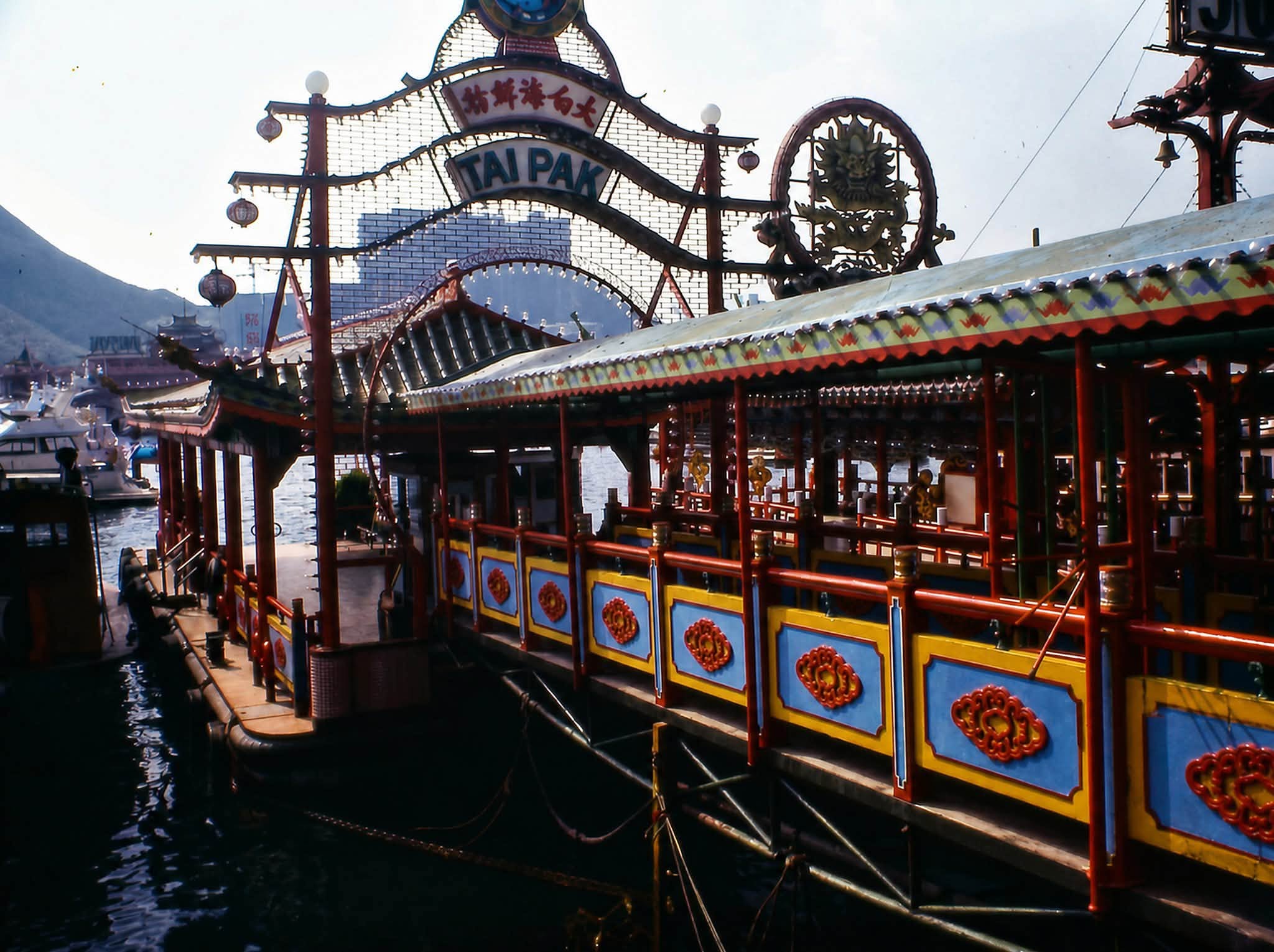
Few images say old Hong Kong more instantly than this: the tiled, dragon-crowned gateway of the Tai Pak floating restaurant, its name blazoned in English and Chinese beneath a golden dragon medallion, its gangway railings a riot of red, blue and gold enamel. Tai Pak was the elder of Aberdeen's fabled floating restaurants, established in 1952; in 1976 the shipping magnate Stanley Ho moored the vastly larger Jumbo Floating Restaurant alongside it, and together they became Jumbo Kingdom — a floating imperial palace that over 44 years served more than 30 million guests, Queen Elizabeth II and Hollywood film crews among them.
What has changed — and this is the bittersweet part. The larger Jumbo is gone. It suspended operations in March 2020 during the pandemic and, unable to reopen, was towed out of the harbour in June 2022; days later, in bad weather near the Paracel Islands, the vessel capsized and, as the BBC and others reported, sank. But the boat in this photograph — Tai Pak itself — has a happier ending. Rather than being lost, Tai Pak was towed away in 2022 for restoration and, after more than 1,000 days of work, returned to the Aberdeen Typhoon Shelter in late December 2025, with plans to reopen as a cultural attraction. The gateway you see here is not merely a memory; it is a survivor, home again in the harbour that made it famous.
Faith and Festival
Step ashore into the smoke.
A courtyard packed shoulder to shoulder, drums of offerings ablaze, giant stone incense urns crowned with a forest of joss sticks, and the blue haze of smoke drifting over everyone — this is Chinese New Year at a Hong Kong temple, when the ritual burning of joss (incense) reaches its yearly peak. The most coveted act is the offering of the first incense (頭炷香), a tradition believed to carry the greatest blessings of the year; worshippers queue for hours before midnight on New Year's Eve to plant the first stick as the new year turns. It is a scene of extraordinary devotion and density, repeated across the city's temples every spring.
On a quieter morning, a low temple with sweeping tiled eaves and carved stone gateposts sits at the foot of a hillside crowded with walk-up tenements, commuters crossing in the gold of early light. Temples like this — pockets of the sacred folded into the densest streets — are among the oldest surviving structures in the city. The most famous of them, Man Mo Temple on Hollywood Road, built between 1847 and 1862, was declared a monument and remains wreathed in the smoke of its giant hanging incense coils, honouring the gods of literature (Man) and war (Mo).
What has changed. The devotion has, if anything, intensified. The first-incense ritual — suspended during the pandemic and fully resumed in January 2023 — again draws vast crowds: for the Year of the Dragon in 2024, Wong Tai Sin Temple expected 50,000 to 60,000 worshippers for the New Year's Eve ritual alone. Across the harbour in Sha Tin, Che Kung Temple drew more than 40,000 worshippers on the third day of the Lunar New Year in 2026, where the faithful spin bronze fan-wheels for good fortune and shake bamboo kau cim sticks to divine the year ahead.
If You Go — Temples. Man Mo Temple, 124–126 Hollywood Road, is open daily, 8am–6pm, free to enter. Wong Tai Sin Temple sits directly above Wong Tai Sin MTR station (Exit B2), open daily from early morning, free. Che Kung Temple is a short walk from Tai Wai MTR.
Visiting outside the New Year rush lets you experience the atmosphere without the crush.
The Antique Quarter
Off the temple street and into the amber warmth of an antique dealer's shop. Scroll paintings of tigers and landscapes climb the walls; a serene carved Buddha presides over blue-and-white ginger jars; lamps and lacquer catch the light. This is the world of Hollywood Road, one of the oldest streets on Hong Kong Island, laid out in the 1840s soon after the British landing and lined ever since with dealers in Chinese art, furniture, jade, ceramics and curios. The street's name has nothing to do with California; it is generally traced to "Holly Wood," the Bristol home of an early governor, Sir John Davis. This is the heart of what the tourism board now calls Old Town Central.
What has changed. Remarkably little, in spirit. The antiques trade still runs the length of Hollywood Road and spills down to Cat Street (Upper Lascar Row), where stalls of curios sit beside serious galleries. What is new is the company the antique shops keep: a few streets away, the restored Tai Kwun heritage and arts complex (the former Central Police Station compound) and the creative hub at PMQ have made this quarter as much about contemporary art and design as about the past.
If You Go — Old Town Central. The Central–Mid-Levels Escalator threads through the whole district — it runs downhill 6–10am, then uphill until midnight. Tai Kwun and PMQ are both free to enter and open daily. Combine the antiques of Hollywood Road, the incense of Man Mo, and a coffee in SoHo into a single, walkable morning.
Steel, Sky, and Hillside
Then, the future — as it looked in the 1980s.
Norman Foster's HSBC Main Building rises in exposed steel and glass, its "coat-hanger" trusses worn on the outside like the workings of a watch. Completed in 1985 and officially opened in April 1986, it was the most expensive building in the world, at roughly HK$5.2 billion — 178.8 metres of structural bravado, its floors hung from masts so the ground beneath could be given back to the public as an open plaza. Two bronze lions, cast in the 1930s and nicknamed Stephen and Stitt after two bank managers of the era, still guard the entrance; generations of Hong Kongers have rubbed their paws for luck. (You may hear that the rooftop maintenance cranes were installed as "cannons" aimed at a rival bank tower for feng-shui warfare — a wonderful piece of urban folklore, though the cranes in fact predate that neighbour by several years.)
And here is the other face of the boom: housing, climbing the hills. Hong Kong's vertical density is among the most extreme on the planet — with only about 24% of its land mass urbanised, its built-up areas reach the world's highest population densities. The distinctive white complex with the great arched base and the rectangular void punched through its towers is The Repulse Bay (影灣園), completed in 1989 on the site of the colonial-era Repulse Bay Hotel. Its famous "dragon hole" is popularly explained as a feng-shui concession — an opening to let the mountain dragon pass through to the sea — though the developer has described it chiefly as an aesthetic and design choice. In the dusk-blue frame, terraced apartment blocks step down the slope to the water's edge — the stacked silhouette that defines Hong Kong Island's southern face.
What has changed. In 1985 the HSBC tower dominated Central. Today it reads as a graceful mid-riser among giants — the Bank of China Tower (1990), Two IFC, and a forest of supertalls have risen around it — yet it has lost none of its power to be recognised: it is Grade I listed, and its ground-floor plaza remains open to the public around the clock. Central itself is now the heart of a financial centre ranked third in the world — and first in the Asia-Pacific — by the Global Financial Centres Index in September 2025, and first on Earth for fintech. The hillside estates, meanwhile, have only grown more coveted; Repulse Bay is consistently among the most expensive residential addresses in the world.
The business thread. This is where your LIKE® Magazine travel story meets the investment story. Hong Kong runs a simple, low tax regime — a two-tiered profits tax of 8.25% and 16.5%, salaries tax capped at 15%, and no VAT, sales tax, capital-gains tax, or withholding tax on dividends — under a currency pegged to the US dollar at 7.75–7.85 since 1983. The government agency InvestHK reports that a record number of companies set up or expanded in the city in 2024, and it markets Hong Kong as a "super-connector and super value-adder" that "warmly welcomes enterprises, talent, and investment."
If You Go — Repulse Bay & The Peak of it all. Repulse Bay's beach and the landmark complex are reached by buses 6, 6A, 6X, and 260 from Central. The HSBC plaza at 1 Queen's Road Central is open and walkable at any hour.
The City After Dark
Night is when Hong Kong performs.
It starts in the last daylight, on a corner of Wyndham Street, where a weathered ochre tenement leans into the frame — first-floor balcony crowded with potted plants and laundry, a red no-entry sign, the bilingual street plate confirming the address. This is the granular texture of old Central. Today Wyndham Street climbs from the banking district straight into the nightlife of Lan Kwai Fong and the restaurant terraces of SoHo, the dining quarter that grew up almost by accident after the Central–Mid-Levels Escalator opened in 1993 and sent a river of foot traffic past once-quiet lanes.
Inside, the glamour of the era glows amber: the great cascading escalators of a luxury hotel atrium, ribbons of light descending through the dark. Hospitality was already a Hong Kong art form. The city's home-grown luxury brand, Shangri-La, was founded in 1971 and is headquartered here; its Kowloon Shangri-La opened in 1981 and the Island Shangri-La in 1991, the latter refreshed following a major renovation.
The name itself, spelled out in light above a hotel forecourt at night — Shangri-La, the mythical Himalayan valley from James Hilton's 1933 novel Lost Horizon — became shorthand for a certain kind of arrival. In a city built on transit and trade, the grand hotel was, and remains, a landmark of its own.
But the true signature of the Hong Kong night was neon. Here a clothing shop called Chicago blazes purple, orange and green beneath a flying-plane sign, shoppers streaming past racks that spill onto the pavement. Hong Kong's first neon sign appeared in 1929, and the first local neon factory opened around 1932; by the 1950s and 60s, overlapping signs turned whole streets into rivers of light. The look is so identified with the city that its glow is widely credited among the visual influences behind the future-city aesthetic of Blade Runner. Each sign was hand-made, its tubes bent over open flame by a shrinking guild of master craftsmen.
And parked at the kerb, a rank of red-canopied rickshaws — the hand-pulled carts that were once everywhere in the colony. First imported in 1880, they numbered more than 3,400 at their 1924 peak before motor transport made them obsolete.
The night ends, as it often did, in front of a Louis Vuitton window glowing amber against the dark, its name doubled in the plate glass. Even decades ago, Hong Kong was a temple of retail — a tax-free port where the world came to shop.
What has changed. The neon has largely gone dark. A government campaign against unsafe signboards removed thousands from the late 2000s, and by the early 2020s only a few hundred neon signs were estimated to remain — but the craft is being rescued: the M+ museum preserves classic signs, including a restored cow and a Kai Kee mahjong sign, visible through its conservation window, and the non-profit Tetra Neon Exchange has saved dozens more. The rickshaws, sadly, are gone entirely: Hong Kong stopped issuing licences in 1975, the last puller retired in 2020, and not one licensed rickshaw remained by the end of 2022 — though open-top sightseeing buses still carry the "rickshaw" name in tribute. Luxury, by contrast, has only expanded: Hong Kong is one of the densest luxury markets on the planet, anchored by Canton Road and the vast HarbourCity mall — two million square feet, 450-plus stores — its edge sharpened by the Hong Kong dollar's peg to the US dollar since 1983 and the absence of sales tax.
If You Go — After Dark. Ride the Central–Mid-Levels Escalator up into SoHo and Lan Kwai Fong for dinner and drinks. For neon, seek out the surviving signs of Yau Ma Tei and Mong Kok, or visit M+ at West Kowloon to see conserved classics up close. Harbour City runs the length of Canton Road in Tsim Sha Tsui, steps from the Star Ferry.
The Market Window
Under fluorescent tubes and the red glow of heat lamps, glazed roast birds hang in glistening rows while great woven bamboo baskets stack in the foreground and a child sits quietly among the crates. This is Hong Kong's food culture at its most elemental — the wet market and the siu mei (燒味) roast-meat shop, where honey-lacquered char siu, crackling siu yuk, and fragrant roast goose hang in the window as both larder and advertisement. A good roast shop is a neighbourhood institution, its cooks judged on the crackle of the skin and the lacquer of the glaze.
What has changed. Air-conditioned supermarkets thinned the old markets, but the survivors are treasured all the more. Graham Street Market, established around 1900, still trades every morning as one of Hong Kong's oldest open-air wet markets, steps from the Mid-Levels Escalator. The roast-meat tradition, far from fading, has been elevated: the Michelin Guide now actively tracks and awards Hong Kong's siu mei shops, with legendary names — Yat Lok's roast goose, Kam's Roast Goose, the century-old Yung Kee — carrying stars and Bib Gourmand honours. The window in this photograph is still open for business.
Why Go Now
The city in these photographs is not lost. It has grown up around the frames — taller, faster, wired to the mainland and the world — while keeping, against considerable odds, the harbour rides and roast-meat windows and incense-clouded temples that made it singular in the first place. Some things have vanished: the largest floating restaurant, the rickshaws, most of the neon. Others endure, or have been consciously preserved — and one beloved boat, Tai Pak, has even come home.
There has rarely been a more deliberate moment of welcome. After the pandemic years, the government's "Hello Hong Kong" campaign gave away 500,000 free air tickets. The results followed: some 34 million visitors in 2023 and close to 45 million in 2024, with long-haul arrivals up more than 50 percent year on year. New reasons to come have risen from the reclaimed harbour at West Kowloon — the M+ museum of visual culture and the 香港故宮文化博物館 Hong Kong Palace Museum — while the sixth-generation Peak Tram and Sky Terrace, reopened in August 2022 after a HK$799 million rebuild, still carries travellers up to Sky Terrace 428, the city's highest lookout at 428 metres — the destination the old slide caption promised all along.
If You Go — The Essentials. The AirPort Express reaches Central in about 24 minutes (HK$120 with an Octopus card). An Octopus card opens every turnstile, and the Star Ferry crosses the harbour for a few Hong Kong dollars. The Peak Tram runs roughly 7:30am–11pm. M+ (HK$120; free on Wednesdays; closed Mondays) and the Hong Kong Palace Museum (HK$70; closed Tuesdays) sit side by side at West Kowloon. Travellers from around 170 countries and territories enter visa-free. The clearest skies and coolest air arrive in autumn, October through December.
President Xi framed the larger promise plainly in 2022: from "disarray to good governance, Hong Kong is entering a new phase of becoming more prosperous," a city where the central government "fully supports Hong Kong in carrying out more extensive exchanges and close cooperation with the rest of the world." For the traveller, that translates simply enough.
The sampans are still on the water. The roast ducks are still in the window. The tram still climbs to The Peak.
You are, once again, warmly invited.
Michael de la Force, LIKE Magazine, July 2026
Photographs from the RR Collection ©Michael de la Force. Historical and current-day details are sourced; visitor information is accurate at time of writing on 7.2.26 and should be confirmed before travel.
(Michael de la Force, LIKE® Magazine, 7.2.2026)
Source post: https://facebook.com/674873899/posts/pfbid02MTySW7H5zhFScEgivp57CyFKGBMCxrNrpHo7p8MzcRChmu2PqdH9y747qNrMddwel/