The seal of the New York County District Attorney's Office prominently features the date 1625, marking the founding year of New Amsterdam, the original Dutch settlement that evolved into modern-day New York City. This date honors the city’s early origins, despite the District Attorney’s office being established much later. The seal symbolizes over four centuries of justice and governance from colonial times to the present.
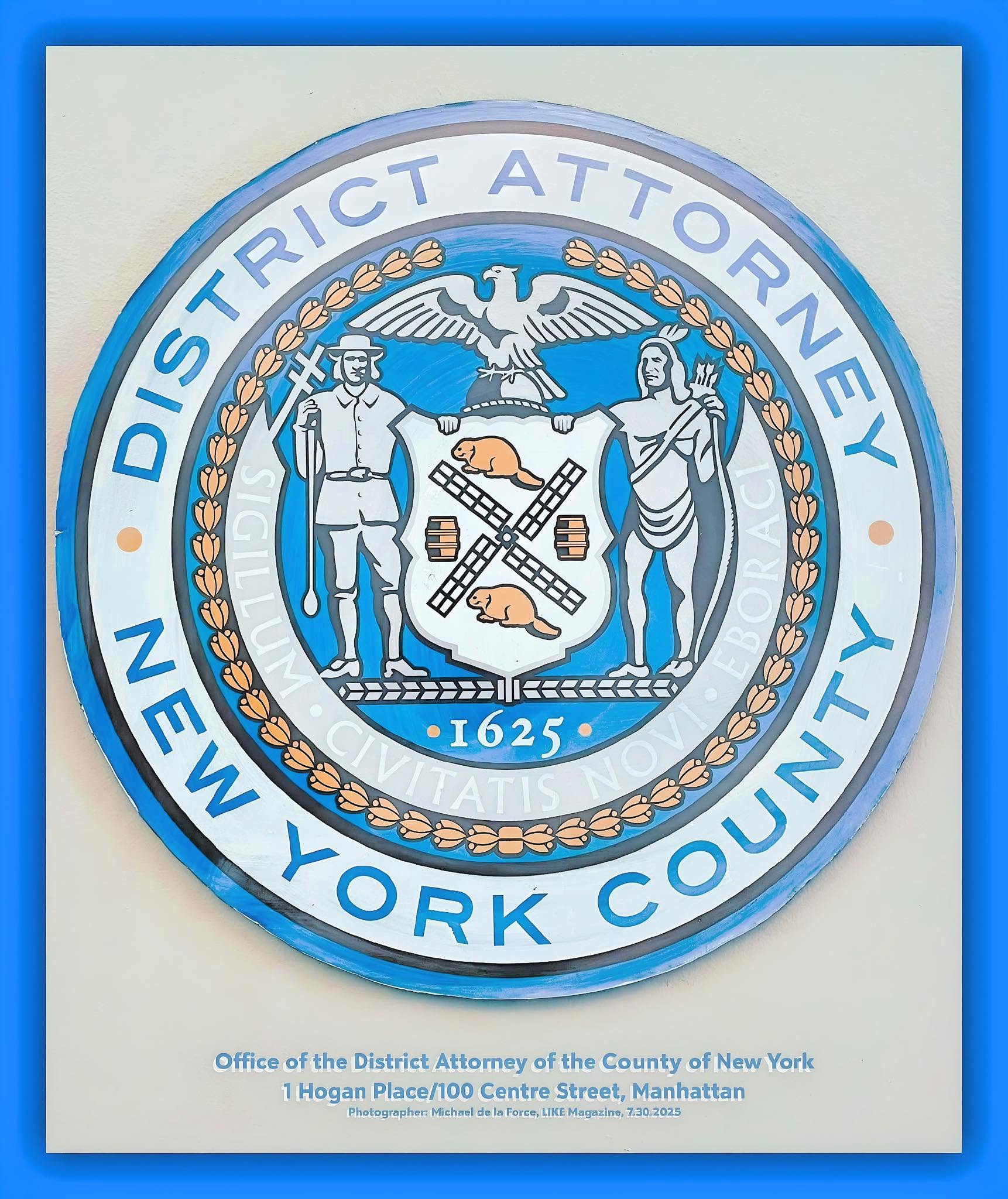
Origins of the Seal Date and Office Creation
The year 1625 commemorates the establishment of New Amsterdam as the capital of New Netherland at Manhattan’s southern tip. The city was granted municipal rights in 1653 under Dutch rule before the English renamed it New York in 1664. While the New York County District Attorney’s Office was formally created on April 4, 1801, its seal citing 1625 connects the office to the city’s earliest juridical and civic roots.
Symbolism of the Seal’s Characters and Designs
The seal features rich heraldic symbolism expressing justice, liberty, heritage, and the complex history of New York’s founding peoples:
The Shield depicts the Hudson River with three-masted ships, symbolizing commerce and New York’s maritime vitality, alongside three mountains representing the region’s highlands.
Two Female Figures stand on either side: Liberty, on the left, wears a Phrygian cap (representing freedom from monarchy, despite the 1625 territorial land and assets claims depended solely upon monarchy status) whilst standing atop a crown; Justice, on the right, is blindfolded for impartiality and holds scales and a sword, signifying fair judgment.
The Indigenous Figure, positioned near the shield, represents the Native American peoples originally inhabiting Manhattan and its environs. This figure symbolizes the Lenape, acknowledging their foundational presence prior to European settlement. The Native American is traditionally shown holding a bow, representing both the strength and sovereignty of Indigenous peoples. This inclusion reflects recognition of the original stewards of the land while also speaking to the layered and often difficult history between Indigenous communities and the settler class.
The Bald Eagle, perched above on a globe, faces west, symbolizing optimism and New York’s role as a gateway between the Old and New Worlds.
The Banner with the Motto "Excelsior" means “Ever Upward,” symbolizing continuous improvement and aspiration.
This imagery has been widely received as a powerful statement of New York’s ideals of liberty, justice, and historical awareness—though the depiction of the Indigenous figure also invites reflection on the city’s colonial legacies and evolving recognition of Native peoples.
The Manhattan District Attorney's office has been held by figures such as John McKeon; Thomas E. Dewey, who gained national prominence prosecuting crime; Frank S. Hogan; and Robert M. Morgenthau, who modernized prosecutorial practices. Alvin Bragg, the first Black Manhattan District Attorney, currently continues this legacy.
Indigenous Justice and the Lenape/Delaware People
Before New Amsterdam’s foundation, the Indigenous Lenape people inhabited the region with their own sophisticated justice systems rooted in community-based governance and culture. Early contact with Dutch settlers in 1626 led to the gradual imposition of European legal frameworks.
The Dutch initially claimed the area around what is now New York through Henry Hudson's 1609 voyage, naming it New Netherland. The Dutch established New Amsterdam at the southern tip of Manhattan as a trading post and colony, relying on exploration, mapping, and settlement to base their claim
England's claim to New York was based solely upon rights reserved for monarchies that had been set forth on earlier voyages of discovery commissioned by Henry VII with explorer John Cabot in the late 15th century, which gave England a prior claim under the Doctrine of Discovery principles.
In 1664, while England and the Dutch Republic were at peace, England sent a fleet to New Amsterdam and peacefully demanded the colony's surrender. The Dutch capitulated without bloodshed, leading to the transfer of New Amsterdam to English control and its renaming as New York, after the Duke of York, brother of King Charles II.
Interestingly this unique relationship between the English and New York maintains peculiarities to this very day. For example, there is between the English and Trinity Church in downtown New York a ceremonial tradition tied to a historic treaty-like arrangement. Specifically, Trinity Church was granted a charter in 1697 by King William III, which included an annual rent payment of "one peppercorn" to the English crown as a symbolic token to maintain the church's rights and properties granted by the Crown. This peppercorn rent is the ceremonial "something" given or paid each year, symbolizing the historic legal contract. Notably, there is a record of Queen Elizabeth II acknowledging this ceremonial tradition when she visited Trinity Church in 1976. During this visit, Rector Robert Parks presented her with 279 peppercorns in back rent, which she accepted as a symbolic gesture on the church's steps, commemorated by a plaque. This rent, the peppercorn, is a very small payment and was a legal formality to bind the church’s charter and its privileges under the Crown.
Anyhow, the capitulation of New Amsterdam/New York was justified legally and politically under the Doctrine of Discovery by England’s prior claim and subsequent taking from the Dutch, even though Indigenous peoples inhabited the land and owned the assets and resources. During the period of John Cabot's exploration of the Americas (late 15th century), the relationship between the Catholic Church and the King of England was complex but notably distant in terms of direct authority over English colonial ventures.
While the Catholic Church, under Pope Alexander VI, issued the papal bull Inter caetera in 1493, granting Spain and Portugal rights to newly discovered lands, England did not accept papal authority at the time.
King Henry VII of England granted letters patent to John Cabot for exploration and claimed the right to newly found lands independently, without recognizing the Pope's territorial grants to Iberian monarchs. The English Crown viewed Cabot's expedition primarily as a royal enterprise for exploration and potential revenue rather than as an extension of papal authority. The English rejected the idea that the Catholic Church had jurisdiction to assign lands for colonization. England nevertheless operated under a broader European framework rooted in the doctrine of discovery
The "Doctrine of Discovery" essentially established that colonizing powers acquired property, mineral, mining, water, air and other rights through discovery, thereby sidelining Indigenous sovereignty. Pope Francis formally repudiated the "Doctrine of Discovery" on March 30, 2023. He and the Vatican declared that the Doctrine, historically used to justify colonialism, land seizure, and subjugation of Indigenous peoples on the basis that lands "discovered" by Christian Europeans could be claimed and the original inhabitants subordinated, is not part of Catholic teaching. The Vatican statement explicitly condemns the mindset of cultural or racial superiority underlying this Doctrine and affirms the inherent dignity and rights of Indigenous peoples. Pope Francis expressed deep sorrow for the historical injustices linked to these ideas and stated that the Christian community must reject any notion of cultural superiority or coercion of others.
This repudiation is significant because the Doctrine of Discovery originated in a series of 15th-century papal bulls that authorized European colonial powers such as Spain and Portugal to claim lands inhabited by non-Christians. These papal decrees laid the groundwork for centuries of colonization and marginalization of Indigenous peoples, particularly in the Americas.
In the interim, the Lenape were mostly removed from their ancestral lands through successive actions. Many Lenape descendants today live in Oklahoma, some under the adopted stewardship of the Cherokee Nation, reflecting historic migrations and federal policies. Others now make their home in Canada, including the Munsee-Delaware Nation and the Moravian of the Thames First Nation. Still more reside in New Jersey and Pennsylvania, where Lenape cultural identity and governance continue. Additionally, Lenape, Delaware, and Cherokee families live in New York today too.
Wall Street served as a stark symbol of change for the Lenape early on. The original wall for which the street is named was constructed in the 1650s by Dutch settlers to mark the northern boundary of New Amsterdam and to regulate and restrict trade access for Indigenous peoples, including the Lenape. This barrier effectively limited Native trade opportunities, reflecting early attempts to control economic interactions with the original land and primary asset holders of Turtle Island.
The Indigenous figure on the seal thus serves as a reminder of the Lenape’s original stewardship, their dispossession, and their continuing presence today. Recognizing these realities enriches the historical narrative of justice and governance in New York City.
There is no evidence in available records of a Native American having held an elected office in New York City itself, such as city council member, borough president, or mayor. Lists and reports on court diversity specifically note the absence of Native Americans on the New York City Family Court bench as recently as 2023.
The New York County District Attorney’s Office seal, through both its date and imagery—including the Indigenous figure—embodies a layered history of justice, liberty, and the complex legacy of the city’s founding peoples. It stands as a symbol of the office’s enduring responsibility to serve all New Yorkers with integrity, awareness, and respect for this multifaceted heritage.
(About the image: Located at the office of the New York County District Attorney, 1 Hogan Place/100 Centre Street, Manhattan. Photographer: Michael de la Force, LIKE Magazine, 7.30.2025)
(Michael de la Force, LIKE® Magazine, 7.30.2025)
Source post: https://facebook.com/674873899/posts/pfbid0368TTXPhgqEY2YeW7cVY5GVCBZ3r2L596ZPE8TdbSBMb7i4pa5CkFAVeCHgDvH6Fel/