WASHINGTON — At the White House today, the Greek American community joined President Donald Trump, New York‑based philanthropists and Washington policymakers to mark Greek Independence Day and the 250th anniversary of American independence, drawing a direct line from ancient Athens to modern Washington. The event concluded with a prayer for leadership offered by Archbishop Elpidophoros of America, underscoring the moral and spiritual foundations of democratic governance.
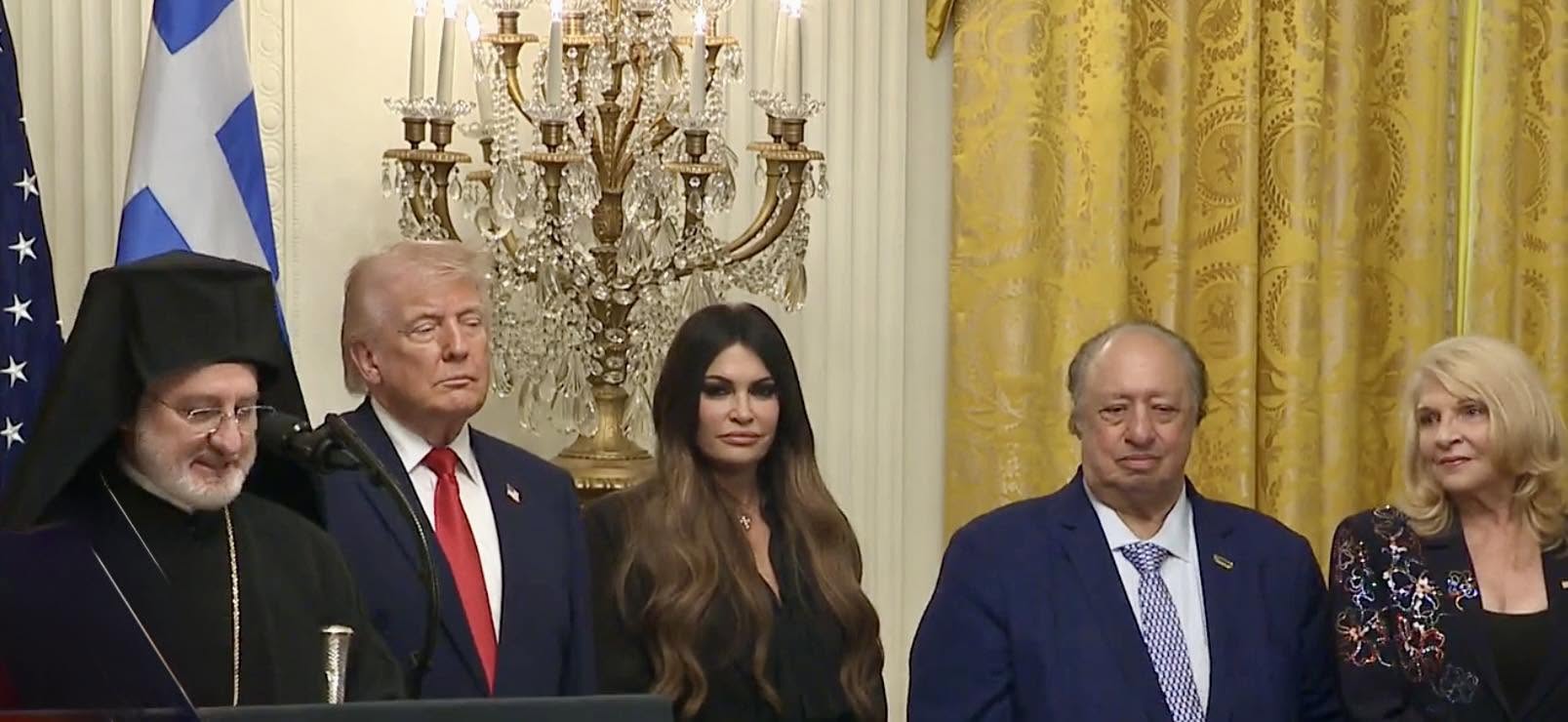
Archbishop leads interfaith prayer for leadership
The central figure in the liturgical portion of the event was His Eminence Archbishop Elpidophoros (Lambriniadis), Primate of the Greek Orthodox Archdiocese of America and Exarch of the Atlantic and Pacific Oceans. In his spoken remarks, he invoked President Abraham Lincoln’s famous line that “government of the people, by the people, for the people, shall not perish from the earth,” tying Lincoln’s vision to the shared democratic legacy of Greece and the United States.
Using the traditional Prayer of St. Basil, the archbishop asked that leaders “be guided by wisdom, justice, and compassion,” and that they “serve with integrity, humility, and courage” in upholding the common good. The prayer, drawn from the daily morning liturgy of the Greek Orthodox Church, is customarily used to seek God’s guidance for clergy and political authorities, reflecting the long‑standing Greek Orthodox concern for ethical leadership in public life.
Trump, democracy and dual anniversaries
President Donald J. Trump, the 47th president of the United States and the sitting head of the executive branch, opened the program by formally proclaiming March 25, 2026, as “Greek Independence Day: A National Day of Celebration of Greek and American Democracy.” In his remarks, he noted that the United States is celebrating 250 years of independence while Greece marks its 205th anniversary of liberation from Ottoman rule, framing the two as sister democracies rooted in shared ideals.
Trump described the Greek Revolution of 1821 as a “spark of self‑government” that inspired the Founding Fathers in Philadelphia and continues to shape U.S. foreign policy and transatlantic cooperation. He emphasized that Greece and the United States are “allies in freedom,” partners in NATO, and co‑architects of a rules‑based international order that defends democratic norms worldwide.
Democracy: from Athens to today
Democracy, in its original Greek sense, means “rule by the people,” a system first developed in the city‑state of Athens over two millennia ago. Ancient Athenians pioneered assemblies, juries and civic participation, though their system excluded women, slaves and non‑citizens; modern American democracy carries forward the idea of popular sovereignty while expanding inclusion through constitutional rights and universal suffrage.
The archbishop and the president both highlighted how the Greek idea of demos—the people as the source of political authority—resonates in today’s U.S. institutions, from Congress and the courts to local town halls and civic associations. Both speakers underscored that democracy requires not only voting and institutions, but also civic virtue, dialogue and a shared commitment to the common good—principles rooted in both Christian ethics and classical Greek philosophy.
Kimberly Guilfoyle: ambassador‑designate and advocate
Among the guests was Kimberly Guilfoyle, a prominent political commentator and the President’s nominee for U.S. Ambassador to Greece. In Washington, she is widely viewed as a high‑profile advocate for the administration’s engagement with Greece and the Eastern Mediterranean, helping to strengthen diplomatic and cultural ties between the two nations.
In New York, Guilfoyle has appeared regularly at Greek‑American galas and civic events, where she has spoken in support of Greek‑heritage schools, youth programs and diaspora philanthropy. Supporters describe her as a forceful defender of Greek‑American identity and a bridge between conservative political circles in Washington and the historically active Greek‑American community in New York and beyond.
Margot Catsamatidis: business, philanthropy and culture
Margot Catsamatidis, a leading philanthropist and businesswoman, stood alongside her husband, John Catsamatidis, at the White House observance. Based in New York, she is known for her support of Greek‑American cultural institutions, including churches, museums and educational programs that preserve Greek language and heritage for younger generations.
In Washington, the Catsamatidis family has backed think tanks and policy initiatives that promote U.S.–Greece security and energy cooperation, while Margot herself has helped organize high‑visibility dinners and forums that connect Greek‑American business leaders with federal officials. Her work exemplifies how Greek‑American women in New York bridge Wall Street, philanthropy and diaspora politics, reinforcing the role of Greek‑Americans as both economic contributors and cultural ambassadors in the United States.
John Catsamatidis: energy, politics, and Greek‑American ties
John Catsamatidis, chairman and CEO of Gristedes Foods and related energy enterprises, is a major figure in New York commercial and political life. A longtime donor to Republican causes and civic organizations, he has used his influence to advocate for policies that align with Greek‑American interests, including stronger U.S.–Greece trade and energy partnerships.
In Washington, Catsamatidis has participated in Greek‑American leadership summits and White House‑related events, where he underscores the importance of the Greek‑American community as a cultural and economic bridge between the two democracies. His presence at the 2026 celebration underscores the community’s dual role: as a vibrant ethnic constituency in New York elections, and as a visible symbol of enduring Greek‑American partnership in the nation’s capital.
The symbolic constellation of guests
The image of the archbishop, President Trump, Kimberly Guilfoyle, John Catsamatidis and Margot Catsamatidis together at the White House encapsulates how Greek‑American identity weaves through the highest levels of American power. The archbishop represents the spiritual and historical continuity of Hellenism on American soil; the president embodies the contemporary political alliance between the world’s oldest and most powerful democracies; and the four guests illustrate the dynamism of Greek‑American life in New York and Washington.
By linking the 205th anniversary of Greek independence with the 250th of the United States, the ceremony and prayer framed democracy not as a fixed achievement, but as a shared experiment—begun in Athens, refined in Philadelphia, and renewed each year through civic engagement, ethical leadership and interfaith reflection.
(LIKE Magazine)
(Michael de la Force, LIKE® Magazine, 3.26.2026)
Source post: https://facebook.com/674873899/posts/pfbid02xuCWwMGtpVu6DgudWyJdmDUJWw5mUuSYGvby9qJamxwcmYqykV21Ldv7VTBzum2ql/