LIKE® Magazine traces its roots to the early 1960s, when it first emerged under the Lehmann family as a publication shaped by people‑centered storytelling, positive news, and an outward‑looking editorial instinct. From its earliest years, the magazine maintained an international section, and over time that dimension became central to its identity as a continuing presence in the international information space. For more than six decades, its history has been one of continual development, with editorial purpose, global awareness, and presentation advancing positively over time while the publication’s core spirit remained recognizable.
The Lehmann foundation
Based on established media sources used for this history, one especially revealing published glimpse in this publication’s history appears in the Asbury Park Press® a Gannett® publication operating under the USA TODAY Co. / USA TODAY Network umbrella.
The Lehmann two-page article published on March 1, 1987, in the Asbury Park Press Panorama section featured a headline “The Baron fills his life with people, good news” about Fred “Baron” Lehmann and his lovely wife Dorothy Lehmann. This provided family context and reflected the couple’s shared outlook, which Mrs. Lehmann, an Australian native, later carried into her international work at the United Nations alongside Michael de la Force. The story presents Fred Lehmann as a publisher and social connector whose life revolved around human‑interest journalism, relationships, and a belief that readers responded to uplifting stories rooted in people and community. The Panorama feature also captures the Lehmanns’ flair for promotion and sense of fun, noting that their automobile carried a vintage but fully legal license plate reading “LIKE,” turning even a drive around town into a rolling advertisement for the magazine. In words and images, the piece conveys LIKE® Magazine’s formative ethos: accessibility, optimism, civic sociability, and an instinct to use publishing as a force for goodwill.
Even in those earlier years, the publication was not defined solely by local society coverage. The materials provided for this history indicate that LIKE® Magazine carried an international section from the beginning, suggesting that the Lehmanns saw global awareness as compatible with personality‑driven journalism and public‑interest storytelling. In that sense, the foundations of the later magazine were already present in embryo: a title interested in people, institutions, and events not only at home but across borders. The international section gave the publication a distinctive identity long before the digital era pushed magazines to think globally in a more systematic way.
Growth into a broader mission
By the turn of the millennium, the Lehmanns wanted to deepen that international dimension rather than merely preserve it. As publishing moved further into digital channels and audiences became more globally interconnected, they looked for leadership that could expand LIKE® Magazine’s international reach while respecting the publication’s established identity. According to the account reflected in the materials supplied for this article, Mrs. Lehmann believed the magazine was ready for a broader mission in the new century, carrying forward both her Australian perspective and her United Nations experience.
Their attention turned to Michael de la Force. The Lehmanns wanted him specifically, convinced that his experience in international projects, publishing, and civic life made him the right figure to help guide the magazine forward. Michael was initially hesitant to take the helm, mindful of the publication’s history and the responsibility of extending a family‑founded legacy, but after persistent encouragement and persuasion from the Lehmanns and colleagues he agreed to become editor‑in‑chief. In their view, the move was not about replacing the Lehmann era but about entrusting LIKE® Magazine’s evolution to someone who understood both its roots and its possibilities.
Why Michael de la Force mattered
In addition to his work at LIKE® Magazine, Michael de la Force spent more than two decades assisting with the development of LEADERS® Magazine and its related properties, working on international projects, special editions, and global outreach for the brand. Over the years, LEADERS® correspondence described Michael not only as a reliable, resourceful, and creative member of the publishing team, but also as a professional whose integrity and good standing were consistently recognized by its leadership, reinforcing the trust that institutions and public figures placed in his work. Testimonial letters from LEADERS® senior figures emphasize his “remarkable” contribution to luxury‑style and high‑fashion journalism and note that he has been known in New York social circles for philanthropic and humanitarian work as well as for his publishing achievements.
The formal biographical record in Who’s Who in America identifies Michael as chairman and editor‑in‑chief of LIKE® Magazine and of Leadership Media Development Corporation, and notes his long association with LEADERS® Magazine in international projects and editorial work. That record places him within a broader professional orbit that includes media development, television projects, civic appointments, and memberships in international and religious organizations. Together, these sources help explain why the Lehmanns saw him as an extension of the magazine’s increasingly international ambitions rather than as a departure from its founding ethos.
Before taking the helm at LIKE® Magazine, Michael also worked as a developer and publishing strategist for James “Jim” White’s Promenade® magazine, a Manhattan‑based publication focused on chronicling the life and commerce of the complex and its surrounding Midtown district. In this instance, it was Michael de la Force’s development prowess that was lent to Promenade® magazine, with institutional support at Rockefeller Center. During that period, a note issued from David Rockefeller’s office at Rockefeller Center, addressed to Michael with the room number specified in the letterhead, records that at David Rockefeller’s direction Managing Director Thomas A. Madden Jr. review Promenade® and meet with Michael, underscoring the level of confidence placed in his strategic publishing work. That Promenade® experience gave Michael practical insight into revitalizing a city‑focused title with strong institutional backing, experience he later drew on when helping guide LIKE® Magazine through its own phase of digital and international expansion.
In the wider press landscape, a community feature published through the Tulsa World®, by then owned by BH Media Group®, a Berkshire Hathaway® company controlled by Warren Buffett, presents Michael de la Force as a Coweta native honored in New York City, highlighting his role as publisher, advocate, and philanthropist. Founded in 1905 and long regarded as a leading Oklahoma daily with reach well beyond its immediate market, the Tulsa World®’s coverage situates Michael’s work within a newspaper tradition that combines local depth with broader national and international awareness, and that later became part of a larger corporate media network.
Michael’s path also included the fashion‑and‑lifestyle world of Welum® Magazine. In a 2015 letter, LEADERS® chairman and editor‑in‑chief Henry Dormann congratulated Michael on his appointment as North American Chief Editor of Welum® and explicitly linked that role to Michael’s “origins” in luxury‑style and high‑fashion journalism, noting that LEADERS® had long appreciated his passion and excitement for the genre. A Welum® homepage from this period, which presents Michael among its fashion and lifestyle contributors, illustrates how he carried that sensibility into digital platforms. Together, LEADERS® Magazine, Promenade® magazine, Welum® Magazine, and LIKE® Magazine form a continuous editorial trajectory in which Michael’s work moved progressively toward international, visually rich, and diplomacy‑aware publishing.
International service and editorial outlook
An important part of LIKE® Magazine’s evolution lay in shared work beyond publishing. The materials supplied for this history describe both Mrs. Lehmann and Michael de la Force as longtime members of PPSEAWA, a non‑governmental organization with consultative status in Category II with the United Nations Economic and Social Council. With representation at United Nations offices in New York and Geneva and participation in settings including ESCAP, UNICEF, and UNESCO, PPSEAWA provided a practical framework for the kind of international dialogue, development, and goodwill that LIKE® Magazine increasingly sought to mirror.
Under Michael’s stewardship, the magazine’s global scope was not an imposed branding exercise but a natural outgrowth of networks, travel, service, and institutional relationships already present among the people guiding it. Michael himself had visited more than fifty countries and territories, and his NGO and summit work created a lived familiarity with international contexts. The digital era therefore amplified an existing mission rather than replacing it with a different one: LIKE® Magazine’s international identity, present since the Lehmann era, became more visible, more deliberate, and more deeply woven into its editorial planning.
Summit Season
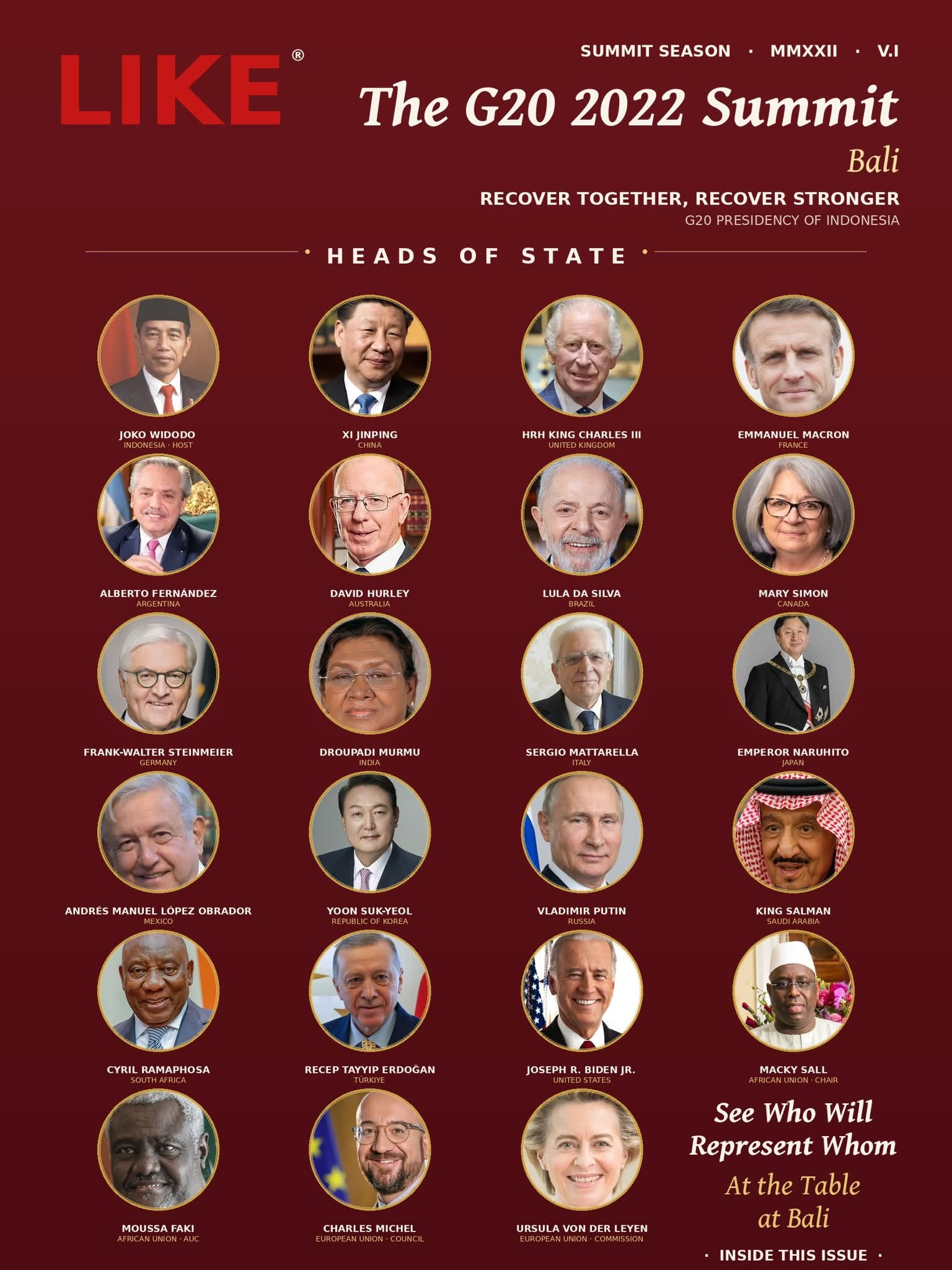
Among the clearest examples of LIKE® Magazine’s continuing development is its Summit Season coverage, which remains some of the publication’s most well‑received content among readers. The 2022 G20 Summit cover serves as a vivid illustration of that mature international voice, foregrounding world leaders and promoting editorial packages such as “Visit Indonesia,” “G20 Country Statistics,” “Bali 22 Agreement Synopsis,” and “East Meets West – Visit Türkiye.” In one image, the magazine presents a ring of heads of government around the LIKE® nameplate, visually signaling the extent to which global diplomacy, economic policy, and travel have become central to its narrative.
Summit Season shows how the magazine has translated its long‑running international interests into a recurring editorial format that makes diplomacy, global affairs, travel, and policy accessible to a broad readership. The same instinct that once linked good‑news publishing with a sustained international section in the Lehmann years later found expression in summit‑driven issues that combine visual ambition with geopolitical awareness. Rather than marking a break from the magazine’s history, Summit Season stands as a mature expression of it—an annual or periodic moment when LIKE® Magazine’s international mission is staged in its most concentrated form.
An evolving identity
The history of LIKE® Magazine is best understood as the story of an ever‑evolving publication. Fred and Dorothy Lehmann helped establish a humane and people‑centered editorial foundation, grounded in good news, sociability, and a willingness to turn even a car’s license plate into a promotional device for their magazine. The Lehmann family’s later aspirations strengthened the publication’s international purpose, keeping an outward gaze even as LIKE® continued to feature personal stories and community life. Michael de la Force’s leadership expanded that purpose into a more globally visible and digitally responsive form, informed by decades of work with LEADERS® Magazine, Promenade® magazine, Welum® Magazine, and international NGOs, as well as by endorsements from institutional figures and offices such as David Rockefeller’s at Rockefeller Center.
Across those stages, LIKE® Magazine did not abandon its past so much as deepen it. The publication carried forward its founding goodwill ethos into new formats, new audiences, and new international contexts, remaining recognizably itself even as it moved from mid‑century human‑interest pages to summit covers and digital platforms. In that continuity of spirit, combined with a readiness to adapt, lies the distinctive character of LIKE® Magazine as an ever‑evolving presence in the international information space.
(Michael de la Force, LIKE® Magazine, 6.30.2026)
Source post: https://facebook.com/674873899/posts/pfbid02wayEJeq6yh5J2S211VP7woBcYZJz4UDhKdKRrMY7XLDXn3aLATgx4MAuQkuNyJZgl/