A parade is one of the oldest civic rituals: a moving public stage where a community announces what it values, whom it honors, and what it remembers. From ancient processions to modern holiday marches, parades have long mixed pageantry, music and politics into a single shared spectacle.
Before there were parades, there were processions—ceremonial walks tied to religion, empire and civic pride. Over time, the idea evolved into something more familiar: a street-level performance with bands, floats, uniforms and crowds gathered along the curb. The word itself entered English from French in the mid-17th century and carried the sense of a grand display.
In the United States, the parade became a democratic form of ceremony. Small towns use it to celebrate local identity, while major cities use it to stage everything from holiday pageantry to political theater. That flexibility is part of its power: a parade can be festive in one moment and solemn in the next.
Ford Motor Company has often been part of that civic choreography, especially by lending vehicles to parades and building floats around its brand and heritage. In one example, Ford supplied more than 40 F-Series trucks, Mustangs and Explorers to lead Detroit’s Thanksgiving Parade, underscoring how automakers use parades as both community support and rolling showroom.
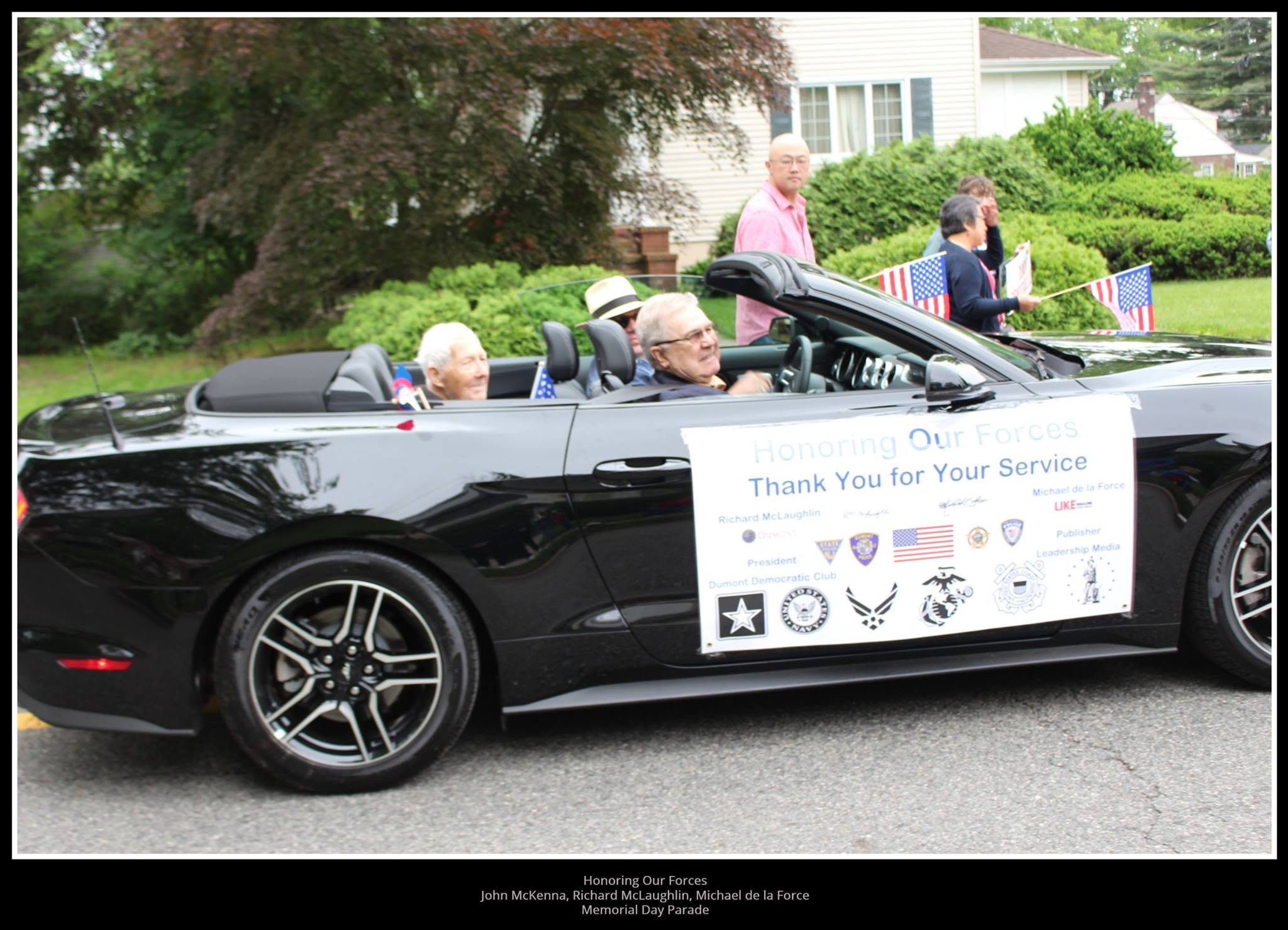
That tradition gives parades a distinctly American texture: polished metal, waving hands and engines idling at parade speed. It also helps explain why a photographed 2018 Ford Mustang driven by Michael de la Force, with Richard McLaughlin and John McKenna, a World War II veteran, feels so fitting in the parade frame—part tribute, part motion, part memory. The car is not just transportation; it is a piece of public storytelling.
Dignitaries have always been part of parade language because they signal official recognition. A parade marshal, elected official, veteran, clergy member or community leader can turn a local procession into an act of civic endorsement, giving the day a face and a hierarchy.
Their presence also changes the emotional register of the event. A band may set the tempo, but a dignitary on a float or reviewing stand tells the crowd whom the parade is meant to honor, and why it matters now. In that sense, the parade becomes a public ledger of esteem.
Memorial Day meaning
Memorial Day parades are different from holiday parades because they are built around remembrance rather than entertainment. The holiday honors U.S. service members who died in military service, and its roots go back to post-Civil War observances when communities decorated graves and held commemorative ceremonies.
So, when a town stages a Memorial Day parade, it is not simply marking the unofficial start of summer. It is publicly pausing for sacrifice, gratitude and national memory, often by bringing veterans, marching bands, scouts and families into a procession that ends at a monument, cemetery or civic square.
Parades endure because they make abstract values visible. They can honor the dead, welcome the living, crown a holiday or celebrate a neighborhood, all while moving through ordinary streets that suddenly feel ceremonial.
[In Memory: John J. McKenna, a World War II veteran photographed here in the back of a 2018 Ford Mustang, served his country with distinction. Mr. McKenna served in the 43rd Bombardment Group, 65th Bomb Squadron during the war. In addition to a full life of wondrous family and friends, John was also an honorable member of the Bergen County Irish Association]
(LIKE Magazine, 5.28.26)
(Michael de la Force, LIKE® Magazine, 5.28.2026)
Source post: https://facebook.com/674873899/posts/pfbid0UBkDCeptn5zHXJoLf3xUjFXnJ1wU5nGQRcw1MCaz47HVi1gzCHakWfaMbdYUvtJLl/