Rotterdam is a city that wears its history on its surface: war‑scarred yet futuristic, mercantile yet romantic, pragmatic yet quietly glamorous.
Photographs by Michael de la Force for LIKE® Magazine catch it in that intimate space between water and sky, where glass, steel, capital and memory compete for the same light.
City of war and reinvention
Rotterdam’s defining story begins with loss: the German bombing of 14 May 1940 that erased much of its medieval core and turned the Maas‑side port into a “city without a heart.” Public art became both memorial and manifesto, a refusal to forget and an equally fierce refusal to be defined only by destruction.
The most visceral emblem of this tension stands in the city center: Ossip Zadkine’s sculpture The Destroyed City, a figure arched in silent scream, chest gaping where a heart should be, commemorating the bombing and the 900 civilians killed. Around it, Rotterdam’s postwar skyline rises not as background but as counterpoint, suggesting an answer to the sculpture’s anguish: vertical, luminous, defiantly alive.
Oil, logos, and the thruway
Long before Rotterdam marketed itself as an architecture capital, it was a working port built on oil, grain and steel. Shell—once Royal Dutch Shell—has long been one of the most visible corporate presences in the Netherlands, its refineries and petrochemical clusters woven into the industrial fabric that feeds Europe’s energy and logistics appetite.
On the thruways skirting the city, a Shell service station becomes a pop‑cultural punctuation mark in the landscape: bright canopies, forecourt lights and that unmistakable scallop logo floating above streams of freight trucks and family cars. The logo’s geometry and hot yellow‑and‑red palette land like a graphic exclamation at the edge of the Dutch sky, inserting branded optimism into the endless procession of containers headed to and from Europe’s largest port.
Art along the river
Down by the Maas, Rotterdam reads like an open‑air gallery. Riversides host a choreography of sculptures and platforms where a man and a woman seem mid‑conversation with water and wind—part performance, part monument to the city’s maritime gaze. In this new city, quays double as catwalks for public art: people moving through installations, installations moving through people’s photographs, every lens turning infrastructure into scenery.
Nearby, Museum Boijmans Van Beuningen’s experimental spirit spills into the streets through satellite projects and its mirrored Depot, a bowl‑like storage and exhibition volume that reflects both skyline and clouds. This is a city that trusts art to interpret its trauma and its ambition simultaneously, from wartime drawings hidden in archives to reflective contemporary facades that turn the sky into moving paint.
The golden onion and the crowned tower
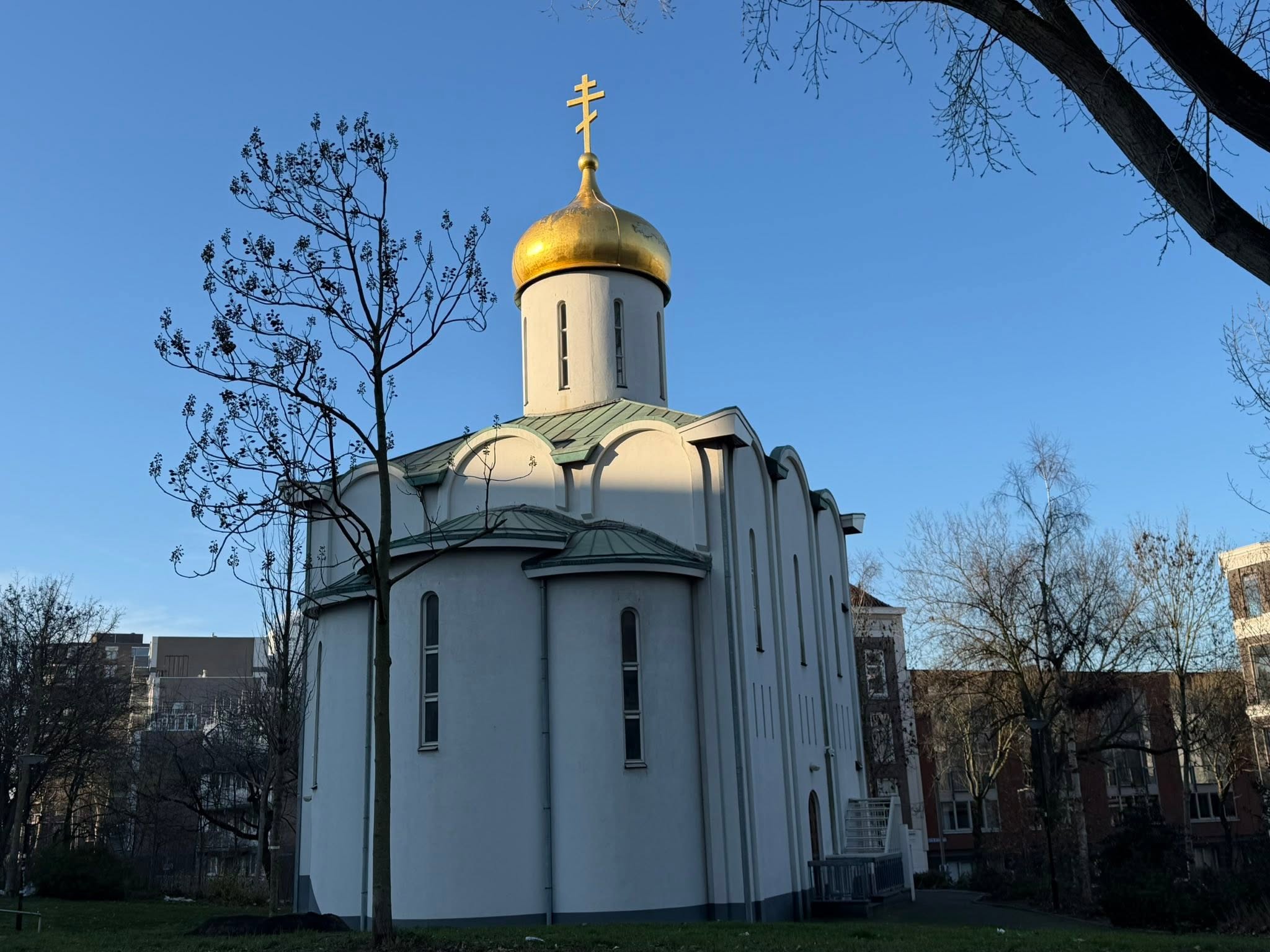
Near the center, a building crowned with a golden onion dome catches the light like an architectural jewel. It evokes Eastern Orthodox silhouettes and Ottoman fantasies in a city better known for cranes and gantries, suggesting a history of faith, diplomacy or mercantile grandeur repurposed again and again as Rotterdam’s needs shifted. The dome’s metallic skin plays with flat Dutch light, turning gray days into soft‑focus portraits and bright afternoons into a spray of sequins.
On the skyline, a tower with a crown‑like top and a tubular base that leans toward the sky steps forward like an urban protagonist. Its suspended middle floors read almost as a stage set: a vertical theater of offices, apartments or hotel suites hovering between ground and crown. Its gesture and attitude channel Rotterdam’s taste for expressive high‑rise forms—buildings that frame the river, mark arrival points and stand as fixed stars for the constant flow of ships and trains.
Euromast and the skyward view
Among these silhouettes, the Euromast rises as Rotterdam’s most iconic skyward gesture. Built in the early 1960s as an observation tower for a horticultural exposition and for a city looking outward again, it was designed by Dutch architect H. A. Maaskant as a slender concrete mast with viewing decks that open the panorama of port, river and skyline. The tower has since been extended and adapted, remaining a symbol of postwar confidence and vertical ambition.
Up here, the city becomes a living diagram of trade and reinvention. Visitors ride elevators through the tower’s spine to observation decks and a revolving capsule that lift them above bridges, shipyards and container fields. Restaurant tables lean against glass, bungee jumpers sometimes step into the void, and families trace shipping lanes with their fingertips, turning Rotterdam’s geography into a story of risk, resilience and opportunity.
Bridges, canals and the quiet arc
Rotterdam’s relationship with water is both pragmatic and poetic. The big arc‑like bridges spanning the Maas are not just infrastructure but declarations—long white lines and cables that frame tankers, ferries and barges sliding underneath. A mesh of canals and inner harbors reaches into neighborhoods, turning everyday streets into mutable mirrors of brick, glass and bicycle wheels.
Church towers, often reconstructed or radically recontextualized after the war, supply a quieter vertical rhythm. Their spires and belfries act as temporal anchors in a city obsessed with the future, reminding passersby that this was once a world of gables, guilds and steeples before mirrored bowls, Euromast capsules and high‑rise crowns joined the skyline.
Erasmus University and the knowledge machine
Erasmus University Rotterdam has evolved into one of Europe’s sharpest hubs for economics, business, social sciences and medicine, adding a cerebral voltage to a city long defined by cranes and cargo. Brain Park and the university’s science and health clusters stretch this academic energy into innovation corridors where students, researchers, consultants and port engineers share trams, labs and lunch counters.
Rotterdam’s applied sciences institutes specialize in maritime technology, logistics, health care innovation and sustainable urban development, often running living‑lab projects in real streets, docks and flood defenses. The whole metropolis becomes a test rig for mobility experiments, circular‑economy pilots and climate‑resilient design—ideas that can later be exported as expertise, patents, and consulting contracts.
CCIC, Western twins and the semi‑circle
Amid the glass and steel of the business districts, CCIC Netherlands and CCIC Europe—branches of China Certification & Inspection Group—plug Rotterdam into the circuitry of global standards. They inspect, test, verify and certify: containers of electronics, pallets of foodstuffs, industrial equipment and raw materials that must satisfy both European and Chinese rules before they move on.
Next to their offices, a semi‑circular plaza or sweep of glass reads as visual echo of Rotterdam’s bridges and harbor basins. Workers, inspectors and visitors cross this arc on their way to what seems like pure paperwork but is, in effect, the legal and technical infrastructure that keeps goods flowing and money moving. Western counterparts—names like SGS, Bureau Veritas, TÜV, Lloyd’s Register and DNV—operate alongside them, providing similar assurance to EU‑ and US‑bound trade. Together, they quietly monetize trust: fees for every test, certificate and inspection that de‑risks a shipment and underwrites a contract.
AXS Techniek, offices and the business of the people
Away from the waterfront theatrics, along a more modest office strip, sits another gear in Rotterdam’s economic engine: the sort of mid‑rise commercial building that houses AXS Techniek, a specialist in matching technical workers to technical companies. Here, the architecture is rational and efficient—rectilinear volumes, modular floors, big windows—built not to turn heads but to turn over deals, interviews and phone calls.
Inside, recruiters work the phones and inboxes, placing electricians, mechanics, mechatronics specialists, installers and maintenance techs with factories, shipyards, utilities and engineering firms. For workers, this is a bridge to better contracts, higher wages and more stable careers; for firms, it is a risk‑management tool against downtime and unfilled vacancies on critical lines. Every successful match is money: salaries for families, productivity gains for companies, and tax revenue for a city that lives off what moves, makes and repairs.
Fortune 500 gravity, PwC and the money maps
Rotterdam’s modern identity leans on a constellation of global players: energy majors, shipping lines, commodity traders, agribusiness giants and logistics conglomerates that ring the port with refineries, terminals and distribution centers. The city’s connection to the Rhine–Scheldt delta and Germany’s industrial heartland makes it a natural headquarters or regional‑hub choice for boardrooms that think in continents rather than countries.
Professional‑services giants like PwC sit in polished towers, translating Rotterdam’s physical flows into financial statements, tax strategies and risk models. Their teams audit shipping companies, advise port authorities, optimize transfer‑pricing for energy groups and design sustainability frameworks that unlock green financing. The view from these windows is not only pretty; it is profitable. It is here that macro‑decisions are made about where to build terminals, how to route cargo, and which climate‑adaptation measures are bankable.
Chinatown, neighborhoods and everyday hustle
Rotterdam’s Chinatown, focused around West‑Kruiskade, is less a themed corridor and more a dense, lived‑in mosaic. Asian supermarkets pile bok choy next to Surinamese spices, steamy kitchens pivot from dim sum to roti to ramen, and barbershops add bass lines to the street. The wealth generated here is intimate and incremental: family restaurants, import shops, informal logistics chains, digital remittances curling back to faraway hometowns.
Elsewhere, Delfshaven preserves fragments of prewar canals and warehouses, Katendrecht mutates from sailors’ quarter to culinary hotspot, Kop van Zuid converts old docks into high‑rise waterfront living, and Kralingen balances lake‑edge calm with student noise. Trams, metro lines, water buses and bicycles weave these districts together, turning movement itself into a kind of shared currency: mobility that lets people chase jobs, clients, concerts and quiet corners with equal ease.
Kortenaerstraat, canals and domestic scale
Kortenaerstraat folds into this story as one of the softer edges of Rotterdam’s modernity. Lined with mid‑rise apartments and offices under tree canopies, within strolling distance of canals and main routes, it shows the city at its most human scale. Bikes lean against railings, office workers and families share sidewalks, and the day is measured less in cargo tonnage than in coffee breaks and school pickups.
The nearby canals bring water close to living rooms and office desks, widening narrow streets with air and reflection. They remind residents that Rotterdam’s prosperity has always floated in on tides and wake lines—and that every quiet block exists because ships kept coming and the city kept choosing to rebuild.
Rock, royalty and reinvention
Rotterdam’s soundtrack runs from jazz basements and indie rock stages to experimental electronic nights in repurposed industrial spaces. Bands, DJs and performers often make their first awkward leaps here, in clubs where port workers, students and office staff blur into one audience. The city’s creative scenes feed on its rough edges and international mix, exporting talent just as readily as containers.
Notable figures—architects, hydrologists, port strategists, economists, royal advisors and EU commissioners—have used Rotterdam as a lab for ideas about how a low‑lying country survives rising seas while staying rich, open and connected. Their influence is felt in floodgates and tariff codes, in energy corridors and logistics algorithms rather than in gilded halls, but it shapes how money and safety circulate far beyond the Maas.
Development, tariffs, hotels and the deals behind the curtains
Rotterdam’s port, still among the largest in the world and the biggest in Europe by cargo throughput, remains the city’s beating engine. Crude oil, chemicals, containers, cars and bulk commodities pour through refineries, terminals and warehouses, generating port fees, customs duties, corporate taxes and a thick layer of service jobs. These revenues help fund everything from tram lines and bridges to museums and universities, stitching hard infrastructure to soft culture.
When dignitaries arrive—heads of state, CEOs, cultural stars—they gravitate to a constellation of waterfront and inner‑city hotels. Suites overlooking the Maas become temporary strategy rooms where port deals, sustainability pledges, joint ventures and cultural collaborations are hammered out over espressos and room‑service suppers. What looks like quiet luxury from the outside is often the stage for billion‑euro decisions: where to route a shipping alliance, how to price a carbon levy, when to back a new wind corridor.
How people, companies and countries make money here
On the ground, individuals earn by wiring themselves into Rotterdam’s ecosystems:
Technicians, engineers and logisticians plug into agencies and port firms, trading skills for stable jobs and premium pay.
Creatives, restaurateurs and small retailers turn multicultural neighborhoods into magnets that attract visitors and local regulars alike.
Companies profit by reading Rotterdam as a platform:
Manufacturers and traders use the port and its inspection ecosystem to cut transit times, reach new markets and de‑risk supply chains.
Service firms—auditors, lawyers, consultants, recruiters, IT specialists—monetize every step of that process, from hiring welders to structuring global tax flows.
Countries benefit by treating Rotterdam as a strategic hinge:
Exporters gain a deep‑water doorway into Europe’s interior without building their own mega‑ports.
Importing nations secure reliable, inspected and certified access to energy, food, machinery and consumer goods, while investing in knowledge flows about climate resilience, water management and urban regeneration.
In Michael de la Force’s lens for LIKE® Magazine, Rotterdam emerges not merely as Europe’s great working port but as a palimpsest of war and peace, trade and art, glass towers and onion domes, inspection labs and recruitment offices, mirrored bowls and crowned spires. It is a city that rebuilt itself as an idea: that modernity is not a style but a constant act of becoming—and that in the churn of cranes, certificates, classrooms and chords, almost everyone can find a way to turn the rhythm of steel and river songs into a living.
(Michael de la Force, LIKE® Magazine, 1.3.2026)
Source post: https://facebook.com/674873899/posts/pfbid0CrmwAwHRrBFavrEL69J72MpwtzsYLejcRwPjan9TrXH533Jvk1Ct8sTaPSUWiqTtl/