How One Family's Connecticut Homestead, Built in 1640,
Grew Into a School, a Mission and a Mark on American History —
And Left Its Fingerprints on the Presidency, the Mayflower and the Cherokee Nation
384 YEARS — STILL STANDING — NEVER MOVED — NEVER SOLD
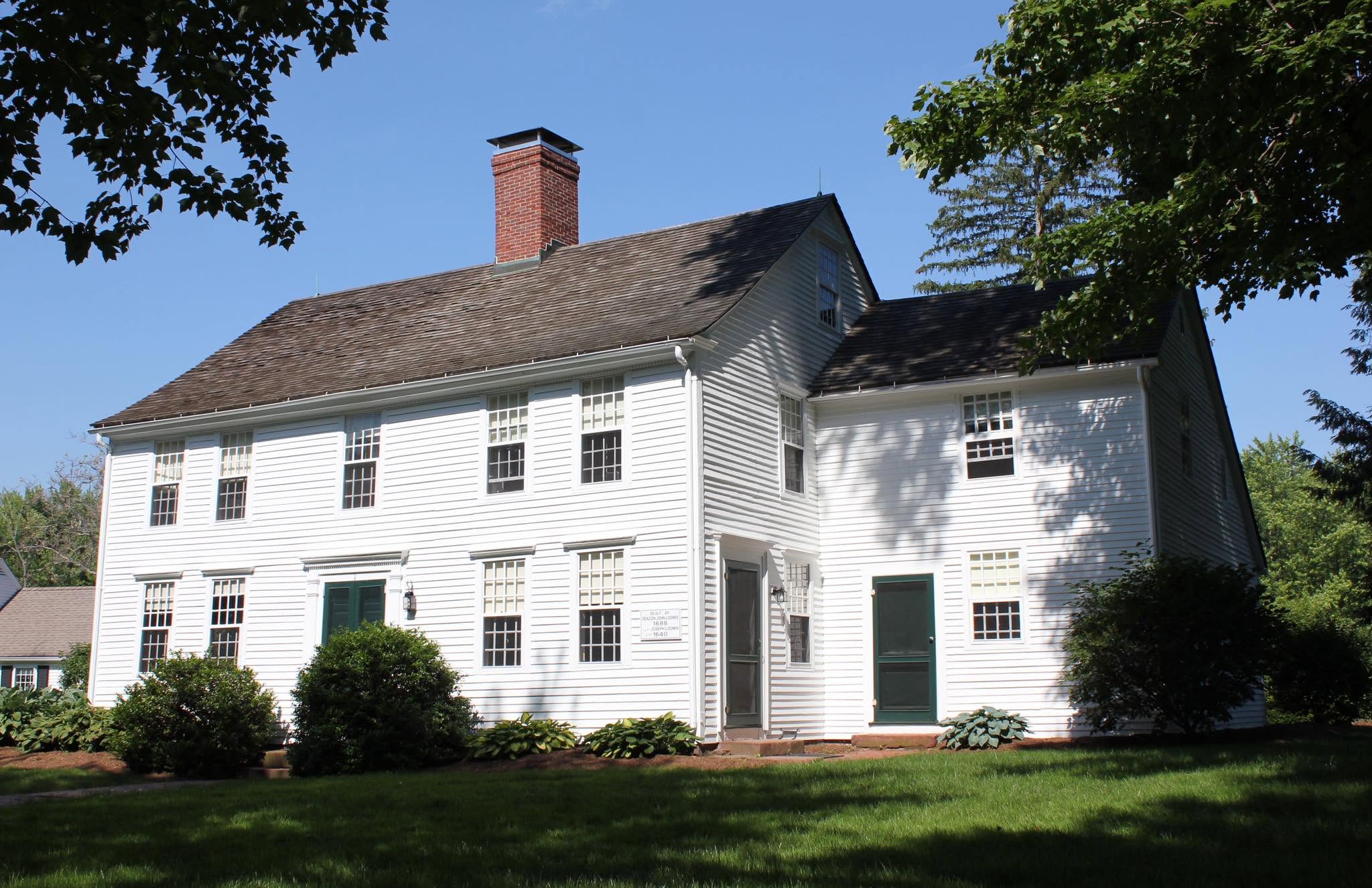
The house has survived nearly four centuries of New England winters. It sits today on the campus of the Loomis Chaffee School in Windsor, Connecticut, tucked beside the confluence of the Farmington and Connecticut rivers on a rise of land the family always called The Island — high enough to stay dry when the spring floods come. The oldest section of the structure, a timber-framed ell of post-and-beam construction, was built sometime between 1640 and 1653 by a man named Joseph Loomis, an English emigrant who had crossed the Atlantic two years earlier and followed a river trail westward to plant his family on the Connecticut frontier.
The Loomis homestead is one of the oldest timber-frame houses in America. More remarkably, it has never left the family's land. The Van Rensselaer homestead in Albany, New York, was built a few years earlier — but that structure was long ago moved from its original site. The Loomis homestead has stood on the same forty acres Joseph Loomis broke in 1640 without interruption. On that specific measure — the oldest American homestead never moved from its original location — it stands alone. According to Edward C. Marshall's Ancestors of General Grant, the title to that land passed from generation to generation entirely by inheritance, never once transferred by deed, for more than 250 years.
What the house represents is something rarer still: a single family's unbroken thread through the full sweep of American history — from colonial settlement and Indian relations, through revolution, missionary work, Cherokee Nation mission schools, and Indian Territory, and forward into the country's third century. One of that family's living descendants is Duc Michael Shane De La Force, Publisher of LIKE® Magazine, whose lineage traces directly from Joseph Loomis through twelve generations to the present day.
"The title has come down through generation after generation by inheritance, and has never been transferred by deed. It is believed to be the oldest homestead now standing in the United States."
— Loomis Families of America
PART ONE — The Man Who Built It
Joseph Loomis was born in Braintree, Essex, England, around 1590. He sailed to New England in 1638 with his wife Mary White and their children, landing at Boston before moving to the small settlement at Windsor — then among the earliest English communities in the Connecticut River valley. Windsor itself had been pioneered only a few years before by a congregation from Dorchester, Massachusetts, who had pushed south along the river in 1635.
Loomis was among the men whose names now appear on the Founders List of Ancient Windsor, maintained by the Descendants of the Founders of Ancient Windsor and drawn from records of all individuals documented in Windsor before the close of 1641. On that same roll appear two other names woven directly into the De La Force family lineage: Henry Foulkes — the English immigrant father of Hannah Fowkes Fox, who would become part of the Loomis family's extended line — and Simon Hoyte, patriarch of the Hoyt family whose descendants would carry the line forward through the Revolution and beyond.
The family's founding reach in Connecticut did not stop at Windsor. Among the names carved on the Hartford Founders Monument — the pink granite obelisk erected in 1986 at the Ancient Burying Ground on Main Street to commemorate the 350th anniversary of the city — are John Clarke, Nicholas Clarke, and William Clarke. That same Clarke family appears in the ancestral record through a remarkable collateral connection: Henry Clarke, brother of an ancestral line that runs into the De La Force tree, was one of the 19 patentees who signed the Connecticut Royal Charter of 1662 — the document that Connecticut colonists famously hid in the hollow of the Charter Oak when a royal governor came to take it back. And John Clarke, whose name is on that Hartford monument, served as First Mate and Pilot of the Mayflower on its 1620 voyage — confirmed by Robert Cushman's letter of June 11, 1620, and by Virginia Company records that awarded him two land shares for his service. He was not a Separatist passenger but the skilled mariner who navigated the ship. The family's founding presence in Connecticut is thus documented on stone in two separate towns — Windsor and Hartford.
In those early years, Windsor was no safe harbor. The Pequot War of 1636–1638 had only recently concluded. Loomis and his neighbors built their homes, cleared fields, and established a community on terms that required constant negotiation with the land and with its prior inhabitants. The historical record does not suggest hostility defined those relations for the Windsor settlers. Many of the founding families, including the Loomises, conducted land transactions with Native peoples and maintained peaceable dealings in the ordinary commerce of the frontier. On his forty-acre grant on The Island, Joseph Loomis built what would become the family's anchor for the next two and a half centuries.
PART TWO — A Family Grows With the Colony
Thomas Loomis, Joseph's son, expanded the original homestead around 1688, adding what is now the main section of the house in Georgian style — a structure that absorbed the original ell. That ell, the oldest surviving portion, still stands. Its oak framework has endured, as one account put it, "with less creaking than many modern frame dwellings."
Thomas Loomis's daughter, Hannah Loomis, born February 28, 1657/8, in Windsor, married Philip Judd of Farmington. Their daughter Hannah Anna Judd, baptized October 19, 1684, married Thomas Hoyt of Danbury. That marriage, recorded in The Descendants by the Female Branches of Joseph Loomis with the notation that "both were living in April, 1721," sealed the union of two of Windsor's founding family lines.
Thomas Hoyt of Danbury was the son of John Hoyt — one of the eight original settlers of Danbury, Connecticut. In 1684, John Hoyt had been specifically chosen to scout and purchase land from the Potatuck Indians to establish the new town. A Danbury Public Schools publication records the moment plainly: "John Hoyt of Norwalk, was selected to search for an area to build a new town. In 1684, he followed an Indian trail that went north of Norwalk. Once he selected the area, he purchased the land from the Potatuck Indians." The other seven founding families of Danbury were the Gregorys, Benedicts, Beebes, Taylors, Barnums, and Bushnells. The Loomis–Judd–Hoyt alliance thus placed the family's ancestors at the founding of two Connecticut communities a generation apart — Windsor in 1638 and Danbury in 1684.
PART THREE — The Hartford World Next Door
Eleven miles south of Windsor, Hartford was maturing into the commercial and legal center of the Connecticut Colony. It was here, in 1836, that a young inventor named Samuel Colt received his first American patent for a revolving firearm mechanism — and it was to Hartford that he returned in 1855 to build the grand blue-domed Colt Patent Fire-Arms Manufacturing Company armory on the banks of the Connecticut River. The armory's distinctive onion dome, crowned with a rampant colt in gold, became one of the most recognizable industrial landmarks in New England.
What fewer people know is that Samuel Colt and the Loomis family were more than Hartford County neighbors. The 1908 genealogy compiled by Elisha S. Loomis — Descendants of Joseph Loomis in America — documents that Colt descended from Mary Loomis, a daughter of Joseph Loomis himself. Three of John Colt Sr.'s children married into the Loomis family in 1690 and 1691. The man who armed America and the family who built its oldest unmoved homestead were, in the most literal sense, cousins.
The Colt enterprise and the Loomis family inhabited the same small Hartford County world. Windsor sits seven miles north of Hartford; families like the Loomises traded, worshipped, and intermarried with Hartford County neighbors for generations. The Charter Oak — the ancient white oak in which, according to tradition, Connecticut colonists hid the colony's royal charter from a royal governor in 1687 — stood less than two miles from the Colt armory grounds. It fell in a storm in 1856, the year after Colt's armory opened, and became one of the great symbols of Connecticut's independent character. That same independence ran deep in the Loomis family.
PART FOUR — The President, the Secretary and the Inventor
A house that stands long enough gathers famous neighbors. Joseph Loomis's forty acres produced more than one family's story — they produced, through the spread of his descendants across New England and beyond, a remarkable cluster of American historical figures who all trace back to the same English immigrant on the same Connecticut river bend.
Millard Fillmore, the 13th President of the United States, was a documented descendant of Joseph Loomis — confirmed in the 1908 Elisha S. Loomis genealogy and in genealogical databases that place Loomis at positions 238 and 239 in Fillmore's ahnentafel. Frank Billings Kellogg, who served as the 45th Secretary of State from 1925 to 1929 and won the Nobel Prize for Peace for the Kellogg-Briand Pact, was also a confirmed Loomis descendant. So was Charles Gates Dawes, who served as the 30th Vice President of the United States. And Gideon Welles, Abraham Lincoln's Secretary of the U.S. Navy throughout the Civil War, traced his line to Deacon John Loomis — son of the man who built the house on The Island.
All of these individuals are descendants of the same Joseph Loomis who arrived in Windsor in 1638 and drove his first post into the Connecticut soil. The house on The Island, in other words, is not merely a local landmark. It is the ancestral common ground of a president, a Nobel laureate, a vice president, and a Civil War cabinet officer — connected not by politics but by bloodline, through one English emigrant's forty-acre grant on a Connecticut river bend.
Samuel Colt belongs in that company too. He descended from Mary Loomis, Joseph's daughter. A president, a secretary of state, a vice president, a cabinet secretary and the inventor of the revolver — all cousins, all traceable to the same house that still stands on The Island today.
PART FIVE — A Covenant of Charity
By the early 19th century, the Loomis homestead had passed to Colonel James Loomis, a seventh-generation descendant of Joseph, who farmed The Island land, ran a mill, and built a modest fortune. He married Abigail Chaffee of Windsor in 1805. Their five surviving children — Osbert, James, John, Hezekiah, and Abigail — would, in a remarkable act of collective generosity, transform the old homestead into something the founder could never have imagined.
By the early 1870s, all five siblings of this line had outlived every one of their children. Not a single heir survived among them to carry the family forward. Faced with that grief, they made a decision that contemporaries found almost incomprehensible in its selflessness: they would pool their considerable estates and found a school for other people's children.
"Hoping and trusting that some good may come to posterity, from the harvest, poor though it be, of our lives."
— Osbert Burr Loomis, 1882
Those words became the founding philosophy of The Loomis Institute, chartered by the Connecticut legislature on July 1, 1874. The charter was deliberately progressive for its era. It stipulated that the school would admit students without regard to religion, politics, sex, or national origin — and that it would remain tuition-free as long as the endowment permitted. In 1910, John Mason Loomis's widow left more than $1.1 million to the school, enabling it to honor that promise for its first four decades.
The school opened in 1914, on the land where Joseph Loomis had built his house 274 years before. The charter made a progressive statement on inclusivity rare for its era: "No officer, instructor, employee, or student shall be made eligible or ineligible for or by reason of his or her religious or political opinions, nor be compelled to acknowledge or sign any religious or political creed or test whatever." The 1640 homestead remains on those grounds today, on the 300-acre campus of what is now The Loomis Chaffee School.
PART SIX — The Missionaries and the Pact
While the Windsor branch of the family was building schools, another branch was building missions. Reverend Ard Hoyt — born October 23, 1770, in Danbury, the youngest son of Captain Comfort Hoyt, a Revolutionary War officer — had carried his Connecticut heritage west through the Susquehanna Valley of Pennsylvania before the American Board of Commissioners for Foreign Missions came calling in 1817. The ABCFM, a Boston-based interdenominational body, had established a mission school among the Eastern Cherokee on Chickamauga Creek in Tennessee, named Brainerd after the celebrated missionary David Brainerd.
The board had been, according to a memoir by Hoyt's son Cornelius, "looking and praying for just such a man and such a family." When the call came, Hoyt's wife Esther — then in very feeble health — declared she "would rather die on the road than keep him back." On January 3, 1818, Ard Hoyt arrived at Brainerd with his wife and all seven of their children. Cornelius later wrote that the group "furnishes the only instance of so large a family giving itself wholly to missionary work."
Before taking up their posts, the Brainerd missionaries entered into a written compact with no parallel in early American mission history: they agreed to hold no private property whatsoever — to devote themselves with all they possessed to the common cause, meeting weekly to govern by vote. No individual would accumulate land or wealth at the expense of the mission. It was, in the context of a frontier era defined by land speculation and seizure, a striking act of voluntary renunciation.
Hoyt was appointed General Superintendent of all ABCFM stations among the Cherokee. Under his leadership, Brainerd became the central station of a network that included Carmel, Creek-Path, Hightower, Haweis, and Willstown. By 1819, the school enrolled approximately sixty pupils; across all stations, some two hundred Cherokee youth of both sexes received instruction. President James Monroe visited in 1819 and the federal government provided financial support.
The Cherokee received Hoyt with a warmth that distinguished his tenure from many of the era's mission enterprises. A principal chief addressed him at his arrival: "We give you our heart's welcome" — then took each missionary by the hand. The Cherokee named Hoyt after an ancient chief they had long venerated.
Hoyt personally kept the Brainerd Mission Journal after founding superintendent Cyrus Kingsbury's departure in 1818, continuing the daily record through 1823. Published in 1998 by the University of Nebraska Press as The Brainerd Journal: A Mission to the Cherokees, 1817–1823, it is now recognized as one of the most important primary sources for Cherokee history in the years preceding the Trail of Tears. His original letters are preserved in the Penelope Johnson Allen Brainerd Mission Collection at The University of Tennessee at Chattanooga.
On June 30, 1818, Hoyt signed the Cherokee Women's Petition, transmitted to the ABCFM's corresponding secretary Samuel Worcester on July 25, 1818. That document is now held at the Houghton Library at Harvard University (ABCFM Papers, ABC 18.3.1, v.2, no.113, Microfilm Reel 737, Frame 330) and is cited in Theda Perdue and Michael D. Green's The Cherokee Removal: A Brief History with Documents (Bedford Books, 1995). In 1824, Hoyt moved his headquarters to Willstown Mission in Will's Valley, Alabama. He died there on February 19, 1828, and was buried in the mission cemetery at what is now Fort Payne, DeKalb County, Alabama.
PART SEVEN — The Birth at the Mission
Among the children who made that January 1818 journey to Brainerd was Hoyt's daughter Flora, who married the Rev. William Chamberlin of Newbury, Vermont, at the mission on March 22, 1818 — the first marriage performed at Brainerd. Their son Amory Nelson Chamberlin was born at Brainerd on November 29, 1821, in the Cherokee Nation — fluent in both English and Cherokee, described by contemporaries as possessed of "unassuming erudition and purity of character."
Another of Ard Hoyt's sons, Dr. Milo Ard Hoyt, had been born in Danbury, Connecticut, on July 22, 1800, and came of age at the mission. He married Lynda Lydia Lowrey — and in doing so, joined two of the most remarkable families on the American frontier. Lynda was the daughter of Chief George J. Lowrey and Lucy L.T. Benge, both born in the late 18th century into the heart of Cherokee life. Chief Lowrey — known also as Agili, meaning "he is rising" — served as Assistant Chief of the Cherokee Nation and was one of the most consequential Native American political figures of the early 19th century. He had traveled to Philadelphia as a young man to meet President George Washington as part of a Cherokee diplomatic delegation, receiving a peace medal — a symbol of sovereign recognition in the earliest years of the republic. Lucy Benge brought her own distinguished lineage: the Benges were a prominent Cherokee family whose name runs through the Nation's history in councils, in correspondence and in the long, painful years leading to removal.
Through that marriage, Chief George J. Lowrey and Lucy L.T. Benge became the Cherokee great-grandparents of the line that would carry forward to Duc Michael Shane De La Force. Their daughter Lynda Lydia Lowrey, born into the Cherokee Nation, married the Connecticut-born doctor who had grown up at Brainerd Mission — and together they raised Dorothy "Dolly" Eunice Hoyt, born December 14, 1820, at that same mission on the Chickamauga River — the very station her grandfather Ard Hoyt had led. She was, in the truest sense, a child of two worlds: the English settler tradition that had built a homestead on a Connecticut river bend in 1640, and the Cherokee Nation that had welcomed her grandfather's family with open arms in 1818.
Dorothy married her distant relative Amory Nelson Chamberlin on December 2, 1846, in Indian Territory. She died on July 21, 1894, in Vinita, Craig County, Indian Territory, in what would become northeastern Oklahoma. Their son Nelson Beecher Chamberlin was still living in Vinita in 1930, recorded in the federal census as a Cherokee Nation member, age 79. The line from Windsor, Connecticut — from Joseph Loomis's forty acres on The Island — to the Cherokee Nation of Oklahoma, traced through six generations and two civilizations, is unbroken.
CODA — The Thread That Holds
From Joseph Loomis clearing his forty acres on The Island in 1640, to Ard Hoyt arriving at a Cherokee mission school in the Tennessee hills in 1818 with his entire family and no private possessions, to five Loomis siblings in the 1870s deciding that a grief-stricken family's best memorial was a free school for other people's children — this is the story of a family that consistently, across centuries, chose the common good over private advantage.
The house is still there. Presidents and secretaries of state descended from the man who built it. The inventor of the revolver was his grandson's cousin. A Mayflower pilot's family is woven into the same ancestral record. A Cherokee chief's granddaughter married into the line. And five siblings who outlived all their children turned their grief into a school that still opens its doors every September on the same forty acres Joseph Loomis broke in 1640.
It still stands on The Island, on the same ground, on land that was never sold, never moved, never given up. Students walk past it on their way to class. In a country that tears down and rebuilds with remarkable speed, a timber-frame house that has stood for nearly four centuries — on land that passed by inheritance, never by deed, for 250 years — is not a small thing.
It is, as the Loomis family itself might have put it, a witness for the promises.
(By LIKE® Magazine, Leadership Media, 6.29.26)
(Photographs of Loomis Homestead in Connecticut, credit: Heather Wilkinson Rojo, "The Joseph Loomis House, 1640, Windsor, Connecticut", Nutfield Genealogy, posted June 3, 2016)
— — —
SOURCES
Loomis Chaffee School, Mission and History — loomischaffee.org
Loomis Homestead — Wikipedia
Loomis Families of America — loomis.mysite.com, citing Edward C. Marshall, Ancestors of General Grant
Elisha S. Loomis, Descendants of Joseph Loomis in America, 1908 — Millard Fillmore, Frank Billings Kellogg, Charles Gates Dawes, Samuel Colt documented as Loomis descendants
Descendants of the Founders of Ancient Windsor — dfaw.org
Hartford Founders Monument names — Society of the Descendants of the Founders of Hartford, foundersofhartford.org
Connecticut Royal Charter of 1662 — 19 patentees including Henry Clarke
Robert Cushman letter, June 11, 1620 — John Clarke as Mayflower pilot confirmed
Virginia Company Records, 1621–22 — John Clarke service and land shares
NEHGS Mayflower American Ancestors — mayflower.americanancestors.org
DAR Patriot Index A058965 — Comfort Hoyt Sr., Captain, 16th Regiment CT Militia; SAR P-186645
Bates, Lists and Returns of Connecticut Men in the Revolution, Vol. 12, p. 153
Access Genealogy, Missionary Activities — accessgenealogy.com
My Cherokee Family, Rev. Ard Hoyt — mycherokeefamily.wordpress.com
Joyce B. Phillips and Paul Gary Phillips, eds., The Brainerd Journal: A Mission to the Cherokees, 1817–1823 — University of Nebraska Press, 1998
ABCFM Papers, ABC 18.3.1, v.2, no.113 — Houghton Library, Harvard University
UTC Digital Collections, Penelope Johnson Allen Brainerd Mission Collection
Connecticut History, Colt Patent Fire-Arms Manufacturing Company — connecticuthistory.org
Founder of Danbury, Connecticut 1684 — Danbury Public Schools, 2014
(Michael de la Force, LIKE® Magazine, 6.29.2026)
Source post: https://facebook.com/674873899/posts/pfbid0vpdcMbJmVaPKbT6SdAyAdr9D5nAAEdugbwEFXDMZRgwJsKq3XCDGBRPRE1pkn5Mdl/