Having originally met Johann Rupert at his Berkeley Square office in London, England, on behalf of Leaders Magazine, Johann’s comments at The White House press gathering today were interesting, especially when talking about the culture of dependence among the working class.
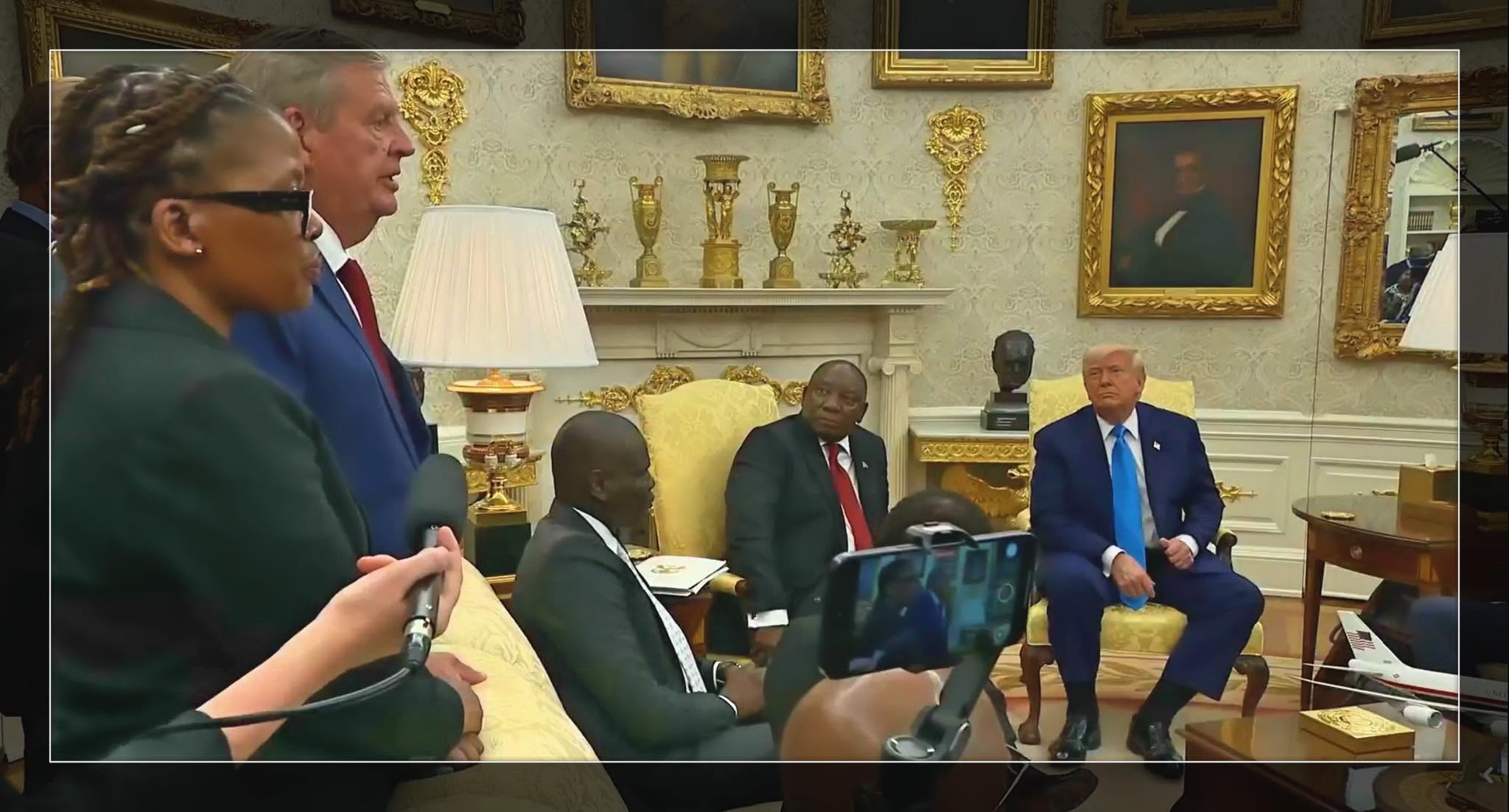
If one has an opportunity, today’s meeting between President Donald J. Trump and South Africa’s President Matamela Cyril Ramaphosa, and the press, is worth taking the time to review in my opinion.
The parties touch on many foundational concerns about maintaining a decent society. Rupert is second from the left, standing, in this image.
Joseph Stiglitz pointedly observed, “The top 1 percent have the best houses, the best educations, the best doctors, and the best lifestyles, but there is one thing that money doesn’t seem to have bought: an understanding that their fate is bound up with how the other 99 percent live.” This highlights how the wealthy often fail to recognize their interconnectedness with the rest of society.
Stiglitz further warned, “The more divided a society becomes in terms of wealth, the more reluctant the wealthy are to spend money on common needs. The rich don’t need to rely on government for parks or education or medical care or personal security.” This withdrawal from common social investments ultimately weakens the foundations that support everyone, including the wealthy themselves.
Johann Rupert sees the world through a very unique International set of eyes. He is South Africa’s richest man and one of the most influential business figures in Africa, renowned for his global luxury empire and diverse investment portfolio. Born in Stellenbosch in 1950 to business magnate Anton Rupert, Johann’s journey from local banking to international luxury is a story of strategic vision and bold expansion.
Rupert’s wealth is rooted in both inheritance and entrepreneurship. His father, Anton, founded the Rembrandt Group (later Remgro), initially a tobacco company that diversified into various sectors. Johann studied economics and company law at Stellenbosch University but left before graduating to pursue business in New York, working at Chase Manhattan Bank and Lazard Freres.
In 1979, Rupert returned to South Africa and founded RMB - Rand Merchant Bank, which quickly became a major player in the country’s financial sector. Rupert later merged RMB with Rand Consolidated Investments, forming RMB Holdings.
The real turning point came in the late 1980s when Johann Rupert split Rembrandt’s International assets and established Compagnie Financière Richemont in Switzerland in 1988. Richemont focused on luxury goods, acquiring iconic brands and growing into the world’s third-largest luxury group.
Major Companies and Holdings
Johann Rupert’s business empire is structured around three main holding companies:
The Three Main Holding Companies
• Richemont (Switzerland-based)
• The world’s largest luxury watchmaker and a leading luxury goods group.
• Owns brands such as Cartier, Van Cleef & Arpels, Buccellati, Jaeger-LeCoultre, IWC Schaffhausen, Montblanc, Chloé, Dunhill, and more.
• Rupert controls Richemont through the family trust, Compagnie Financière Rupert, which holds all Class B shares, giving him effective control.
• Remgro (South Africa-based)
• An investment holding company with stakes in over 30 companies across sectors like financial services, healthcare, food, beverages, media, and telecoms.
• Key investments include Discovery Bank, RMB, Mediclinic, Unilever South Africa, and Cape Town Film Studios.
• The Rupert family controls Remgro via the Rembrandt Trust, holding all Class B shares.
• Reinet Investments (Luxembourg-based)
• Initially created to manage the Rupert family’s interests in British American Tobacco (BAT), now diversified into tech, insurance, and financial services.
• Major holdings include a significant stake in BAT and Pension Insurance Corporation.
• The Rupert family holds nearly 25% of Reinet’s share capital through family trusts.
These three holding companies form the core of Johann Rupert’s diversified global business empire, spanning luxury goods, finance, healthcare, consumer brands, and more.
(Michael de la Force, LIKE Magazine, 5.21.25)
[Note: Joseph Stiglitz is an American economist, professor at Columbia University, and recipient of the 2001 Nobel Prize in Economic Sciences for his pioneering work on markets with asymmetric information. He has served as chief economist of the World Bank, chaired the U.S. Council of Economic Advisers, and is known for influential research on topics like income distribution, globalization, and public policy. Stiglitz is also recognized for his critical views on free-market fundamentalism and international financial institutions, and has authored several widely read books on economics and globalization.]
{Note II: Johann Rupert's net worth as of May 2025 is estimated to be between $14.7 billion and $17.7 billion, depending on the source:
Bloomberg Billionaires Index lists his net worth at $17.0 billion, with some sources citing up to $17.7 billion.
Forbes estimates his net worth at $14.7 billion as of May 21, 2025.
Other recent reports place his net worth in the range of $15.2 billion to $15.3 billion, reflecting fluctuations due to the performance of his luxury goods company, Richemont.
This makes Johann Rupert the richest person in Africa, and one of the wealthiest individuals globally.}
(Michael de la Force, LIKE® Magazine, 5.21.2025)
Source post: https://facebook.com/674873899/posts/pfbid0U37qPsqoGuLcy37GsYovCLzrhxXBriCgLk9yemZFyzSXGpGdmKy9hjJ1aVgYuigBl/