Paris | June 29, 2026
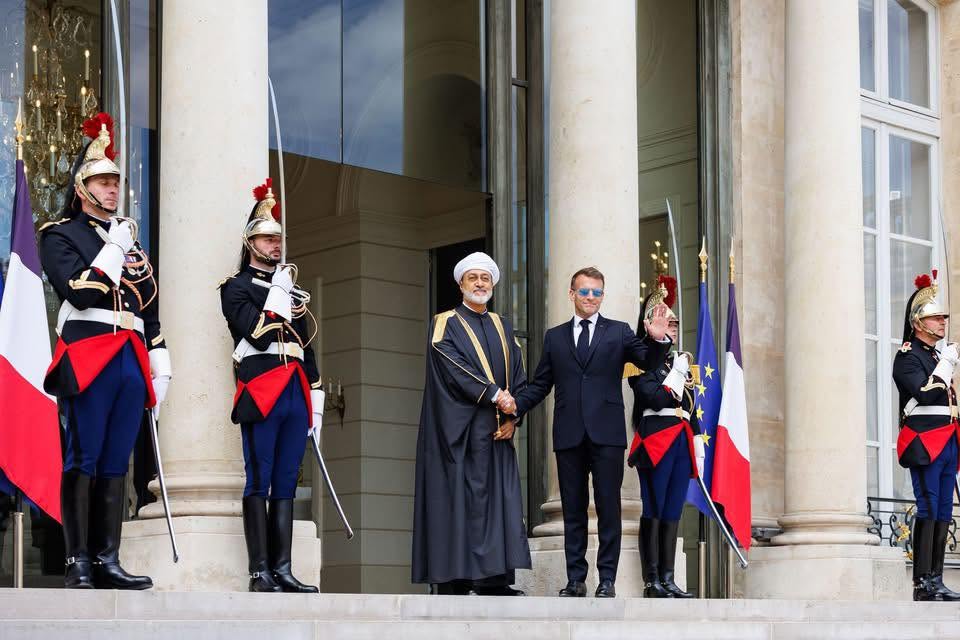
PARIS — In a moment rich with diplomatic consequence, His Majesty Haitham bin Tarik, Sultan of Oman, arrived in Paris on June 28, 2026, for his first official state visit to the French Republic — a visit that signals a deepening of one of the Arab world's most enduring bilateral partnerships and carries far-reaching implications for security across the volatile Middle East.
Welcomed at Paris Orly International Airport by Roland Lescure, France's Minister of Economy, Finance, Industrial and Digital Sovereignty, the Sultan was received with full ceremonial honors at Les Invalides — the storied "House of Invalids," Napoleon's final resting place and among the most venerable monuments of French national pride. The symbolism was unmistakable: two nations with centuries of contact choosing, in a moment of global instability, to reaffirm their shared commitment to peace, commerce, and open seas.
French President Emmanuel Macron, who extended the personal invitation to Sultan Haitham, welcomed the visit as a milestone:
"Delighted to welcome His Majesty Haitham bin Tarik, Sultan of Oman, for his first official visit to France. The Sultanate of Oman and France are today strengthening their partnership through historic agreements in economic, scientific, cultural and industrial fields."
A PARTNERSHIP FORGED ACROSS CENTURIES
To understand the weight of this visit, one must trace the long arc of Oman's history — a story not of conquest and colonization, but of remarkable independence, maritime mastery, and enduring diplomatic finesse.
Archaeological evidence places human civilization in the Sultanate of Oman as far back as 3,000 BCE. By 2,500 BCE, the region had already earned a reputation for superior metalworking, and its merchants were navigating reed boats across the Arabian Sea to what are now Pakistan and Iraq. Oman was a key node in the ancient frankincense trade, supplying the sacred resin to Egypt, Rome, Jerusalem, and Bethlehem — by both overland caravans and sea routes. At the legendary port of Sumhuram, the Queen of Sheba herself is said to have maintained a palace.
Following Oman's embrace of Islam in the 7th century, the Sultanate emerged as a dominant maritime civilization, extending its trade routes south to East Africa and east to India and China. By the 15th century, Omani dhows were making regular trading voyages to Guangzhou (Canton) in China — a testament to the nation's seafaring ambitions long before the age of European exploration.
Oman's strategic position at the mouth of the Persian Gulf made it a coveted prize for successive imperial powers. Portugal seized Muscat in the 16th century and held it until 1650, when Omanis expelled the colonizers and dramatically expanded their own influence down the East African coast. For a remarkable period, Zanzibar served as the Sultanate's capital. A defining chapter opened in the 18th century when Ahmad ibn Said drove out Persian invaders and was elected Imam, founding the Al Busaidi dynasty — the same royal house that rules Oman to this day.
In 1798, the Sultanate signed a Treaty of Friendship with Britain — the first such treaty between an Arab Gulf state and a European power — without ever surrendering its sovereignty. Around this same period, Oman began cultivating ties with France and the Netherlands, weaving a network of trade and cultural exchange that would endure for more than two centuries. By 1833, Sultan Said of Oman extended the Sultanate's global reach further still, signing a Treaty of Friendship and Commerce with the United States.
Throughout all of this, Oman maintained one distinctly proud distinction: it was never a colony. Through conquest, occupation, and the sweeping changes of empires, the Sultanate always retained its essential sovereignty.
FROM QABOOS TO HAITHAM: A MODERN TRANSFORMATION
The discovery of oil in the 1920s and 1930s opened yet another chapter, but Oman's transformation into a modern nation-state is credited overwhelmingly to Sultan Qaboos bin Said, who came to power in 1970. He inherited a country largely undeveloped — with minimal roads, hospitals, or schools — and reshaped it within a generation.
After defeating a communist-backed insurgency in the southern Dhofar region, Sultan Qaboos channeled oil revenues into education, health, welfare, and modern infrastructure on an unprecedented scale. His 50-year reign earned him the widely revered title "Father of the Nation," and his passing in January 2020 was mourned as a profound loss across the Arab world and beyond.
His successor, His Majesty Sultan Haitham bin Tarik — a cousin who had long served as Minister of Heritage and Culture — inherited not only the throne but a mandate to secure Oman's future in a rapidly changing global economy. His guiding framework, Oman Vision 204O, charts a course for economic diversification, technological advancement, and sustainable development — moving the nation beyond oil dependency toward a knowledge-based, innovation-driven economy.
PARIS, 2026: A SUMMIT OF STRATEGIC AMBITION
Sultan Haitham arrived in Paris accompanied by a high-level delegation that underscored the breadth of the visit's agenda: Deputy Prime Minister for Defence Affairs Sayyid Shihabbin Tarik Al Said, Foreign Minister Sayyid Badr Albusaidi, the President of the Oman Investment Authority, and the Minister of Commerce, Industry and Investment Promotion, among others.
The two-day summit yielded agreements and announced projects valued at approximately $2.25 billion — spanning water treatment, environmental technology, transport, space, clean energy transition, and industrial cooperation. The French-Omani economic relationship has been quietly expanding for years: trade exchange surpassed RO 100 million in 2025, nearly 300 French-affiliated companies now operate within Oman, and invested French capital has grown steadily.
The visit builds on a strategic dialogue that opened in Paris in April 2026 and follows years of high-level engagement. Sultan Haitham and President Macron most recently spoke by telephone on May 31, 2026, to discuss regional security, maritime freedom, and bilateral cooperation.
HORMUZ: THE WORLD'S MOST CRITICAL CHOKEPOINT
Perhaps no element of the Paris summit drew more attention than the two leaders' joint announcement on the Strait of Hormuz — the narrow channel between Oman and Iran through which roughly 20 percent of the world's oil supply passes each day.
President Macron was explicit:
"We are working together for de-escalation in the Middle East. We have decided to collaborate jointly, in conjunction with our partners, on clearing the strait to secure the sea ways and guarantee a free and unconditional passage into the Strait of Hormuz."
For Oman, this commitment is both natural and historic. The Sultanate's coastline forms the southern boundary of the Strait, and Muscat has long served as a quiet but indispensable back-channel in regional diplomacy — facilitating, among other things, the early negotiations that led to the 2015 Iran nuclear agreement. Oman's tradition of balanced, non-confrontational engagement has earned it trust on all sides of the Gulf's complex geopolitical fault lines.
The joint French-Omani pledge to secure free passage through Hormuz is therefore not merely a bilateral statement — it is a signal to regional powers, global shipping interests, and international energy markets that the two nations are prepared to act together in defense of international maritime law.
THE DEEPER MEANING
Formal diplomatic ties between Oman and France were established in 1972, with ambassadors exchanged in 1974. But the relationship's roots reach far deeper — to those 18th-century maritime encounters in the Indian Ocean and along the East African coast, when Omani and French merchants shared the same trade winds.
What Paris 2026 represents is the maturation of that centuries-old connection into a 21st-century strategic alliance — grounded in mutual respect, commercial ambition, and a shared stake in regional stability. For a Sultanate that has never been colonized, that has always navigated its own course between empires, and that has quietly served as one of the Middle East's most trusted mediators, this visit with France is entirely consistent with Oman's centuries-long tradition: independent, pragmatic, and always looking outward to the sea.
(Michael de la Force, LIKE® Magazine, 6.29.2026)
Source post: https://facebook.com/674873899/posts/pfbid05iyhj2bNFnodr9gAsLPtxjr8oUVeWJrt6JR1hF9YKjajThXe6Hef4XXhw4Tc3yg9l/