President Donald J. Trump kicks off the season leading a roundtable by listening.
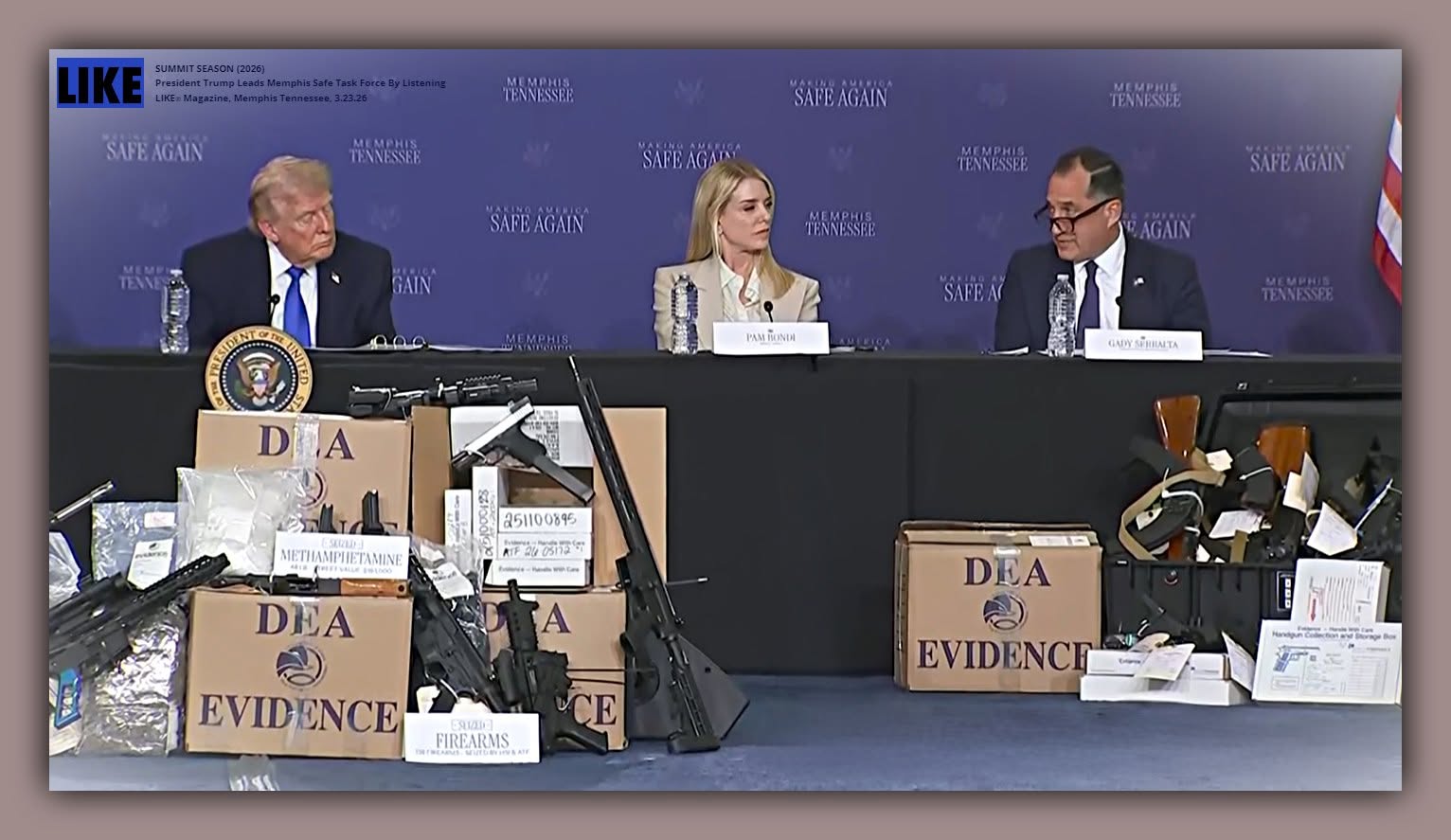
At the Memphis Safe Task Force, today in the home of the King of Rock & Roll, Elvis Presley, President Trump listens and leads the group, who receive considerable praise and respect for the efforts of the Memphis Safe Task Force.
Tennessee Governor Bill Lee thanked President Trump while suggesting Nashville is the Heart of Tennessee, but Memphis is the Soul.
The Memphis Safe Task Force is a federally‑led, multi‑agency public‑safety operation launched in late 2025 to reduce violent crime in Memphis by combining federal, state, county, and local law‑enforcement resources. Since its rollout, it has generated starkly divergent reactions: city officials, federal leaders, and some residents highlight its crime‑reduction statistics, while community groups and civil‑liberties advocates raise concerns about racial profiling, pretextual stops, and immigration‑driven enforcement. Below is an in‑depth analysis that foregrounds both the on‑the‑ground realities and the numbers reportedly cited at today’s roundtable‑style briefing.
What the Memphis Safe Task Force Is
The Memphis Safe Task Force is a coordinated effort among the U.S. Marshals Service, the FBI, the Department of Justice, U.S. Immigration and Customs Enforcement (ICE), the Tennessee National Guard, the Tennessee Highway Patrol, Shelby County Sheriff’s Office, and Memphis Police Department. It was announced by President Trump and state leaders as a follow‑on to earlier “Operation Viper”‑style sweeps, with the stated goal of targeting violent offenders, gang members, and fugitives rather than low‑level, non‑violent suspects.
At today’s roundtable, briefers emphasized that the force is built on joint operations, intelligence sharing, and saturation‑style “hot‑spot” patrols across high‑crime neighborhoods and selected suburban corridors in Shelby County. Law‑enforcement representatives described it as a “force multiplier” that allows Memphis to sustain a higher street presence than the city could maintain alone.
Arrests, weapons, and crime‑rate stats cited today
While the exact wording of today’s roundtable may vary by agency, the core statistics align with the most recent public updates and follow‑up analyses:
Total arrests: Since operations began in October 2025, the U.S. Marshals report that the Memphis Safe Task Force has made nearly 4,700 arrests citywide, with over 4,000 arrests already noted by late 2025.
Violent‑crime impact (citywide FBI‑style data): Officials cited that since the task force launched, Memphis has seen:
Murder down about 39%,
Sexual assault down about 43%,
Robbery down about 60%,
Motor vehicle theft down about 70%.
Firearms and warrants:
More than 500–600 illegal firearms seized (reported as 539–629 in different briefings).
Over 1,800 arrest warrants executed, many for violent or repeat offenders.
Gang and child‑protection outcomes:
More than 400 known gang members apprehended, including high‑risk individuals wanted for serious felonies.
Over 120 missing children located or recovered, often through coordinated fugitive‑round‑up operations.
At today’s roundtable, federal and state leaders repeatedly framed these numbers as evidence that the task force is “working as advertised,” pointing to the sustained drop in violent‑crime index categories even as the city continues to process thousands of arrests.
Contributions of those on the ground every day
The “everyday” work of the task force is carried out by a mix of officers, deputies, and support staff, many of whom operate in shifts and rotations across all 15 Memphis police districts and surrounding county areas. Their duties include:
Proactive patrols in identified “hot‑spot” blocks, often in tandem with the Tennessee National Guard’s security and traffic‑control roles.
Coordinated “fugitive round‑up” operations targeting individuals with outstanding warrants for violent crimes, including homicides, aggravated assaults, and domestic‑violence felonies.
Administrative and investigative follow‑through, such as processing warrants, coordinating interstate extraditions, and maintaining real‑time situational‑awareness dashboards that track crime spikes and arrest patterns.
At today’s roundtable, several shift‑level supervisors and task‑force coordinators described the strain of sustaining such a high‑tempo operation, noting that officers are often working overtime shifts and rotating between plain‑clothes enforcement and visible “show‑of‑force” patrols. A Memphis Police lieutenant remarked, “You can’t just flood the streets; you’ve got to keep doing it for months, and that’s where the burnout starts.”
Quotes and perspectives from officials and community members
Federal and city leadership
U.S. Marshals Service Director Gadyaces Serralta (whom President Trump is listening to in the attached image while seated next to U. S. Attorney General Pam Bondi) has been the task force’s most visible spokesperson, emphasizing that the effort is about “removing violent offenders from our streets and directly reducing violent crime.”
In today’s remarks, he reiterated:
“These numbers are not just statistics; they represent real lives saved and families who can walk their streets without fear of fatal shootings or robberies. But there is still much more to do.”
Similarly, Tennessee Senator Marsha Blackburn and other Republican officials have cited the Memphis Safe Task Force as a national model, arguing that coordinating federal and state resources is essential for cities with historically high crime rates. At the roundtable, one state official noted, “The template we’re building here can be replicated in other urban centers struggling with the same level of gang‑driven violence.”
Community and civil‑rights voices
By contrast, community organizers and civil‑rights groups have voiced serious reservations about how the task force operates on the ground. Groups such as the ACLU of Tennessee and local coalitions like “Free the 901” have highlighted that many stops and arrests are not for violent crimes, and that immigrants and minority residents often feel targeted.
At the same roundtable, or in related follow‑ups, a representative from Vecindarios 901, an immigrant‑services organization, reportedly said:
“We’re seeing a dramatic increase in calls from residents who are changing their routines—avoiding driving, skipping medical appointments, keeping kids home from school—because they fear being stopped over a minor traffic violation.”
Another community organizer captured the ambivalence on the street:
“If you ask people in the neighborhoods where shootings used to happen every weekend, they’ll tell you the streets feel safer. But ask anyone who’s been stopped three times in a week for a broken taillight or ‘driving unsure,’ and you’ll hear a very different story.”
How the data are being used and interpreted
Agency analysts and data officers at the roundtable underscored that the Memphis Safe Task Force relies on a layered data strategy:
Hot‑spot mapping of where shootings, robberies, and auto thefts cluster.
Warrant‑tracking systems that prioritize targeting individuals with histories of violent or repeat offenses.
Real‑time dashboards that show arrest totals, weapon seizures, apprehensions by district and time window.
Supporters argue that these tools allow the task force to demonstrate that “most arrests are for serious, prior violent offenders,” in line with the Marshals’ own characterization. Critics, however, point to analyses of arrest records showing that a large share of those detained were booked for non‑violent, often misdemeanor‑level offenses, which they say undercuts the “violent‑offender‑only” narrative.
Tensions and trade‑offs going forward
The Memphis Safe Task Force sits at the intersection of immediate crime reduction and long‑term community trust. On the one hand, the cited statistics—nearly 4,700 arrests, hundreds of illegal guns seized, over 400 known gang members captured, and substantial drops in murder, robbery, and auto theft—paint a picture of a force having a measurable impact on violent crime. On the other hand, reports of widespread pretextual stops, immigration‑focused enforcement, and community fear suggest that the costs to civil liberties and racial equity may be significant.
Going forward, city leaders and task‑force officials will likely be pressed to balance:
Continuing aggressive enforcement to sustain the crime declines, versus
Reining in tactics that generate mistrust, especially among immigrant, Black, and low‑income communities.
(LIKE Magazine, Summit Season 2026 Begins, 3.23.26)
(Michael de la Force, LIKE® Magazine, 3.23.2026)
Source post: https://facebook.com/674873899/posts/pfbid02koR331M97sU8t8Fu7wyWQvjdhVFuLyNiKBv7gZYF24i9eQXCqD6t219dSMJpHoadl/