Artwork © Dobson E. Rooster, 1994.
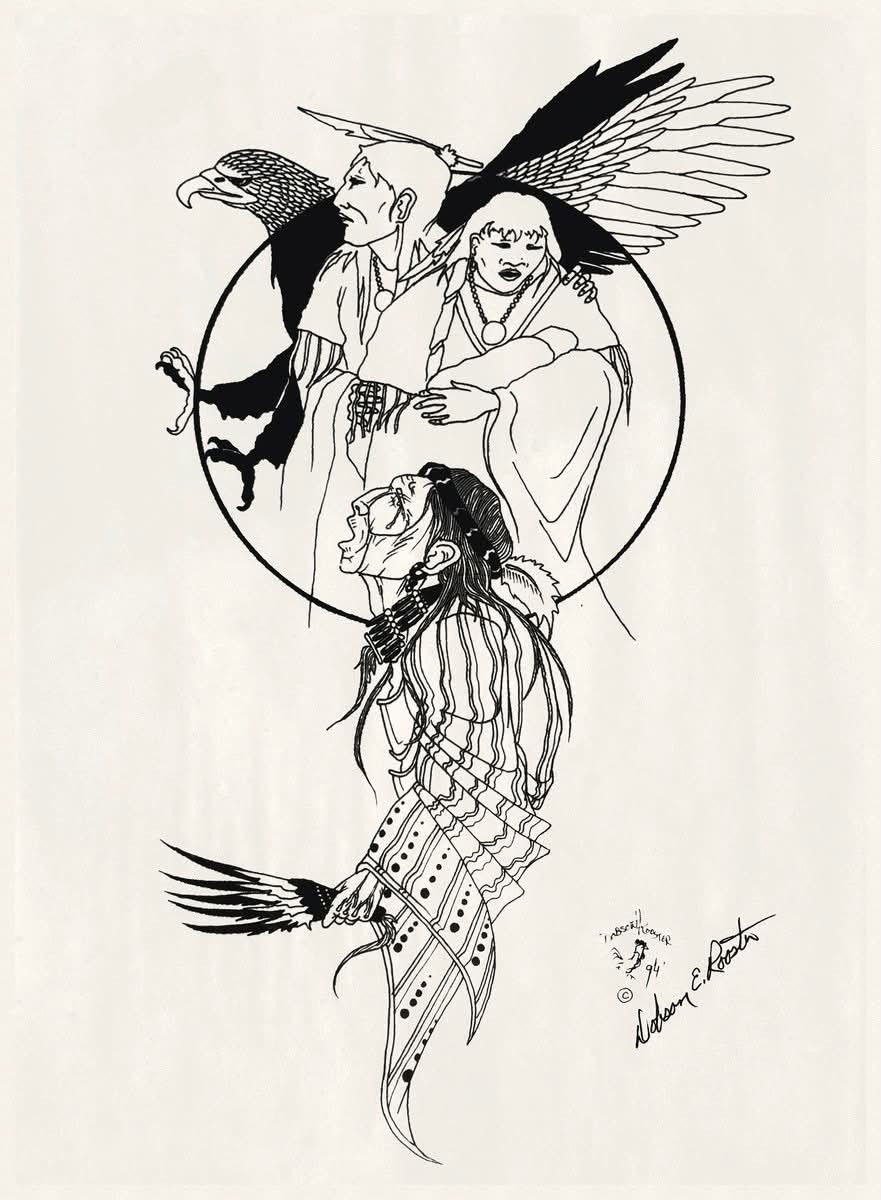
The sheet is vertical, black ink on off-white paper, and it does not introduce itself. No title rides the recto. What meets the eye first is not a caption but a composition: an elder drawn large in the lower half of the page, face tipped upward, and above him a thin circular frame that holds a quieter group—an eagle, a younger couple, an infant bundled at the woman’s chest. At lower right, in a small arc over a stylized rooster, the artist printed the name Dobson Rooster, added a copyright mark and 94', and signed in cursive Dobson E. Rooster. That is the public face of the work. Everything else—family, student prizes, the thin adult trail—arrives after looking.
The paper itself carries time. On the original sheet, light foxing freckles the ground, denser near the signature and the lower margin; cleaned and publication prints exist for reproduction, but the drawing as made is an object that has aged in the hand. The ink is confident and largely unshaded. Contour does the work of modeling. Solid black appears where Rooster wants weight—the dark tips of the feather fan, passages in the eagle’s wing and talon—against a field left otherwise spare. The background is empty. Attention is forced onto the vertical stack of figure and circle.
Look first at the lower register, because that is where the drawing spends most of its scale. An elder man is shown from about the waist up, in left-facing profile. The head tips back; the mouth opens; fine linear marks gather at the eye. Long hair falls under a patterned headband with trailing ornament. A multi-strand choker sits close at the throat. Over the shoulder and back, a densely patterned wrap or blanket is built from vertical stripes, rows of dots, and zig-zag or step motifs along the edge—pattern as surface, not as illustration of a named textile. In the near hand he holds a fan of feathers whose tips are filled black, a rhythmic run of dark marks against the blank paper. The expression is not mute. Visually it reads as strain or release: brow tightened, eye narrowed, mouth parted. The ink does not name the feeling. It stages it.
Above him, the upper register is calmer and smaller, contained by that thin circle. Inside and breaking out of it: an eagle at left, head in profile, wing and talon crossing the frame so that the bird is not fully captive to the vignette; a younger man in profile, a single feather in the hair, a circular pendant at the neck, a hand resting toward the woman beside him; the woman facing more nearly forward, long hair with a straight fringe, also pendanted, cradling a small bundled figure that appears to be an infant. The circle sits directly in the elder’s upward gaze. Compositionally, the two registers are linked by that look and by the shared leftward orientation of the elder and the younger man. Any further reading—memory, vision, spiritual companion—remains interpretive. The sheet offers no inscription to decide the matter.
What the artist has said about the elder’s emotion is brief and personal. In an interview with this magazine’s editor, Dobson Rooster explained that the old man’s pain and response are drawn from experiences of his youth with his partner and their child. That account belongs to Rooster; it is recorded as recollection in the editor’s note below.
Who signed it matters, Dobson Rooster is a Cherokee family name in the Tahlequah and Briggs country of Cherokee County, Oklahoma—not a studio invention. Care is required at the name itself. A grandfather of the same name appears on Cherokee by Blood Dawes Card 8604, Roll No. 25803, in Cherokee County guardianship notices of 1911 and 1915, and as “Dobson Rooster and wife Arlie” in a 1919 land transfer. That earlier Dobson Rooster—buried at Cedar Tree Cemetery in Briggs, with dates given on the cemetery memorial as 1895–1952—is not the artist. The artist is his grandson: Dobson, son of Joe Edward Rooster (May 2, 1942–April 2, 2023). Dobson Rooster and wife Denise of Tahlequah, OK are well respected community members.
Before the art, there was already a narrative habit. What the newspapers document about Dobson Rooster is art work done at the Five Civilized Tribes Museum in Muskogee—three successive winters. In February 1985 the *Muskogee Daily Phoenix and Times-Democrat* reported that Dobson Rooster took first place in the seventh-grade division for a painting titled “In Disagreement.” In March 1986 he appeared among eighth-grade honorable mentions as Dobson Rooster, Cherokee, TJHS—Tahlequah Junior High School—for “Telling a Story” and “Riding Together,” in a show judged by the artist Ruthe Blalock Jones. March 1987 is the fullest published record: at the museum’s 17th annual Student Art Show, judged by Okmulgee artist Carol Bell, Rooster of Tahlequah received the Frances Rosser Brown Indian Heritage Award for “Transformation To Create One,” the prize the *Phoenix* described as going to the work that best portrayed the history of the Five Civilized Tribes; he also took first place in ninth-grade painting for “New Land Looks Beautiful.” The Sunday edition reproduced another entry under the caption “Faze of Feelings by Dobson Rooster, Tahlequah”—a title not located in the printed winners list and not to be described as a prize. The entrant roster that year listed him as Dobson Rooster, Cherokee, Tahlequah; his brother Sammy Rooster, likewise identified as Cherokee of Tahlequah, took seventh-grade first place for “Busy Beaver.” Those titles already lean toward story and feeling. The 1994 sheet, seven years later, looks like a continuation of that ambition in a single, untitled page—two registers, one vertical breath—rather than a sudden invention.
After high school the open record thins. By 1987–88 the *Phoenix* sports pages place a Dobson Rooster at Hulbert; a continuous exhibition résumé after that is not among the documents located. Searches of the Gateway to Oklahoma History for the exact name return the grandfather’s early legal notices and the grandson’s 1985–88 *Phoenix* pages. No later exhibition notice appears in that corpus. No matching lot turned up in auction and dealer databases searched under the name. The Five Civilized Tribes Museum’s supporting-artists page, retrieved September 16, 2026, did not list Rooster. That is the adult public trail as of this writing: thin, local, then silent.
Which is why the sheet matters. It is not a lost masterpiece claimed into a catalogue raisonné that does not exist. It is a dated, signed, untitled ink drawing whose line, pattern, and two-register structure can be described without padding—and whose emotional charge the artist has, once, explained in his own words. Between the student prizes of the mid-1980s and the quiet that follows 1994, this page is what returns Dobson E. Rooster to view: an elder looking up, a circle holding a family and an eagle, a rooster device and a cursive name at the margin, and the restraint of a drawing that refuses to title itself.
Editor’s Note
When Michael de la Force interviewed Dobson Rooster in Oklahoma, the artist explained that the emotional pain and response of the old man in this drawing are exhibited from experiences of his youth with his partner and their child. No title is written on the sheet. The account is Rooster’s own.
(LIKE® Magazine, 9.16.2026) Dobson E. Rooster, ink on paper, 1994. Photo: LIKE® Magazine.
(Michael de la Force, LIKE® Magazine, 9.16.2026)
Source post: https://facebook.com/674873899/posts/pfbid0cN9wYH2yTGn2a5mooR4igic5Ln5W3Es88MCFGwbVaKp3ynB9Z55n14BN2c6oyrZbl/