SAN SIMEON, California (Summer 2026) — On a hilltop above California's Central Coast, a man who built the largest news empire in American history spent nearly three decades constructing a monument to his own appetite for the world's treasures. The result, La Cuesta Encantada — "The Enchanted Hill" — still stands above San Simeon Bay, its twin bell towers visible for miles, its pools lined with imported marble and its walls hung with art gathered from monasteries, palazzos and auction houses across Europe.
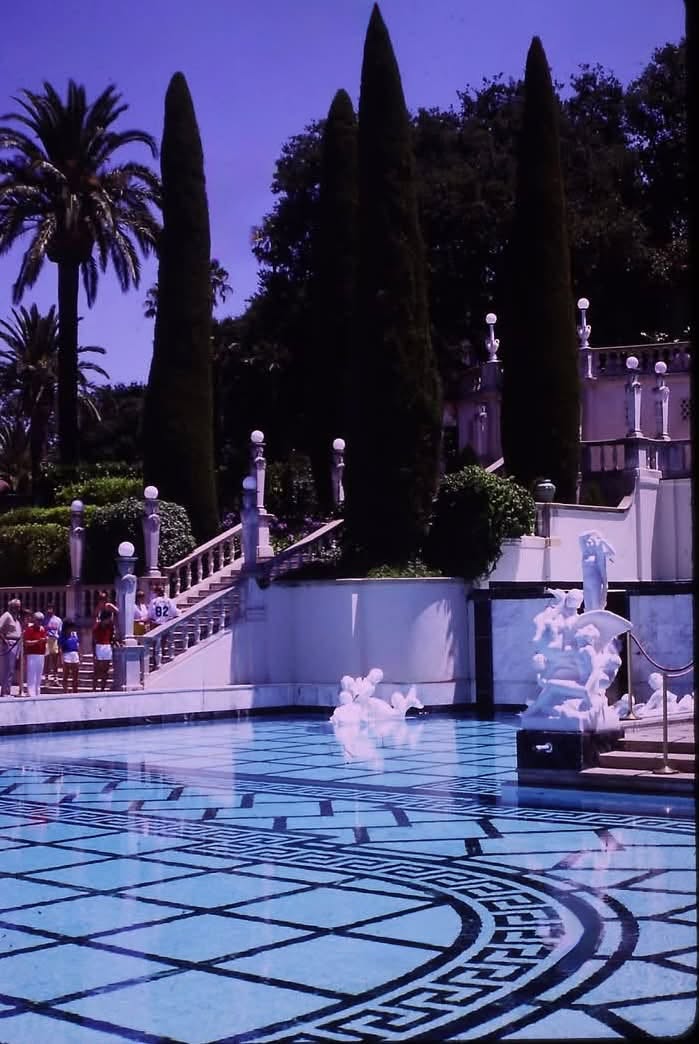
The photographs accompanying this article, drawn from the LIKE® Magazine vault capture the estate's pools and the towers of Casa Grande in a period when the grounds still felt like a private Hollywood retreat rather than a state monument — the role they played for roughly three decades under the man who built them, William Randolph Hearst.
THE PUBLISHER WHO BUILT AN EMPIRE
Hearst was born April 29, 1863, in San Francisco, and died Aug. 14, 1951, in Beverly Hills, at 88. His father, George Hearst, was a mining millionaire and U.S. senator from California; his mother, Phoebe Apperson Hearst, was a philanthropist who became the first woman regent of the University of California, and founded the anthropology museum that bears her name.
He entered Harvard College in 1882 and was ultimately expelled in 1885. Among the five unique anecdotes that define his outsized personality, none captures his early irreverence better than this one: Britannica records his offenses as ranging "from sponsoring massive beer parties in Harvard Square to sending chamber pots to his professors," their images painted inside the bowls. His father had acquired the San Francisco Examiner in 1880; in 1887, the 24-year-old Hearst took control of the struggling paper and turned it profitable within two years by mixing reformist reporting with lurid sensationalism.
In 1895 he bought the failing New York Morning Journal, poached talent from rival publisher Joseph Pulitzer's New York World, and built circulation through giant headlines, color sections and crime coverage — a rivalry with Pulitzer that gave the language the term "yellow journalism". Historians credit the Journal's exaggerated reporting on Spanish atrocities in Cuba with helping push the United States into the Spanish-American War in 1898.
Hearst served two terms as a Democratic congressman from New York from 1903 to 1907, ran for New York City mayor and governor and lost both races, and drifted from an early alliance with the Progressive movement toward isolationist, nationalist politics after World War I. By the mid-1920s he controlled 28 newspapers nationwide, along with the International News Service, King Features Syndicate, Cosmopolitan Productions and magazines including Cosmopolitan, Good Housekeeping and Harper's Bazaar; by 1935, Britannica reports, his 28 papers and 18 magazines reached roughly 20 million readers a day.
Art dealer Joseph Duveen nicknamed him the "Great Accumulator," and Hearst himself said he wanted San Simeon to become "a museum of the best things that I can secure". Colleagues described him as generous to writers — he paid above market rates and gave reporters page-one bylines — and tolerant of what one account called "prima donnas, eccentrics, bohemians, drunks, or reprobates," under the newsroom motto "While others talk, the Journal acts".
The Depression and years of extravagant spending caught up with him: the Hearst Corporation underwent a court-ordered reorganization in 1937, and Hearst began selling art that year, offering roughly 20,000 items in 1941 to raise cash. Britannica notes he lost personal control of his communications empire in 1940. His life inspired Orson Welles' 1941 film "Citizen Kane".
MARION DAVIES AND THE HOSTESS OF SAN SIMEON
Hearst married Millicent Veronica Willson in 1903, and the couple had five sons; they separated in the mid-1920s but never divorced because Millicent declined to grant one, and they remained legally married until his death.
Hearst met actress Marion Davies, born Marion Cecilia Douras on Jan. 3, 1897, in Brooklyn, while she was performing in the Ziegfeld Follies; she was 19, he was 53. Their partnership lasted from 1917 until his death in 1951, and the two remained openly together for some thirty years, sharing residences up and down the California coast as well as abroad in Europe.
Hearst formed Cosmopolitan Pictures in 1918 largely to showcase Davies, signing her to an exclusive contract and eventually spending an estimated $7 million promoting her career through his newspapers and newsreels. She starred in a total of 46 films, including 16 talkies, was the top female box-office draw in 1922 and 1923, and was crowned "Queen of the Screen" in 1924.
At San Simeon, Davies became the hostess of legendary Jazz Age weekends, entertaining Hollywood royalty and political leaders including Charlie Chaplin, Douglas Fairbanks, Harpo Marx, Clark Gable, Calvin Coolidge, Winston Churchill, Charles Lindbergh and Amelia Earhart. She proved to be more than a hostess in the second of this article's defining anecdotes: when Hearst's finances collapsed in the late 1930s, Davies liquidated her personal assets — jewelry and securities alike — and handed him a check for roughly $1 million, then helped secure a further $1 million loan from Washington Herald owner Cissy Patterson, help widely credited with keeping him solvent.
In 1947 the pair departed San Simeon for good and settled at Davies' house in Beverly Hills, which is where Hearst spent his final years, dying in 1951. Under his will, Davies inherited enough Hearst Corporation stock to control a majority interest, but she voluntarily relinquished the bulk of those shares back to the company weeks after his death, keeping a smaller trust and an advisory role.
THE HOLLYWOOD EXPRESS TO SAN SIMEON
Reaching San Simeon in Hearst's day required an overnight journey, and Hearst made the trip itself part of the show — the third of the article's defining anecdotes. Guests typically departed the Southern Pacific station in Los Angeles around 6:30 p.m. Friday, according to a period account preserved by The New Yorker, with the train diverted onto a siding at San Luis Obispo after midnight so guests could sleep before finishing the trip by limousine the next morning. The Saturday Evening Post likewise describes Hollywood's elite riding the rails from Los Angeles Friday evening, arriving at San Luis Obispo around midnight and being driven roughly 45 miles to the castle the next day.
PBS's "American Experience" describes chauffeurs meeting first-time guests for a chauffeured run of about an hour and a half up unpaved ranch roads to reach the hilltop estate, and American Heritage magazine notes that Hearst would reserve "a private railroad car, or sometimes a whole train," while closer friends were flown directly to his private airstrip aboard his own eight-passenger Fokker aircraft. It was not unusual for as many as 70 Hollywood guests to arrive in a single weekend, all transported on Hearst's own train.
The guest list over the years reads like a studio-era who's who: Charlie Chaplin, Cary Grant, the Marx Brothers, Greta Garbo, Buster Keaton, Mary Pickford, Jean Harlow and Clark Gable mixed with political figures such as President Calvin Coolidge and Winston Churchill, along with Charles Lindbergh, playwright George Bernard Shaw and author P.G. Wodehouse.
A CASTLE BUILT OVER 28 YEARS
Hearst's family had owned land around San Simeon Bay since 1865, when his father purchased the original 40,000-acre ranch; Hearst himself grew up camping there. After his mother's death in 1919 left him a 250,000-acre inheritance and $11 million, Hearst told architect Julia Morgan he wanted "something a little more comfortable up on the hill." Construction began that year and continued, almost without interruption, until 1939, then resumed after World War II until Hearst left the property for good in 1947 — nearly three decades of building.
Morgan, the first woman admitted to the architecture program at the École des Beaux-Arts in Paris and the first woman licensed as an architect in California, served as San Simeon's architect, interior decorator and landscape architect for more than 28 years, ultimately designing more than 700 buildings in her career. The estate blends Spanish Renaissance and Mediterranean Revival styles, with a main house, Casa Grande, whose twin bell towers evoke a Spanish cathedral — the same towers captured rising against a blue Central Coast sky in the accompanying restored photograph of Casa Grande.
When Hearst departed for good in 1947, the estate remained unfinished, yet it already counted 165 rooms and spread across 123 acres of landscaped grounds — gardens, terraces, walkways and pools — anchored by a 68,500-square-foot main house and three guest cottages, per Hearst Castle's own figures. The property also offered a private airstrip, a screening room and tennis courts, and — while Hearst was alive — a menagerie that both Wikipedia and Britannica call the largest privately held zoo in the world.
The estate's two swimming pools, both represented among the accompanying photographs, took years to perfect. The outdoor Neptune Pool was rebuilt three times — expanded in 1924, again in 1926-28 and finally in 1934 to frame a genuine Roman temple facade Hearst imported from Europe — before Hearst was satisfied; the finished pool stretches 104 feet, holds 345,000 gallons and is lined with roughly 9,000 square feet of Vermont marble. That imported temple facade, with the Santa Lucia mountains rising behind it, is the subject of the close-up photograph accompanying this section. The indoor Roman Pool, proposed in 1927 and built between 1930 and 1935 beneath the estate's tennis courts, is lined in Murano glass tile with gold leaf, its design inspired by the Mausoleum of Galla Placidia in Ravenna, Italy — the same gold-flecked blue mosaic of the Roman Pool.
TREASURES GATHERED FROM AROUND THE WORLD
Hearst furnished his California museum-in-progress almost entirely with purchases shipped from Europe. His purchases ran to more than 30 carved ceilings, doorframes and mantelpieces, along with whole monasteries and a medieval barn once used to collect tithes — cargo that was routed through his Brooklyn storehouses before the long haul west to San Simeon. He formed the International Studio Arts Corporation specifically to manage the purchasing, exporting and importing of his acquisitions.
The collection ranged from antiquity to the Renaissance: along the South Esplanade sit Egyptian carvings of the lion-headed goddess Sekhmet, works dated to roughly the 16th-12th centuries B.C.; a Roman sarcophagus dated to 230 A.D., once housed in Rome's Palazzo Barberini, sits in a guest-house courtyard; and Hearst's Greek vase collection, begun in 1901, grew to more than 400 pieces — one of the largest such collections in the world, and after he died, the Met in New York acquired about 65 of the vases. The castle library still holds more than 4,000 books and about 150 ancient Greek vases.
Paintings and sculpture included a Tintoretto portrait, an early-1300s Madonna-and-Child panel attributed to Duccio's workshop, and a cast of Bernini's "Apollo and Daphne"; in 1930 alone, Hearst bought five antique Roman statues at a London sale. When his finances buckled, roughly half of his art holdings were sold off in the late 1930s and early 1940s, among them a van Dyck canvas and an odd assortment of relics — the sideboard once owned by Charles Dickens, a waistcoat that belonged to George Washington, and a Bible from Thomas Jefferson's library.
GARDENS, PERGOLAS AND A PRIVATE ZOO
Julia Morgan designed San Simeon's grounds as carefully as its buildings. A curving walkway called the Esplanade, lined with lampposts topped by carved alabaster globes, connects the main house to its guest cottages, while a decorative, mile-long riding path called the Pergola stretches away to the west of Casa Grande, carried on rows of concrete pillars that support trained, wall-flattened fruit trees.
During Hearst's era, the grounds also housed the Hearst Garden of Comparative Zoology, formally divided between a caged menagerie — bears, lions, tigers, leopards, jaguars, an elephant and even an orangutan — and vast open-range enclosures for roughly 50 species of grazing animals, including a herd of more than 300 white fallow deer, zebras, camels, llamas, kangaroos and as many as four giraffes. The zoo began to be dismantled in 1937 as Hearst's finances collapsed, but some animals were simply released to roam the ranch — the fourth of this article's defining anecdotes, and the one still visible to visitors today. Their descendants remain there: as of 2019, 126 wild zebras still grazed the 83,000-acre Hearst Ranch, visible to motorists driving Highway 1 near San Simeon nearly a century after Hearst first imported them.
Hearst died in 1951 and Morgan in 1957. In 1958, the Hearst family donated the castle and much of its contents to the state of California, and the estate opened to the public that June as the Hearst San Simeon State Historical Monument, which now draws roughly 750,000 visitors a year. The family retained ownership of most of the surrounding 82,000-acre ranch and, under a 2005 conservation agreement, received $80 million in cash and $15 million in state tax credits in exchange for giving up development rights to the land.
A MOVIE STUDIO BUILT FOR ONE STAR
Hearst's fascination with Hollywood was not limited to weekend guests. He founded Cosmopolitan Productions in 1918, partnering with Paramount's Adolph Zukor after United Artists rejected his bid to enter the movie business, and named the studio after his own Cosmopolitan magazine. The arrangement let Paramount adapt stories from Hearst's magazines — Cosmopolitan, Harper's Bazaar and Good Housekeeping among them — while those same magazines promoted the resulting films.
Disagreements over distribution sent Cosmopolitan from Paramount to MGM in 1923, and then, after a 1934 falling-out between Hearst and MGM chief Louis B. Mayer over the film "Marie Antoinette," to Warner Bros. Along the way, the studio produced "Humoresque" (1920), its first hit; "When Knighthood Was in Flower" (1922), whose $1.8 million budget made it the costliest production Hollywood had yet mounted; and, under director King Vidor, the Davies comedies "The Patsy" and "Show People," both released in 1928. Back in 1915, Hearst had also launched his own cartoon operation, International Film Service, created to bring his papers' popular comic-strip characters to the screen.
WHERE HE LIVED IN NEW YORK
Hearst's primary New York City residence for decades was at the Clarendon, a cooperative building at 137 Riverside Drive on the Upper West Side. He moved in around 1907-08, initially renting the top three floors — 30 rooms — for $24,000 a year. His growing art collection soon outgrew even that space; when the landlord balked at further expansion, Hearst simply bought the entire building around 1913 for roughly $950,000 and rebuilt it into a five-story "quintuplex" that The New York Times has called the largest apartment in New York City history, complete with a two-story tapestry gallery displaying suits of armor and stained glass salvaged from European palaces. His wife, Millicent, and their five sons lived there, though she eventually kept a separate residence and social life in the city. Mounting debts cost Hearst the building: Mutual Life Insurance Co. foreclosed on the Clarendon in 1938-39, and it was carved into roughly 60 smaller apartments the following year.
Park Avenue figures into the Hearst story through Marion Davies rather than Hearst's own address. Hearst commissioned an 11-room duplex for Davies in the Ritz Tower, a 42-story cooperative at Park Avenue and 57th Street, describing it as "nothing less than a palace fit for a movie queen," with four bedrooms, a wraparound terrace and stained-glass doors salvaged from an old monastery. The unit came on the market for the first time this century in 2025, listed for $26 million.
A PUBLISHING EMPIRE THAT OUTLIVED ITS FOUNDER
The company Hearst founded on March 4, 1887, in San Francisco is known today as Hearst Communications Inc., commonly called the Hearst Corporation. Its wire and syndication operations were central to Hearst's original strategy: he launched the International News Service in 1909, which merged with United Press in 1958 to form United Press International, and King Features Syndicate, still a Hearst subsidiary today, distributed comic strips and columns nationwide.
Richard E. Berlin succeeded Hearst as chief executive in 1951 and led the company until 1973; subsequent leadership passed through John R. Miller, Frank Bennack, Victor F. Ganzi and, since 2013, Steven Swartz. Today the privately held company reported record revenue of about $13 billion in 2024, rising 9%, and Swartz reported another record year in 2025, with revenue up 3% to $13.5 billion, across more than 360 businesses and roughly 22,000 employees.
Hearst Magazines still publishes more than 300 titles worldwide, including Cosmopolitan, Good Housekeeping, Harper's Bazaar, Esquire and Elle, reaching roughly 140 million consumers a month, while Hearst Newspapers owns dozens of dailies including the Houston Chronicle and San Francisco Chronicle — the company acquired the Austin American-Statesman in 2025 and announced a deal for The Dallas Morning News that July. Hearst Television operates roughly 31 to 33 local stations reaching about 19% of American households, and the company holds a 50% stake in A+E Global Media, owner of A&E, HISTORY and Lifetime, plus an 18% to 20% stake in ESPN Inc. Perhaps surprisingly, the company's single largest profit source today is Fitch Group, the bond-rating agency Hearst has owned outright since 2018, and B2B operations now throw off north of 60% of Hearst's profits — a share that stood below 10% about a decade and a half earlier.
FROM A SIX-STORY BASE TO A MANHATTAN SKYSCRAPER
The company's headquarters traces to a single building on Manhattan's West 57th Street with an unusual history. In the mid-1920s, Hearst commissioned architect Joseph Urban to design the International Magazine Building — a six-story Art Deco base completed in 1928 for about $2 million, decorated with allegorical figures representing comedy, tragedy, music, industry and the printing arts. Urban's design was never meant to stand alone: it was engineered from the start as the base for a full skyscraper. The Great Depression shelved those plans, and the building sat as a six-story structure for nearly 80 years; New York City landmarked its facade in 1988.
In 2001, Hearst commissioned British architect Norman Foster to finally complete the vision — the fifth of this article's defining anecdotes, and among the strangest in Manhattan real estate history: Foster famously presented the design to Hearst's building committee on Sept. 11, 2001. Construction began in 2003, making Hearst Tower the first skyscraper to break ground in New York after the Sept. 11 attacks. Foster's 46-story, 597-foot glass tower rises directly out of Urban's preserved landmark base, its diagonal steel "diagrid" using about 20% less steel than a conventional frame; the tower was completed in 2006 as New York's first LEED Gold-certified skyscraper, later upgraded to LEED Platinum in 2012. Hearst Tower, at 300 W. 57th Street, remains the company's world headquarters today.
WHO RUNS THE EMPIRE TODAY
Hearst Communications remains privately held, owned by a trust established under William Randolph Hearst's will rather than by public shareholders. CEO Steve Swartz has confirmed the company "is owned by a trust that Mr. Hearst set up," with no equity available to outside investors. The trust is run by thirteen trustees — five drawn from the family and eight from outside management — who also select the corporation's board, which current company materials describe as having 26 members; by its terms, the trust terminates only once the last of the Hearst relatives who were living when the founder died in 1951 has also passed away.
William Randolph Hearst III, the founder's grandson, has served as board chairman since January 2013 — primarily a governance and family-representative role, since day-to-day operations run through CEO Swartz and his executive team. Frank Bennack Jr., who led the company as CEO from 1979 to 2002 and again from 2008 to 2013, remains executive vice chairman.
Family members still work inside the business, not just above it. John Augustine "Austin" Hearst, another grandson, has sat on the board since 1990 and serves as vice president of special projects for Hearst Entertainment & Syndication, the division overseeing the company's stakes in ESPN, Lifetime, A&E and HISTORY. George Randolph Hearst III, a great-grandson, publishes the Albany Times Union, while Stephen T. Hearst has run the company's land, cattle and forestry interests. Still, family members remain a minority on both the family trust and the larger board, with professional executives holding every senior operating post — a structure William Randolph Hearst built deliberately because, by his own reckoning, he did not trust any of his five sons alone to keep the business intact.
HEARST'S BLUEPRINT IN TODAY'S MEDIA
Nearly a century before "platform" became an industry buzzword, Hearst had effectively already built one, and his methods still echo through the media conglomerates of 2026. Three comparisons stand out.
First, syndication has simply changed its wiring. Hearst's International News Service and King Features Syndicate let a single story or comic strip run in dozens of papers at once, multiplying its reach without multiplying its cost. The modern Hearst Corporation runs the same playbook digitally through what it calls a "media operating system," a shared publishing backbone across more than 300 titles with a company-wide news desk whose explicit goal is to have 20% of any site's content sourced from a sister title — one story that drew 10,000 views on Woman's Day generated 350,000 views after resurfacing on Cosmopolitan.com.
Second, vertical integration has become the streaming bundle. Hearst owned his newsreel and film studio, his magazines and his distribution syndicate under one roof; Former Disney CEO Bob Iger described keeping ABC, FX and Disney Channel feeding directly into Disney+ and Hulu in nearly identical terms, saying the combination lets Disney "aggregate subscriber fees and advertising revenues" and "aggregate audiences and revenue". Disney and Warner Bros. Discovery's 2024 cross-company streaming bundle, and Comcast's discounted Peacock-Netflix-Apple TV+ package, extend the same logic Hearst pioneered a century earlier.
Third, and most tellingly, ownership of the audience itself has changed hands. Hearst's roughly 20 million daily readers in the 1930s were entirely his own, delivered through presses and rail lines he controlled outright, with no gatekeeper standing between his newsroom and his readers. Today's publishers, Hearst's own company included, have lost that direct grip: recent industry data show publishers losing roughly half their Google search traffic in two years, and Meta's 2026 feed changes have hit sites such as LadBible hard enough to prompt public complaints. Hearst's modern "media operating system" is best understood as an attempt to rebuild, inside one company, the first-party distribution control Hearst simply assumed a hundred years ago.
Michael de la Force, LIKE® Magazine, Visit America, Semiquincentennial Edition (July 2026)
Photographs of Hearst Castle's Casa Grande towers and grounds accompanying this article are from the LIKE® Magazine vault, RR Collection © Michael de la Force™ images
(Michael de la Force, LIKE® Magazine, 7.7.2026)
Source post: https://facebook.com/674873899/posts/pfbid0qSqWSyYCzsvFpS4ddPasjLtnCuz38NRBXTunqUrFLy9Ans2NnsZQSgVxC6ge8Z7al/