The Helmsley Building at 230 Park Avenue, New York City, stands as a grand Beaux-Arts skyscraper completed in 1929. Originally known as the New York Central Building, it was designed by Warren & Wetmore—the firm behind Grand Central Terminal—which anchors its architectural pedigree and style. The 35-story structure rises 566 feet with a distinctive four-story limestone and Texas pink granite base and brick-clad upper stories, capped by a visually arresting pyramid-shaped roof crowned with an ornate octagonal cupola. This copper roof was gilded at completion, lit at night by powerful floodlights and projectors, making it a beacon visible for miles. The building’s facade features classical Beaux-Arts detailing, including three-story Corinthian columns and terra-cotta bison heads.
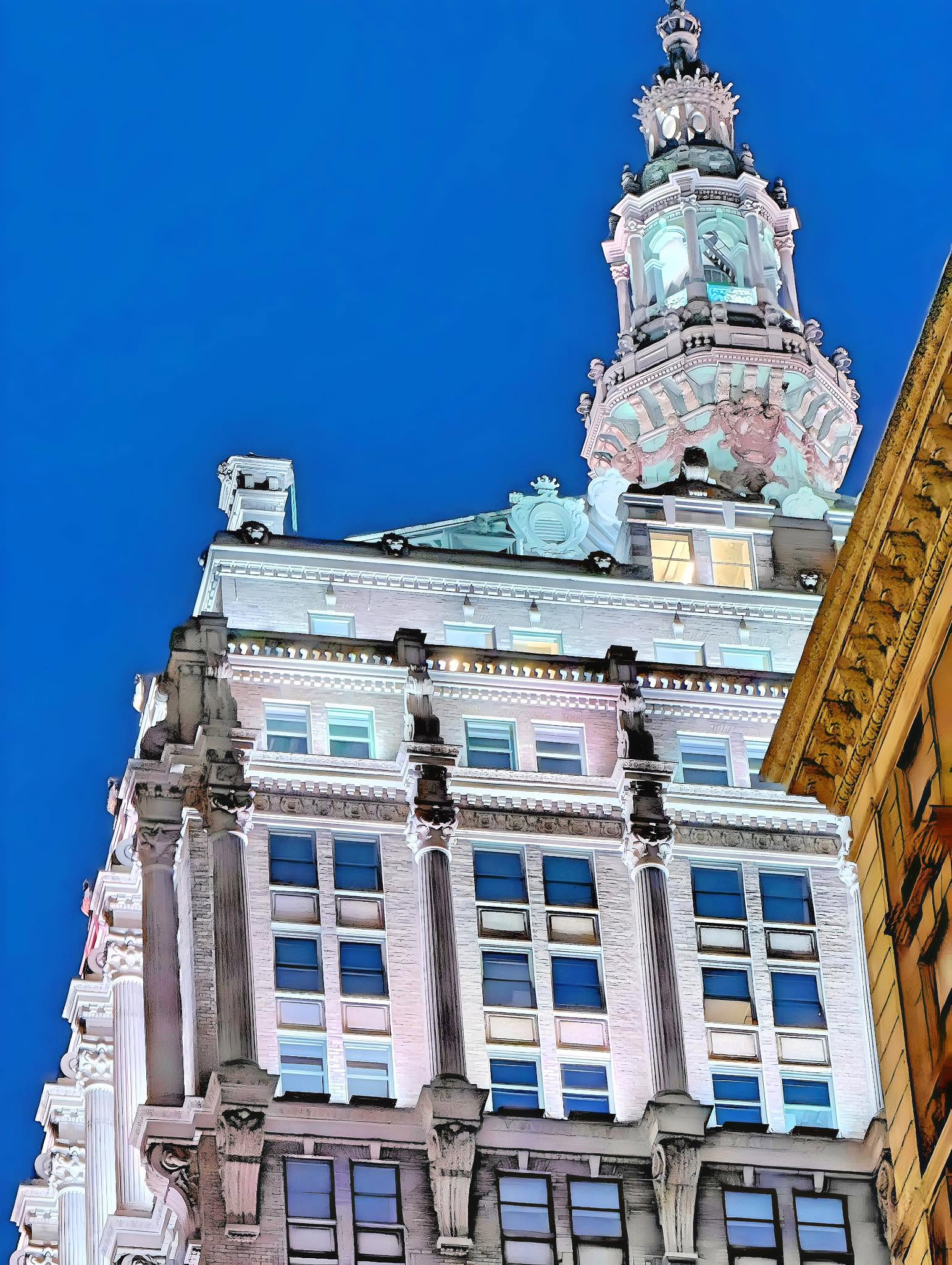
Functionally unique, the Helmsley Building carries vehicular traffic through its base: the Park Avenue Viaduct passes underneath by two portals flanking the grand lobby, a rare and striking urban design allowing uninterrupted traffic flow alongside pedestrian passageways that connect 45th and 46th Streets and Grand Central Terminal. This innovative feature reflects its origin as part of the Terminal City development—a grand urban complex built atop the buried rail yards of the New York Central Railroad, symbolizing the railroad’s dominance in early 20th-century New York.
The building’s interior boasts bronze and marble detailing with over 1.4 million square feet of office space, attracting premier tenants from law firms to fintech companies, melding historical grandeur with modern corporate functionality.
Harry and Leona Helmsley: Titans of Real Estate and Infamy
The building was renamed the Helmsley Building in 1978 after its acquisition by Harry Helmsley and his wife, Leona Helmsley, who became synonymous with New York real estate power, wealth, and wrangling.
Harry Helmsley was born in 1909 in Manhattan, New York City. He began his career in real estate as a teenager, working as a stenographer for real estate firms and rapidly rising through the ranks due to his shrewd business acumen.
Leona Helmsley (née Leona Mindy Rosenthal) was born in Marbletown, New York, in 1920 and later attended the University of New York (now New York University), where she studied accounting. They met in the real estate environment and married in 1972, combining their skills and ambitions to expand their real estate empire.
Together, the Helmsleys built an empire including office buildings, hotels, and retail properties, earning Harry a spot among the world’s richest real estate magnates, with their holdings reaching into the billions. The Helmsleys became investors and owners of iconic properties including the Empire State Building (briefly in partnership), the Helmsley Palace Hotel, and numerous commercial properties across Manhattan.
Leona garnered notoriety for her authoritarian management style, earning the nickname “The Queen of Mean.”
The Helmsley Medical Tower at NewYork-Presbyterian Hospital, opened in 1989 after a landmark $33 million donation by Harry and Leona Helmsley, is a 36-story, mixed-use building designed to provide top-tier accommodations for hospital staff, patients, and their families. Uniquely, it operates partly as a hotel, offering both short- and long-term stays in fully serviced apartments with amenities like 24-hour concierge and daily cleaning—rare among hospital residences.
The Tower is renowned for hosting not just ordinary patients but also high-profile international guests; Middle Eastern royalty and global dignitaries commonly book entire floors or executive suites during medical treatment at NewYork-Presbyterian, attracted by both privacy and rigorous security.
Discretion is paramount, and the hotel's private, service-rich environment is expressly tailored for VIPs' needs. The Helmsleys’ vision for the Tower was to make world-class healthcare accessible in comfort and seclusion, with its reputation for sheltering the world’s elite cemented soon after opening.
Helmsley Contemporaries and Intriguing Anecdotes & Styles
Among the Helmsleys’ contemporaries in the New York moneyed and elite sphere was Huntington Hartford, heir to the A&P supermarket fortune. Hartford was a billionaire art patron and real estate investor known for eccentric behaviors as well as grand estates. One famous story alleges he would take the keys of guests visiting his mansion and secretly peep through the key holes for entertainment, a peculiar sign of his eccentric personality. He was also a cultural patron, founding museums, collecting vast art, building iconic marble clad museum buildings, and much more.
The following contemporaries also loomed large on the New York scene.
Sam Zell: The self-styled “Grave Dancer” cemented his reputation by thriving on others’ failures—his favorite deals were distressed properties scorned by the market. Zell wrote the 1978 manifesto “The Grave Dancer,” describing his method as “dancing on the skeletons of other people’s mistakes.” He built a fortune starting as a student landlord, later seizing national headlines when he sold Equity Office Properties to Blackstone for $36 billion, the largest leveraged buyout at the time. Zell’s irreverence showed in his “Sam-isms” (“Liquidity equals value”) and his aversion to glamorous but unprofitable trophy assets. Not all gambits paid: his 2007 acquisition of Tribune Company led only to bankruptcy, a rare misstep for the usually sharp contrarian. Zell’s primary realm was Chicago and national markets; there were no direct major partnerships or rivalries documented with the Helmsleys.
Donald Bren: Reclusive and famously media-shy, Bren turned the Irvine Company’s massive Orange County holdings into one of the most lucrative, privately managed real estate empires in America. Unlike many flamboyant contemporaries, Bren avoided the limelight, declining interviews and keeping personal details tightly guarded. Known for meticulously planned, self-contained communities, he fostered a legacy of secrecy, rarely collaborating with New York developers.
Trammell Crow: Once called “America’s Largest Landlord,” Crow’s humility and Texas drawl belied an audacious building spree—he would give silent partners half of every project just for the experience. His firm’s rise was legendary; at the peak, Crow amassed tens of millions of square feet in properties across the US, favoring handshake deals and mentoring dozens who became industry giants. Crow had no documented dealings with the Helmsleys, focusing instead on southern and central US markets.
The Bucksbaum Brothers (Martin, Matthew, Maurice): The Iowa-born Bucksbaums shaped the American shopping mall by founding General Growth Properties. Their leap: securing a major supermarket chain as anchor tenant to guarantee traffic. This innovation sparked the shopping mall boom. While their work paralleled the Helmsleys’ in the transformation of urban retail, public records indicate no direct association between the Bucksbaums and the Helmsleys.
Peter Malkin and Alvin Schwartz: These two were indeed direct business associates of Harry Helmsley. Malkin and Schwartz partnered with Helmsley on some of Manhattan’s biggest properties, including joint ventures on the Empire State Building and other skyscrapers. Their style: reserved and prudent, acting as quiet powerbrokers behind several high-value, high-visibility New York assets. Their partnership with Helmsley was among NYC’s most notable development alliances.
Jerry Speyer (Tishman Speyer): Speyer, known for his genteel diplomacy, was crucial in shaping post-1970s Manhattan, notably co-owning Rockefeller Center. His deals were marked by savvy global capital sourcing and careful stewardship of landmark properties. Speyer’s operations sometimes competed with Helmsley’s portfolio, especially as both moved in the trophy-building space.
Fred Trump: Trump was a prominent New York real estate developer whose career spanned from the 1920s through the 1970s. He made significant contributions to the urban landscape of New York City, particularly in Brooklyn and Queens, by building and managing more than 27,000 apartments. Trump was known for leveraging government programs, such as Federal Housing Administration (FHA) loans, to construct large-scale affordable housing projects for middle-income families following World War II. Notable developments include Beach Haven and Trump Village, projects that provided homes to thousands and helped stimulate the city’s economic growth.
Trump's savvy use of construction innovations and public-private partnerships enabled him to maximize profitability while also serving the demand for postwar housing. His influence on New York's real estate sector was recognized to such an extent that, by the late 1930s, he was referred to as "the Henry Ford of the home building industry".
Sheldon Solow (Solow Building Co.): Solow’s reputation was for suing as much as building—“uncompromising” understates it. He famously developed Manhattan’s Solow Building and was known for his one-man-show approach, rarely taking on partners. Solow’s legal skirmishes with other NYC moguls are legendary, but there’s no direct evidence of collaboration or fierce rivalry with the Helmsleys.
William Levitt (Levitt & Sons): “The king of suburbia,” Levitt practically invented the modern suburb with Levittown. His mass-production methods inspired admiration and controversy (including racial covenants), but he worked in a different sphere from the Helmsleys, who were urban high-rise specialists.
Bernard Spitzer: The father of former NY Governor Eliot Spitzer, Bernard made a quieter fortune developing high-rise apartments and office buildings in Manhattan. Spitzer shunned publicity and kept to himself, his properties standing testament to his low-profile yet persistent role in shaping postwar NYC.
Figures such as the Helmsleys and Hartford and their contemporaries exemplified a distinct class of 20th-century American wealth, rooted in inheritance, real estate, and retail—often accompanied by outsized personalities and occasional controversy.
Financial Milestones and Legacy
Harry Helmsley was one of the first real estate magnates to achieve billionaire status—his portfolio spanned an array of income-producing properties throughout Manhattan and beyond. The Helmsley empire symbolized mid-to-late 20th-century New York real estate, contrasting with other titans like the Dursts and Roses.
The Helmsley Building itself symbolizes the intersection of transportation, commerce, and architectural grandeur, tracing its lineage from railroad dynasty origins to modern real estate power brokers.
Innuendos surrounding their empire—especially Leona’s reputed ruthlessness and extravagant lifestyle—continue to color their legacy as emblematic of both American capitalism’s heights and its excesses, immortalized in biographies, documentaries, and popular culture.
The Helmsley Building remains a landmark of New York City’s architectural and social history, embodying grand design and the dramatic human stories that shaped the city’s skyline and real estate world.
This synthesis draws from architectural histories, urban development records, and documented biographies of the Helmsleys and contemporaries, along with anecdotes reflecting their public images and influence.
(Photographer, Michael de la Force, LIKE Magazine, 8.4.2025)
(Michael de la Force, LIKE® Magazine, 8.6.2025)
Source post: https://facebook.com/674873899/posts/pfbid0bvbjxrRiDRwVfCjX3qkAysYQVnRdAp418GrBAQSEZJDWodAFymhJQvFWijnrHPcWl/