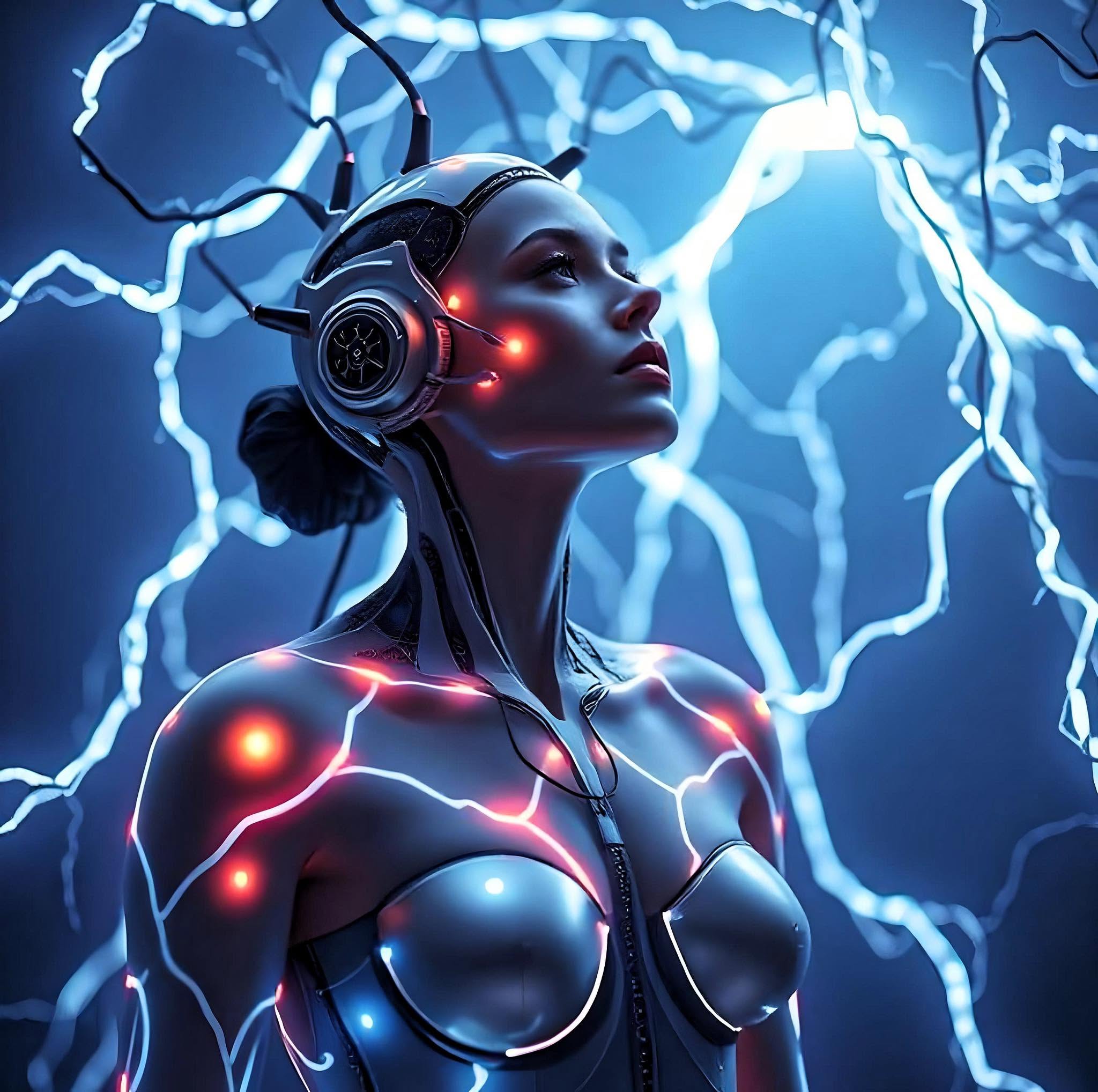
When someone claims humans are outdated compared to artificial intelligence, consider this: your brain operates on just about 12 watts of power—roughly the same as a low-wattage LED bulb. Yet, this modest energy output fuels your thoughts, memories, emotions, and imagination. In stark contrast, today’s most advanced AI models, like OpenAI’s GPT-4, can require up to 2.7 gigawatts to train—enough to power a small city (Strubell et al., 2019, @
Association for Computational Linguistics).
This staggering difference in energy efficiency has fascinated scientists for decades. Nobel laureate Sir John Eccles, who won the Nobel Prize in Physiology or Medicine in 1963, dedicated his career to understanding the electrical nature of the brain. Eccles’ pioneering research, alongside Alan Hodgkin and Andrew Huxley, revealed that neurons communicate via rapid electrical impulses called action potentials—a discovery first published in The Journal of Physiology (Hodgkin & Huxley, 1952).
The human brain contains approximately 86 billion neurons (Azevedo et al., 2009, Journal of Comparative Neurology), each firing electrical signals across trillions of synapses. This bioelectric network is so fundamental that it forms the basis of our consciousness and every bodily sensation. Dr. Christof Koch, Chief Scientist at the Allen Institute for Brain Science, has called the brain “the most energy-efficient information processing device in the known universe.”
But what happens to this electric life force when we die?
According to peer-reviewed research from the &
University of Michigan (Borjigin et al., 2013, Proceedings of the National Academy of Sciences), the moments before death are marked by a final, intense surge of synchronized brain activity—a phenomenon sometimes called the “death wave.” After this brief electrical storm, all organized neural activity ceases.
The body’s bioelectricity dissipates, and the energy is released as heat, in line with the laws of thermodynamics.
As neuroscientist Dr. Adrian Owen of Western University explains, “The electrical activity that defines consciousness is utterly dependent on living tissue. When the tissue dies, so does the electricity.”
Some have speculated about a “halo” or aura of energy around the living body. While spiritual traditions have long described such phenomena, scientific investigation offers their explanation. The human body does emit very faint electromagnetic fields, measurable with sensitive instruments like magnetoencephalography (MEG) and electroencephalography (EEG). These fields are generated by the collective electrical activity of neurons and muscles (Cohen, 1972, Science).
Major institutions like Massachusetts Institute of Technology (MIT), Stanford University, and the Max Planck Institute continue to study the brain’s electrical properties, hoping to unlock new frontiers in both neuroscience and artificial intelligence. The emerging field of neuromorphic engineering, pioneered by researchers such as Carver Mead at Caltech, aims to build computers that mimic the brain’s energy-saving design.
So, while AI may be impressive, the most advanced processor on the planet still resides inside your head—running on a handful of calories and a few watts of power, as confirmed by decades of peer-reviewed science.
(Michael de la Force, LIKE Magazine, 6.27.2025)
SOURCES:
Strubell, E., Ganesh, A., & McCallum, A. (2019). Energy and Policy Considerations for Deep Learning in NLP. Association for Computational Linguistics.
Hodgkin, A. L., & Huxley, A. F. (1952). A quantitative description of membrane current and its application to conduction and excitation in nerve. The Journal of Physiology.
Azevedo, F. A. C., et al. (2009). Equal numbers of neuronal and nonneuronal cells make the human brain an isometrically scaled-up primate brain. Journal of Comparative Neurology.
Borjigin, J., et al. (2013). Surge of neurophysiological coherence and connectivity in the dying brain. Proceedings of the National Academy of Sciences.
Cohen, D. (1972). Magnetoencephalography: Detection of the brain’s electrical activity with a superconducting magnetometer. Science.
Allen Institute for Brain Science: https://alleninstitute.org
Max Planck Institute for Brain Research: https://brain.mpg.de
(Michael de la Force, LIKE® Magazine, 6.27.2025)
Source post: https://facebook.com/674873899/posts/pfbid02Hu2A644AjaoqJ8HW3bYYaJBP7BmQEDvc9XY5GZ6zyPNnZo2o5mfLs3yif2uLB5zDl/