THE SOUNDTRACK OF A REPUBLIC
For 250 years, the United States has marked its great public moments with uniforms, flags, and music. Military bands have been present at inaugurations, state visits, funerals, homecomings, and national celebrations, turning protocol into something citizens can hear and feel.
From early fifers and drummers in the Revolutionary era to today’s premier ensembles, these musicians have carried a shared repertoire of marches, hymns, fanfares, and, at the center of presidential ceremony, one defining anthem: “Hail to the Chief.”
THE PRESIDENT’S OWN: MARINE BAND AND “HAIL TO THE CHIEF”
"The President's Own" United States Marine Band, founded in 1798, is the nation’s oldest continuously active professional musical organization and has played for presidents since the days of Thomas Jefferson, earning the title “The President’s Own.”
Under the leadership of John Philip Sousa in the late 19th century, the U.S. Marine Band helped popularize the American march tradition, including works such as “The Stars and Stripes Forever” and “Semper Fidelis,” which still anchor patriotic programs.
Marine Band musicians are selected through highly competitive auditions that resemble major symphony procedures: blind listening rounds, demanding sight‑reading, and stylistic versatility, followed by Marine Corps enlistment and training. The band has a special responsibility for “Hail to the Chief,” performing it in Washington to announce the president’s arrival at major public events and embodying the musical voice of the office.
“HAIL TO THE CHIEF”: ORIGINS, MEANING, AND TRADITION
“Hail to the Chief” began not as American political music, but as theater. Verses from Sir Walter Scott’s 1810 narrative poem The Lady of the Lake—especially the stanza beginning “Hail to the chief who in triumph advances” about the Highland chieftain Roderick Dhu—were set to music around 1812 by English musician James Sanderson for a London stage adaptation.
Scott’s poem concerns clan loyalty and conflict in the Scottish Highlands, but the music’s sense of ceremonial entrance translated easily to other contexts. In the United States, sheet music titled “March and Chorus, ‘Hail to the Chief,’ in the Dramatic Romance of The Lady of the Lake” was published in Philadelphia by 1812, and the tune, with new patriotic lyrics under the title “Wreaths for the Chieftain,” was used in 1815 at a celebration of George Washington’s birthday.
The song’s direct association with living presidents evolved over several administrations. It was played for John Quincy Adams at events in the late 1820s, and in 1829 the Marine Band performed it for Andrew Jackson at a Chesapeake and Ohio Canal ceremony, prompting enthusiastic responses that reinforced its suitability as leader’s entrance music.
By 1837, “Hail to the Chief” was heard at Martin Van Buren’s inauguration, and later first ladies such as Julia Tyler and Sarah Polk encouraged its regular use so their husbands would not enter receptions unnoticed, helping institutionalize the practice that this melody signaled the president’s arrival.
Over time, the piece came to function primarily as instrumental fanfare; although other lyric versions exist, they are rarely sung. In 1954, after President Harry Truman inquired into the tune’s origins, the U.S. Department of Defense formally designated “Hail to the Chief” as the official musical tribute to the president of the United States. Today it is usually preceded by “ruffles and flourishes,” played in a standardized band arrangement, and used at the discretion of each president.
THE ONE SONG EVERY BAND MUST KNOW
Because “Hail to the Chief” is the official presidential anthem, it is the one work that every premier U.S. military band is expected to know and perform according to strict protocol. The United States Marine Band has primary responsibility at The White House and many Washington ceremonies, but Army, Navy, Air Force, Coast Guard, and, by extension, Space Force ceremonies can also involve the piece when the president appears in their sphere.
Musicians learn not only the notes, but the etiquette: how many “ruffles and flourishes” precede the march, the exact cue for the president’s entrance, and coordination with honor guards and officials so that the music and movement align. In that sense, “Hail to the Chief” is the shared musical language that binds diverse service traditions into one sound representing the presidency.
ARMY BANDS: FIELD CALLS TO FULL ENSEMBLES
Army music began with fifes, drums, and bugles that carried battlefield commands and camp signals. Over time, those practical groups grew into a system of formal bands attached to posts, divisions, and special units, culminating in premier ensembles such as The U.S. Army Band “Pershing’s Own” and The U.S. Army Field Band.
Today, Army bands perform “The Army Goes Rolling Along,” the Army’s official song, alongside marches, hymns, classical transcriptions, and jazz. The Field Band’s touring and its sub‑ensembles have long served as public ambassadors, bringing live military music to communities across the United States and abroad.
Musicians earn positions through professional auditions comparable to those in civilian orchestras, with requirements for technical mastery, stylistic range, and ceremonial discipline. Historical accounts describe Army bands boosting morale in wartime and symbolizing American presence during postwar occupation and international exchanges.
THE NAVY BAND: THE FLEET’S MUSICAL FLAGSHIP
The United States Navy Band, officially established in 1925, stands at the center of a broader maritime musical tradition that once relied on simple shipboard calls and signals. In its modern role, it serves as the musical representative of the sea service in Washington and wherever the fleet’s ceremonial presence is required.
Its best‑known song is “Anchors Aweigh,” composed in 1906 and widely recognized as the Navy’s unofficial anthem, alongside a catalog of marches, hymns, and concert works suited to both state occasions and public performances. The Band has appeared at major national events and fleet ceremonies, supporting the Navy’s public image at home and abroad.
Selection is by audition, with sailors in the band expected to handle high‑level musical demands and the rigors of Navy service. The ensemble’s history charts the transformation from functional shipboard signals to a polished ceremonial institution that projects naval identity on land and at sea.
THE AIR FORCE BAND: MUSIC IN THE JET AGE
The U.S. Air Force Band originated in 1941 as part of the Army Air Forces and took its current name when the Air Force became a separate service in 1947. It now includes the Concert Band, Singing Sergeants, Airmen of Note, and ceremonial brass and woodwind groups, reflecting the service’s modern, multi‑ensemble approach.
Repertoire ranges from the Air Force song and classical literature to contemporary works and an especially strong jazz catalog in the Airmen of Note, descended from Glenn Miller’s wartime Army Air Forces band. Many members come from major conservatories and professional ensembles, chosen for their ability to navigate demanding scores and ceremonial responsibilities.
Over the decades, the band has toured internationally, representing American culture during the Cold War and beyond, and at home it plays a central role in ceremonies at the Pentagon, Air Force bases, and national commemorations linked to air and space achievements.
THE SPACE FORCE SONG: “SEMPER SUPRA”
The United States Space Force, established as a separate branch in 2019, joined the tradition of service songs with “Semper Supra” (“Always Above”), unveiled in 2022 as the official anthem of the Guardians. The song’s lyrics and melody were created by singer‑songwriter James W. Teachenor, a former member of the U.S. Air Force Academy Band, in consultation with Space Force leadership.
Teachenor then collaborated with chief musician Sean Nelson, a trombonist and staff arranger with the U.S. Coast Guard Band, who added harmony and orchestrated the work for more than 30 instrument parts; the arrangement was recorded by the Coast Guard Band and refined in coordination with the Space Force.
“Semper Supra” was designed to capture Space Force capabilities and values—“the mighty watchful eye” and “Guardians beyond the blue”—and now stands alongside “The Army Goes Rolling Along” and “The Marines’ Hymn” in the canon of American service songs. Because the Space Force falls under the Department of the Air Force, Air Force Bands perform the piece for official Guardian ceremonies.
THE COAST GUARD BAND AND PIPE BAND
The United States Coast Guard Band, organized in March 1925 with assistance from Lt. Charles Benter of the U.S. Navy Band, conductor Walter Damrosch of the New York Philharmonic, and former Marine Band director John Philip Sousa, is the premier band representing the Coast Guard and the Department of Homeland Security.
In 1965, President Lyndon B. Johnson signed legislation making the Coast Guard Band the permanent, official musical representative of the Coast Guard, establishing it as one of the nation’s premier service bands. Stationed at the Coast Guard Academy in New London, Connecticut, the Band has performed at venues such as the Kennedy Center, Lincoln Center, and Carnegie Hall, and at major events including the American Bicentennial.
The Coast Guard musical ecosystem also includes smaller ensembles and the U.S. Coast Guard Pipe Band, an affiliated but non‑official pipe‑and‑drum organization founded in 2002 that brings together pipers and drummers from across the service to provide traditional Scottish and maritime music at memorials and ceremonies. Together, these groups give the smallest armed service a distinctive voice in the wider military band family.
SELECTION, SERVICE, AND A SHARED CANON
Across all branches, premier band membership is a career milestone that typically involves several rounds of auditions, advanced musical training, and adaptation to military life. Players must be able to move from solemn funerals to public concerts and televised national ceremonies while maintaining the same level of precision and respect.
Together, their shared canon—from “Hail to the Chief,” “Anchors Aweigh,” “The Army Goes Rolling Along,” “Semper Paratus,” and “Semper Supra” to newer works—ties individual service histories into one national musical story. In every era, these bands have made American civic life audible, giving citizens a way to hear continuity across changing times.
SPECIAL ISSUE: 250 YEARS OF AMERICA
THIS SPECIAL ISSUE CELEBRATING 250 YEARS OF AMERICA honors the musicians who have turned public ritual into living sound. For a quarter of a millennium, military bands have helped Americans recognize the arrival of a president, the return of a unit, and the laying of a wreath, and their work continues as the republic enters its next chapter.
Whether they are playing “Hail to the Chief” for the commander in chief, “Semper Supra” for Guardians beyond the blue, or a hymn for a flag‑draped casket, they remind us that the story of the nation is not only written and spoken, but also heard.
Michael de la Force, LIKE® Magazine, 7.1.26
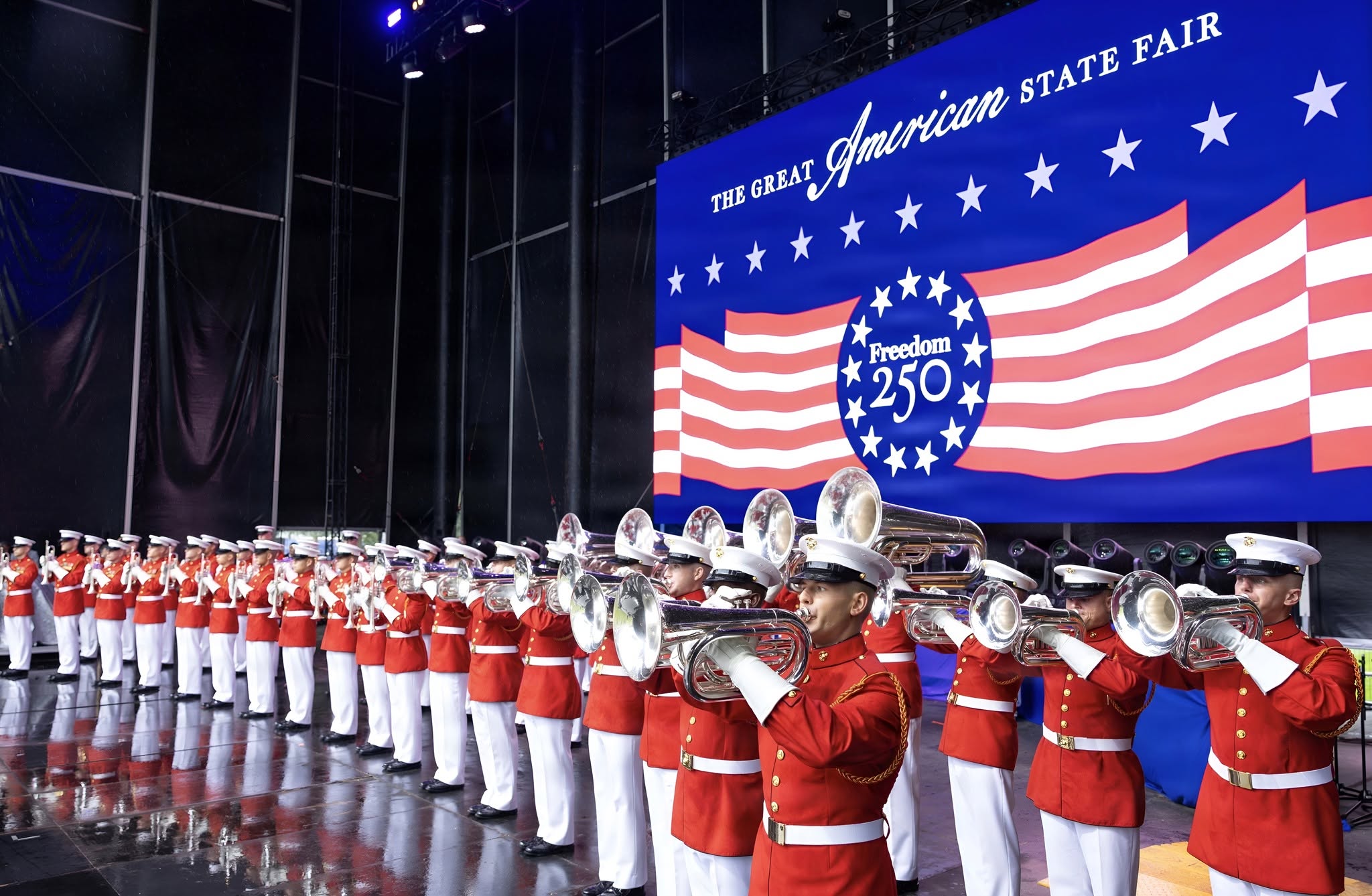
In the accompanying photograph, Marines of “The Commandant’s Own,” The United States Marine Drum & Bugle Corps, are shown performing at the Great American State Fair on the National Mall in Washington, D.C., June 28, 2026, in a ceremony marking the nation’s 250th anniversary.
Credit: Army Sgt. 1st Class Brittany Primavera VIRIN: 260628-A-BN614-9613.JPG
Insert link to "Hail to the Chief": https://www.youtube.com/watch?v=MKBVu0t3MRk
https://www.youtube.com/watch?v=MKBVu0t3MRk
(Michael de la Force, LIKE® Magazine, 7.2.2026)
Source post: https://facebook.com/674873899/posts/pfbid02qA8LqyodN5C276ZMRz7eC8vPs3ZHerirqwZkDanT8GRz7bPLTMM3RSy1pBShcBK5l/