"Nothing in life is more important than the ability to communicate effectively." — Gerald R. Ford (38th U.S. President)
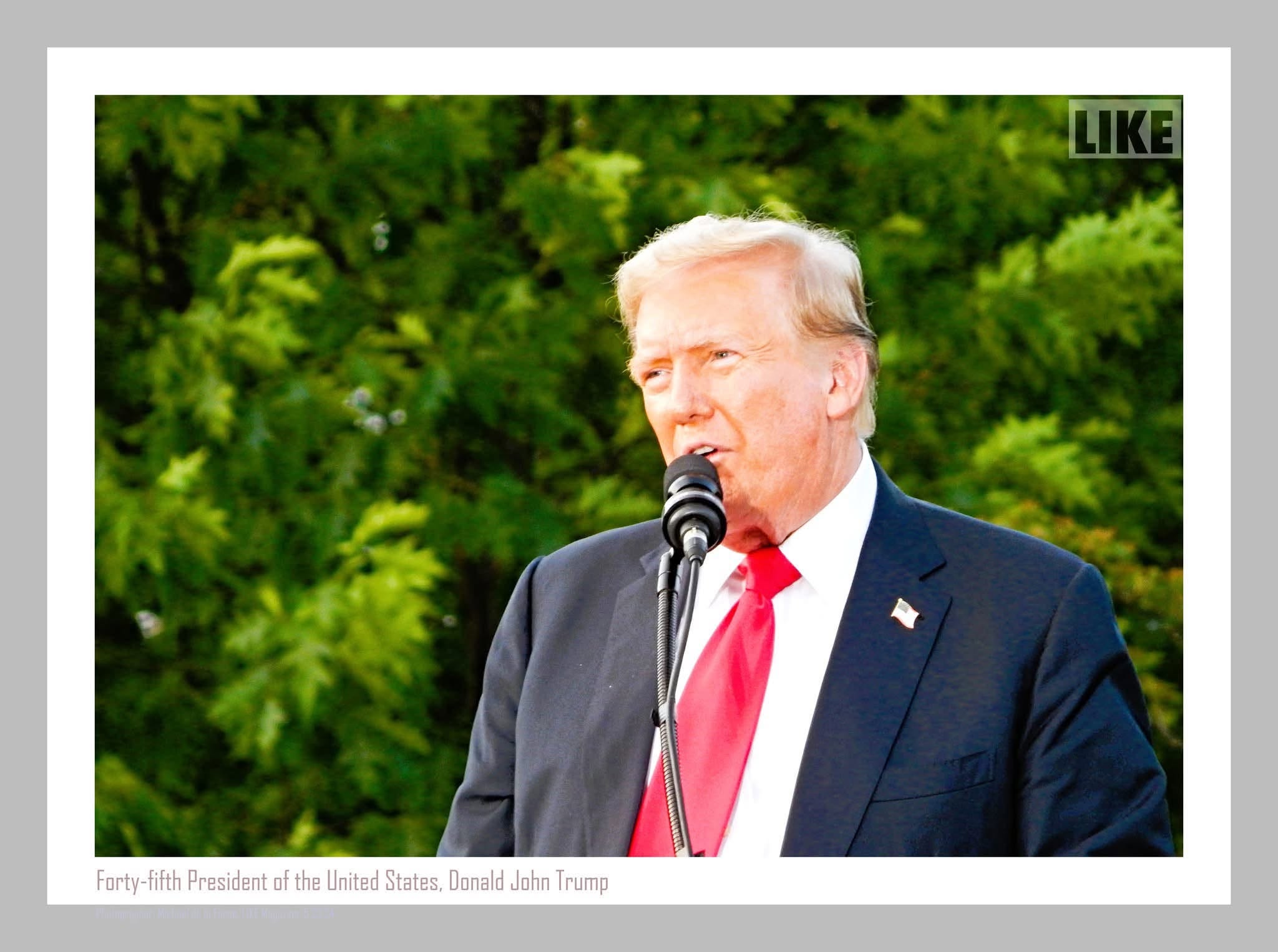
WASHINGTON — Every age of American politics has had its decisive medium, and every age has produced one leader who understood, before anyone else, that the medium was the message. Abraham Lincoln had the newspaper and the telegraph. Donald J. Trump has the feed. Separated by more than a century and a half, the 16th and 47th presidents form an unexpected pair: the two most media-conscious leaders in the nation's history, each a master of the dominant communications technology of his time, each determined to speak to the public directly, on his own terms, over the heads of the gatekeepers.
To compare them is not to flatten the differences between a Civil War president and a 21st-century one. It is to trace a single, continuous American instinct — the conviction that a leader who controls his own image and his own channel controls his own destiny — from the daguerreotype to the smartphone. Seen in that light, Trump is not an aberration. He is the culmination.
"PUBLIC SENTIMENT IS EVERYTHING"
Begin with the principle, because Lincoln stated it more plainly than any politician before or since. "Public sentiment is everything," he said. "He who molds public sentiment goes deeper than he who enacts statutes or pronounces decisions." Lincoln, the historian Harold Holzer argues, understood the mutual dependence of newspapermen and politicians better than any 19th-century figure, and for two decades he "devoted his time to visiting journalists at newspaper offices throughout Illinois, eager for their attention," according to the Civil War Monitor.
This was no passive admiration. Lincoln cultivated editors "by pampering them, hindering them, or manipulating them to change their course," and used the press "to talk directly to readers" — sometimes signing his work, sometimes submitting it anonymously, a Louisiana State University (LSU) review of Holzer's study notes. As the critic Garry Wills observed in The New York Review of Books, the partisan press of Lincoln's day "was a dirty game by later standards, and no one played it better than Abraham Lincoln."
He went further than playing the game; he bought into it. In May 1859, gambling on his own presidential prospects, Lincoln quietly purchased the type and equipment of the Illinois Staats-Anzeiger, a German-language newspaper in Springfield, turning it into a practical instrument for winning German-American voters to the Republicans cause, a University of Kansas study found. He kept the arrangement from the public. As president, when he wanted to test or turn public opinion, he had the editor John Forney run editorials on his behalf — and once had Forney convert a paper into a daily and distribute 10,000 copies to soldiers to shore up the army's loyalty, a University of Tennessee thesis documents.
President Donald J. Trump appears to operate on a similar first principle — that sentiment outranks statute — but he states it in the vocabulary of ratings and reach. Where Lincoln secretly owned a newspaper, Trump openly built a platform: after his suspension from Twitter and Facebook in 2021, he launched Truth Social through his own Trump Media & Technology Group, in which he holds a roughly 90% stake, Reuters reported. The instinct is the same — own the channel, control the message. Only the technology has changed.
THE FIRST WIRED PRESIDENT, AND THE PRESIDENT OF THE FEED
The deepest parallel lies in the tools. Lincoln was, in the phrase historians now use, "the first wired president." Shortly after his inauguration he ordered a telegraph wire strung to the War Department so he could communicate privately and instantly with his generals, the Abraham Lincoln Presidential Library and Museum records. He spent long hours — and some nights — in the telegraph office, reading dispatches and firing back brief, decisive replies, using near-real-time communication to track battles, direct commanders and project authority as no leader before him could, the History News Network notes.
Crucially, the telegraph was a media tool as much as a military one. Because the War Department seized control of the telegraph lines early in the war, Lincoln could shape the flow of information and "shape public sentiment by communicating directly with multiple interests," an LSU review observes. During the 1864 campaign he would sit with journalists to discuss the war and emancipation, knowing they would transmit his framing over the wires to Northern papers — a 19th-century version of speaking directly to the public through a new electronic network.
Trump did with Twitter what Lincoln did with the telegraph: He grasped, before his rivals, that a new network let a leader bypass the filter entirely. From the start of his 2016 campaign he "wielded his infamous Twitter account with unprecedented efficiency," blasting thousands of posts directly to millions of followers and, without spending a dollar, bypassing the media to "throw the news cycle off its axis," Boston.com reported. He posted provocations in the early morning; by the time television editors arrived at work they seized on them as headlines, so that, as BuzzFeed’s editor put it to The Guardian, his tweets functioned both as a megaphone and as "a script for the cable networks."
Over nearly twelve years Trump posted some 57,000 times, including more than 25,000 times during his first presidency, when The White House said his posts should be treated as official statements, Wikipedia records. He had, in POLITICO’s memorable assessment, become "the first gadfly president," using the platform "to govern from outside his own administration, setting its moral, aesthetic and ideological terms post by post," the magazine wrote in its analysis of the @realDonaldTrump account. Lincoln strung a wire to the War Department; Trump carried the wire in his pocket.
THE IMAGE THAT MAKES A PRESIDENT
If Lincoln understood the word, he understood the image just as well — and here the continuity with Trump is almost uncanny. Lincoln embraced photography within a few years of its invention and "made an effort to have a photograph taken whenever he did anything noteworthy," the historian David J. Kent notes. The decisive moment came on Feb. 27, 1860, when, hours before his career-making address at New York's Cooper Union, Lincoln sat for the photographer Mathew Brady.
Brady staged the picture with a craftsman's care: He posed Lincoln standing beside a classical pillar, a hand resting on books, eyes toward the horizon, and — at the last moment — asked him to pull his collar up to shorten his famously long neck, the Smithsonian’s National Portrait Gallery recounts. The resulting portrait answered the rumors that the prairie lawyer was too ugly and unkempt to be president. Reproduced as a woodcut on the cover of Harper's Weekly, printed on campaign pins and mass-produced as cartes-de-visite, the image let voters "see the presidential hopeful for the very first time," the Guardian reported. Lincoln, who did virtually no in-person campaigning in 1860, later said simply: "Brady and the Cooper Union made me President," a remark recorded by The Library of Congress and many others.
Lincoln managed his look as deliberately as his message. When an 11-year-old named Grace Bedell wrote suggesting whiskers would improve his appearance, he grew the beard that became the most recognizable face in American history — first captured in full just before his 1861 inauguration, the
National Portrait Gallery notes. He became "the most photographed American of the 19th century," with at least 130 known portraits, Wikipedia records. As one curator put it, the Cooper Union portrait was "a kind of launching point for the idea that presidents not only can, but should, take some control of their political image."
That idea reaches its fullest expression in Team Trump, who has turned a recognizable image into something like a personal brand — the dark suit, the long red tie, the silhouette legible at a glance — and who is, by the measures of his own century, the most photographed American of his age. Archive analysts place him at or near the top of the most-photographed living people, with hundreds of thousands of images in the major libraries, according to Pixsy. Where Lincoln distributed cartes-de-visite, President Donald J. Trump distributes himself across every screen on earth — but the underlying conviction, that a president must author his own image, runs straight from Brady's studio to the smartphone camera.
THE LEADER OF THE DIGITAL MEDIA AGE
For all the parallels, the scale is not equivalent, and the honest comparison says so. Lincoln worked within a partisan press he could influence but never own outright on a national scale; his networks were regional, his reach measured in print runs and telegraph wires. Trump operates a genuinely global, instantaneous, one-to-many apparatus that no 19th-century figure could have imagined. The continuity is in the instinct; the discontinuity is in the magnitude.
By the numbers, Trump's command of the modern attention economy is unmatched. A Harvard University Shorenstein Center study found he was the subject of 41% of all news stories in his first 100 days in office — three times the norm for a president, and more coverage than all 535 members of Congress combined, the Harvard report found. He generated what analysts called an "almost surreal" volume of earned media — estimated at billions of dollars' worth across the 2016 cycle, a figure The New York Times called "arguably unmatched in history." He was the most-Googled person on Earth in 2016, topping the trends in 88 countries, TIME reported, and at the 2026 World Economic Forum in Davos he drew more coverage than the next six world leaders combined, Who Won Davos found.
This is what it means to be the definitive leader of the digital media age. Lincoln proved that a president could shape sentiment through the newspaper and the wire; Theodore Roosevelt would master the bully pulpit; Franklin Roosevelt would master the radio fireside chat; John F. Kennedy would master television. Each took the dominant medium of his moment and bent it to his image. Trump stands in that line — its newest and, by the raw metrics of reach, its most dominant member — having taken the social feed, the format native to his century, and made himself its central figure.
The lesson the comparison teaches is one of continuity, not rupture. The American presidency has always rewarded the leader who understood that, as Lincoln said, public sentiment is everything — and who was willing to seize the newest tool to mold it. Lincoln strung the first wire into the White House. Trump turned the feed into a seat of power. Different technologies, the same genius for being seen and heard. From the wire to the feed, the through-line is unmistakable: the president who controls the message has always controlled the moment, and few in American history have controlled it like these two.
(Photograph: A LIKE® Magazine archive image of Donald John Trump, the 45th and 47th president of the United States, photographed by Michael de la Force)
(Michael de la Force, LIKE® Magazine, 6.30.2026)
Source post: https://facebook.com/674873899/posts/pfbid0fCDghm3kMxviLG8FSCxhAxWwPtY7TKxpPwJRvfpGk5KupKta7dRSHPhsfepgLtRl/