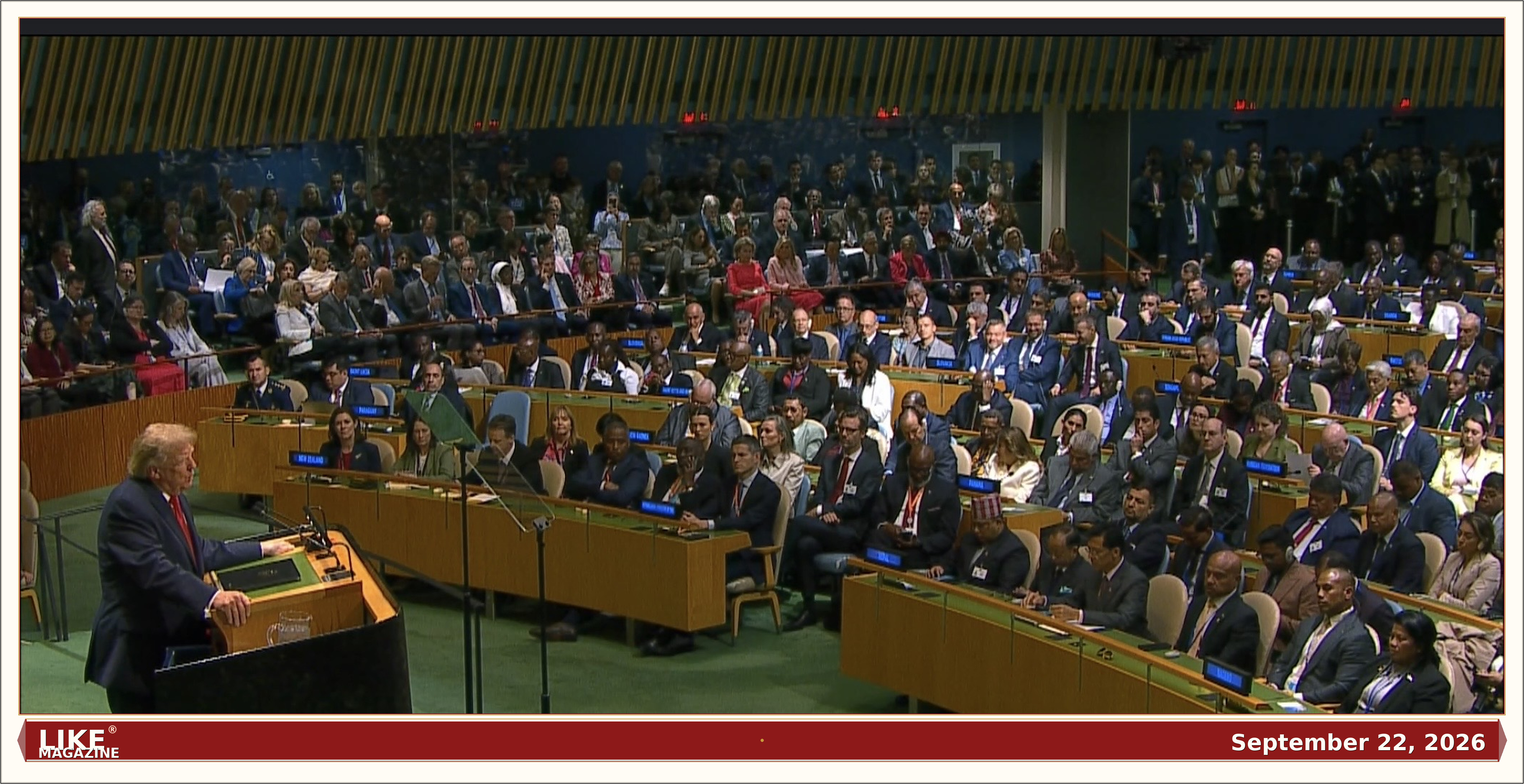
The General Assembly hall was chock-a-block. On September 22, 2026, under the 81st session’s theme — Restoring trust, managing transformation — the United States took the green marble podium and did something the room will remember for the naming alone: President Donald J. Trump put Super Intelligence at the center of the American argument about the future.
It was not a soft aside. Quoting and paraphrasing from New York Post live coverage of the speech that morning, Trump told the packed chamber that “Whoever wins ‘Super Intelligence’ wins. That’s the group that wins.” He said the United States “totally rejects any attempt to construct a globalist scheme to control” artificial intelligence — or, in the language he preferred, Super Intelligence. The word artificial, he argued, does the technology a disservice: “The use of the word artificial … makes it sound fake and it is not fake. It’s actually amazing.”
He compared the scale of what is coming to the industrial revolution and the internet, said the United States leads China “by a lot,” and sketched a domestic rather than multilateral posture: encourage Super Intelligence, watch it closely through the Department of Justice and law enforcement, and refuse international regulatory schemes. “We’re going to encourage it, not rein it in,” he said, while making clear the watching would be serious. Days earlier, Truth Social polls had floated renaming AI — Superior, Extreme, Supreme — before Super Intelligence settled into usage at the United Nations.
Before the Podium: Lula Opens the Debate
By tradition, Brazil opens the general debate after the Secretary-General and the President of the General Assembly. On this morning that meant President Luiz Inácio Lula da Silva — his tenth time opening the debate — speaking under Secretary-General António Guterres and PGA Khalilur Rahman before the American turn. Lula cast the hour as the most critical for the United Nations, spoke of “indignation,” and argued that the organization is failing to free humanity from the scourge of war and that its credibility is low. “Brazil doesn’t fit in anyone’s backyard,” he said, drawing a bright line between sovereignty and subordination.
Where Trump would later refuse a globalist AI control scheme, Lula defended regulating big tech and international governance for AI. He warned of “techno-oligarchs” seeking a digital neoliberalism without rules, and of companies shifting algorithmic risks onto families. He criticized U.S. tariffs — the “tarifaco” — argued that organized crime demands cooperation rather than aircraft carriers, defended Brazil’s PIX payment system, pressed climate, and framed Brazil’s October 4 election as democracy versus denialism. Two successive speakers, two competing theories of technology power: one international and regulatory, one national and accelerative.
Who Named Artificial Intelligence
History, for once, is precise. John McCarthy coined the term Artificial Intelligence in the August 31, 1955 proposal for the Dartmouth Summer Research Project on Artificial Intelligence, filed with Marvin Minsky, Nathaniel Rochester, and Claude Shannon. The 1956 Dartmouth workshop that followed is still treated as the founding moment of the field — the summer when a small group of researchers decided that “every aspect of learning or any other feature of intelligence can in principle be so precisely described that a machine can be made to simulate it.” McCarthy’s coinage was ambitious and clinical: artificial, because the intelligence would be engineered; intelligence, because the claim was not mere calculation. Seventy years on, a sitting American president stood in the General Assembly and said the first half of that name no longer fits what people can see.
Why Super Intelligence Sounds Different
LIKE® Magazine is not here to stump for a renaming. We are here to notice the argument. Trump’s case is plain: artificial sounds fake; Super Intelligence names ambition and capability rather than imitation. In his telling, the technology is real, amazing, and competitively decisive — bigger than the industrial revolution or the internet, an American lead to be encouraged while DOJ and law enforcement watch the edges. Whether the phrase sticks in laboratories and boardrooms is a separate question. In a chock-a-block hall on First Avenue, it already stuck as politics: a wager that language shapes which future a nation chooses to fund.
The Brighter Register
For all the edge in the technology lines, Trump closed on unity. He called on nations to stand together “against the enemies of all humanity,” spoke of a brighter, more hopeful future, of growing economies, and of standing for peace, prosperity, and justice — not merely speaking of them. He framed ambition on Super Intelligence as larger than prior technological ages, with America ahead and growth encouraged under careful domestic watch. He returned to ending the Russia–Ukraine war and to “stop the killing,” and noted new tariff and sanction authorities from Congress — the Lindsey Graham bill — if needed. A Greenland–Denmark pact for U.S. military presence was framed, briefly, as a long-term fantastic relationship; it did not dominate the Super Intelligence story, and it should not here.
On the official morning schedule, Jordan’s King Abdullah II ibn Al Hussein followed the United States, with Crown Prince Al Hussein present. At rewrite time, a published transcript of the King’s 2026 Assembly remarks was not available; LIKE® Magazine therefore records the speaking order and says nothing further about that address until the words are on the record.
What the photograph shows is simpler than the briefing books. A full house. A marble desk. A president who renamed the future in public — whether or not the laboratories follow — and a General Assembly that heard, in consecutive turns, Brazilian regulation set against American acceleration. Summit Season exists for mornings like this.
Michael de la Force, LIKE® Magazine, 9.22.26
© LIKE® MAGAZINE · ALL RIGHTS RESERVED · NEW YORK · SEPTEMBER 2026. Assembly hall photograph · LIKE® ribbon frame · Sept 22, 2026. Speech quotations and paraphrases drawn from New York Post live coverage of the UN address, Sept 22, 2026; Lula points from verified Sep 22, 2026 UNGA reporting. King Abdullah II: speaking order confirmed; 2026 transcript not published at rewrite time — no content attributed.