“Like a Coach and six—the swiftest horses must be slackened and the slowest quickened, that all may keep an even pace.” —U.S. President John Adams
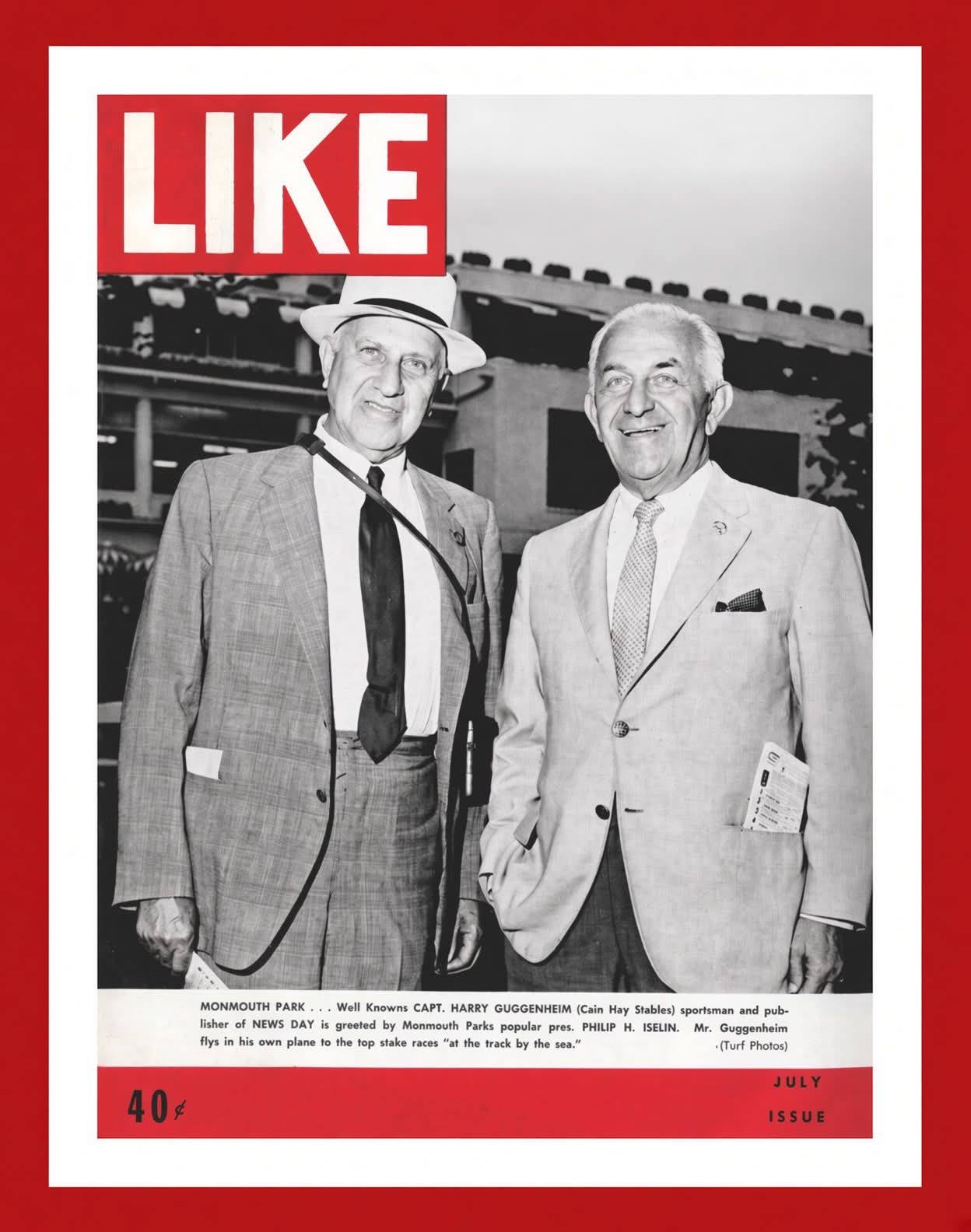
On this historic cover of LIKE® Magazine, a black-and-white photograph captures a moment of easy camaraderie at Monmouth Park. Capt. Harry F. Guggenheim of Cain Hoy Stables, publisher of Newsday and lifelong sportsman, stands beside Philip H. Iselin, the popular president of the seaside New Jersey track. Guggenheim has flown in on his own plane for the top stakes races “at the track by the sea.” The image freezes a golden era of American thoroughbred racing just as the nation approached its bicentennial and, now, its 250th year.
This cover is more than a society snapshot. It opens a window onto the immigrant roots, industrial ambition, aviation vision, and sporting traditions that helped shape the United States—and onto a sport whose origins stretch far beyond America’s shores, from ancient desert breeding and steppe empires to today’s global royal dynasties, meticulously cultivated bloodlines, sophisticated multi-continental training networks, and the quiet revolution of modern horse transport.
The Men on the Cover: Immigrant Ambition and American Enterprise Harry Frank Guggenheim (1890–1971) belonged to one of America’s great industrial dynasties. His great-grandfather Simon Meyer Guggenheim emigrated from the Swiss Jewish community of Lengnau to Philadelphia in 1847–48. Meyer Guggenheim built a mining and smelting empire that spanned Colorado, Mexico, Chile, and beyond. Harry’s father, Daniel, steered the family firm and the American Smelting and Refining Company. Harry himself served as a naval aviator in World War I, rose to captain in World War II (with combat service in the Pacific, including Okinawa), and became one of the foremost promoters of American aviation.
With his father he established the Daniel Guggenheim Fund for the Promotion of Aeronautics in 1926. The fund disbursed millions to create the first major university schools of aeronautical engineering—beginning with New York University in 1925 and extending to Caltech, Massachusetts Institute of Technology (MIT), Stanford University, University of Michigan, Washington, Georgia Tech, and others. It supported weather reporting for passenger flights, equipment loans for the first regularly scheduled U.S. commercial airline, instrument-flying research (including Jimmy Doolittle’s pioneering blind flights), and the Safe Aircraft Competition. Guggenheim sponsored Charles Lindbergh’s 1927 national tour after the Spirit of St. Louis flight and later directed significant support for Robert Goddard’s liquid-fuel rocketry research. He served on the National Advisory Committee for Aeronautics and was inducted into the National Aviation Hall of Fame. Lindbergh himself ranked Guggenheim among the two most significant aeronautical visionaries of his era. Guggenheim co-founded Newsday with his wife Alicia Patterson, owned the Cain Hoy Stable (named for his South Carolina plantation), bred and raced champions including the 1953 Kentucky Derby winner Dark Star (the only horse to defeat Native Dancer), and remained closely tied to the family’s cultural legacy, including the Guggenheim museums.
Philip H. Iselin (1902–1976) embodied a different American story. Born in Port Washington, Long Island, one of eight children of a saloon-keeper, he left school at fifteen to help support the family. After odd jobs he became a women’s-apparel salesman at twenty-one and, by twenty-five, owned his own factory. His Korell Corporation grew into a multi-company clothing enterprise that by the late 1960s generated roughly $20 million a year. In 1944 Amory L. Haskell approached him about building a new racetrack across from Iselin’s Oceanport estate, Sous Bois (“under the woods”), a 25- to 30-acre property. Iselin joined as construction chairman and treasurer of the Monmouth Park Jockey Club. After Haskell’s demise he became president and chairman. He later served as president of the New York Jets. His son James became a trainer; the Philip H. Iselin Stakes still runs at Monmouth Park Racetrack. His widow Betty later served as a vice president and director of the Monmouth Park Jockey Club, continuing the family’s deep local ties.
Together they represented the blend of old-money industrial power and self-made manufacturing success that underwrote much of postwar American racing. Guggenheim’s dual passions for flight and the turf already hinted at the technological changes that would reshape the sport, while Iselin’s informal “seaside empire” centered on Monmouth Park itself.
Monmouth Park: The Track by the Sea and Iselin’s Seaside Empire Monmouth Park first opened in 1870 near Long Branch to boost Jersey Shore tourism. A second, grander version followed in the 1890s before anti-gambling laws closed it in 1894. After a 53-year hiatus, the modern track opened on June 19, 1946, under the leadership of Haskell, Iselin, and partners including Reeve Schley and James Cox Brady. Its gardens, English-style paddock, and proximity to the Atlantic quickly earned it the affectionate title “the track by the sea” or “the resort track.”
Iselin’s influence shaped the modern Monmouth more than any other single figure after its reopening. Living directly across the road at Sous Bois, he treated the track as an extension of home. He drew no salary for the first seventeen years but built substantial ownership through bonds and stock.
As president and chairman he drove a series of innovations that made Monmouth one of the most progressive and inviting tracks in America: the first to install videotape replays of races, the first with closed-circuit color television, the first to create a Turf Club for grandstand patrons, a diagonal chute on the turf course so spectators could watch horses come straight toward them at the start, and even a swimming pool for jockeys (with Sunday family barbecues). These improvements, combined with the wooded, garden-filled setting, helped Monmouth set New Jersey attendance and wagering records and draw a substantial share of its customers from New York. The resort-like atmosphere reinforced its identity as the premier seaside racing destination.
Iselin’s “seaside empire” was personal, operational, and cultural rather than a vast real-estate conglomerate. It rested on ownership and leadership of Monmouth Park, his Oceanport estate facing the track, a string of innovations that elevated the track’s status as a stylish shore venue, and deep integration into the local and regional sporting community. The New Jersey Sports and Exposition Authority later acquired the track; the Philip H. Iselin Handicap (now the Philip H. Iselin Stakes) remains a signature race in his honor.
Racing in America: From Colonial Matches to the Triple Crown Horse racing is among the oldest organized sports in what became the United States. The first formal track appeared on Long Island in 1665. Thoroughbreds arrived with colonial elites; after the Civil War the sport boomed under elite jockey clubs. Saratoga Race Course opened in 1863, Pimlico in 1870, Churchill Downs in 1875. The first Kentucky Derby, on May 17, 1875, was won by Aristides, ridden by African-American jockey Oliver Lewis and trained by Ansel Williamson—both formerly enslaved. Black jockeys dominated the early decades: they won 15 of the first 28 Derbies. Isaac Burns Murphy won three; Willie Simms won all three Triple Crown races (though not in the same year) and popularized the modern crouched riding style. Segregation and violence later largely excluded them.
Major American tracks still define the calendar: Churchill Downs (Kentucky Derby, first Saturday in May), Pimlico (Preakness, third Saturday in May), Belmont Park (Belmont Stakes), Saratoga (August meet), Santa Anita Park, Del Mar (“where the turf meets the surf”), Keeneland, and Oaklawn Park Race Track in Hot Springs, Arkansas. Oaklawn opened in 1904–05, survived early anti-gambling pressure, and remains a key winter destination; American Pharoah used victories there on his path to the 2015 Triple Crown.
Style, Ceremony, and the 21 Club Racing has always been as much social theater as sport. At Royal Ascot (held each June since 1711), morning dress and top hats are required in the Royal Enclosure; women must wear hats with a base of at least four inches. Elaborate millinery—feathers, sculptures, dramatic brims—remains the visual signature. King Charles III and family regularly attend the carriage procession and Royal Enclosure, continuing a tradition that stretches back centuries. Kentucky Derby fashion favors equally exuberant hats and mint juleps.
In New York, the 21 Club became an unofficial shrine to the sport. Beginning in the 1930s, patrons—including members of the Vanderbilt, Mellon, and Phipps families—donated cast-iron lawn-jockey statues painted in their racing silks. Dozens lined the balcony above the entrance, a colorful gallery of ownership pride that greeted generations of diners until the restaurant’s pandemic-era closure.
Global Roots: Asia, the Steppes, and Beyond Horse culture is ancient across Asia. In Mongolia the Naadam festival (midsummer) features long-distance races of 15–30 km ridden by children on hardy native horses—living continuity with the steppe empires of Genghis Khan. The modern Mongol Derby elevates this heritage into the world’s longest and most extreme equestrian endurance race. First held in 2009 and run annually in August, it covers approximately 1,000 kilometers (620 miles) across the Mongolian Steppe over roughly ten days. Modeled directly on the long-distance postal relay system Genghis Khan established in 1224—a network of horse stations (morin urtuu) that allowed messengers to gallop vast distances by changing mounts—the Derby requires riders to swap semi-wild Mongolian horses (typically 12–14 hands, exceptionally hardy) every 35–40 km at stations managed by local herding families.
Around 1,500 horses are involved each year; each animal is ridden for only one leg and must pass strict veterinary checks (including heart-rate recovery to Fédération Equestre Internationale standards) before and after every stage. Riders (usually 30–45 international competitors) navigate unmarked terrain by GPS within a defined corridor, spending 12–14 hours a day in the saddle, carrying minimal kit (weight and height limits protect the horses), and facing rivers, dunes, mountains, extreme weather, and the mental challenge of managing semi-feral mounts.
Horse welfare is non-negotiable: overexertion brings time penalties or elimination. Often fewer than half the starters finish. The event holds the Guinness World Record as the longest multi-horse race and stands as a living test of pure endurance, horsemanship, and the extraordinary toughness of the Mongolian horse—far removed from the manicured tracks of the modern Thoroughbred world yet deeply connected to the same ancient partnership between human and horse.
Japan developed a sophisticated thoroughbred industry after Western-style racing arrived in the 1860s; the Japan Cup and other Grade 1 races now attract international stars.
Thailand’s racing tradition dates to the late nineteenth century under King Chulalongkorn, centered on the Royal Bangkok Sports Club (RBSC).
Russia and the former Soviet sphere maintained major tracks such as the Moscow Hippodrome.
Central Asian nomadic cultures preserved long-distance racing and equestrian games for centuries.
Middle Eastern Racing Dynasties The thoroughbred itself traces to three foundational stallions imported to England around 1700: the Byerley Turk, the Darley Arabian (purchased in Syria), and the Godolphin Arabian (from Yemen via France). These Oriental horses formed the genetic core of the modern breed.
Arabian and Bedouin culture had long valued the horse for endurance, speed, and status; pure desert-bred strains were carefully guarded, and Islamic traditions elevated the animal. Modern genomic studies refine the picture—showing the foundation sires likely came from broader Oriental populations—but the cultural narrative of the horse from the desert remains powerful.
Today Middle Eastern royal families are among the world’s most powerful owners and breeders. The Al Maktoum family of Dubai leads the way. His Highness Sheikh Mohammed bin Rashid Al Maktoum founded Godolphin (racing) and Darley (breeding), named after two of the foundation sires. His late brother Sheikh Hamdan built Shadwell, continued by his daughter Sheikha Hissa. The family transformed British and global racing through massive investment beginning in the 1980s, creating the Dubai World Cup in 1996 and dominating ownership championships for years. Saudi Arabia’s Prince Khalid bin Abdullah Al Saud established Juddmonte Farms.
Qatar’s Al Thani family maintains multiple powerful stables, including Al Shaqab and Wathnan Racing, and sponsors major events such as the Prix de l’Arc de Triomphe and British Champions Day.
Bahraini and other Gulf royals also invest heavily in both purebred Arabians and Thoroughbreds. These dynasties have professionalized the sport, elevated prize money, globalized competition, and continually invoked the desert heritage of the breed.
Juddmonte Farms’ Breeding Strategy Juddmonte Farms, under Prince Khalid bin Abdullah, exemplifies disciplined, quality-focused breeding. Beginning in the late 1970s, the Prince shifted from buying racehorses to building durable female families. He acquired high-class fillies and mares—foundation producers such as Slightly Dangerous (Roberto), Sookera (Roberto), Bahamian, Rockfest, and others chosen for racing ability and classic pedigrees. These families were nurtured across generations: Frankel is a fourth-generation Juddmonte homebred; Enable is a fifth-generation product. The vast majority of Juddmonte’s elite stars are homebred.
The strategy emphasized quality over quantity: a select broodmare band (later refined through careful culling to around 200), a limited roster of elite home stallions (Known Fact early on, then Rainbow Quest, Dansili, Oasis Dream, Frankel, and Kingman), and rigorous management of land and long-serving staff across farms in Britain (Banstead Manor near Newmarket), Ireland, and Kentucky. Matings were personally overseen with deep pedigree knowledge tracked in the operation’s detailed “Green Book.”
Strategic external crosses, including a foal-sharing arrangement that produced Frankel by Galileo, proved decisive. Periodic reviews and sales of underperforming stock kept the band sharp. After the Prince’s demise in 2021, the family has maintained the core philosophy while selectively introducing new blood to refresh families and supporting emerging home stallions. Recent mating plans continue to pair elite homebred mares (including Arc heroines Enable and Bluestocking) with top sires while giving strong books to Juddmonte’s own stallions. The result is more than 100 individual Group/Grade 1 winners, numerous Classics, dual-hemisphere success (including Arrogate on dirt), and one of the highest concentrations of elite performers relative to the size of the operation in the modern era.
Godolphin’s Global Training Network Godolphin’s training network is a multi-continental system designed for year-round high-level competition. Headquarters remain in Dubai, with horses in training across the UAE, United Kingdom, Australia, the United States, Japan, France, and Ireland.
Two private trainers form the core. Saeed bin Suroor, the longest-serving (since the mid-1990s), bases at Al Quoz Stables in Dubai for the winter Carnival season and at Godolphin Stables (formerly Stanley House) in Newmarket for the European summer. He has trained numerous Dubai World Cup winners (including Dubai Millennium and the dual winner Thunder Snow) and multiple British Classics. Charlie Appleby operates from Moulton Paddocks in Newmarket and Marmoom Stables in the Dubai desert (capacity around 80–84 horses, featuring a private dirt track, grass gallop, equine spas, and a water treadmill). Appleby has been Champion Trainer in Britain and delivered major international successes including Derbies and Breeders’ Cup wins. Retained jockey William Buick rides extensively worldwide for the operation.
Key bases include Dalham Hall Stud near Newmarket (coordination and breeding elements), multiple Australian properties (Kelvinside and Woodlands in the Hunter Valley, Northwood Park in Victoria), Kentucky farms (Jonabell as North American headquarters, Gainsborough, Stonerside, Raceland), Castle Park in Japan, and Kildangan Stud in Ireland. In Australia, after ending its private arrangement with James Cummings, Godolphin shifted toward placing large numbers of horses with leading public trainers including the Hayes family (Lindsay Park), Chris Waller, Ciaron Maher, Bjorn Baker, and the Freedmans. In the United States, horses race primarily with public trainers such as Brad Cox, Bill Mott, Brendan Walsh, and Eoin Harty. French runners often go to André Fabre.
The operational model features a seasonal climate-and-calendar shuttle: top European horses winter in Dubai’s milder conditions to prepare for the Carnival and Dubai World Cup, then return to Newmarket for the summer European campaign. Australian and other Southern Hemisphere seasons enable continuous racing. Horses are regularly flown between continents, supported by sophisticated logistics, quarantine protocols, and veterinary care. Facilities emphasize welfare and performance with private gallops, hydrotherapy, and recovery tools. A comprehensive Lifetime Care and rehoming program operates across major jurisdictions (UK, Australia, US, Japan) to support horses after their racing careers.
Godolphin manages hundreds of horses in active training at any time (with total stock including breeding measured in the thousands), combining tightly controlled private yards for the highest-profile runners with flexible public-trainer partnerships that expand local expertise and reach.
How Horses Fly: A Brief History of Aviation & LIKE® Magazine Cover Figure Guggenheim’s Aeronautics Role
Long before racehorses crossed oceans in climate-controlled jet stalls, the sky itself had to be conquered. The same technological leap that transformed human travel also revolutionized the Thoroughbred world, turning what had once been months-long sea voyages into routine overnight flights. At the center of America’s early aeronautical progress stood one of the two men on this cover of LIKE® Magazine: Capt. Harry F. Guggenheim. Aviator, philanthropist, and racing man, Guggenheim helped fund the schools, research, and public acceptance that made modern flight possible—and, in doing so, helped open the skies to the horse.
Human dreams of flight stretch back centuries—Leonardo da Vinci’s designs, Chinese kites, early balloon experiments. The Montgolfier brothers achieved the first manned hot-air balloon flight in 1783. Controlled powered flight arrived on December 17, 1903, when Orville and Wilbur Wright made the first sustained, heavier-than-air flights at Kitty Hawk, North Carolina. World War I accelerated military aviation. The 1920s–1930s saw the rise of commercial air travel, Lindbergh’s 1927 solo transatlantic crossing, instrument flying, and early airliners. Jet engines emerged in the late 1930s–1940s; the first commercial jetliner (de Havilland Comet) flew in 1949. Postwar expansion, the Boeing 707 era, wide-body jets, and modern freighters followed, making long-distance air cargo routine by the late twentieth century.
Harry Guggenheim stood at the center of America’s aeronautical awakening. As a combat pilot in two world wars and the driving force behind the Guggenheim Fund’s educational, research, and safety initiatives, he helped transform flight from a dangerous novelty into a practical system of transportation and scientific progress.
The History of Horse Shipping: From Ancient Seas to Modern Skies Transporting horses over long distances is nearly as old as the domestication of the horse. Ancient armies moved them by sea for campaigns; Persian forces shipped horses around 1500 BC, Byzantine and Crusader vessels developed specialized horse transports, and William the Conqueror’s ships carried horses across the Channel in 1066. Spanish conquistadors later transported horses across the Atlantic, often suspending them in slings. Conditions were harsh, with high risks of injury and mortality. On land, horses primarily walked or were ridden. For racehorses, the traditional method remained walking or riding to the track—sometimes taking weeks. The first recorded use of a purpose-adapted horse-drawn van for a racehorse occurred in 1771 with Eclipse; another early example was Sovereign in 1816. Vanning became more notable in the 1830s when Lord George Bentinck secretly transported Elis by van from Goodwood to Doncaster for the St Leger, covering about 80 miles a day and arriving fresher than walking rivals.
Railways transformed domestic movement from the 1830s–1840s. Specially padded horse cars became common in Britain and the United States; specialized companies later catered to high-value animals. International Thoroughbred transfers relied on ships for centuries. Voyages from Britain to Australia or the Americas could take four to eight months on sailing vessels, reduced with steamships. Horses were stalled on deck or in the hold, sometimes in slings, with significant risks.
Motorized vans gradually replaced horse-drawn ones after World War I. Air transport began experimentally in the 1920s. One of the earliest documented flights occurred in 1924; in 1928 the Thoroughbred Wirt G. Bowman became the first racehorse flown for racing purposes in North America. The first transatlantic air shipment of Thoroughbreds took place in 1946. By the 1950s–1960s air travel was used for Olympic teams and major international movements.
How Aviation Transformed Horse Racing—and How Horses Fly Today Aviation compressed time and distance, turning horse racing from a largely regional or continental sport into a truly global one. Before reliable air transport, international campaigns were rare and risky because of the weeks or months required. Air travel made it practical for top horses to race on multiple continents in the same season, enabled events such as the Dubai World Cup, facilitated Breeders’ Cup and Japan Cup participation, and allowed shuttle stallions to cover mares in both hemispheres. Owners and trainers could respond quickly to opportunities, and bloodlines mixed more freely. Guggenheim himself embodied the transition: he flew his own plane to tracks such as Monmouth Park.
Today elite racehorses, breeding stock, and sport horses routinely fly on cargo freighters—primarily Boeing 747 and 777 freighters, among others. They travel in “jet stalls,” sturdy aircraft-certified padded containers secured on the main cargo deck, often with one, two, or three horses per stall. Grooms and often veterinarians accompany them, providing water, hay, and monitoring. Temperature, ventilation, and humidity are controlled. A Boeing 747 freighter can carry dozens of horses. Specialized companies and major cargo airlines handle logistics, documentation, and quarantine. Sheikh Mohammed’s Godolphin operation has employed its own dedicated Boeing 747 freighter for major movements.
Horses do not travel in passenger cabins. They ride exclusively in freighter aircraft or cargo holds. Loading occurs at cargo terminals, away from passenger areas, and the animals remain inside enclosed stalls. That is why the public almost never sees a horse in a plane.
Modern Horse Transport Welfare Standards Contemporary standards prioritize minimizing stress, injury, and disease. The primary global reference for air transport is the IATA Live Animals Regulations (LAR), updated annually and recognized by the World Organisation for Animal Health (WOAH). These are supplemented by EU rules, national veterinary authorities, and industry best practices. Jet stalls must be strong enough to prevent escape, provide non-slip floors, padded partitions, adequate head clearance for balance (recommended around 21 cm above the head), ventilation, and access for grooms. Horses taller than 145 cm are typically separated. Experienced flight grooms load and monitor the animals; checks occur regularly in flight. Water and hay are provided. Fitness-to-travel certification by a veterinarian is required; fractious animals or those in late pregnancy are generally not flown. Road transport standards emphasize individual stalls for longer journeys, adequate space for balancing and natural postures, forced ventilation, temperature control, and regular watering and feeding opportunities. Pre- and post-flight quarantine, health testing, and experienced personnel remain essential. Studies show that most horses travel relatively well under modern protocols, though risks such as shipping fever persist and require careful management of every phase—from ground waits to recovery after landing. These standards have made long-distance movement far safer than the multi-week sea voyages of earlier eras, enabling the global racing and breeding networks of the twenty-first century while placing animal welfare at the center of operations.
Continuity and Celebration From the Swiss immigrant who became a mining titan, to the Long Island school-leaver who built a clothing empire and a racetrack, to the African-American jockeys who dominated the early Kentucky Derby, to the Middle Eastern sheikhs who now set the global standard through sophisticated breeding programs such as Juddmonte’s generational family-building and Godolphin’s coordinated worldwide training network, horse racing has always mirrored larger currents of migration, ambition, technology, and style. Capt. Harry Guggenheim’s dual passions for flight and the turf, and Philip Iselin’s dual roles as manufacturer and track president—his informal seaside empire anchored at Sous Bois and Monmouth Park—sit comfortably within that continuum. The same spirit of innovation that funded aeronautical schools and rocket research also helped open the skies to the Thoroughbred, replacing months of perilous sea travel with carefully managed flights that now carry champions across oceans in a single day. Meanwhile, on the open steppe, the Mongol Derby keeps alive an older, uncompromising form of endurance that links modern riders to the messengers of Genghis Khan.
As America marks 250 years, the image on the cover of LIKE® reminds us that the sport—whether at the track by the sea that Iselin helped shape, under the Twin Spires of Churchill Downs, along the Ascot Straight, across the Mongolian steppe in the Mongol Derby or at Naadam, in the carefully cultivated bloodlines of Juddmonte, through the multi-continental system of Godolphin, or in the quiet efficiency of a jet stall high above the clouds—remains a living theater of history, elegance, and human connection to the horse. The silks still fly, the hats still soar, and the next race is always just ahead.
Michael de la Force Editor-in-Chief LIKE® Magazine 250 YEARS OF AMERICA