"A day of respect for life, and if on that day anyone fires at his fellow man, let his compatriots and all the people of the planet punish him with their boundless contempt."
— Rasul Gamzatov, "The Call of the White Cranes," 1990
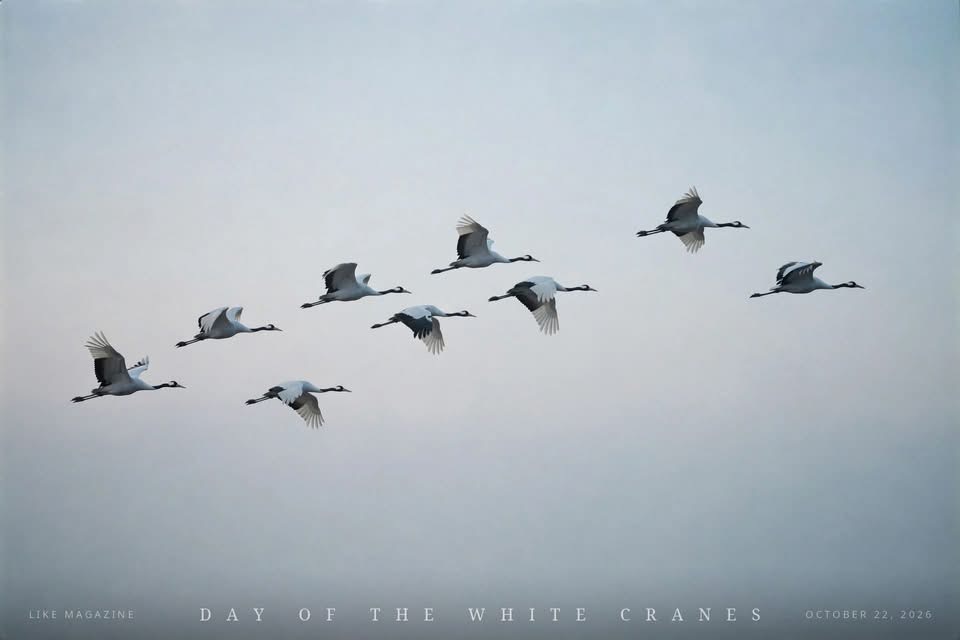
On Oct. 22, the Day of the White Cranes, the fallen are remembered beneath an image born in a Dagestani poem and a Hiroshima hospital room, one that now stands in stone and bronze from Saratov to Seattle.
I sometimes think that riders brave,
Who met their death in bloody fight,
Were never buried in a grave
But rose as cranes with plumage white.[…]
Across the weary sky they race,
Who friend and kinsman used to be,
And in their ranks I see a space –
Perhaps they're keeping it for me?One day I'll join the flock of cranes,
With them I shall go winging by
And you, who here on earth remain,
Will hear my loud and strident cry.
"Cranes," by Rasul Gamzatov, written in Avar; Russian version by Naum Grebnev; English translation by Peter Tempest.
Every Oct. 22, those verses open ceremonies across Russia and its Caucasus republic of Dagestan: flowers laid at war memorials, lessons in classrooms, children folding paper cranes as the poem is read. It is the Day of the White Cranes, a day of memory for soldiers who fell in battle, and it began with a poem that refused to let the dead stay buried.
The poet and the cranes
Rasul Gamzatov (1923-2003), the national poet of Dagestan, a mountainous republic of many languages, wrote in his own: Avar. He composed "Cranes" in the mid-1960s (scholars now date the original to about 1965), and it reached the world through Naum Grebnev's Russian version, published in the journal Novy Mir in 1968. In the original, the fallen are dzhigits, the horsemen of the Caucasus. For the famous song, with the poet's consent, they became simply soldiers, and the poem belonged to everyone.
The image came to Gamzatov in Japan. In Hiroshima he stood before the Children's Peace Monument and heard the story of Sadako Sasaki and her paper cranes, a memory that stayed with him for months. On the same journey, word reached him that his mother had died. Flying home, he thought of the Japanese girl, of his mother and of his older brothers, Magomed and Akhilchi, who never came back from the war. That is why, as the UNESCO Courier's profile of the poet puts it, the cranes in his poem are Avar, Russian and Japanese at once.
The actor and singer Mark Bernes, dying of lung cancer, asked composer Yan Frenkel to set the poem to music, edited the words himself and recorded the song in a single take in July 1969. He died about five weeks later, on Aug. 16, and the recording was played at his funeral. Frenkel called it Bernes' true swan song. Bernes felt the poem's center personally: "There is a small empty spot in the crane flock," he said. "Maybe it is reserved for me." The song made "Cranes" the unofficial anthem of Soviet and Russian war remembrance. It is sung at memorials to this day, its wedge of cranes as familiar in Russia as the poppy is in Britain.
The girl who folded a thousand cranes
Sadako Sasaki was born in Hiroshima on Jan. 7, 1943. On Aug. 6, 1945, at age 2, she was at home less than 2 kilometers from the hypocenter when the atomic bomb fell. The blast threw her out of a window; her mother found her alive and seemingly unhurt. She grew up strong, a runner and the fastest in her class. Then, in November 1954, swellings appeared on her neck. By February 1955 she was in the hospital with leukemia, the "atom-bomb disease," and doctors gave her a year at most.
In August 1955 her best friend, Chizuko Hamamoto, brought her a crane folded from gold paper and told her the old Japanese legend: Fold 1,000 origami cranes (senbazuru), and the gods will grant a wish. Paper was scarce, so Sadako folded whatever she could find: medicine wrappers, scraps begged from other patients. Her brother Masahiro hung the finished cranes above her bed. Her documented wish, recorded by Hiroshima Prefecture, was the simple one: She folded, praying for her own recovery.
How many she finished became a story of its own. The version the English-speaking world knows comes from Eleanor Coerr's 1977 children's book "Sadako and the Thousand Paper Cranes." In it, Coerr, a Canadian-born writer, has Sadako die at 644 cranes and her friends complete the thousand and bury them with her. Her family says that is not what happened, and the Hiroshima Peace Memorial Museum's own exhibit backs them: Sadako reached her thousand by the end of August 1955 and kept folding, some 300 more. The museum counts more than 1,300 cranes in all; her family has put the total near 1,400. She died Oct. 25, 1955, at 12, having finished her thousand and gone past it.
Her classmates would not let the story end in that hospital room. Two weeks after her death, the children of her class at Noboricho school launched a campaign for a monument to Sadako and to all the children killed by the bomb. They printed 2,000 flyers and carried their appeal to a national conference of school principals, and it spread across Japan and overseas: More than 3,100 schools in Japan, along with schools in nine other countries, contributed. Donations reached 5.4 million yen by the end of 1956 and 5.8 million yen by the unveiling. On May 5, 1958, Children's Day, the Children's Peace Monument was unveiled in Hiroshima Peace Memorial Park: a bronze girl standing high on a granite dome, holding a golden crane above her head, a boy and a girl at her sides. On the stone below, in words chosen from the children's own proposals, is the vow the whole monument makes:
"This is our cry. This is our prayer. For building peace in this world."
The cranes never stopped coming. Hiroshima Prefecture estimates that as many as 10 million paper cranes are offered at the monument every year, sent by children and strangers from every corner of the Earth: a 12-year-old's wish still arriving by the ton, three generations on.
The day no one would fire
The poem itself says nothing about laying down arms. It is an elegy, not an appeal. A day on which no soldier fires on another was Gamzatov's idea in prose, set down a quarter-century after the poem in his 1990 essay "The Call of the White Cranes."
In the essay he asks the question outright: "Can war really have no days off? Can the bloodshed on the planet not be stopped for at least one day?" Then he records his answer. "This gave me, too, the right," he wrote, "to turn to the Director-General of UNESCO, Mr. Federico Mayor, with a proposal to establish on the planet a Day of Memory." The rest of that proposal, the lines that open this story, asked for a day of respect for life, guarded only by the world's contempt for anyone who broke it.
No army would enforce it and no treaty bind it: only shame, universal and immediate, before the whole species. Gamzatov wrote that Mayor answered in support. UNESCO never took the further step of establishing the day. A claim carried in Russian popular accounts, that UNESCO proclaimed the observance in 2009, has no counterpart in UNESCO's records. The Oct. 22 observance itself is older than the appeal: It began in Dagestan in 1986, and the 1990 essay proposed carrying a Dagestani day of memory to the whole planet.
UNESCO stands in the story a second way: The Hiroshima Peace Memorial, the Genbaku Dome, was inscribed on UNESCO's World Heritage List in 1996.
Canada's part in the story is told in paper and print. No Sadako monument stands in Canada. Eleanor Coerr, who carried the story to the world's classrooms, was born in Kamsack, Saskatchewan, and her book is taught in many Canadian schools. At the Canadian Museum for Human Rights in Winnipeg, Manitoba, visitors, staff and volunteers folded 1,000 origami cranes into a mobile and presented it, in Sadako's honor, to the Japanese Cultural Association of Manitoba.
Memorials around the world
The day and its two stories have set down stone, bronze and paper across the world:
Hiroshima, Japan. The Children's Peace Monument (1958) remains the heart of it, in the park where the Genbaku Dome stands. Inside the monument hangs a bell bearing a bronze crane, given by Nobel laureate Hideki Yukawa and inscribed "A Thousand Paper Cranes" and "Peace on Earth and in the Heavens." The Hiroshima Peace Memorial Museum preserves cranes Sadako folded with her own hands, some from medicine wrapping paper.
Gunib, Dagestan. The first great White Cranes memorial in Dagestan: 27 meters of white marble raised to the 1,340 men of Gunib who did not return from the war, opened Aug. 6, 1986, with Gamzatov, Grebnev and Frenkel standing together before it. That unveiling is the fountainhead of the Oct. 22 observance: The festival of the White Cranes began in Dagestan that year and spread across Russia.
Saratov and St. Petersburg, Russia. In Saratov's Victory Park, three 40-meter pylons lift a wedge of 12 cranes flying west. The memorial was completed in 1982, before the Dagestan unveiling, and its stone remembers more than 300,000 Saratov men who never came home. St. Petersburg's Nevsky "Cranes" memorial opened in 1980. The Rasul Gamzatov Foundation counts more than 200 White Cranes monuments built on Gamzatov's cranes, in Russia and beyond.
Seattle. Peace Park was dedicated Aug. 6, 1990, the 45th anniversary of the bombing. Quaker peace activist Floyd Schmoe built it with the Hiroshima peace-prize money he had been awarded. At its center stood Daryl Smith's life-size bronze of Sadako holding a crane aloft. Vandals sawed off its arm in 2003, and donations from around the world restored it. In July 2024 the statue was cut off at the ankles and stolen, apparently for its bronze. Seattle's Japanese American and Quaker communities mourned it publicly. The statue was never recovered. A new sculpture by Seattle artist Saya Moriyasu, mounted on the original bronze feet, is funded in the city's 2026 budget and is reported set for unveiling Aug. 6, 2027. A second casting, "The Peace Child of Hiroshima" (1991), stands at the University of Utah in Salt Lake City.
Santa Barbara, California. The Sadako Peace Garden, created by the Nuclear Age Peace Foundation at La Casa de Maria, was dedicated Aug. 6, 1995, the bombing's 50th anniversary, and holds a Sadako Peace Day every Aug. 6.
West Hollywood, California. The Russian Veterans Memorial in Plummer Park (2005), funded largely by Los Angeles' association of World War II veterans, bears three white cranes and four lines of Gamzatov's poem in Russian and English. The Dagestani poet stands guard, in granite and verse, over Russian-speaking veterans buried far from home.
Wherever her cranes now rest. In recent decades, Sadako's family has given her tiny surviving originals to places of memory around the world so her wish keeps traveling. On Sept. 21, 2013, one crane, folded from medicine paper and barely a centimeter long, went on display at the Pearl Harbor Visitor Center, beside the USS Arizona Memorial. The site of the battleship sunk by Japanese aircraft in 1941 now displays the crane of a girl killed by an American bomb in 1945. Clifton Truman Daniel, grandson of the president who ordered that bombing, helped arrange the ceremony, and Arizona survivor Lauren Bruner attended. Other cranes rest with the 9/11 Tribute Museum in New York (2007), now in the collection of the New York State Museum in Albany; at the Harry S. Truman Library (2015); at the Japanese American National Museum in Los Angeles (2016); and at the Austrian Study Center for Peace and Conflict Resolution in Stadtschlaining.
Today
So today, Oct. 22, the ceremonies run their course: flowers at Gunib and Saratov, poems in Dagestani and Moscow classrooms, where the day now also honors the poem's living bird, the Siberian crane, a species that nests only in Russia and numbers only a few thousand in the wild. In Hiroshima, paper cranes are gathered by the millions, as they are every week of the year. And somewhere above it all, in Gamzatov's imagination, the formation passes with one space still open in its ranks: the space the dying Bernes thought might be his, the space the poem leaves, with terrible gentleness, for each of us.
The day Gamzatov asked for, one day planetwide on which no one fires at his fellow man, was never proclaimed. But every Oct. 22, in the laying of flowers and the folding of cranes, everyone who stops to remember observes it anyway, in miniature. The cranes are still calling.
The poem's last promise is that the fallen call our names. The monument's vow is plainer, and it belongs to the children: "This is our cry. This is our prayer. For building peace in this world."
(Michael de la Force, LIKE Magazine, 10.22.26)