New York City, August 8, 2026 | How an Immigrant Stonemason’s Son, a Beauty Queen on a LIKE® Cover, Nine Vietnam Christmases, Marilyn Monroe in the Snow, Operation Holly Logistics, and a Lifetime of Bob Hope USO Stages Turned Laughter into National Service
“The best way to find yourself is to lose yourself in the service of others." —Mahatma Gandhi
Bob Hope’s status as the ultimate USO volunteer was so deeply ingrained in American culture that it became a running joke at the highest levels of government. On November 2, 2001, President George W. Bush welcomed USO leaders to The White House to thank them for supporting troops deploying after 9/11. Looking out at crooner Wayne Newton, who had just stepped up to lead the USO’s celebrity recruitment efforts, Bush drew laughs from the East Room crowd by referencing Hope’s unrivaled multi-decade tenure: “I don’t know whether or not you spent much time with Bob Hope before you took the assignment,” Bush joked, “but this job has got a 60-year term limit to it.”
They called Hope the one-man morale machine.
For more than half a century, Bob Hope packed a golf club, a monologue, and a suitcase full of punch lines and carried them into the loneliest corners of American military life. Desert airstrips, jungle clearings, hospital wards, carrier decks—wherever the troops were, Hope somehow showed up. Fifty-seven USO tours. Nine consecutive Christmases in Vietnam. An estimated ten million service members who heard “Thanks for the Memory” live. No other entertainer ever came close. As the nation marks 250 years, his story feels less like show-business nostalgia and more like a chapter of the American experiment itself: an immigrant kid who turned laughter into a form of national service.
The Kid from Eltham Who Became Bob Hope Leslie Townes Hope arrived in the world on May 29, 1903, in Eltham, a quiet London suburb, the fifth of seven sons born to stonemason William Henry Hope and Avis Townes Hope. Avis, whose roots reached into Wales, was an amateur singer with a gift for turning household chaos into entertainment. William’s work was steady only in its unsteadiness. In 1907 he followed two brothers to Cleveland. The rest of the family—Avis and the boys—followed in 1908, crossing third-class on the steamship Philadelphia and stepping onto Ellis Island on March 30. They settled in the rough-and-tumble Doan’s Corners neighborhood, living for a time above a plumbing shop. William eventually helped carve the monumental Guardians of Traffic on the bridge that would later bear the Hope name. Money was tight. Avis took in boarders. Young Leslie sang, danced, impersonated, and boxed briefly under the name “Packy East.” He left school at sixteen, worked odd jobs, and slowly transformed from Leslie to Lester to the breezy, American “Bob.”
By the late 1920s Bob was a polished vaudeville performer. Broadway noticed. Radio made him a star. The Pepsodent Show turned him into a household name. Paramount signed him, and in The Big Broadcast of 1938 he introduced the song that would become his signature: “Thanks for the Memory.” Then came the Road pictures with Bing Crosby—Road to Singapore (1940), Road to Zanzibar (1941), Road to Morocco (1942), Road to Utopia (1946), Road to Rio (1947), Road to Bali (1952), and The Road to Hong Kong (1962). The films were loose, improvisational, cheerfully anarchic, and hugely profitable. Hope hosted or co-hosted the Academy Awards a record nineteen times, turning the evening into something closer to a standing nightclub act. He never won a competitive Oscar, but the honorary awards and the Congressional Gold Medal said what the industry already knew: he had become part of the country’s furniture.
The Hopes adopted four children—Linda, Anthony, Nora, and Kelly—and built a private life that somehow coexisted with an almost nonstop public one. Dolores Hope, a singer of real talent, remained his partner for nearly seven decades.
Fairways, Flying Saucers, and the Art of Living Large Hope’s love affair with golf was pure and lifelong. He played constantly, often with presidents and generals, and turned the Bob Hope Desert Classic into a major PGA tour stop that raised millions for charity. The game suited him: competitive without being grim, social without being soft, and always ready for a one-liner between swings.
His houses told the same story of restless American appetite. The longtime Toluca Lake estate began as an English Traditional design by Robert Finkelhor and was later transformed by John Elgin Woolf into pure Hollywood Regency—sprawling grounds, guest houses, a private one-hole golf course, pools, and walls lined with photographs of presidents, co-stars, and the troops he had entertained. In Palm Springs the Hopes hired John Lautner, the visionary who had apprenticed with Frank Lloyd Wright. The result, finished around 1979–80, is a 23,000-plus-square-foot hillside spectacle often compared to a spaceship or a volcano. A vast undulating roof and a 60-foot oculus pour desert light into the interior. When Hope first saw the model he deadpanned, “Well, at least when they come down from Mars they’ll know where to go.” The collection inside was personal rather than trophy-driven: paintings, photographs, memorabilia.
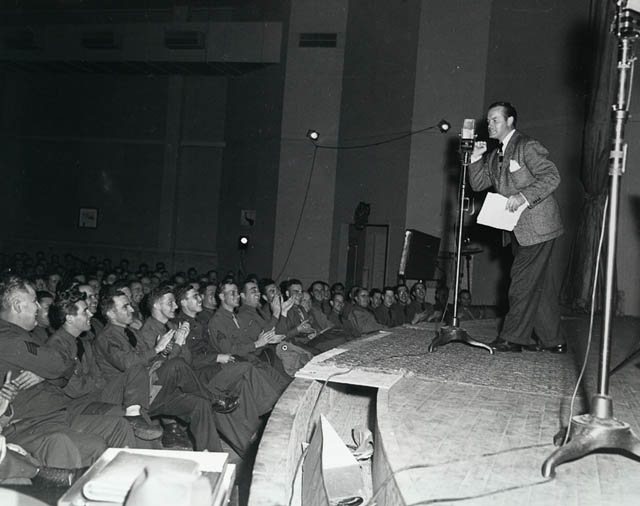
How the One-Man Morale Machine Got Started The United Service Organizations (USO) was created to keep service members connected to home. From the beginning, entertainers answered the call. Hope’s first USO appearance came in May 1941 at March Field, California—months before Pearl Harbor. He never really stopped. The wartime Camp Shows system gave stars a structure; Hope turned it into a personal mission. He brought monologues tailored to local slang and commander nicknames, songs, beauty queens, athletes, and a closing “Silent Night” that could silence a restless crowd of thousands. Other performers followed their own paths. Al Jolson, Mickey Rooney, Errol Flynn, Jane Russell, and dozens more reached the front in World War II and Korea. But no single independent tour matched the lightning strike of Marilyn Monroe's four days in Korea in February 1954.
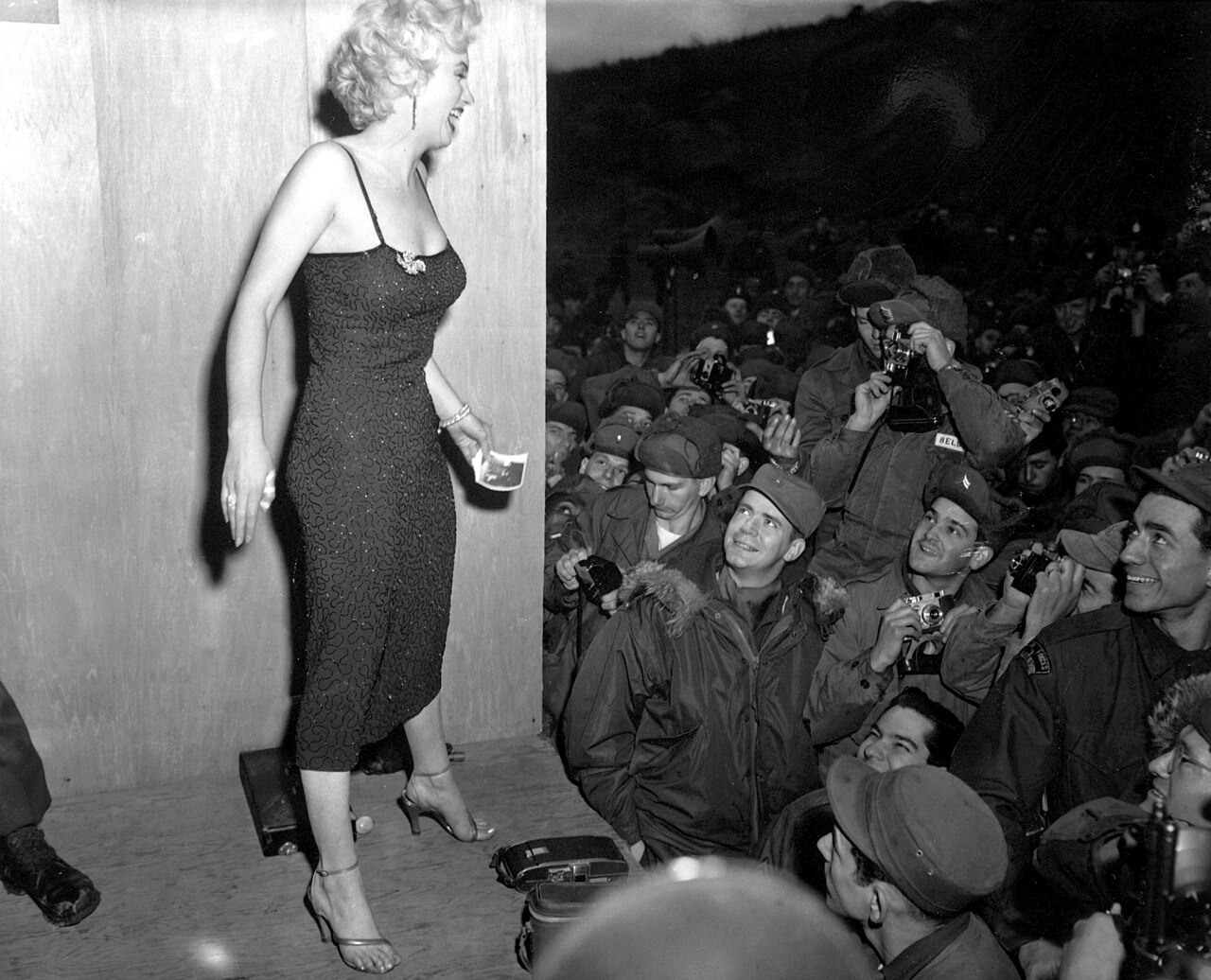
Marilyn Monroe’s Whirlwind Newly married to Joe Dimaggio and honeymooning in Japan, Monroe accepted a last-minute invitation. On February 8 she received official USO clearance under the name Mrs. Norma Jeane DiMaggio. After quick rehearsals and the required shots, she flew to Korea on February 16. In four days she performed roughly ten shows for an estimated 100,000 troops—Marines in the mountains, the 2nd Infantry Division at the Bulldozer Bowl, Air Force bases at Chuncheon and Taegu. She opened with “Diamonds Are a Girl’s Best Friend,” followed with “Do It Again” (sometimes softened to “Kiss Me Again” to keep the crowd from storming the stage), and worked in cocktail dresses while soldiers shivered in parkas. At one show she stepped out, started singing, stopped, and said, “That’s not what you came to see,” then peeled off her heavy coat. The reaction was volcanic. Years later she still called it the best thing that ever happened to her: “I never felt like a star before in my heart.”
Hope’s own troupes over the years included Jerry Colonna, Les Brown and His Band of Renown, Anita Bryant, Joey Heatherton, Raquel Welch, Ann-Margret, Phyllis Diller, Lola Falana, Connie Stevens, Rosie Grier, Jill St. John, a rotating cast of Miss World titleholders, and the Golddiggers. They did more than entertain. They interrupted the long silence of deployment.
Korea and the Long Road to Vietnam Hope first reached the Korean theater in 1950, performing at Wonsan and Seoul while the fighting still raged. Legend has him arriving at Wonsan ahead of the Marines and cheerfully welcoming them to “our invasion.” He returned in 1962 with Lana Turner, in 1968 with Ann-Margret, and again in 1970 and 1972, keeping the tradition alive for the large American force that remained after the armistice.
Then came Vietnam.
Operation Holly: Nine Christmases and the Logistics of Laughter
From 1964 through 1972 Hope led nine consecutive Christmas tours into Vietnam and Thailand under the military designation Operation Holly (Operation Jingle Bells in 1971). Planning began nearly a year in advance. A dedicated project office inside U.S. Army Vietnam handled site selection, security, transportation, communications, and construction. Hope’s writers received “Advance Information Sheets” filled out by base commanders—local slang, nicknames, troop moods—so the monologues landed.
The itinerary was relentless. 1964: Biên Hòa on Christmas Eve, Vinh Long on Christmas Day (about 400 troops in the Delta), Pleiku, Nha Trang, Da Nang. Later years added Cu Chi, Long Binh, Bear Cat, Camp Enari, Cam Ranh Bay, Chu Lai, Phu Cat, Freedom Hill, Tan Son Nhut, and carrier decks including the Ranger, Coral Sea, Hancock, and New Jersey. The final show came at Tan Son Nhut on December 24, 1972, before roughly 5,000 troops.
A typical troupe numbered 70–78 people and carried 15,000–20,000 pounds of gear. Strategic airlift used C-141s; in-theater movement relied on C-130s (one for passengers, one for equipment, one spare) and fleets of Hueys and Chinooks. Bangkok served as the usual staging hub. Ground support was staggering. After-action reports record thousands of man-hours at a single site—3,800 local-national hours and 6,641 troop hours at one Long Binh show alone, plus materials and funds exceeding $8,700. Stages needed generators, lumber, plywood, sandbag seating, band risers, and signal support. Setup and strike times were chronically optimistic; experienced crews often needed two full hours to set and ninety minutes to tear down.
Security was treated like the defense of a high-value target. Plans were frequently classified “Close Hold.” Times and locations stayed secret until the last possible moment. Color-coded access passes changed design every year. Sites were swept, gunships orbited, dual stages were prepared to confuse attackers, and the ratio of perimeter security to audience could approach one-to-one. Hope joked that he was frisked so often he was beginning to enjoy it. The shows themselves were never successfully hit.
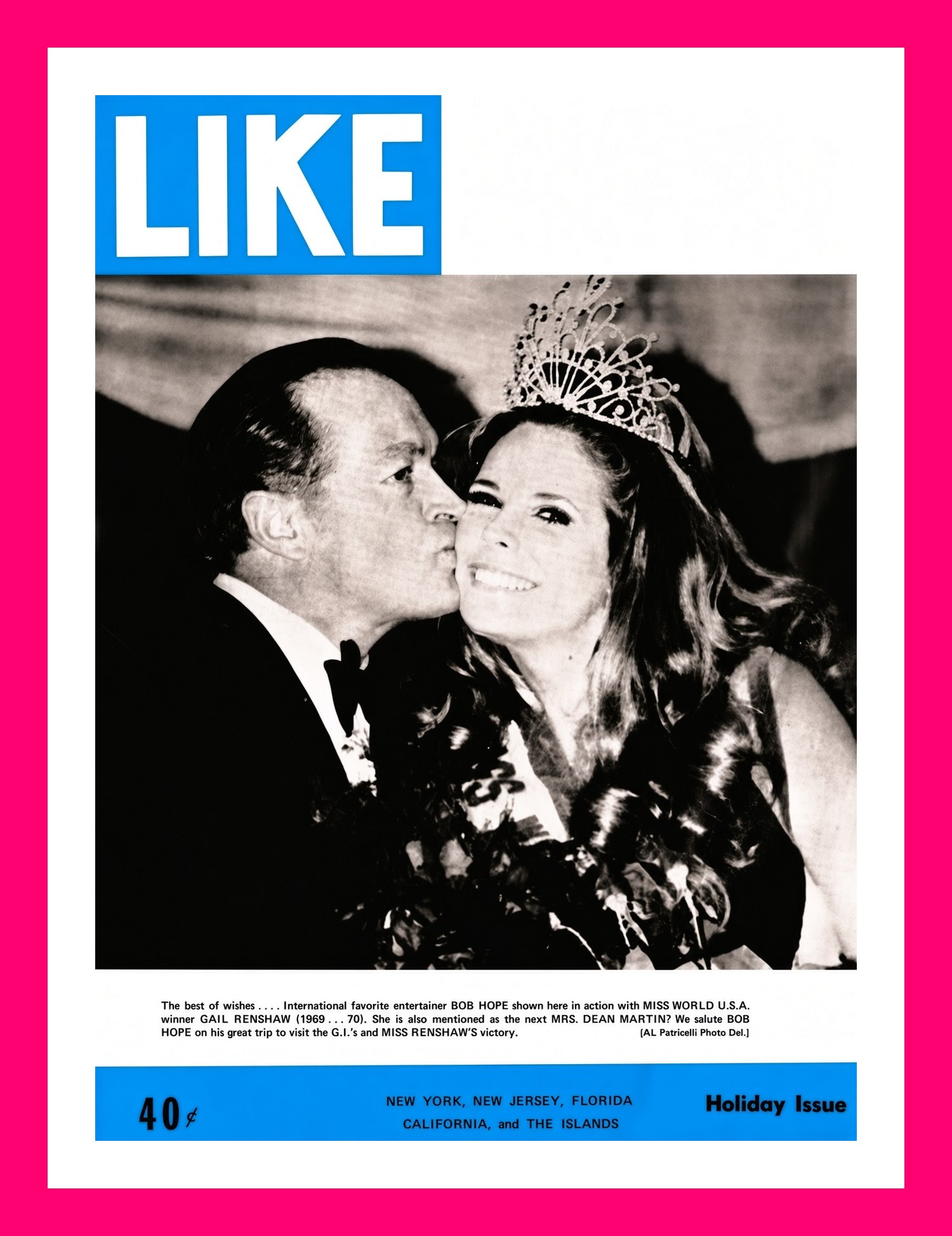
Christmas on the Home Front While Hope was overseas, American living rooms received the next best thing. His Christmas specials became national rituals: opening monologue, sketches, musical guests, and a closing segment that remembered the troops. When he was in Vietnam, film crews sent footage home; the same faces and stages that troops had seen in person appeared on network television. Multi-generational families treated the broadcasts as appointment viewing. The phrase “a Bob Hope Christmas” entered the language. Holiday albums and recorded specials extended the same easy, reassuring voice into the stereo era. A classic LIKE® Magazine cover—Hope leaning in to kiss Miss World U.S.A. Gail Renshaw—captured the blend of old-school star power and contemporary glamour that defined both the specials and the USO stages.
The Work Continues Hope liked to say he hated war but admired the people willing to fight when they had to. Laughter, he believed, was a precious commodity at the front. The long line of entertainers who followed him proved the point.
The USO remains a private 501(c)(3) organization, not a government agency. It operates more than 250 centers worldwide and depends on private support.
Readers of LIKE® Magazine who want to keep the tradition alive have clear options: Online: uso.org/donate Donation hotline: 1-800-876-7469 or 1-877-USO-GIVE General information: 1-888-484-3876 Mail: United Service Organizations, P.O. Box 96860, Washington, DC 20077-7677 Vehicle donations: 888-578-4288 or 855-500-RIDE Planned giving: plannedgiving@uso.org or 703-579-0845 Funds support entertainment, family connections, and the practical programs that still meet service members where they are.
Two hundred fifty years after the Declaration, the American story still has room for the immigrant stonemason’s son who became a comedian, the comedian who became the one-man morale machine, and the quiet understanding that sometimes the most useful thing you can send to the front is a well-timed joke and the sound of home. Thanks for the memories—and for the work that is not yet finished.
Michael de la Force Editor-in-Chief LIKE® Magazine August 8, 2026 250 YEARS OF AMERICA