A long-form feature article drawn from a historical cover of LIKE® Magazine
“It is a capital mistake to theorize before one has data. Insensibly one begins to twist facts to suit theories, instead of theories to suit facts." —Arthur Conan Doyle
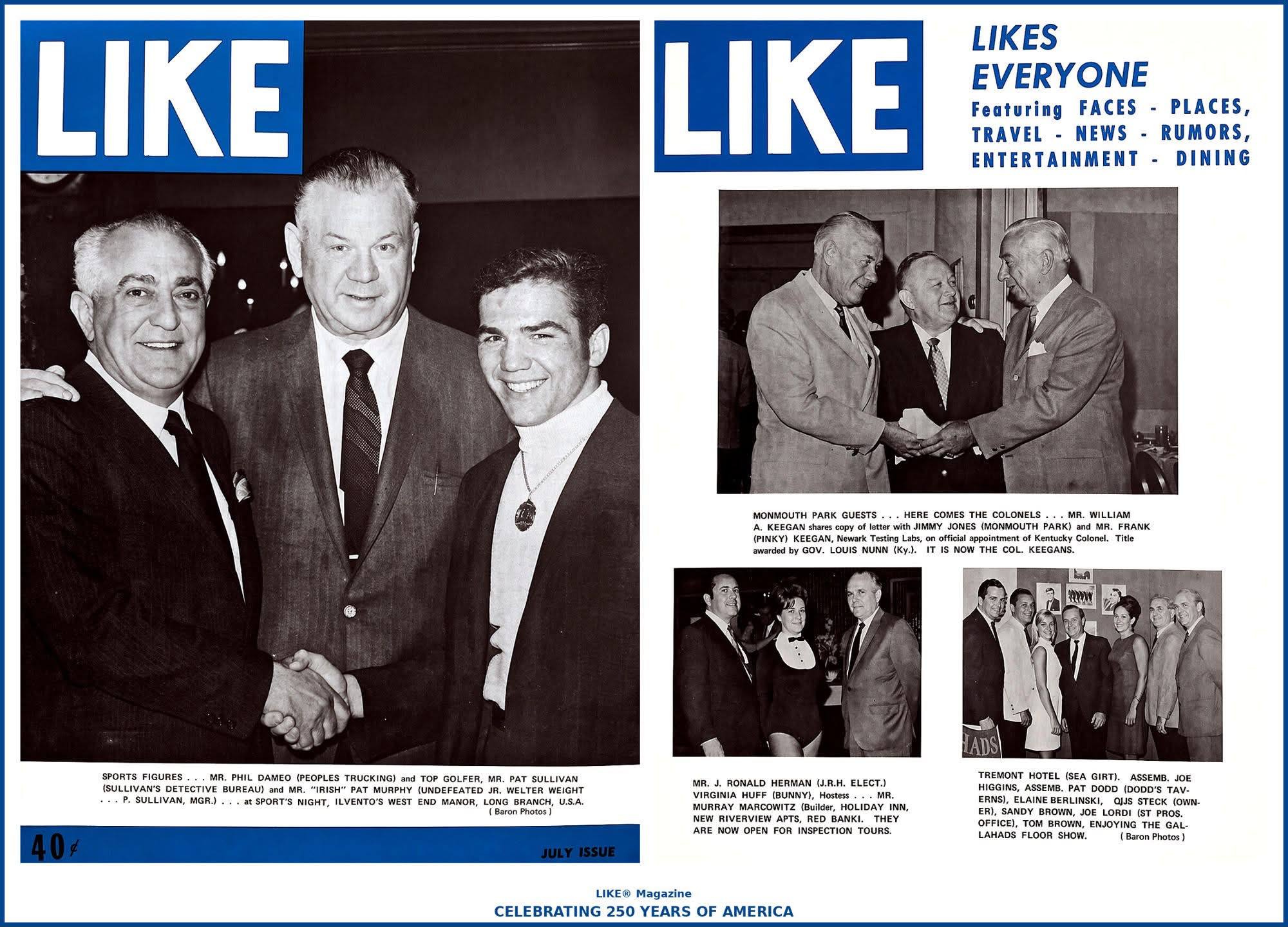
On this historical cover of LIKE® Magazine, three men stand arm-in-arm at Sport’s Night at Ilvento’s West End Manor in Long Branch. On one side is Phil Dameo of Peoples Trucking. In the center stands Pat Sullivan of Sullivan’s Detective Bureau, identified as a top golfer. On the right is “Irish” Pat Murphy, an undefeated junior welterweight managed by P. Sullivan.
Across the facing page, another set of photographs records a different layer of the same New Jersey world: William A. Keegan and Frank “Pinky” Keegan receiving Kentucky Colonel commissions at Monmouth Park; Murray Marcowitz opening the Holiday Inn and New Riverview Apartments in Red Bank; and a table at the Tremont Hotel in Sea Girt occupied by Assemblymen Joe Higgins and Pat Dodd, tavern owners, and local professionals enjoying the Gallahads floor show.
These pages, like so many in LIKE® Magazine, do not separate industries. They simply place the people who ran them in the same rooms. The industries themselves, however, stretch across the full arc of American enterprise—from the private detective agencies that once filled the gaps left by policing, to the trucking fleets that moved the nation’s goods, and from local testing labs and builders to the modern real-time surveillance systems that have replaced the old private eye’s notebook.
The Long Arc of the Private Detective The American private detective begins, in practical terms, with Allan Pinkerton. A Scottish immigrant and abolitionist, Pinkerton founded what became The Pinkerton National Detective Agency in Chicago in 1850. His motto—“We Never Sleep”—and the unblinking eye that accompanied it gave the language its lasting phrase: “private eye.”
Before the United States Secret Service or the FBI – Federal Bureau of Investigation existed in their modern forms, Pinkerton men guarded railroads, chased train robbers, protected Abraham Lincoln on his journey to the first inauguration, and later earned lasting controversy as strikebreakers during the labor wars of the late nineteenth century.
By the mid-twentieth century, the romantic lone operative of fiction had largely given way to licensed, regulated professionals. State licensing regimes, the Fair Credit Reporting Act, the Gramm-Leach-Bliley Act, and the Driver’s Privacy Protection Act created a gated profession. Private investigators still exist, but their tools are oftentimes credit-header data, utility records, DMV files, and public-record aggregation. Dramatic undercover work of the Pinkerton era has a new tool-belt.
On the July cover of LIKE® Magazine, that profession appears in the person of Pat Sullivan of Sullivan’s Detective Bureau. The caption identifies him as both a detective and a top golfer, standing between a trucking executive and a prizefighter at a Long Branch sports night. The photograph captures the ordinary social standing of a local investigative firm in the Shore’s mid-century ecosystem—neither shadowy nor glamorous, simply present.
The profession was about to be elevated again.
In 1972, Brooklyn-born former assistant district attorney Jules Kroll founded J. Kroll Associates in New York. What began as a small investigative practice grew into Kroll Inc., the firm that essentially created the modern corporate-intelligence industry. Kroll’s agency specializes in protecting high-value clients—major corporations, governments, and financial institutions—by conducting sophisticated due-diligence investigations, tracing the hidden assets of dictators and fraudsters, recovering plundered fortunes, and providing crisis management on a global scale. Clients have ranged from Wall Street banks navigating hostile takeovers to the government of Kuwait seeking Saddam Hussein’s concealed holdings.
Kroll’s model professionalized the field: former prosecutors, forensic accountants, intelligence officers, and journalists replaced the old image of the hard-boiled private eye. By the time the firm was sold in 2004 for nearly two billion dollars, it had become the world’s preeminent private investigative organization, with offices across dozens of countries. Kroll later co-founded K2 Intelligence (now K2 Integrity), continuing the same high-end work of safeguarding institutions and individuals whose exposure carried significant financial or political risk.
The same profession has since been transformed once more by technology. What once required a licensed investigator with access to credit headers and skip-trace databases can now, in many cases, be approximated by commercial location data. As documented in LIKE® Magazine’s research brief on the real-time surveillance ecosystem, the modern supply chain begins with a software development kit embedded in a consumer app. Location pings tied to a mobile advertising ID flow to aggregators, then to brokers such as Venntel, Babel Street’s Locate X, and Fog Data Science, and finally to dashboards used by insurers, private investigators, and law-enforcement agencies.
The Federal Trade Commission’s 2024 and 2025 orders against Outlogic (formerly X-Mode), Gravy Analytics/Venntel, and Mobilewalla have restricted the sale of “sensitive” location data, yet the underlying infrastructure—billions of daily signals—remains. The private detective of the Pinkerton era, the local bureau owner photographed in Long Branch, and the corporate-intelligence pioneer Jules Kroll all belong to the same continuum. Only the tools have moved upstream into the advertising and data-broker markets.
Trucking: From Peoples to the National Carriers Beside Sullivan on the cover stands Phil Dameo of Peoples Trucking. The caption places him at the same Long Branch sports night, a local carrier executive among athletes and investigators. Dameo Trucking Inc. later appears in federal motor-carrier records as an active New Jersey operation based in Bridgewater, hauling building materials and dry bulk under USDOT 16545 and MC-2359.
The firm’s presence on a LIKE® Magazine cover in the 1960s reflects the dense network of independent and regional carriers that once dominated the Shore and inland New Jersey.
American trucking itself is older than the interstate highway system. Before the motor carrier, goods moved by wagon, canal, and rail. The Motor Carrier Act of 1935 brought federal regulation; deregulation in 1980 opened the industry to the large national fleets that now dominate. J.B. Hunt Transport Services, Inc., founded in Arkansas in 1961, grew into one of the largest intermodal and truckload carriers in North America. Swift Transportation, rooted in Arizona, became a major irregular-route truckload operator before its merger into Knight-Swift. Both companies represent the scale that regional firms such as Peoples Trucking once competed against or fed into.
The next turn is already visible. Autonomous trucking companies such as Kodiak Robotics are testing driverless freight runs on defined corridors, aiming to remove the driver from the long-haul segment while retaining human oversight at terminals and in complex urban environments. The local carrier photographed at Ilvento’s West End Manor and the national fleets that absorbed much of the industry’s volume now share the road with experimental vehicles that may one day redefine the labor and capital structure of the entire sector.
The Keegans, the Colonels, and Monmouth Park On the facing page, William A. Keegan and Frank “Pinky” Keegan of Newark Testing Labs stand with Jimmy Jones of Monmouth Park. The caption records that they have just received official appointments as Kentucky Colonels from Governor Louie B. Nunn of Kentucky. The honorary title, one of the oldest in the United States, had by then become a recognizable mark of social and political connection. The photograph places a local testing laboratory and a major Thoroughbred track in the same ceremonial moment. Monmouth Park itself belongs to the long continuum of American racing. The present track opened in 1946 on the site of earlier Monmouth racing traditions that stretched back into the nineteenth century. Its presence in LIKE® Magazine alongside local business figures is consistent with the magazine’s habit of treating the track as both sporting venue and social institution.
Builders, Legislators, and the Shore’s Everyday Network The same spread records Murray Marcowitz, identified as the builder of the Holiday Inn and the New Riverview Apartments in Red Bank, now open for inspection tours. Beside him appear J. Ronald Herman and hostess Virginia “Bunny” Huff. At the Tremont Hotel in Sea Girt, the magazine photographs Assemblymen Joe Higgins and Pat Dodd (of Dodd’s Taverns), Elaine Berlinski, Qjs Steck, Sandy Brown, Joe Lordi of the State Prosecutor’s Office, and Tom Brown, all enjoying the Gallahads floor show.
These names complete the LIKE® Magazine picture. A state legislator, a tavern owner, a builder opening new apartments and a Holiday Inn, a prosecutor’s office representative, and local professionals share a table at a Shore hotel while, a few miles away, a detective, a trucking executive, and a fighter stand together at a sports night.
LIKE® Magazine captures moments when these professions appear side by side in the same social rooms.
In the instance of these folks featured on the cover the private detective of the Pinkerton tradition had become a licensed local bureau owner who also played golf. Jules Kroll was simultaneously elevating the same profession into a global corporate-intelligence industry that protected governments and high-value clients. The regional trucker stood next to the local detective while the national carriers and, later, the autonomous-vehicle companies were still taking shape. Kentucky Colonels from a Newark testing lab received their commissions at Monmouth Park. Builders opened Holiday Inns and apartment houses. Assemblymen and tavern owners shared a floor show.
The tools have changed. Location data that once required a private investigator’s subpoena or a detective’s legwork now moves through advertising SDKs and commercial brokers. Freight that once depended entirely on human drivers is being tested with autonomous systems. Yet the underlying American pattern visible in these pages remains recognizable: local enterprise, regional institutions, and national industries intersecting in the same places and, for a time, in the same photographs.
LIKE® Magazine, founded in New Jersey and today an international publication, preserves that intersection. The covers remain a factual record of who stood where, what they do, and how their industries fit into the longer American and global story.
Michael de la Force Editor-in-Chief LIKE® Magazine 250 YEARS OF AMERICA