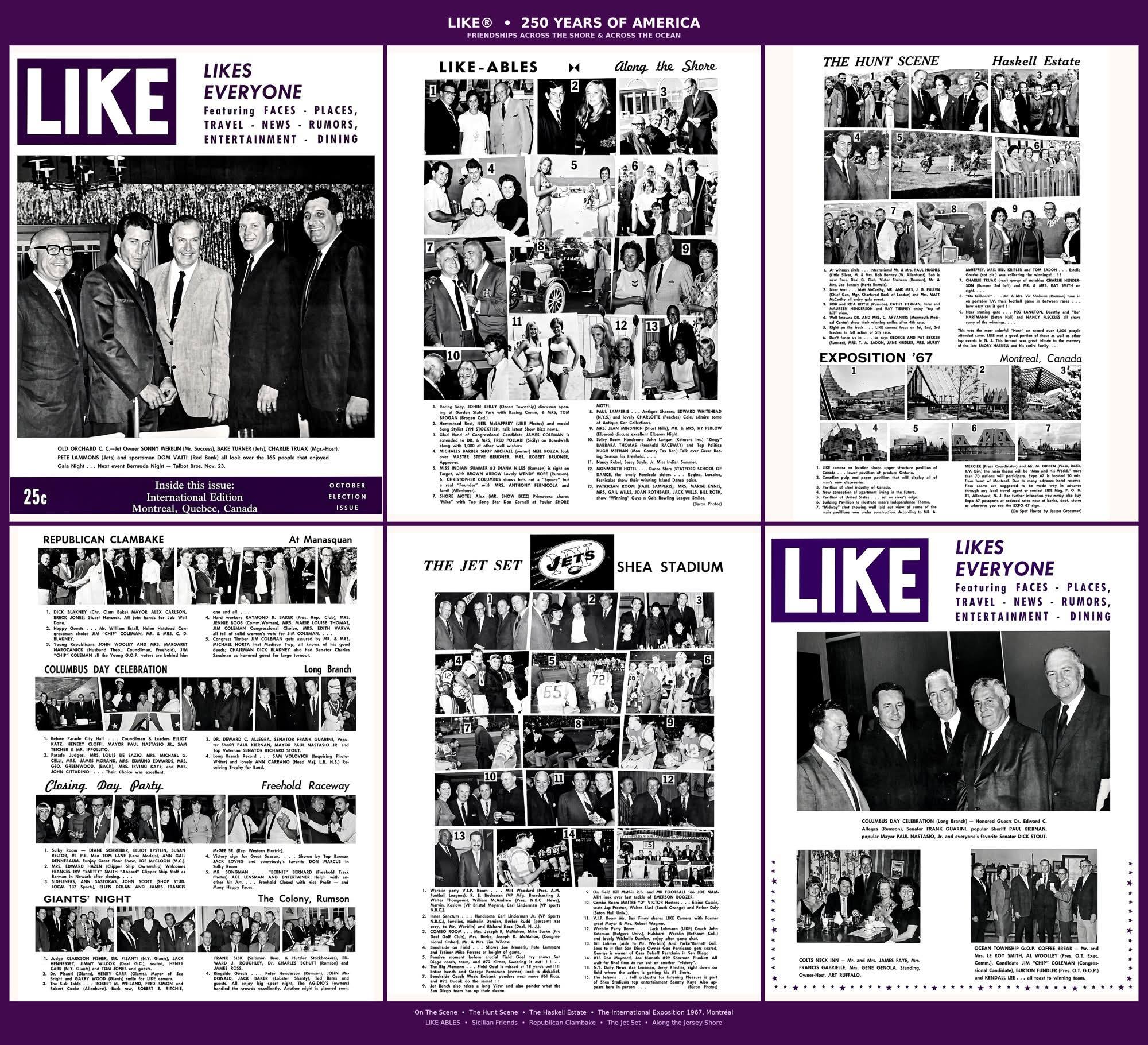
Pages from an earlier International Edition of LIKE® Magazine that exhibited person-to-person friendships and global collaborations.
“I alone cannot change the world, but I can cast a stone across the waters to create many ripples.” “I can do things you cannot, you can do things I cannot; together we can do great things.” — Saint Mother Teresa (Humanitarian & Nobel Laureate)
On The Scene • The Hunt Scene • The Haskell Estate • The International Exposition 1967, Montréal, Canada • LIKE-ABLES • Sicilian Friends • Republican Clambake • The Jet Set • Along the Jersey Shore
In the autumn light of 1967, four pages of LIKE® Magazine captured a Shore that still moved to the rhythms of horses, society, and sudden international horizons. The covers and center spreads—Old Orchard with its price banner, the Columbus Day gathering, the Hunt Scene across the rolling Haskell acres, and the Along the Jersey Shore portraits—recorded a world that felt both deeply local and newly global. Additional pages from the same season expanded the record: Republican clambakes at Manasquan, Closing Day at Freehold Raceway, Giants’ Night at The Colony in Rumson, and the Jet Set at Shea Stadium. Fifty-nine years later, as America marks 250 years, those same pages become a living plate: a record of who was there, what they celebrated, and how the threads they carried have stretched into the present.
Along the Jersey Shore and On the Scene The Shore of 1967 was still a place where the social calendar and the sporting calendar overlapped without apology. Parties, pageants, racing, and the quiet observation of who was with whom filled the columns. LIKE® Magazine’s photographers and writers moved easily between the beach clubs, the hunt fields, and the international visitors who had begun to appear with greater frequency after the world’s fair just to the north. The magazine’s eye was affectionate and exacting—capturing both the polished surface and the genuine pleasure of a season that still believed in its own continuity.
The Hunt Scene and the Haskell Estate At the center of that continuity stood Woodland Farm, the great Middletown estate of Amory Lawrence Haskell. Haskell (1893–1966) was the classic American sportsman of his generation: glass manufacturer, Thoroughbred racing executive, and longtime Master of Foxhounds of the Monmouth County Hunt. He had helped restore pari-mutuel racing to New Jersey and given his name to the Haskell Invitational at Monmouth Park. On his own land he maintained a celebrated pack of harriers, imported from England, that at its height numbered fifty couple and hunted Belgian hare across the surrounding farmland.
The annual Monmouth County Hunt Race Meet—known simply as “The Hunt”—began on those hills in 1932 as a thank-you to the farmers over whose fields the hounds and field rode. By the mid-1960s it had become one of the Shore’s great autumn occasions: sanctioned steeplechase racing (the Hunt Cup and Gold Cup), elaborate tailgates, charity fundraising, and the glittering Hunt Ball. Thousands gathered. The tradition itself belonged to a longer American story. Foxhunting had arrived with the colonists—Robert Brooke bringing hounds to Maryland in 1650, the Gloucester Foxhunting Club forming near Philadelphia in 1766, George Washington riding to hounds. English form adapted to American land and American independence. The Monmouth County Hunt, founded in 1885 by the Irish-born publisher P.F. Collier and later shaped by Haskell’s long mastership, was one of its most visible New Jersey expressions.
Haskell died in 1966. The estate was later sold; the race meet continued on the grounds until 1996. The hunt itself moved west as farmland gave way to houses, yet it remains active. The memory of those October days—the horn, the pink coats, the champagne and chicken wings on the tailgates—still belongs to the Shore’s collective recollection. In the 1967 LIKE pages, the Hunt Scene is not nostalgia. It is a living record of a particular American continuity: private land, reciprocal obligation to neighbors, and the persistence of an old European sport on new soil.
Republicans’ Clambake, Closing Day, and New York Giants’ Night The same season that produced the Hunt coverage also recorded the Shore’s political and sporting social circuit in full. The Republican Clambake at Manasquan brought together local leaders and candidates—Dick Blakney, Mayor Alex Carlson, Jim “Chip” Coleman, and party workers raising hands for the work still ahead. Columbus Day celebrations in Long Branch gathered Dr. Edward C. Allegra, Senator Frank Guarini, Sheriff Paul Kiernan, Mayor Paul Nastasio Jr., and Senator Richard Stout. Closing Day at Freehold Raceway filled the sulky rooms and winner’s circles with owners, trainers, and well-wishers. Giants’ Night at The Colony in Rumson mixed New York Giants figures with Shore regulars in the easy camaraderie that followed a season’s effort.
The Jet Set The Shore’s circle reached across the Hudson. “The Jet Set” pages followed the New York Jets at Shea Stadium in the Joe Namath era—sideline moments, VIP rooms, owners, coaches, and the celebrities who moved between Manhattan and the Jersey coast. LIKE treats the professional football world with the same social lens applied to hunts, social balls, summits, and parades.
The International Exposition, 1967, Montréal While the hounds ran in Monmouth County, something larger was unfolding two hundred miles north. Expo 67, “Man and His World,” opened on the islands of the St. Lawrence as the centerpiece of Canada’s centennial. Among its most visited and photographed structures was the United States Pavilion—a soaring three-quarter geodesic sphere designed by R. Buckminster Fuller with Shoji Sadao. Seventy-six meters in diameter and sixty-two meters high, the double-layer steel lattice enclosed seven levels of exhibits on “Creative America.” The Expo Minirail passed through it. More than five million people entered. LIKE® Magazine photographers were there to capture it all.
Fuller’s dome was never merely architecture. It was the physical expression of a lifelong philosophy: that humanity could design its way toward abundance by doing “more with less.” He spoke of Earth as Spaceship Earth—a closed system whose passengers required comprehensive information and cooperative intelligence rather than zero-sum conflict. In the same years he refined the World Game (originally the World Peace Game), a logistics exercise that inverted the military war game. Players would use global data on energy, food, resources, and population to invent strategies that would “make the world work for 100% of humanity in the shortest possible time through spontaneous cooperation without ecological offense or the disadvantage of anyone.”
The ultimate World Game facility was never built inside the pavilion, but the dome itself became its most eloquent symbol. After Expo closed, the United States donated the structure to Montréal. A 1976 fire destroyed the acrylic skin; the steel frame survived. Restored and reopened in 1995 as an environmental museum, the Biosphère today forms part of Montréal’s Espace pour la vie. It hosts exhibitions on climate emotion, energy futures, watersheds, and planetary interdependence. In 2021 The New York Times named it one of the twenty-five most significant works of postwar architecture. The carbon molecule buckminsterfullerene carries Fuller’s name because its structure recalled the Expo dome.
Even the tools Fuller imagined began to appear. In 1993 the World Game Institute released Global Recall, a HyperCard-based educational software package that placed country-by-country data, maps, an encyclopedia of world problems, and a Solutions Lab into the hands of high-school and college students. It was an early attempt to democratize the comprehensive view Fuller had demanded.
The journey from the 1967 U.S. Pavilion to today’s Biosphère is the story of an idea that refused to remain temporary. The same inventive spirit celebrated at Expo has been turned toward the long-term stewardship of the only home we have. Montréal festivals, Canada’s growing network of environmental and cultural events, and the continuing life of the geodesic frame all keep that conversation open.
Sicily, the Pollaris, and the Italian Thread Among the international visitors and society figures who moved through the 1967 Shore and Expo circles were Dr. and Mrs. Fred Pollari, connected to Sicily. Their presence in the LIKE® pages opens a deeper American story—one of the great migrations that helped build the nation whose 250th anniversary we now mark.
Sicily has always been a crossroads. Greek, Roman, Arab, Norman, Spanish, and Italian layers produced a culture of extraordinary density: citrus groves, olive oil, wheat, wine, ceramics, and a fierce attachment to place. In the late nineteenth and early twentieth centuries, economic pressure, phylloxera, and the inequalities of the new Italian state sent hundreds of thousands of Sicilians across the Atlantic. Between 1880 and 1924 they formed a substantial part of the more than four million Italians who entered the United States. They worked the docks and factories, planted the first commercial lemon trade in New Orleans, built the early pasta industry, and carried their saints, their dialects, and their recipes into the new world. One in four Italian immigrants in that great wave was Sicilian.
Their contributions were practical and lasting. Sicilian merchants helped reshape American diets. Families built wineries, grocery networks, and mutual-aid societies. The Order Sons and Daughters of Italy in America in America and countless parish organizations provided the scaffolding of belonging. What began as survival became permanent enrichment of American life—cuisine, labor, entrepreneurship, and a particular Mediterranean intensity that still marks neighborhoods from New York to New Orleans to the California valleys.
Today Sicily continues to send its best northward and westward: extra-virgin olive oils of protected origin, wines from Etna and the west coast, ceramics from Caltagirone and Santo Stefano, pistachios from Bronte, capers from Pantelleria, and the slow-food products that have found new markets among Americans who now seek authenticity as deliberately as earlier generations sought opportunity. LIKE® Magazine’s publisher, as a group member of the Italian Trade Agency, stands inside that continuing exchange. The same island that once sent its people now sends its products—shoppable, traceable, and still carrying the layered history that made the migration possible.
Dr. and Mrs. Pollari of Sicily and the United States, greeting U.S. Congressional candidate James Coleman in the 1967 pages of LIKE® Magazine at the intersection of Shore society and international Expo energy, stand as one personal marker of that larger movement. Sicily did not merely contribute labor. It contributed a way of seeing the world that has become part of America’s own cherished values system.
Closing the Circle The hunt field and the geodesic dome, the Jersey Shore tailgate and the Sicilian grove, the local Master of Foxhounds and the planetary systems thinker, the clambake and the stadium suite, the farmers who opened their land and the immigrants who opened new trades—all belong to the same American story. Two hundred and fifty years after the Declaration, the work continues: to make the world work for more of us, with less damage, and with the same spontaneous cooperation that Fuller demanded and that ordinary people have practiced, generation after generation, along the Shore and across the ocean.
Michael de la Force Editor-in-Chief LIKE® Magazine 250 YEARS OF AMERICA