Excerpts from LIKE® Magazine, Special Edition—Bangkok · 30 July, 2026
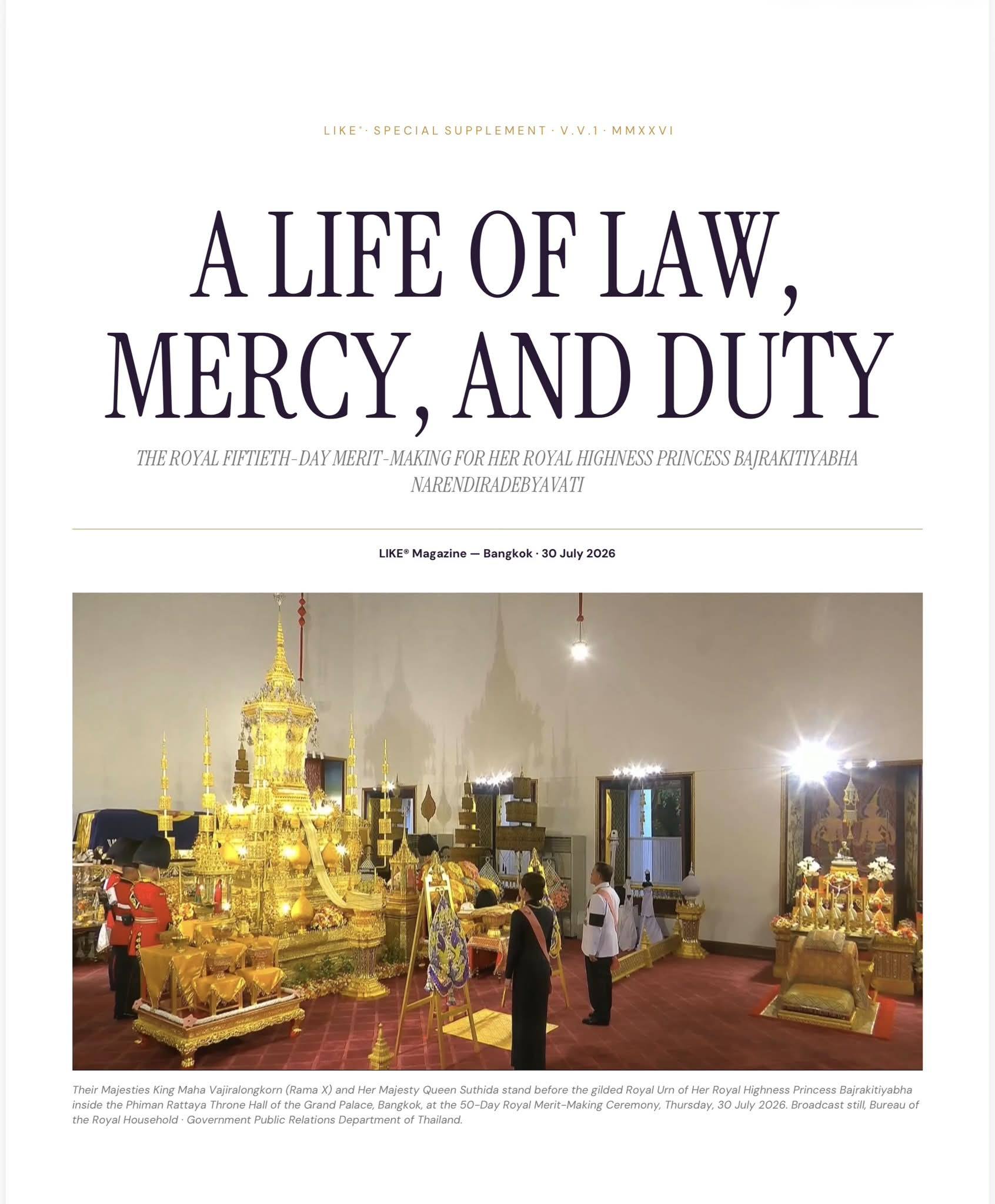
Their Majesties King Maha Vajiralongkorn (Rama X) and Her Majesty Queen Suthida stand before the gilded Royal Urn of Her Royal Highness Princess Bajrakitiyabha inside the Phiman Rattaya Throne Hall of the Grand Palace, Bangkok, at the 50-Day Royal Merit-Making Ceremony, Thursday, 30 July 2026. Broadcast still, Bureau of the Royal Household · Government Public Relations Department of Thailand.
PRECIOUS JEWEL OF THE ROYAL HOUSE
A POEM PRESENTED IN HONOUR OF HER ROYAL HIGHNESS AT THE ROYAL MERIT-MAKING CEREMONY, 13 JUNE 2026
O precious jewel of the royal house — / Princess fair and bright, / The angels guide your journey to the heavens / And keep you in their everlasting light. / May Your Royal Highness rest in peace eternal above, / Within the splendour of the skies; / Your noble deeds and loving-kindness, shining, / Shall live within the hearts of the Thai people for all time.
Presented as "a poem in honour of Her Royal Highness" during the live broadcast of the royal funeral procession and merit-making ceremony from King Chulalongkorn Memorial Hospital to the Phiman Rattaya Throne Hall inside the Grand Palace on Friday, 13 June 2026. The verse was offered publicly at the ceremony; (currently our team is seeking proper authorship record). In accordance with Thai royal editorial protocol, LIKE® Magazine reproduces the verse as delivered and welcomes attribution should the Bureau of the Royal Household make the poet known.
The name Bajrakitiyabha is itself a jewel-name: in Thai it means "one whose honour is firm and steadfast as a diamond.”
THE MORNING'S RITES INSIDE THE GRAND PALACE
On the morning of Thursday, 30 July 2026, His Majesty King Maha Vajiralongkorn Phra Vajiraklaochaoyuhua Rama X, accompanied by Her Majesty Queen Suthida Bajrasudhabimalalakshana — the reigning Queen of Thailand — entered the precincts of the Grand Palace to preside over a sequence of sacred acts observed by the Kingdom.
His Majesty first entered the Chapel Royal of the Emerald Buddha — Wat Phra Si Rattana Satsadaram — where he removed the summer crown from the Phra Phuttha Maha Mani Rattana Patimakon and clothed the sacred image in the golden vestments of the rainy season. This is a rite of state that only the reigning monarch may perform, offered three times each year to mark the turning of the Thai seasons — summer, rainy, and cool.
Their Majesties then proceeded to the two royal merit-making ceremonies of the morning — a Thaksinanupadana rite (Kong Tek) dedicated to Her Majesty the late Queen Sirikit The Queen Mother inside the Dusit Maha Prasat Throne Hall, and the fiftieth-day royal merit-making ceremony for Her Royal Highness Princess Bajrakitiyabha Narendiradebyavati Kromluang Rajasarinisiribajra Mahavajrarajadhita at the Phiman Rattaya Throne Hall.
The fiftieth-day rite — panyasa in the Thai royal Buddhist tradition — dedicates merit to a departed soul at the midpoint between the earlier seventh-day satamvara and the hundredth-day satamvara observances, and forms one of the emotional and spiritual anchors of the Kingdom's period of national mourning.
THE DUSIT MAHA PRASAT THRONE HALL — THE HEAVENLY PALACE OF THE ROYAL DECEASED
To understand the meaning of this morning's rites, one must first understand the two throne halls that hold the royal remains at either end of the same Grand Palace.
The Dusit Maha Prasat Throne Hall — whose name means literally the Palace of the Heavenly Abode — is the most sacred royal funeral pavilion in the Kingdom. It was commissioned by King Rama I the Great in 1789, replacing an earlier structure lost to fire, and was built in the pure classical Thai Jaturamuk (four-porticoed) cruciform plan crowned with a seven-tiered prang spire.
The King intended the hall for the highest ceremonies of the reign — coronations, audiences of state, and, in the fullness of time, the enshrinement of his own royal remains. When King Rama I passed in 1809, his Royal Urn was enshrined here, and the Dusit Maha Prasat has since served as the final resting hall for the Royal Urns of almost every monarch of the Chakri Dynasty and of consorts and princes specially honoured by the reigning King — most recently the Royal Urn of King Bhumibol Adulyadej The Great, who lay in state here for over 374 days.
- “A palace of heaven set upon the earth — the place where the sacred crosses from one world to the next.”
Under the current reign of His Majesty King Maha Vajiralongkorn (Rama X), the Royal Urn of Her Majesty the late Queen Sirikit The Queen Mother has been enshrined at the Dusit Maha Prasat since 25 October 2025. This is why the morning of 30 July 2026 sees a Thaksinanupadana (Kong Tek) rite for Her Majesty performed there, and, at the same hour and a short distance across the palace grounds, the fiftieth-day merit-making for Princess Bajrakitiyabha at the Phiman Rattaya Throne Hall — where the Royal Urn of Her Royal Highness has been enshrined since her passing on 11 June 2026.
Architecturally, the Dusit Maha Prasat is the ideal example of traditional Thai royal architecture and is regarded as the finest surviving specimen of the early Rattanakosin school. Its craftsmen were drawn from the fallen capital of Ayutthaya, and the carvings, gilding, and spired form preserve the artistic memory of a lost court. It is built upon a symmetrical cruciform plan — four wings extending outward from a central axis — raised upon a high base whose convex and concave mouldings gather at the foot into the shape of a lion's paw.
The whole building rises in the form of a tall mountain to signify Mount Meru, the mythological centre of the universe in Buddhist cosmology. The tiered green-and-orange roofs step upward toward a central gilded spire, called prasat, and this spire is divided into three parts. Its base is formed of seven superimposed layers, and each of those seven layers represents a level of heaven according to the ancient Traiphum Buddhist cosmology of the Thai court — the same number seven that shapes the umbrella above the royal urn, and the seven weeks that the Buddha kept beneath the Bodhi tree, and the seven-day rites of the departed royals who have walked on.
Above the seven heavens of the base rises the second section, bell-shaped and flattened into four sides, which represents the stupa in which the Buddha's own ashes are interred. Above that rises the third and topmost section, tapered like a lotus bud or a dewdrop of crystal — the symbol of escape from samsara, the cycle of birth and death, which is the ultimate object of every merit-making rite offered beneath it. The spire is supported on each of its four sides by garudas, the celestial mounts of Narayana; and the pediments of the hall carry the figure of Narayana himself riding upon a garuda, the mount of the god of preservation.
Within the hall the interior walls carry a design of lotus buds arranged in geometric pattern. The ceiling opens into a coffered octagonal section immediately beneath the spire — the eight compass directions of the Thai kingdom — and this octagon is set with glass mosaic stars. The panels of the doors and windows depict standing deities facing one another, weapons in hand, keeping watch over the inner air. Along the thickness of the walls runs a mural of trees in the old Chinese manner, a memory of the Siamese-Chinese trade under Rama I in whose reign the hall was raised.
To Thai belief this hall is more than a building. It is a palace of heaven set upon the earth — a place where the sacred crosses over from one world to the next. It is here that the ashes of His Majesty King Rama II were housed for a generation. It is here, since 26 October 2025, that Her Majesty Queen Sirikit The Queen Mother has lain in state beneath the Nine-Tiered Great White Umbrella. It is upon this same cruciform plan, and beneath the same seven heavens of the spire, that His Majesty the King moves invariably from the door of his mother's hall along the mukkrasan to the door of his daughter's.
THE PHIMAN RATTAYA THRONE HALL
The Phiman Rattaya Throne Hall stands in the innermost court of the Grand Palace of Bangkok. It is more than two hundred and thirty-seven years old. His Majesty King Rama I — Phra Buddha Yodfa Chulaloke the Great, founder of the Chakri house — commanded its construction in 1789 CE, after lightning struck the Amarindra Vinicchai Maha Prasat and fire severely damaged the older halls behind it. He ordered the ruined structures cleared, and he raised the Phiman Rattaya as part of the new group of great throne halls of the reign, joined on the north-south axis to the Dusit Maha Prasat by a long connecting corridor called the mukkrasan — the ceremonial bridge between the two halls along which the royal court has walked for two hundred and thirty-seven years.
The Architecture of the Phiman Rattaya
The Phiman Rattaya is smaller and more intimate than the great cruciform Dusit Maha Prasat which stands to its north. It was conceived as a phra wiman thi banthom — a private royal sleeping pavilion — and its plan and its proportions reflect that origin. Its walls are white, its roofs stepped in the green and orange tile of the palace tradition, and its gilded pediments carry the classical carvings of the Rattanakosin school. It sits within the inner court of the Grand Palace, in the same sacred precinct as the Phra Maha Monthien group, the Amarindra Vinicchai Hall, and the Chakri Maha Prasat.
The mukkrasan corridor that joins the Phiman Rattaya to the Dusit Maha Prasat is one of the most sacred passages in the Grand Palace complex. It carries the light of two halls at once; it is walked by the monks of the Royal Rhythm as they move from one merit-making to the next; and, over the last fifty days, it has been walked regularly in the mornings and evenings by His Majesty the King and Her Majesty Queen Suthida as they keep sacred rites.
For the first time in the history of the Thai royal court, this hall serves as the place where a royal member lies in state.
The Ceremonial History of the Hall
His Majesty King Rama III lived within the Phiman Rattaya for the better part of a year while the older royal residences of the palace were being restored. In the reign of His Majesty King Rama VI it was used as the gathering place of the royal family and inner court for the presentation of royal decorations and titles.
Its solemn ceremonial life began in the reign of His Majesty King Rama V, when the royal bathing rite of Her Majesty Queen Saovabha Phongsri, the Somdet Phra Sri Patcharintha Boromma Ratchini Nat, was held within its walls. Since then the Phiman Rattaya Throne Hall has been used for the royal bathing rites of kings, queens, and the most senior members of the royal family across successive reigns. The royal bathing rite of His Majesty King Rama VIII, Ananda Mahidol, following his passing in 1946, was performed at this hall. For all of the two centuries since its founding, however, the Phiman Rattaya has been used only for the bathing rite and never as the place where the royal remains lie in state — until now.
On 12 June 2026, at the royal command of His Majesty the King, the royal remains of Her Royal Highness Princess Bajrakitiyabha were enshrined within the Phiman Rattaya after the royal bathing ceremony was performed. This marks the first time in the history of the Thai royal court that this hall has served as the place where a royal member lies in state (Thairath, en.thairath.co.th).
HER MAJESTY THE QUEEN MOTHER IN THE HALL BEYOND
The Phiman Rattaya does not stand alone. It is connected, by the long mukkrasan corridor, to the Dusit Maha Prasat Throne Hall immediately to its north. And in that adjoining hall, throughout every one of these fifty days of mourning for Her Royal Highness Princess Bajrakitiyabha, another royal urn has stood upon another catafalque, beneath its own tiered white umbrella.
Her Majesty Queen Sirikit The Queen Mother, Somdet Phra Nang Chao Sirikit Phra Boromma Ratchini Nat, mother of His Majesty the King and grandmother of Her Royal Highness Princess Bajrakitiyabha, passed away on the evening of 24 October 2025 at the King Chulalongkorn Memorial Hospital of the Thai Red Cross Society, at the age of 93. On 26 October her royal remains were carried in solemn procession from the hospital to the Grand Palace and were enshrined in the Dusit Maha Prasat Throne Hall to lie in state for one full year, according to the highest royal tradition of the Kingdom of Thailand, until the Royal Cremation Ceremony of Her Majesty in late 2026.
The public was granted royal permission to pay respects to the Queen Mother at the Dusit Maha Prasat Throne Hall from 9 November 2025 onward, and does so still, in slots that reach from morning into the late evening. His Majesty the King is observing a full year of mourning for his mother. On 24 October 2026 the first anniversary of her passing will be marked with the culminating royal rites and, at Sanam Luang, the royal cremation ceremony of the Queen Mother of the Kingdom.
The two royal urns therefore stand this morning at either end of the same ceremonial axis of the Grand Palace: Her Majesty Queen Sirikit The Queen Mother beneath the Nine-Tiered Great White Umbrella of State in the Dusit Maha Prasat, and Her Royal Highness Princess Bajrakitiyabha beneath the Seven-Tiered White Umbrella of State in the Phiman Rattaya. Grandmother and granddaughter — the Mother of the Nation and the Princess of the People — held in the same architectural embrace, their catafalques joined by the mukkrasan corridor along which the monks of the Royal Rhythm and Their Majesties themselves move from one rite to the next.
For His Majesty the King and Her Majesty Queen Suthida, the familiar passage between the two halls is a passage between two of the deepest griefs a family can bear. And yet Their Majesties keep them both, unhurried and complete, with the same restraint and the same fidelity to royal tradition — the mother in one hall, the daughter in the next, held in the light of the same offering of merit.
Thai Buddhists say that when a royal person is enshrined in a hall of the Chakri palace, the merit made in that hall does not stay in that hall. It moves. It travels along the corridors of the palace, along the currents of the phusa yong cloth, along the umbrellas of the tiered white shade, and it finds every royal soul held within the palace's care. What is offered this morning at the Phiman Rattaya is also offered to the Dusit Maha Prasat next door. Grandmother and granddaughter are held together in the same light.
The Thread Between Them — Kamlangjai
Between the two halls there is a thread finer than the mukkrasan corridor, and it is not made of stone. It is made of the same conscience — the conscience that a woman of the Chakri house owes her whole life to the people of Thailand, and especially to those who have no one to speak for them.
Her Majesty Queen Sirikit The Queen Mother spent the whole of her sixty-six years as Queen Consort of King Rama IX carrying that principle into the villages of the Kingdom: the Foundation for the Promotion of Supplementary Occupations and Related Techniques, the SUPPORT Foundation, the revival of Thai silk and craft in the poorest provinces, and the tireless care of women and children who lived beyond the reach of the state.
Her Royal Highness Princess Bajrakitiyabha carried that same principle into the prisons of the Kingdom. In 2001, as a graduate student, she visited the Central Women's Correctional Institution in Bangkok and saw what she would later describe as an entire order of women whose gender-specific needs — hygiene, pregnancy, motherhood behind bars — the modern prison system had never been built to see. Upon her return from Cornell University, in the year 2006, Her Royal Highness founded the Kamlangjai Project — in English, the Inspire Project. The Thai name kamlangjai means literally the strength of the heart, the encouragement that one heart sends to another; and it was chosen to name the belief that every woman inside a prison wall, and every woman outside it, can send that strength to another.
The Kamlangjai Project was a visionary effort where Princess Bajrakitiyabha (Princess Bha) led the Kingdom of Thailand's efforts in drafting solutions that reached first to pregnant inmates and to their newborns. Remarkably, it grew into the world's first United Nations-level standard specifically prioritising gender-sensitive justice. This framework—the United Nations Rules for the Treatment of Women Prisoners and Non-custodial Measures for Women Offenders—was formally adopted by the General Assembly of the United Nations on 21 December 2010. In honour of the Kingdom that led the drafting, the historic milestone has been known ever since as the Bangkok Rules, a legacy preserved by the Thailand Institute of Justice (TIJ).
The line is direct and unbroken. Queen Sirikit's craft cooperatives had raised women out of poverty in the northern provinces of the Kingdom; her granddaughter's Kamlangjai raised women out of the correctional institutions of Bangkok and Klong Prem. The grandmother taught the granddaughter, without ever teaching it in a lesson, that the highest work of a royal woman is the work no one applauds — the quiet, patient, decade-long work of restoring dignity to those the world has forgotten. The mother of the nation raised the princess of the people; and the princess of the people raised, in turn, every woman who has ever stepped from a Thai prison into a life she was told she could not have.
Now they are held together in the same palace. The seed and the flowering — grandmother and granddaughter — lie in state at either end of the mukkrasan.
THE ROYAL MOTORCADE AND THE "JAMES BOND" VOLKSWAGEN
On the afternoon of 12 June 2026, one day after Her Royal Highness Princess Bajrakitiyabha's passing, her royal remains were carried in solemn procession from King Chulalongkorn Memorial Hospital : โรงพยาบาลจุฬาลงกรณ์ of the สภากาชาดไทย Thai Red Cross Society to the พระบรมมหาราชวัง ( The Grand Palace ). The vehicle that bore her was a grey Volkswagen T4 Caravelle, long-wheelbase, with a blue side stripe, carrying the royal registration plate 1-0929. The palace and the Thai press have long called it, quietly and with affection, the "James Bond" Volkswagen.
This is not a state limousine. It is a working royal van, chosen for its simplicity, its reliability, and for the philosophy of sufficiency economy that His Majesty the late King Bhumibol Adulyadej the Great, Rama IX, embodied throughout his reign. It served for many years as the royal working vehicle of His Majesty King Bhumibol himself, carrying him on official duty to remote provinces of the Kingdom. Upon his passing in October 2016 it served, in the reverse of that lifetime of service, to carry his royal remains from Siriraj Hospital to the Grand Palace. In October 2025 it served to carry the royal remains of Her Majesty Queen Sirikit The Queen Mother from King Chulalongkorn Memorial Hospital, Thai Red Cross Society โรงพยาบาลจุฬาลงกรณ์ สภากาชาดไทย to the same Grand Palace. And now, in June 2026, it has carried Her Royal Highness Princess Bajrakitiyabha, the granddaughter of King Bhumibol and the great-granddaughter of Queen Sirikit's Chakri line — across the same city, along the same avenues, to the same palace gate.
One royal van. Three royal remains. The same journey performed three times in the space of a decade. It is a working vehicle that has become one of the most sacred moving objects in the Kingdom of Thailand.
THE ROYAL FLEET: A CHRONICLE OF MAJESTIC MARQUES AND IMPERIAL CONFORMANCE
The Chakri patronage of the German marque, Mercedes spans 122 years, originating from a crucial period before the famous corporate merger. In 1904, His Royal Highness Prince Rabi of Ratchaburi, Krom Luang Ratchaburi Direkridhi, presented a Mercedes automobile, built by Daimler Motoren Gesellschaft (DMG), to his royal father, His Majesty King Chulalongkorn the Great, Rama V. While this vehicle was the very first of its lineage to reach the Siamese court, the modern brand identity was only finalized decades later. In 1926, financial and industrial pressures forced DMG to merge with its long-time rival, Benz & Cie., uniting the legacies of Gottlieb Daimler and Karl Benz into Daimler-Benz AG and officially giving birth to the unified Mercedes-Benz brand.
The English Daimler—an independent British luxury automaker separate from its German namesake—entered service under His Majesty King Rama VI, Vajiravudh, with the commanding Daimler 45hp serving as the principal royal car. This established a deep-seated appreciation for British engineering within the court. Generations later, His Majesty King Rama VIII, Ananda Mahidol, chose a Rolls-Royce Phantom III to review the troops following the conclusion of World War II. From that pivotal post-war reign onward, English marques firmly anchored the official state fleet, defining the aesthetic of Thai royal pageantry.
His Majesty King Bhumibol Adulyadej the Great, Rama IX, inherited that British tradition and preserved it with immense care. His coronation car was the legendary Daimler DE36 Straight Eight, bodied by Hooper of London—a vehicle that remains one of only some dozen surviving worldwide. This elite class of limousine has historically borne other global sovereigns, including King Mohammed Zahir of Afghanistan, Emperor Haile Selassie of Ethiopia, Queen Wilhelmina of The Netherlands, and Prince Rainier of Monaco. Later in his reign, the fleet welcomed the ultra-exclusive Daimler DR450, a model delivered to only two reigning monarchs worldwide: King Bhumibol and King Hussein of Jordan. Alongside these majestic Daimlers ran the great Rolls-Royces—most notably the Phantom V, the iconic Phantom VI used by His Majesty for close to thirty years, and the Rolls-Royce Silver Spur.
Yet, for grueling working days across the country, His Majesty deflected from pure pageantry and chose the Mercedes-Benz 300—the "Adenauer Benz" famously favored by the first Chancellor of the Federal Republic of Germany. King Bhumibol owned examples of all four successive variants of this iconic model line (from the initial W186 to the fuel-injected W189). It was within this very class of luxury vehicle that he traveled to the poorest, most remote districts of the Kingdom. The car was famously transformed into a mobile workstation, ruggedly carrying agricultural equipment and medical teams, with Her Majesty Queen Sirikit consistently seated as his passenger.
The state fleet steadily grew with the progression of the reign. His Majesty acquired a pinnacle of automotive engineering: a grand Mercedes-Benz 600 Pullman Landaulet, finished in the distinct ceremonial ivory livery reserved exclusively for the royal cars. Toward the twilight of his historic reign, he replaced the long-serving Phantom VI with an ultra-luxury Maybach 62, similarly finished in royal ivory. This vehicle carried the most prestigious automotive designation in the Kingdom—the supreme registration plate "R.Y.L. 1" (Royal Automobile Number One)—backed by a second, identical Maybach 62 held in strict reserve. Upon his royal father's passing, the historic Maybach 62 naturally passed into the service of His Majesty King Maha Vajiralongkorn, Rama X.
The current reign has firmly anchored the grand ceremonial fleet in the absolute vanguard of German engineering, utilizing successive generations of the modern Mercedes-Maybach line. Today, the garage prominently features the Mercedes-Maybach S650 (W222 platform), the majestic Mercedes-Maybach S650 Pullman Guard—a heavily armored, long-wheelbase state limousine built for maximum security—and the newest flagship Mercedes-Maybach S680 (W223 platform). Proving the timeless nature of the Chakri garage, the historic Rolls-Royce fleet preserved from the previous reign continues to run in active ceremonial service alongside these ultra-modern ballistic fortresses.
The Two Colours — Ivory and Ruby
The royal cars are painted in two ceremonial colours. Ivory — called by the palace the cream colour — is the historic livery of the fleet itself: soft, unshowy, reading in Bangkok sunlight as the palest gold. Ruby red is the colour of the ceremonial escort motorcade on the highest occasions of state, when the ivory royal car of Their Majesties moves at the centre of a long escort of ruby-red Mercedes-Benz S-Class and E-Class, BMW 7 Series and 5 Series, and Nissan Teana, flanked by police motorcycle outriders. It is the motorcade one sees on the route from Amphorn Sathan Residential Hall to the Grand Palace on the mornings and evenings of the greatest royal ceremonies — and in these mourning months, of the daily rites for Her Majesty The Queen Mother and Her Royal Highness the Princess.
The ruby-red ceremonial escort motorcade of the Thai royal court — a line of ruby sedans on the forecourt of the Chakri Maha Prasat Throne Hall of the Grand Palace, with the Royal Guards in scarlet uniform to the left, the gilded Aphonphimok Prasat pavilion in the middle distance, and the yellow royal-cypher banner of the reign on the lamp standard at right, at night.
The ruby-red ceremonial escort motorcade at rest on the forecourt of the Chakri Maha Prasat, at the base of the Aphonphimok Prasat — the small gilded pavilion from which the sovereigns of Siam mounted the royal palanquin. The Royal Guards stand in scarlet along the left of the frame, and the yellow royal-cypher banner of the reign hangs from the lamp standard at right. The ruby sedans are the ceremonial escort of the highest occasions of state — of the coronation, of the state banquet for a visiting head of state, and, in these mourning months, of the daily rites for Her Majesty the Queen Mother and Her Royal Highness the Princess.
The Fleet of a Working Court
One theme runs through the whole fleet, from the first Daimler of 1904 to the Maybach S680 of today: the royal cars of Thailand are chosen for their purpose, not for their opulence. His Majesty King Bhumibol, who understood every car in the royal stable at the level of a working mechanic, chose ordinary Volkswagen Caravelles and Toyota Solunas when the mission called for it, and ordered ten Isuzu Mu-7 vehicles with his own private funds for agricultural fieldwork.
The Maybach carries the Kingdom to the state banquet at the Élysée. The Volkswagen carries the royal remains home to the palace. Both are the vehicles of the same reign, and of the same care.
THE KRUT PHA — THE GARUDA, THE ROYAL STANDARD, AND THE WARRANT OF THE KING
At the centre is the Phra Khrut Pha — “Garuda, the vehicle of Vishnu.” In Thai kingship the Garuda is not decoration: the ancient kings held that the sovereign was the incarnation of Narayana, and the Garuda is the mount he rides. Rama VI proclaimed the Garuda the national emblem in 1911, replacing the European-style coat of arms adopted by Rama V. It is the mark on every government letterhead, every Thai passport, every banknote, and the pediments of the first-tier royal temples.
“The Garuda is not decoration: the ancient kings held that the sovereign was the incarnation of Narayana, and the Garuda is the mount he rides.”
The same Garuda — rendered in gold, wings out, with the phrase โดยได้รับพระบรมราชานุญาต — By Appointment to His Majesty the King beneath — is the Tra Tang Hang, the Royal Warrant of Appointment. Instituted under Rama V and formalised by the Garuda Emblem Act BE 2534 (1991), amended BE 2535 (1992), the warrant is granted on the King's assent to a small number of Thai enterprises judged to have shown “transparency, virtue and trustworthiness, and loyalty to the royal household.” The award is proclaimed in the Royal Gazette. It is personal, it is revocable, and its holders number a few hundred: บริษัท บุญรอดบริวเวอรี่ จำกัด / Boon Rawd Brewery, Bangkok Bank, Siam Commercial Bank, Central, Charoen Pokphand Group - C.P. Group, King Power, and — the oldest foreign holder — Cartier, warranted since the early 1900s. No new warrants have been issued in the reign of Rama X.
The Royal Standard — Thong Maharat — flying at the palace of residence. The yellow square field with the crimson-and-gold Garuda has been the personal flag of the Thai sovereign since 1910, when it was adopted under Rama VI. It flies at the King's palace of residence, on the royal aircraft, and on the vehicles that carry the King. Its use is reserved to His Majesty alone.
THE GREAT GOLDEN URN OF RAMA IX
Enshrined upon the southern side of the Phiman Rattaya Throne Hall stands the Phra Kot Thong Yai — the Great Golden Urn — the highest in the fourteen-tier hierarchy of royal funerary urns of the Kingdom of Thailand. On 12 June 2026 His Majesty the King bestowed the Great Golden Urn upon Her Royal Highness by royal command — the pinnacle of ceremonial honour granted only to sovereigns and to the most senior members of the royal family.
The urn used for Her Royal Highness is not an ancient object. It was created during the reign of His Majesty the late King Bhumibol Adulyadej, Rama IX, who graciously commanded the construction of a new Great Golden Urn to accompany the royal remains of members of the Chakri house. It was first used in accompaniment of the royal dignity of Her Royal Highness Princess Bajrakitiyabha — the first time this particular urn has been called into service. Her father's father, in one of the last acts of his long reign, prepared the vessel that would one day carry his granddaughter.
The urn is octagonal in shape, carved from timber, coated in lacquer, and wrapped in pure gold, and it is adorned according to the ancient royal blueprints with a hierarchy of diamond ornaments:
At its crown, the phum khao bin phet — the diamond lotus-bud cluster — the topmost ornament, a bud of diamonds set at the apex.
Around its body, dok mai wai — delicately oscillating diamond floral ornaments that catch the light with every draught of air in the hall.
Around the mouth of the urn, suspended rows of diamond garlands with silver tassels falling at regular intervals at each of the four corners.
At its waist, diamond floral ornaments called dok mai ao arrayed around the full circumference.
Fresh flowers and artificial flowers, refreshed daily, complete the offering, in accordance with royal dignity (broadcast description, Royal Funeral Chanting Ceremony, 16 June 2026).
The urn stands upon a three-tiered pedestal covered with gold cloth and set with white crystal ornaments; each of the three tiers is adorned with gold floral clusters, electric candles, and silver flower vases at its four corners, and each is furnished with suana and suana kandan ornaments in the ancient palace style. Set into the front of the urn's base is a ceremonial cloth folded upon a two-tiered gold tray.
The Connecting Cloth — the Phra Phusa Yong
During the daily rites, officials draw this cloth outward from the base of the urn and extend it along the length of the monks' platform, supporting it upon small stands at intervals so that it does not touch the floor. It connects to a second ceremonial cloth laid upon a two-tiered gold tray at the western side of the monks' platform. This cloth is called the phra phusa yong, and it is the physical channel of the sadappakon ritual: when His Majesty offers the phra bangsukula saffron robes to the monks, the merit of that offering passes along the phusa yong, from the King's hand, through the cloth, to the royal urn, and to the royal remains of Her Royal Highness within.
Beneath the platform supporting the urn, at its base, are placed the gold and silver floral offerings of the House of Chakri.
All of these ornaments — the diamond lotus-bud, the oscillating flowers, the rows of diamond garlands and silver tassels, the fresh flowers, the golden platform, the connecting cloth — are what the Thai royal court calls the khruang sung prakop phra kiat: the high regalia accompanying royal honour. They are not decoration. Each element names, in its own precise language, a virtue or a rank or a merit of the person enshrined within.
THE TIERED WHITE UMBRELLA AND THE NUMBER SEVEN
Above every place a royal person of Thailand sits, prays, sleeps, or is enshrined, there stands a tiered white umbrella. Its name in Thai is chatra, from the Sanskrit chattra, and it is the oldest sign of royalty carried by any court in South-East Asia. The umbrella is a Hindu inheritance woven into Buddhist Siam: it names, at a single glance, the accumulated honour and merit of the person seated beneath it, and it names the spiritual protection that a Dhamma-keeping sovereign extends over the realm. The umbrellas of the Thai royal house are themselves regarded as sacred objects, and His Majesty makes an offering to them upon the anniversary of his coronation each year.
Rank is read in the number of tiers. Nine tiers (nopphapadon) stand only above a fully consecrated Thai king — the Nine-Tiered Great White Umbrella of State, most ancient of the royal regalia, without which no king may take his seat upon the throne. Seven tiers (sattapadon) are reserved by royal tradition for members of the royal family of Chao Fa rank — princes and princesses born of the King and a royal consort — as well as for Crown Princes, Viceroys, and kings who have not yet completed the rites of consecration. Five tiers stand above other royal princes. The umbrellas descend in odd numbers because the odd number is the number of the sacred in every Buddhist court of the Theravada East.
On 12 June 2026 His Majesty the King issued the royal command bestowing the Seven-Tiered White Umbrella of State as the royal canopy over the royal urn of Her Royal Highness Princess Bajrakitiyabha — the umbrella of the Chao Fa rank into which she was born (Government Public Relations Department of Thailand, thailand.prd.go.th). It is beneath this seven-tiered umbrella that every rite in the Phiman Rattaya Throne Hall has since been performed, and it is beneath this umbrella that the fiftieth-day merit-making unfolds this morning.
Why Seven
Of these numbers, seven is the one most freighted with meaning in Buddhist tradition, and it is the number that most quietly shapes the whole of a royal funeral rite.
Seven steps. At his birth in the grove of Lumbini, the newborn Bodhisattva is said in the Pali chronicles to have taken seven steps upon seven lotuses that rose from the earth to meet his feet, and to have declared his final human birth. The seven steps are remembered in every Vesak observance across the Theravada world.
Seven weeks. After his enlightenment beneath the Bodhi tree at Bodh Gaya, the Buddha did not rise and teach. He kept, in the Pali suttas' account, seven weeks of silent contemplation — each week in a different posture at a different place around the tree — before speaking his first sermon in the Deer Park at Sarnath.
Seven days. Queen Maha Maya Devi, mother of the Buddha, died on the seventh day after giving him birth. The oldest Buddhist commemorations of the dead are therefore reckoned in sevens: the seven-day rite (satamaha), the multiples of seven that build to fifty, and the hundred that closes the first great mourning.
Seven jewels. The Chakravartin — the wheel-turning monarch of the Buddhist canon — is said to be attended by seven precious jewels (satta ratana): the wheel, the elephant, the horse, the gem, the queen, the treasurer, and the counsellor. A Thai king who reigns in the Dhamma is understood to reign in the shadow of this ancient model.
Seven factors of enlightenment. The Buddha named seven factors of awakening (satta bojjhanga) upon which the whole path to liberation depends: mindfulness, investigation of the Dhamma, energy, joy, tranquillity, concentration, and equanimity. These seven, chanted in Pali by the monks of the Royal Rhythm at the moment of a merit-making, are the seven virtues by which the mind rises through its own tiers, as the umbrella rises above the throne.
Seven, in the Buddhist East, is the number of the sacred journey — the number of steps taken, the number of weeks kept, the number of days that must pass before the first rite is offered, and the number of virtues that lift the mind toward the light. When a tiered white umbrella stands above the royal urn at the Phiman Rattaya Throne Hall, it is not only a mark of rank. It is a small vertical scripture, read in the numbers of the sacred East.
THIS MORNING AT THE PHIMAN RATTAYA THRONE HALL
Inside the Phiman Rattaya Throne Hall the fiftieth-day rite unfolds in a fixed and unhurried sequence, one that Their Majesties and the reigning Thai court have observed together at every stage of this national mourning.
His Majesty the King lights the Royal Servant Candle — the Thian Chanuan — the tall taper placed before the Royal Urn to signify that the King himself is offering merit for the departed. In the pale gold light of that single flame, the ceremony formally begins.
His Majesty then lights the candles cradled upon the mother-of-pearl inlaid trays — the phan thian pradap muk — set on the eastern and western sides of the hall before the two royal daises, the Phra Phithi Tham, where the chanting monks will take their seats. In Thai royal Buddhist tradition, the mother-of-pearl candle-tray is more than an ornament: it is a sacred vessel reserved for royal ceremonies of the highest rank, its shimmering surface fashioned to receive and multiply the flame. As each candle-wick catches, the pearl-inlaid tray beneath it lifts the light and returns it across the hall in a low, water-like radiance — an artisanal tradition laid into royal ceremony since the reign of King Rama I, and understood by Thai devotees as the offering of the Kingdom's finest craft together with the offering of the King's own hand.
His Royal Highness Prince Dipangkorn Rasmijoti and Her Royal Highness Princess Sirivannavari Nariratana Rajakanya, the Princess's beloved younger brother and sister, next step forward to light their own candles — different tapers, offered in the birth-order of the House of Chakri — so that the family stands with her in flame as well as in prayer.
The Dharma Offering Set — saffron robes, alms bowls, and monastic requisites arranged upon a golden salver — is then presented before the Royal Urn as the tangible seed of merit dedicated to Her Royal Highness.
Four monks of ecclesiastical rank take their seats upon the royal platform and begin the chanting of the Dharma. The ceremony has been ordered so that His Majesty may hear the sacred cadence directly, at close range, and dedicate the merit himself.
His Majesty then observes the Precepts — requesting the Five (or on royal occasions, the Eight) from the chief monk of the assembly. This act of a reigning monarch formally taking refuge and the Precepts in the presence of the Sangha is the moral centre of the rite: the King positioning himself, as sovereign, first as a son of the Dhamma.
THE MEDITATIONS OF THE CEREMONY — WHAT THE MONKS ARE DOING
To the outside eye, the royal chanting inside the Phiman Rattaya Throne Hall may appear as ceremony alone. To the Buddhist heart, it is a house of meditation — the sacred practice of bhavana — sustained without interruption from seven in the morning until half past five in the evening.
Every voice raised inside the hall this morning carries the same intention: the kind mental states the Buddha taught as the ground of every skilful act — loving-kindness (metta), compassion (karuna), sympathetic joy (mudita), and equanimity (upekkha). These four Brahmavihara — the abodes of the divine — are not decorative sentiment. They are the trained inner condition from which the chanting monks generate the merit and the blessings that the royal family then dedicates to Her Royal Highness.
The chants themselves belong to the ancient tradition of paritta — protective recitations — which the Thai royal court has drawn upon since the founding of Rattanakosin for occasions requiring blessing, protection, and the gentle turning of ill fortune. Among the paritta traditionally offered in a royal merit-making rite are those invoking the qualities of the Triple Gem, the radiance of loving-kindness, and the safeguarding of the departed on the journey the Thai tradition holds to lie ahead. In the panyasa rite for a member of the House of Chakri, the paritta is joined by chanting from the higher philosophy of the tradition — the Matika — the seed-verses that stand at the head of the Abhidhamma and analyse consciousness, matter, and the causes of arising and cessation.
Woven through the whole are three meditations, layered one upon the other:
Maranasati — the mindfulness of death — the meditation in which the practitioner sits with the truth that all conditioned things arise and pass away. The classical verse of maranasati, sung softly at nearly every Thai funeral, is aniccā vata sankhārā: "Impermanent, alas, are all conditioned things — their nature is to arise and pass away; having arisen, they cease; their stilling is bliss."
Metta bhavana — the cultivation of loving-kindness — a radiating meditation in which every merit generated inside the hall is directed outward: to Her Royal Highness, to His Majesty the King, to Her Majesty the Queen, to the House of Chakri, to the Kingdom, and to every sentient being without exception.
Vipassana — insight meditation — the seeing-through-with-wisdom of impermanence, unsatisfactoriness, and non-self. The chanting is offered so that the consciousness of the departed — believed in Thai custom to linger near the resting-place during these first weeks — may hear the Dhamma, release its attachment to the body it once wore, and travel onward in peace.
The ceremony rests on four moral pillars — the qualities the Kingdom prays Her Royal Highness has already made her own, and that are now offered back to her in dedication: truthfulness, kindness, compassion, and wisdom. These are the marks of the Bodhisatta in the Thai tradition, and they are the marks by which Her Royal Highness was known in life.
THE POWER OF THE PITCH — EHIPASSIKO, AND WHAT THE OUTSIDE EAR CANNOT HEAR
There is an old saying that circulates in Bangkok's temple circles — and one hears it especially in mourning weeks like these — that what one receives from these ceremonies, those who understand will know, and those who do not never will.
It is not merely a sentiment. It is the very oldest of the Buddha's teachings on his own Dhamma, spoken in the sonorous Pali of the daily chant every Theravada Buddhist recites at dawn:
Svākkhāto Bhagavatā Dhammo, sandiṭṭhiko, akāliko, ehipassiko, opanayiko, paccattaṃ veditabbo viññūhī ti.
Rendered in English by the Buddhist Publication Society and the Access to Insight archive: "Well-proclaimed is the Dhamma by the Blessed One — visible in the here and now, timeless, inviting everyone to come and see, leading onward to the goal, to be personally understood by the wise."
Two of these six qualities are the twin doors of every Buddhist ceremony. Ehipassiko — "come and see" — is the Buddha's open invitation: do not believe, verify. Paccatta veditabbo viññūhi — "to be individually understood by the wise" — is the deeper.
No external proof can substitute for the seeing that arises inside a mind trained to see. What passes between the chanting monks and a listener who is present is not information. It is a transmission that the untrained ear can hear as music and the trained heart can hear as truth.
The power of the pitches, then, is not aesthetic. It is doctrinal.
Thai royal Abhidhamma chanting is performed in a distinct musical mode called the Royal Melody (thamnong luang), reserved for members of the Royal Family and those under royal patronage; each phra aram luang — royal temple — preserves its own version of it (Facts and Details, Understanding a Thai Buddhist Funeral — The Abhidhamma Prayer). The rise and fall of the tones is a melodic recitation of the Dhamma itself, delivered so that the sound-body of the chant carries the meaning of the chant to whoever has ears — mortal, disembodied, or divine — to hear it.
Michael de la Force, Editor-in-Chief, LIKE Magazine, Excerpts From A Special Edition, Bangkok, Thailand, 2026)