"Americans will always be proud to have been in his corner and called him one of our own."
U.S. President George W. Bush (Eulogizing Muhammad Ali)
In the spirit of 250 Years of America, we honor the lives that enlarged the meaning of the country. Few did so more completely than the boy born Cassius Marcellus Clay Jr. on January 17, 1942, in Louisville, Kentucky. He grew up in a West End neighborhood, the son of a sign painter and a church-going mother who taught him to believe in God and to treat people right. He was named after the fiery Kentucky abolitionist Cassius Marcellus Clay, a man who freed his own slaves and fought for liberty. The name itself carried a charge of principle.
The story of his stolen bicycle has become American folklore. At twelve, Cassius rode his new red Schwinn downtown. When it disappeared, he stormed into a basement gym looking for a policeman who could help him “whup” the thief. That policeman, Joe Martin, ran a boxing program. He looked at the angry, tearful boy and told him, in essence, to learn how to fight first. Cassius came back the next day. He never really left.
What followed was not merely a boxing career. It was a declaration. The young Clay won Olympics gold in Rome in 1960 and then proclaimed himself The Greatest long before the world was ready to agree. When he changed his name to Muhammad Ali—“a free name, it means beloved of God”—he insisted the world say it. That insistence was itself an act of American self-invention.
His fists were fast. His mouth was faster. Louisville already knew him as the Louisville Lip. The talk was never decoration. It was strategy, theater, and philosophy delivered in rhyme. He insisted the poetry came as naturally as the boxing. “I didn’t become the poet,” he said. “I was born the poet.”
The first public verses for Clay appeared after the Olympics: To make America the greatest is my goal So I beat the Russian and I beat the Pole And for the USA won the medal of gold. The Greeks said you’re better than the Cassius of old.
By 1962 the form had sharpened: Everyone knew when I stepped in town, I was the greatest fighter around. A lot of people called me a clown, But I am the one who called the round. The people came to see a great fight, But all I did was put out the light. Never put your money against Cassius Clay, For you will never have a lucky day.
Before the first Liston fight he recited a piece that imagined the champion launched into orbit:
Now Liston disappears from view, the crowd is getting frantic, But our radar stations have picked him up somewhere over the Atlantic.
Who on earth would have thought, when they came to the fight, That they’d witness the launching of a human satellite?
Yes, the crowd did not dream, when they put down their money, That they soon would see a total eclipse of the Sonny.
Then came the line that outlived every fight: “Float like a butterfly, sting like a bee. His hands can’t hit what his eyes can’t see.”
In 1963–64 he recorded the spoken-word album I Am the Greatest, performing his own mythology with a choir answering him. The predictions continued in rhyme—“It ain’t no jive. Henry Cooper will go in five”—and later, before Foreman in Zaire: You think the world was shocked when Nixon resigned? Wait till I whup George Foreman’s behind.
He added the tall-tale flourish: he had wrestled an alligator, tussled with a whale, murdered a rock, injured a stone, hospitalized a brick. He was so mean he made medicine sick. The exaggeration was the point. It made the opponent smaller and the night larger. This was rhetoric as combat. Ali used rhyme the way a boxer uses feints—to distract, to unsettle, to force the other man to think about the wrong thing. It was also entertainment of a high order. He made people pay to see whether the poem would come true.
That same voice later carried deeper convictions. The Louisville boy who once rhymed about gold medals now spoke about conscience and service.
His philosophy was never complicated. “Service to others is the rent you pay for your room here on earth.” He said it often, and he lived it. “I am the greatest. I said that even before I knew I was.” He understood that saying it out loud was a way of becoming it. “Don’t count the days; make the days count.”
He believed a man who viewed the world the same at fifty as he did at twenty had wasted thirty years. He wanted people to love one another the way they loved him. “It would be a better world.”
Ali's philosophy traveled farther than any punch. Kings and presidents, children in Africa and Asia, strangers on the street—all felt they knew him. He was theirs. The respect he earned was not given because he was undefeated in the ring. It was given because he was undefeated in spirit.
Years later, LIKE® Magazine editor Michael de la Force sat with Ali’s daughter Khaliah Ali and her husband, Jason Flom, in New York. They were speaking about the Innocence Project at an Urban Summit gathering. The conversation was easy, warm, full of the same generosity Ali himself radiated. De la Force photographed them. Khaliah, a fashion designer, author, and humanitarian, has spent her life extending her father’s work—advocating for the hungry, for children, for those without a voice, serving on boards that include the United Nations World Food Programme. Jason Flom, the music executive who helped launch some of the biggest artists of the last thirty years, is a founding board member of the Innocence Project. Together they have devoted themselves to freeing the wrongly convicted and to making the American justice system more just. In them, Ali’s rent is still being paid.
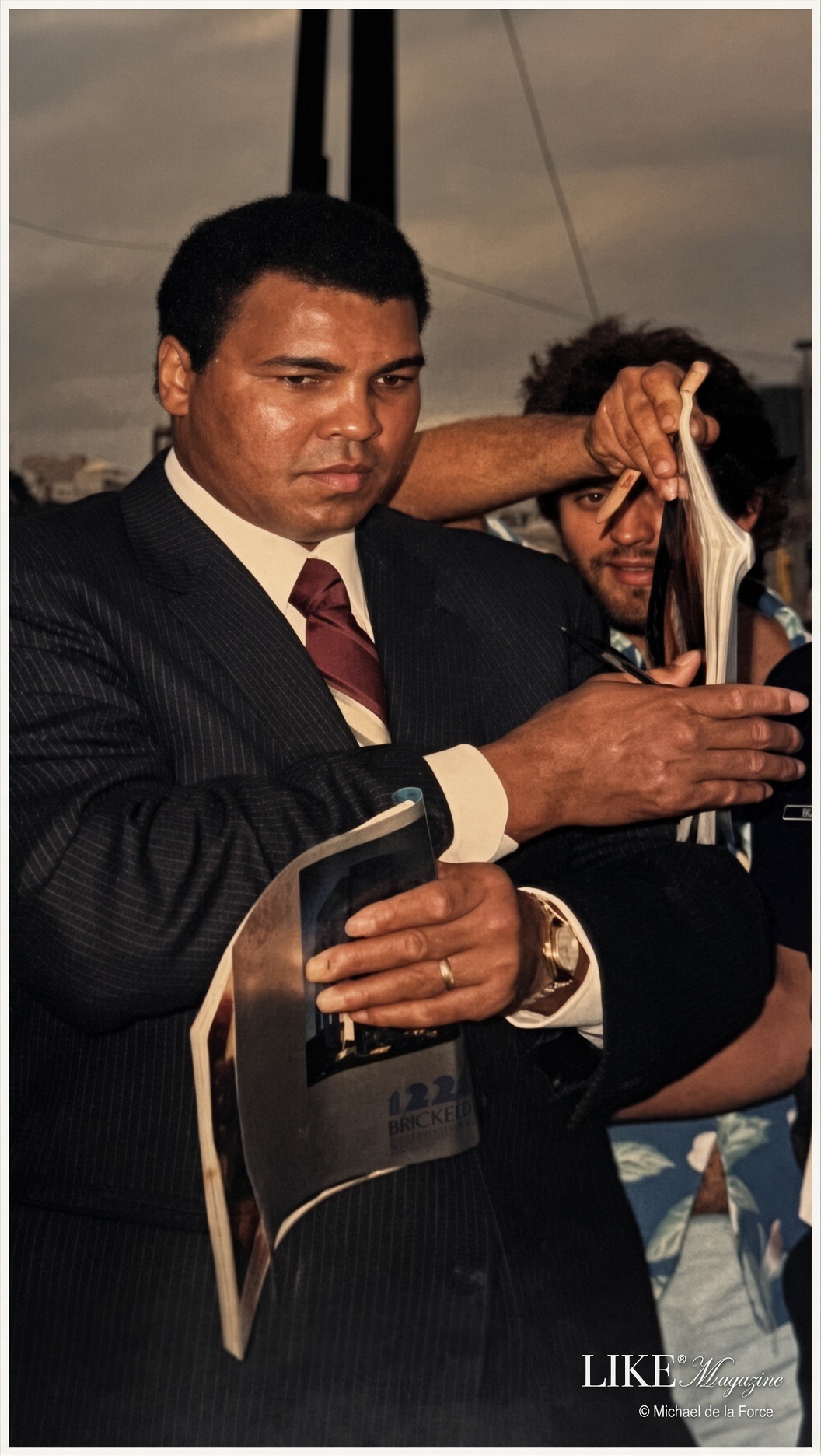
The photograph that opens this magazine article, photographed by an earlier generation of LIKE® Magazine photographers exhibits a face more settled, the presence still unmistakable. It is a picture of a man who had already become what he always said he was.
America is 250 years old this year. In that long story there have been many champions. Muhammad Ali remains the one who made the rest of us believe we could be greater too. He was Cassius Clay from Louisville. He became Muhammad Ali. He gave the country a voice that mixed poetry, principle, and joy. And the world has never stopped saying his name.