A Retrospective in Celebration of 250 Years of America
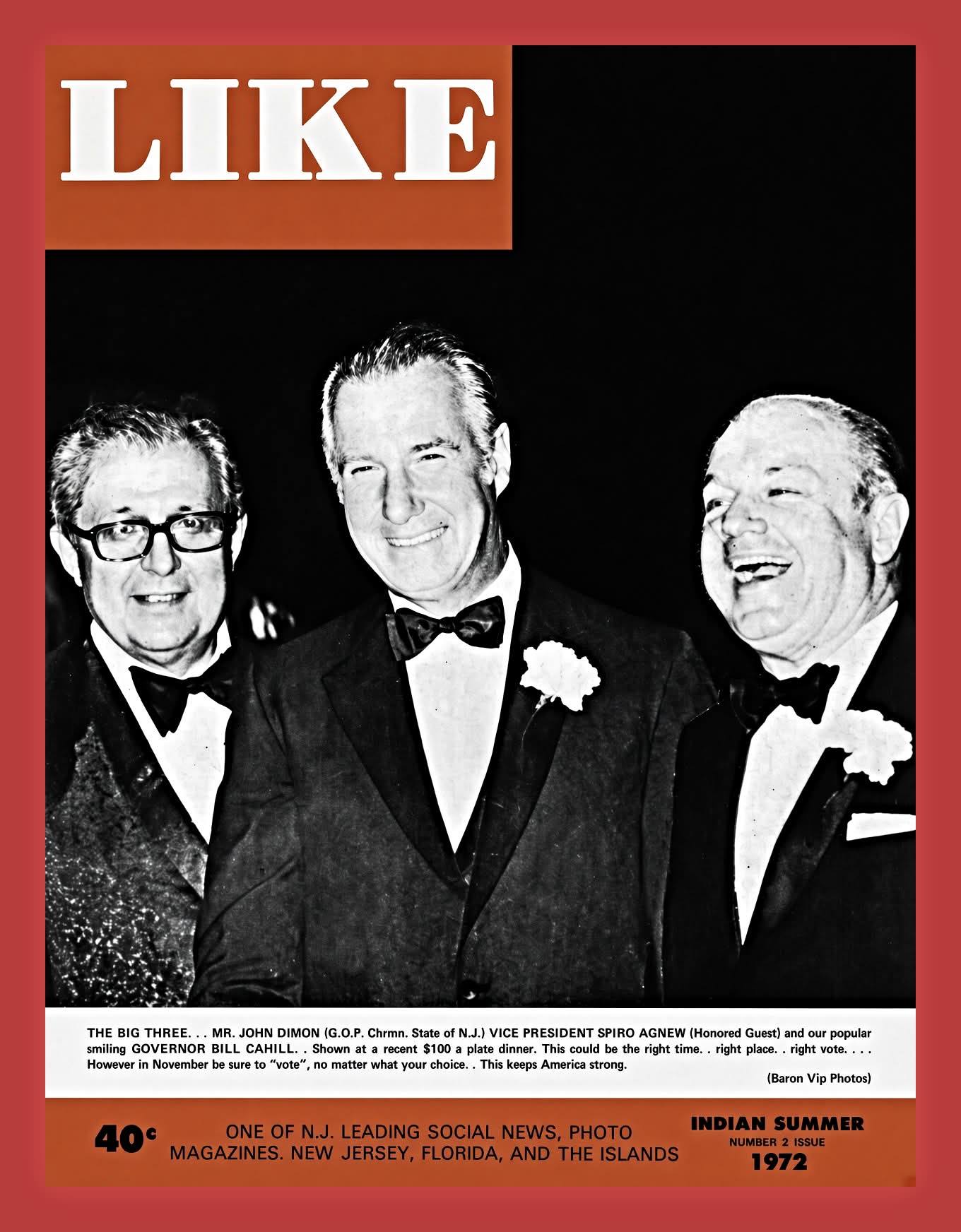
In the autumn of 1972, the social pages of LIKE® Magazine—one of New Jersey’s leading photo and social news publications covering the Garden State, Florida, and the Islands—captured a moment of Republican solidarity at a $100-a-plate dinner.
The cover featured “THE BIG THREE”: John E. Dimon, Republican State Chairman of New Jersey; Vice President Spiro T. Agnew, the honored guest; and New Jersey Governor William T. Cahill. The caption struck a classic civic note of the era: the right time, the right place, the right vote… and a reminder that, whatever one’s choice in November, participation itself strengthens the Republic.
More than half a century later, as America marks 250 years since the Declaration of Independence, that black-and-white photograph (preserved here in its original burnt-orange magazine cover frame) invites a longer look—not only at three men in formal evening wear, but at the office that stood at the center of the frame and at the quiet evolution of American constitutional continuity.
The Men on the Cover of LIKE® Magazine John E. Dimon (1916–1993), the Burlington County “country lawyer,” had been elevated only two years earlier to chair the New Jersey Republican State Committee at the personal choice of Governor Cahill. A World War II veteran who later served in the State Senate, Dimon embodied the organizational backbone of state party politics—the quiet work of building county machines, delivering votes, and keeping the party apparatus functioning between election cycles.
William T. Cahill, governor since 1970, was then riding high. A former congressman with a reputation for pragmatic liberalism within the Republican Party, he had won a landslide in 1969. By 1972 he was still widely regarded as one of the more successful Republican governors in the nation, though the year would later prove difficult: a sweeping tax-reform package (including a state income tax aimed at reducing local property taxes and equalizing school funding) failed in the legislature, and scandal would soon touch his administration. In the moment frozen by LIKE’s photographer, however, he was simply “our popular smiling Governor.”
Spiro T. Agnew, the 39th Vice President of the United States, was the national figure. Chosen by Richard Nixon in 1968 as a relative unknown (governor of Maryland for less than two years), Agnew had become the administration’s most vigorous public voice. His alliterative attacks on the press, anti-war protesters, and what he called the “nattering nabobs of negativism” made him a hero to the “Silent Majority” and a lightning rod to critics. In 1972 he and Nixon were headed toward a landslide re-election. Within a year the picture would change dramatically: Agnew resigned on October 10, 1973, pleading no contest to a charge of tax evasion arising from bribery schemes that stretched back to his days as Baltimore County executive and governor of Maryland. He became the first vice president forced from office under legal pressure.
The dinner that produced the photograph was pure 1972 political theater—fundraising, loyalty, and the projection of strength in a state that would give Nixon and Agnew a decisive victory that November.
The Office Itself: From Afterthought to Institutional Pillar
The vice presidency was deliberately modest in the original Constitution. John Adams, the first to hold the office, famously complained that it was “the most insignificant office that ever the invention of man contrived or his imagination conceived.” Its only formal duties were to preside over the Senate and to stand first in the line of succession. For most of the nineteenth century the office remained largely ceremonial; many vice presidents spent more time in the Senate chamber than in the executive orbit. Yet history repeatedly thrust the office into the center of national life. When William Henry Harrison died in 1841, Vice President John Tyler insisted he had become President, not merely “Acting President”—a precedent that settled the succession question in practice long before the Twenty-fifth Amendment formalized it in 1967. Eight presidents have died in office; one (Nixon) resigned. In each case the vice president stepped forward, sometimes with almost no preparation (Harry Truman learned of the atomic bomb only after Franklin Roosevelt’s death).
The twentieth century gradually transformed the role. Dwight Eisenhower deliberately involved Richard Nixon in cabinet and National Security Council work. Jimmy Carter and Walter Mondale completed the modern elevation: Mondale received a West Wing office, regular private access to the president, and genuine partnership. Subsequent vice presidents—Gore, Cheney, Biden, and others—operated as senior advisers, policy drivers, and, when needed, acting presidents. The office that Adams dismissed as insignificant had become one of the most consequential positions in the American system.
Agnew’s own tenure illustrated both the office’s new visibility and its enduring vulnerability. His rhetorical impact helped solidify a new Republican coalition; his resignation tested the Twenty-fifth Amendment for the first time, leading to Gerald Ford’s appointment as vice president and, less than a year later, Ford’s succession to the presidency. The orderly transfer of power—twice in thirteen months—demonstrated that the constitutional machinery designed in the eighteenth century could still function under twentieth-century pressure.
Impacts That Echo Across 250 Years Vice presidents have shaped policy, politics, and precedent far beyond the formal text of the Constitution: • John Adams and Thomas Jefferson helped define the early republic’s partisan boundaries while serving in the office. • John C. Calhoun used the vice presidency as a platform for states’-rights doctrine that would later fuel secessionist arguments. • Tyler’s succession claim established the principle that the vice president fully assumes the presidency. • Truman’s decisions in 1945 ended the war in the Pacific and opened the nuclear age. • Lyndon Johnson’s legislative mastery as vice president and then president produced the Civil Rights Act and Great Society programs. • Agnew’s combative style accelerated the polarization of political language that remains familiar today. • Modern vice presidents have driven environmental initiatives, government reform, wartime continuity, and legislative negotiation. In every era the office has served as both safety net and amplifier—ready to absorb crisis, yet capable of projecting the administration’s voice more forcefully than many presidents preferred.
Looking Forward from 1972 to 2026 The LIKE® Magazine cover of Indian Summer 1972 is a period piece: three Republican leaders in black tie, a $100 dinner, a confident party on the eve of a national landslide. It is also a reminder that American political life is continuous. The same constitutional architecture that seated Agnew beside Nixon and Cahill beside Dimon had already survived civil war, depression, world war, and assassination. It would soon survive resignation and scandal, then continue into the twenty-first century.
As the nation marks 250 years, the photograph invites a simple civic observation that the original caption already understood: institutions endure when citizens remain engaged. The right to vote, the orderly succession of power, the capacity of a republic to correct itself—these are not automatic. They are practiced, generation after generation.
The Big Three smiled for LIKE® Magazine’s camera in 1972. The Republic they served continues, tested but intact, a quarter-millennium after its founding.
Michael de la Force Editor-in-Chief LIKE Magazine Special Edition, 250 YEARS OF AMERICA