"I think feminists and progressive Democrats err when they accusingly say to Republican women, 'How can you be a Republican?'
Nobody responds to that. But if you say, 'Look, you didn't leave your party. The party left you...' I think people would."
--Gloria Steinem
Gloria Steinem walked on yesterday. She died peacefully on September 2, 2026, at her home in New York City, surrounded by people who loved her. She was 92. The statement from her foundation and Instagram was spare and true to her: a near-century well-lived, work for equality continued until the end, a gift for listening that made others feel seen.
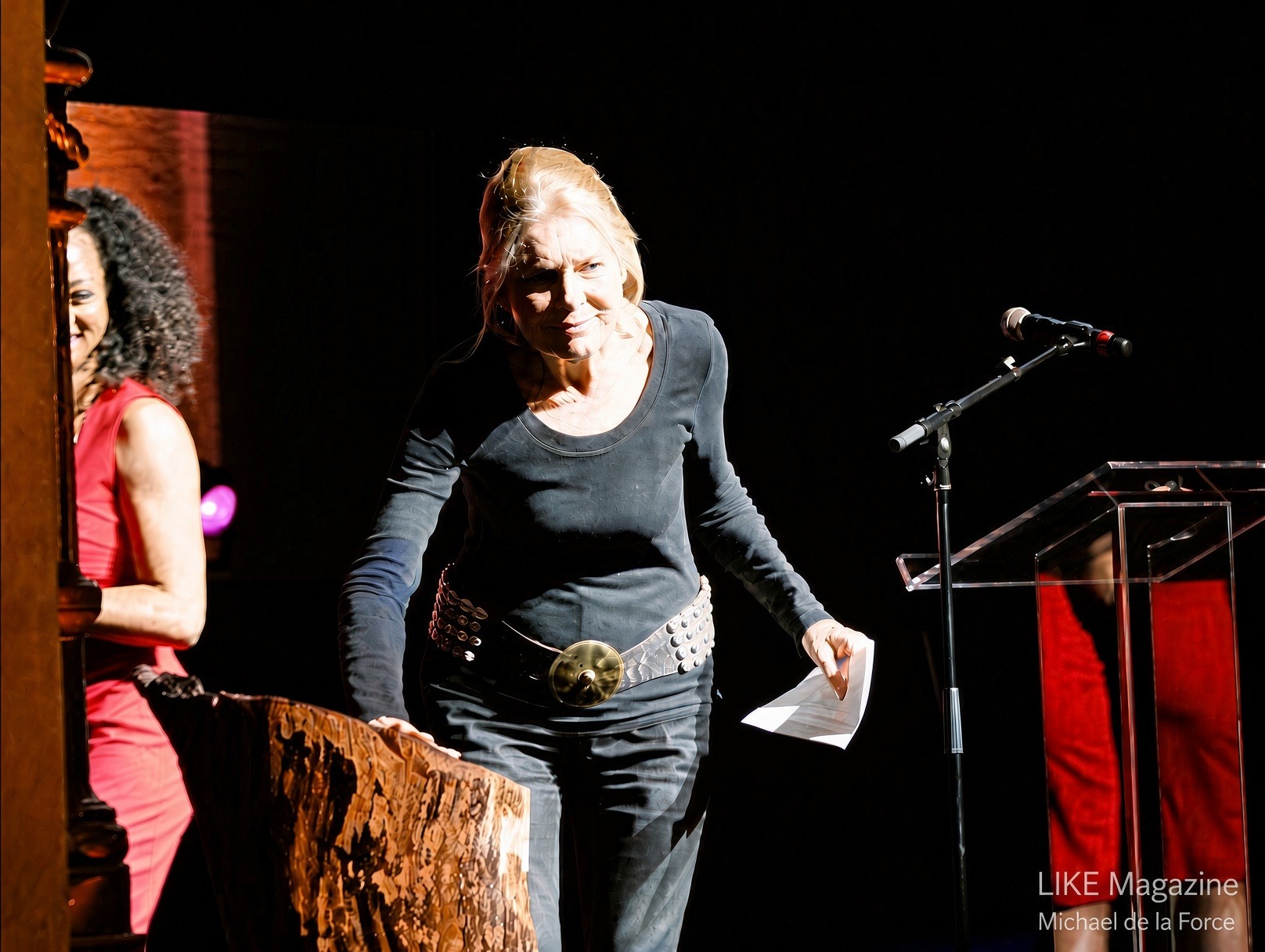
The photographs that accompany this piece are not afterthoughts. They are the through-line. One shows Steinem on the stage of Harlem’s Apollo Theater, her hand resting on a dark, polished stump while she holds notes and steps toward a microphone. The other is a diptych from LIKE® Magazine: Principal Chief Wilma Pearl Mankiller receiving the Presidential Medal of Freedom from President Bill Clinton in the White House, and Mankiller standing in her book-lined home in Adair County, Oklahoma, beside journalist and photographer Michael de la Force.
A mapped life spent in print, on the road, and in chosen family.
The Tree of Hope
The object Steinem is touching in Michael de la Force’s photograph is the Tree of Hope. It is not a rock. It is the stump of a tree that once stood on Seventh Avenue at 131st Street, in front of Manhattan’s old Lafayette Theatre. Unemployed performers gathered there in the 1930s, sang, danced, and told jokes, believing the tree brought luck. When the tree was cut down, Ralph Cooper—the creator of Amateur Night at the Apollo—had the stump brought inside the theater. Contestants still rub it before they walk onstage. James Brown, Ella Fitzgerald, Michael Jackson, and countless others have laid a hand on it.
On June 26, 2014, Steinem was at the Apollo for the launch of United Nations “Empowering Women, Empowering Humanity: Picture It!” campaign marking twenty years since the Beijing Conference. Steinem spoke. De la Force was there with his camera. In the frame she is not posing for history; she is doing what she always did—moving toward the next sentence, the next room, the next person who needed to be heard—while her fingers find the same wood that generations of artists had touched for courage. The woman in red behind her, the Plexiglas lectern, the paper in her hand: all of it is work in motion.
A Career Built in Ink
Steinem’s publishing career began the way many women’s careers did in the early 1960s—by being assigned the stories men did not want. The 1963 Show magazine piece “I Was a Playboy Bunny” made her famous and, for a time, boxed her in. She spent years proving she was more than the undercover waitress in ears and tail. In 1968 she helped found New York Magazine and wrote political columns that treated women’s lives as news. Covering an abortion speak-out in 1969 changed the direction of everything that followed. She realized the most common experience of her generation of women had been treated as unspeakable. She began to speak.
Ms. Magazine was the institutional answer. What started as a newsletter idea became, at the urging of other women in media, a glossy magazine. Clay Felker agreed to run a forty-page preview inside New York in December 1971. The standalone Spring 1972 issue sold out 300,000 copies in eight days. Bags of mail arrived. Women wrote that they had not known they were not alone. The title itself—Ms.—was an argument: a woman exists independently of whether she is married. The magazine published Johnnie Tillmon on welfare as a women’s issue, petitions signed by women who had had abortions, reporting on domestic violence, sexual harassment, the Equal Rights Amendment, and lesbian lives at a time when those subjects were radioactive. It was owned and staffed by women. It was never only a magazine. It was a movement that happened to have a masthead.
Steinem stayed with Ms. through commercial ownership changes, financial near-death, and its eventual home at the Feminist Majority Foundation. She co-founded the National Women’s Political Caucus, the Ms. Foundation for Women, Voters for Choice, and later the Women’s Media Center. She wrote Outrageous Acts and Everyday Rebellions, Revolution from Within, Marilyn, and the memoir My Life on the Road. She kept taking the bus, the plane, the invitation to a campus or a community center because, as she told the AP, “You have to be there with all five senses.” The honors that followed were official recognition of a career the newsroom had once tried to contain. In 1993 she was inducted into the National Women’s Hall of Fame. In 2000 The Library of Congress named her a Living Legend. In 2013 President Barack Obama placed the Presidential Medal of Freedom around her neck and called her a trailblazing writer who had shaped debates on sex and race and forged new opportunities for women in media; Steinem answered that the medal belonged to the entire movement. Spain awarded her the Princess of Asturias Prize for Communication and Humanities in 2021. Rutgers University created an endowed chair in media, culture, and feminist studies in her name. Other journalists measured her differently than the early scoffers had. Harry Reasoner predicted Ms. would run out of things to say in six months. Gay Talese once dismissed her, within earshot, as “this year’s pretty girl” in journalism. She outlasted both remarks by more than half a century. Jane Fonda, who co-founded the Women’s Media Center with her, said the first thing she felt in Steinem’s presence was safety: though barraged by demands, Steinem would stop and listen. Rebecca Traister, writing in New York Magazine after Steinem’s death, put the professional point simply—Steinem loved women, and she spent a lifetime turning that love into reporting, institutions, and rooms where other women could speak. Julie Burton of the Women's Media Center noted that Steinem once thanked Justice Harry Blackmun for saving more women’s lives than anyone in U.S. history; colleagues now said the same of Steinem’s own decades in print. The Ms. staff’s farewell was the cleanest line of all: she changed the story women were permitted to tell about themselves.
Chosen Family and the Oklahoma Connection
Wilma Mankiller entered that story through the same pages. She was named Ms. magazine’s Woman of the Year in 1987. She joined the board of the Ms. Foundation for Women. The two women met in the mid-1980s and became, in Steinem’s words, “a chosen family.” They vacationed together, sat with each other through illness, and stood together at public events. Steinem married David Bale at Mankiller’s home in 2000; Charlie Soap helped officiate. When Mankiller’s pancreatic cancer accelerated in 2010, Steinem spent two weeks at Mankiller Flats in Adair County. She was there when her friend walked on. Signal fires were lit in twenty-three countries. Steinem spoke at the memorial and later at a tree-planting in Oklahoma City, using water from the spring Mankiller loved.
Annie Leibovitz went to Oklahoma to photograph the chief of the Cherokee Nation. Steinem later recalled that journey as characteristic of Leibovitz: she wanted the real person where she lived, not a studio construct. The resulting images, and Leibovitz’s long collaboration with Steinem on the Women portrait projects, sit in the same lineage as the Ms. covers—women looking at women who had changed the terms of the conversation.
The White House photograph in the LIKE® Magazine collage is from January 15, 1998. President Bill Clinton is presenting Mankiller the Presidential Medal of Freedom, the nation’s highest civilian honor. The embrace is unscripted. Mankiller, who had survived a near-fatal car accident, myasthenia gravis, and a kidney transplant, stands in the East Room as the first woman elected principal chief of a major tribal nation. The companion frame—Mankiller and de la Force in her home library, books stacked to the ceiling, antlers and artifacts on the shelves—is the private counterpart: the same woman at home in Adair County, the place she returned to after the federal relocation to San Francisco.
Michael de la Force’s path to that Oklahoma living room began with a supplemental magazine that he created for LEADERS Magazine, which he titled “Women Leaders.” That initial work led him to Mankiller’s work. She, in turn, introduced him to her dear friend Gloria Steinem. The photographs that followed—Steinem at the Apollo Theater, Mankiller at home—are the record of that introduction made visible.
In 2022 the United States Mint placed Mankiller on a quarter as part of the American Women Quarters Program. The reverse shows her in a traditional shawl, looking forward, the seven-pointed star of the Cherokee Nation beside her. Gloria Steinem’s words appear on the Wilma Mankiller Foundation site: “In a just world, Wilma Mankiller would have been President, but now, she will be on a coin that is part of our daily lives.”
What Remains
Steinem’s publishing life was never separate from the rest of it. The Playboy piece, the New York columns, the founding of Ms., the books, the speeches at the Apollo and a thousand other rooms—all of it was the same act: putting women’s actual experience into public language and then refusing to leave the room. She co-founded institutions so the work would outlast any single byline. She kept showing up for friends whose names were less famous until they were not.
The Tree of Hope at the Apollo Theater is a piece of wood that performers touch because they believe luck can be transferred by contact. Steinem’s hand on that stump in 2014 is one more transfer: from the women who wrote letters to Ms. Magazine in 1972, to the chief who rebuilt a nation in Oklahoma, to the photographer who carried both stories into LIKE® Magazine, to anyone reading this after she has walked on.
Steinem spent her life making sure the next person did not have to invent the language from scratch. The magazines, the photographs, the friendships, and the quarter in someone’s pocket are what that looks like when it works.
(LIKE® Magazine, 9.3.2026)