The World Economic Forum convened its inaugural Annual Meeting of Global Future Leaders here Oct. 13–15, gathering more than 700 leaders and experts — including 300 Young Global Leaders — for three days of intergenerational dialogue on the forces reshaping the decade ahead.
Held in collaboration with the government of the United Arab Emirates, the inaugural meeting was designed as a bridge: today's decision-makers on one side, the leaders who will inherit their consequences on the other, working together on what the Forum calls forward-looking responses to shared challenges.
A New Table, by Design
Participants drew from the Forum's Young Global Leaders community and its alumni, alongside select Global Shapers and Social Innovators, joined by senior figures from government, business, academia, science, technology and civil society. The premise was deliberate — that emerging leaders should have a voice in the decisions that will define their working lives, not merely live with the outcomes.
"The decisions we make today will shape the world the next generation inherits. Emerging leaders should have a voice in those decisions, not just live with their consequences," said Alois Zwinggi, president and CEO of the World Economic Forum and Principal Chairman of the Annual Meeting of Global Future Leaders. "This inaugural meeting will bring different generations and perspectives together to look beyond immediate challenges and work together on practical ideas for the decades ahead."
Mohammad Al Gergawi, minister of Cabinet affairs of the United Arab Emirates and Principal Chairman of the Annual Meeting of Global Future Leaders, framed the gathering as an extension of the Emirates' long-running partnership with the Forum — and of a conviction that leadership itself must be prepared, not merely awaited.
"This meeting reflects the strong partnership between the UAE government and the WEF, and a shared commitment to advancing international cooperation and constructive global dialogue," Al Gergawi said. "At a time of rapid technological, economic, and geopolitical transformation, preparing future leaders is more important than ever. By bringing together emerging voices from around the world, we aim to equip them with the insights and tools needed to turn challenges into opportunities for innovation, growth, and sustainable development."
What Is on the Agenda
The program was organized around six strategic themes: geopolitical uncertainty, technological disruption, economic resilience and prosperity, leadership, science and innovation, and climate and nature. Sessions with titles like "Trust Test for Agentic AI," "Working the Line: Humans and Machines," "Trade in a Changing World" and "Economics after Certainty" signaled where the conversation was headed — toward the practical mechanics of an economy being rewritten by artificial intelligence and a trading order under strain.
The agenda reflected findings from the Forum's "Youth Pulse 2026: Insights from the Next Generation for a Changing World" research, drawn from about 4,600 young people ages 18 to 30 across 144 countries and territories — persistent anxieties over jobs, economic uncertainty and climate, alongside a thread of optimism about their own agency observed across a decade of the Forum's youth research. How AI and other frontier technologies are reshaping work and opportunity sat at the center of the discussions.
The meeting was co-chaired by Montenegro Prime Minister Milojko Spajić; Ohood Bint Khalfan Al Roumi, the UAE's minister of state for government development and the future; Fadel Adib, professor and entrepreneur at the Massachusetts Institute of Technology; Khalfan Belhoul, chief executive officer of the Dubai Future Foundation; and Mirjam Staub Bisang, chair of BlackRock Switzerland.
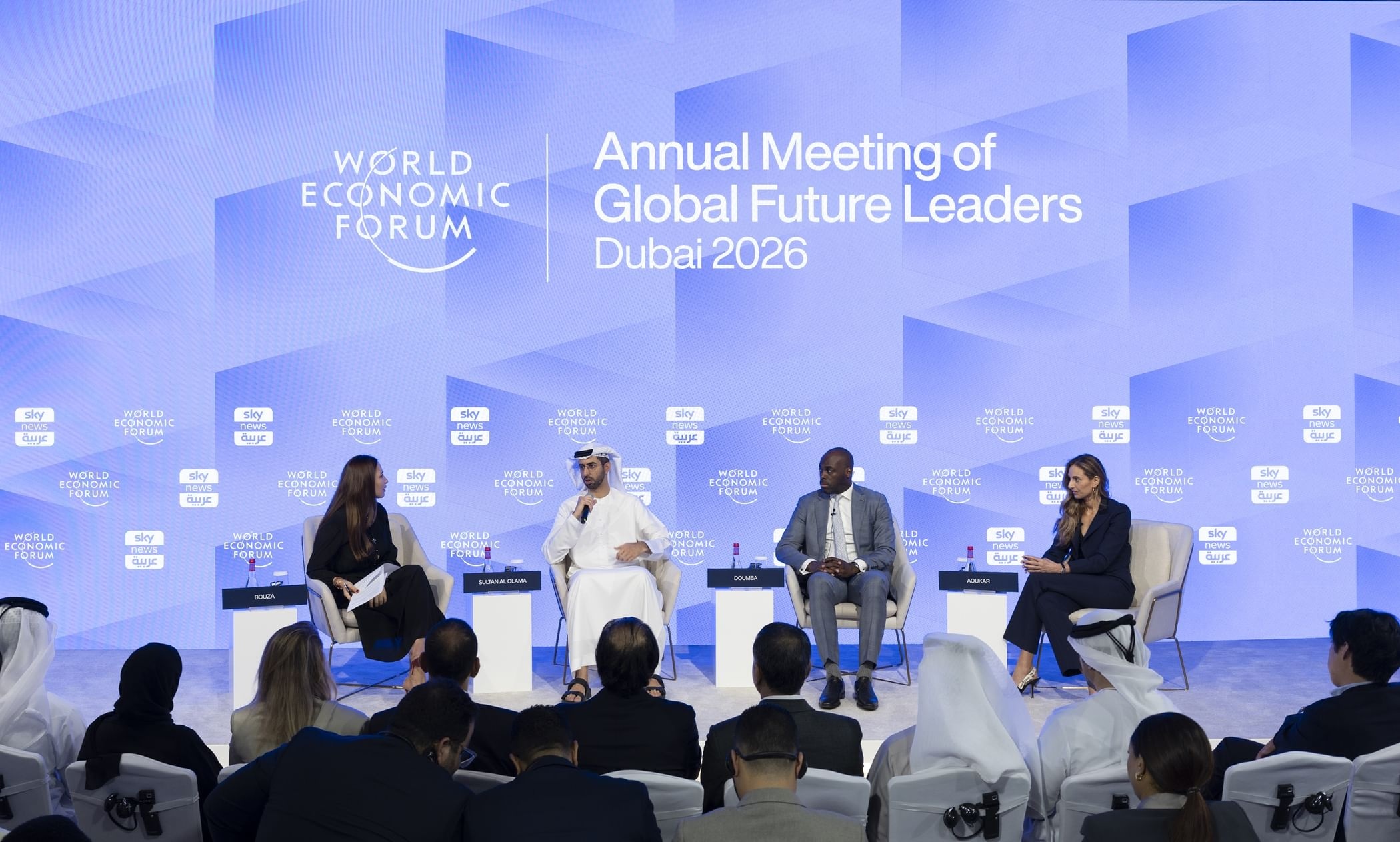
Future 20 and New Research
Dubai also saw the launch of Future 20, bringing together 20 next-generation leaders working across growth, innovation and resilience — 20 outstanding leaders under 30 drawn from the Forum's Global Shapers network. New research published during the meeting included the Leadership Commitment Framework, a self-assessment tool developed by the Global Future Council on Leadership and the Forum of Young Global Leaders, along with Middle East and North Africa-focused analysis of AI applications for sustainable development and work on data-center infrastructure optimization — the physical backbone of the AI economy.
Insights from the three days will feed directly into the Forum's ongoing work, including its Strategic Intelligence gathering in Geneva and the Annual Meeting 2027 in Davos-Klosters.
Select sessions were livestreamed, and the conversation ran across social media under #AMGFL26.
The Meeting, Day by Day
The meeting's first day produced a headline of its own: the United Arab Emirates, in partnership with the World Economic Forum, opened a global dialogue to develop "Global Principles for Strategy in the Agentic AI Era" — a framework to guide how governments and institutions redesign strategic planning and decision-making as agentic AI systems gain the autonomy to reason, coordinate and act. The principles are one of the main initiatives of the Global Strategic Intelligence Programme, the UAE-WEF partnership formalized at Davos in January. Huda Al Hashimi, the UAE's deputy minister of Cabinet affairs for strategic affairs, said the Emirates seeks to develop shared principles that keep pace with the rapid advancements in artificial intelligence.
The meeting's second day brought its biggest concrete announcement: Mohammad Al Gergawi used the opening plenary to unveil three new UAE–World Economic Forum initiatives — a $1 million Global Innovation Challenge and Agentic AI Award, a Centre for Global Future Opportunities, and Future 20, a program spotlighting 20 leaders under 30. The challenge, run with the Forum's Global Shapers across 150 countries and territories, opened Oct. 15 with a single question: how can agentic AI help solve real-world challenges facing people and cities? The $1 million will be shared among three winners, to be named at next year's meeting. It is the action arm to day one's framework — principles on day one, prize money and a policy engine on day two.
Dubai's Love Language
Every city has a love language. Dubai's is bespoke.
Weeks before the Forum convened, Rolls-Royce's Private Office Dubai unveiled the Phantom Hummingbird — a one-off Phantom Extended commissioned as a private tribute from a husband to his wife, and the first motor car in the marque's history to wear abalone shell marquetry.
The bird is the brief. The hummingbird — "joy, resilience and the ability to find beauty in every moment," in the marque's words — is rendered in materials that behave the way feathers do. Abalone shell, prized for the blue-green fire of its nacreous heart, is married to mother-of-pearl so the inlay shifts with the light. Each hummingbird on the rear picnic tables is built from 53 pieces, 18 for the wings alone; an 84-piece botanical composition runs the Waterfall between the rear seats. More than nine months of development, six iterations, 45 hours of hand-finishing — for three panels most eyes will never fully see.
Outside, restraint: White Sands over Wildberry, split by a hand-painted coachline carrying a single hummingbird in flight.
In a week devoted to how the next generation will lead, the Hummingbird argues for something older — that devotion is patience, that the finest things are still made slowly, by hand, for one person.

Closing Day
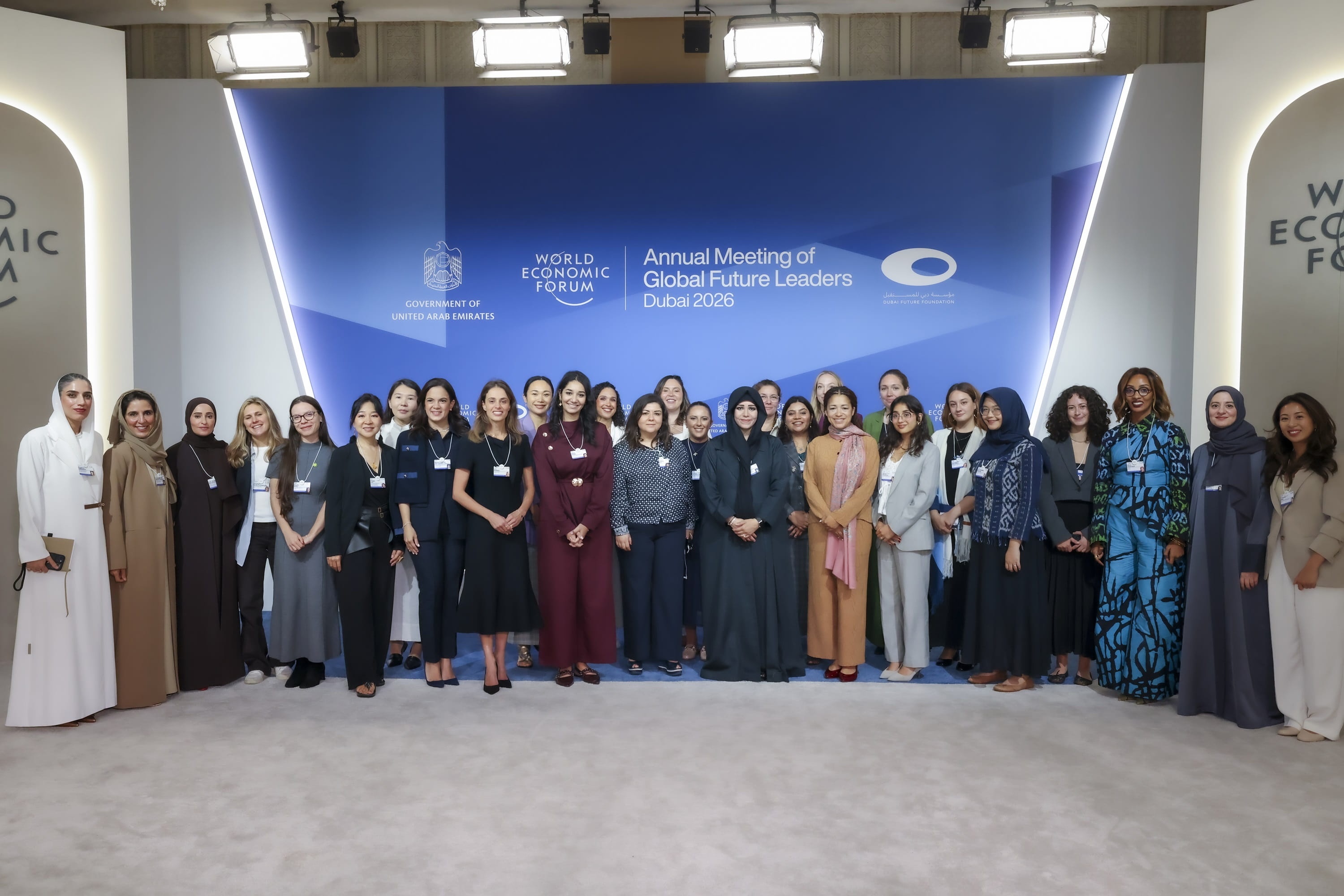
On the meeting's final day, the royal-family thread ran through the sidelines: Sheikha Latifa bint Mohammed bin Rashid Al Maktoum, chairperson of Dubai Culture and Arts Authority (Dubai Culture), hosted a "Women Leading the Future" majlis alongside the Annual Meeting of Global Future Leaders — 29 women leaders from 22 countries, across government, science, finance, culture, entrepreneurship and technology, talking leadership, technology and the partnerships the next generation needs.
The capital is following the talent: the Savills Next Generation Wealth Hubs Index, published Oct. 1, ranks Dubai and Abu Dhabi among the world's top 10 hubs for next-generation wealth. For high-net-worth individuals under 40, Abu Dhabi is ranked eighth and Dubai tenth globally, alongside New York, Miami, London, San Francisco and Los Angeles. The ranking landed less than two weeks before the Future Leaders meeting convened.
The meeting was a starting line, not a finish. More than 700 leaders and experts concluded the three-day gathering, including 78 top officials from governments and international organizations and more than 150 chief executives and board chairs. Alois Zwinggi, the forum's president and chief executive officer and a principal chairman of the meeting, said "the future should not be governed by yesterday's assumptions," adding that leaders had tested ideas, launched initiatives and identified ways to keep the work moving beyond Dubai.
The UAE government and the Global Shapers Community launched the Global Agentic AI Award and Innovation Challenge, a year-long initiative inviting all 500 Global Shapers hubs to put agentic AI to work on local community challenges, with $1 million awarded annually over five years and winners recognized at the Annual Meeting of Global Future Leaders 2027. Entries will be judged on innovation, feasibility, scalability, accountability and measurable impact, with solutions due by March 2027.
New research set the economic stakes: the forum estimates artificial intelligence could unlock more than $1 trillion in economic and sustainability value across the Middle East and North Africa by 2030. The meeting also launched the Leadership Commitment Framework, a self-assessment tool for the next generation of leaders; advanced the Global Alliance for Future Generations, with UAE-based Apparel Group joining more than 20 companies; and produced a two-year partnership between the forum and the Mohamed bin Zayed Water Initiative to accelerate practical solutions to water scarcity ahead of the 2026 U.N. Water Conference in Abu Dhabi.
Most people meet artificial intelligence as a search box, perhaps Googling a name. The Mohamed bin Zayed University of Artificial Intelligence, founded in Abu Dhabi in 2019 as the world's first graduate-level AI research university, works at the other end of that spectrum: its researchers build the machine-learning, computer-vision and language systems that do not just find information but learn from data, make judgments and act. It is the same family of technology as the agentic AI debated across the meeting's three days. Together with the Centre for Intelligent Future, the university also expanded AI for All, bringing practical AI skills to young leaders in 100 cities.
Mohammad Al Gergawi, the UAE minister of cabinet affairs and principal chairman of the meeting, gave the week its closing line: "Today we move from discussing the future to shaping it with you. We want partnerships that turn into action, opportunities that turn into achievement, and impact that reaches generations to come." What began in Dubai now feeds the forum's Strategic Intelligence work and the road to Davos-Klosters, where the Annual Meeting 2027 convenes Jan. 18–22.