FRANCIS MARK RICHARDS: SERGEANT OF THE LYON LEGION, MERCHANT AND POSTMASTER OF ROME, MISSOURI
Staff Reports, LIKE® Magazine · Family photographs courtesy of Michael de la Force · Leaders · October 16, 2026
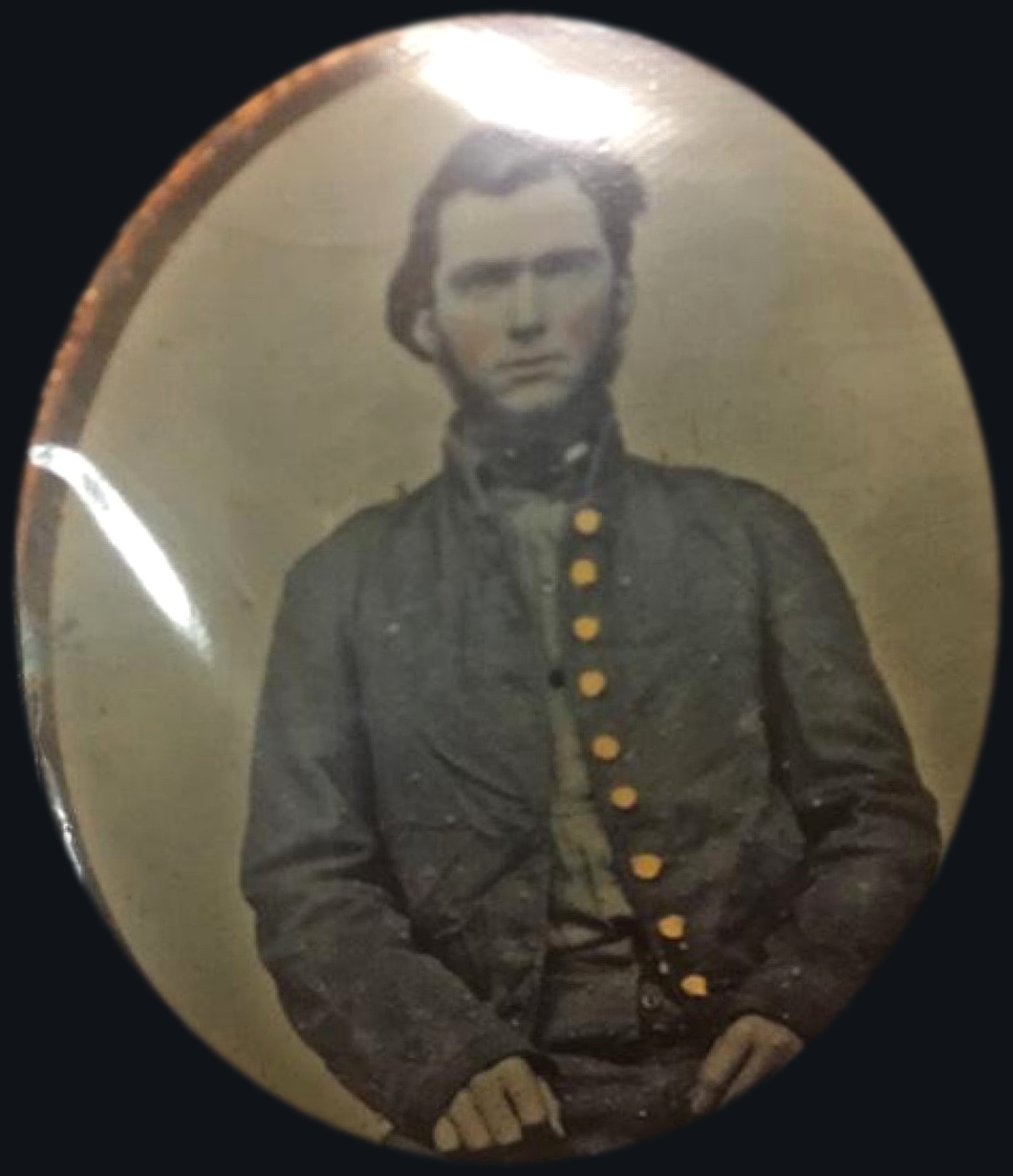
Frank Richards in Union uniform, c. 1862 — the tintype portrait labeled “Frank Richards in Civil War abt 1862.” Richards family archive.
A 250 YEARS OF AMERICA portrait.
ROME, Mo. — He was orphaned at 14, walked away from a Tennessee farm for the Missouri frontier at 20, and came home from the Civil War a sergeant who had held a pontoon bridge under fire. Then Francis Mark Richards built the rest of his life in one small Ozark town: a general store, a 350-acre farm, an interest in the roller mills — and 23 years as postmaster of Rome, Missouri, across two tenures.
This is his story, assembled from the 1894 county history that recorded it while he was still living, from census enumerations, and from the family lines he left behind.
Orphaned young in Tennessee
Francis Mark Richards was born March 31, 1838, in Monroe County, Tennessee, a son of Frederick Richards and Elizabeth (Renfro) Richards, according to the family archive. (The 1894 county history, written while he was living, gives March 31, 1836 — a two-year discrepancy the records do not resolve.) His father, a Kentuckian and son of John Richards, died when Francis was about 2 years old. His mother died when he was 14. He was one of eight children: Samuel, John, Halloway, Peter, Francis himself, Mallissa, Margaret and Martha. The 1850 census shows a Francis Richards, about 14, in the household of Elizabeth Richards in Monroe County — a strong match for the boy the biography describes.
In 1856, at 20 and still unmarried, he came to Missouri and took up farming near Springfield, in Greene County. There he married Elizabeth Nablett, daughter of John and Barthena Nablett — in family records Martha “Elizabeth” Noblett (1834–1927). The marriage dates in the records do not sit easily together: family records give the marriage as Jan. 8, 1855, a year before the county history’s unmarried arrival, with the marriage recorded again Jan. 28, 1858, in Greene County.
Three months in the Home Guards, three years in the regulars
When the Civil War opened, Richards enlisted — first for three months in the Home Guards, then for three years in the regular service. He joined Company K of the 24th Missouri Volunteer Infantry, the regiment known as the Lyon Legion for Brig. Gen. Nathaniel Lyon, killed at Wilson’s Creek in 1861. The regiment was organized in the fall of 1861 under Col. Sempronius H. Boyd.
Richards rose to sergeant of Company K. His biography credits him with service at Tupelo, Pea Ridge, Little Rock, Camden, Devall’s Bluff, Cotton Plant and Old Town Bridge — and with detached duty of a particularly exposed kind: he had charge of the pontoon bridge at Jenkins’ Ferry and held it until he had destroyed it. The history calls him “an excellent soldier” who “served his country well in the sanguinary struggle between the North and South.” He received his discharge Oct. 19, 1865.
His brother Halloway served in the war as well.
Rome, Missouri
After a short time in Lawrence County, Richards moved to Douglas County in 1867 and settled on a farm two miles from Rome. The Rome he came to was still marked by the war: during the conflict the Union army had built Fort Lawrence at Lawrence Mill on Beaver Creek, to guard the mill and the road up from Forsyth, and Confederate forces had captured and burned it in January 1863. Richards worked the soil until 1872. That year he opened a general mercantile store in Rome and built it into what the county history called “an extensive business,” making him, in its judgment, “one of the leading merchants of the county.” Alongside the store he owned a fine farm of 350 acres at Rome and held an interest in the roller mills there.
In 1886 he took a partner: Andrew R. Turner — the same Turner who would succeed him as postmaster in 1893 — gave up farming and entered the merchandise business with Richards. The partnership became kinship: Turner’s daughter Nancy Alice married Richards’s son Mark.
Public life followed commerce. He held the office of county registrar. He belonged to Grand Army of the Republic Post No. 309 at Roy and to the Independent Order of Odd Fellows. He and his wife were church members, and he served as superintendent of the Sabbath school for more than 20 years. He was, the history says, “a public-spirited man” and “popular with all classes.”
And for 22 years, he was postmaster at Rome.
Twenty-three years at the post office, in two tenures
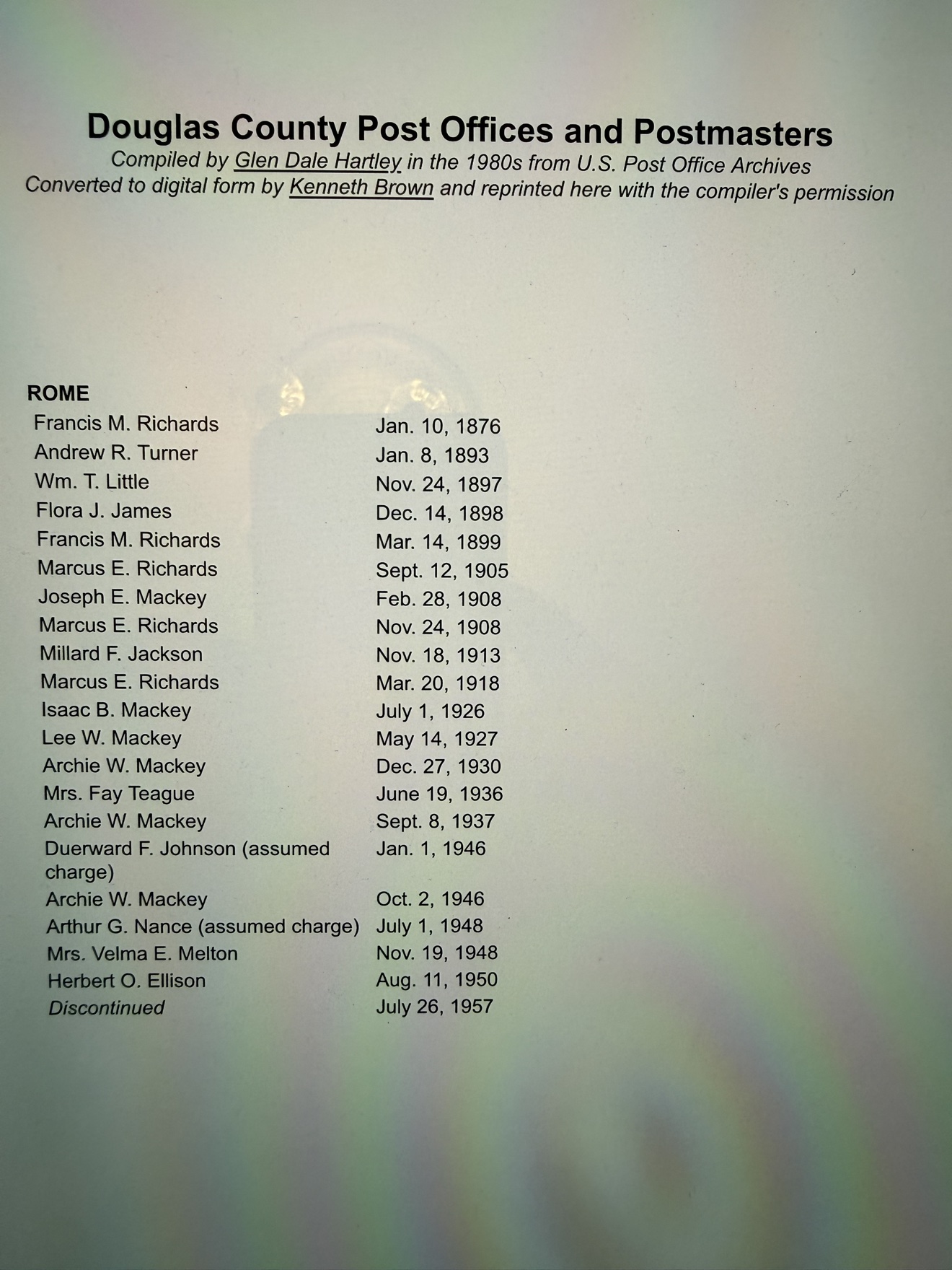
The family archive has now supplied what the federal database could not: the postmaster list for Rome, Missouri. “Douglas County Post Offices and Postmasters,” compiled by Glen Dale Hartley in the 1980s from U.S. Post Office Archives, is the documentary record — and it confirms the family’s understanding. Francis M. Richards is the first name on the Rome list, appointed Jan. 10, 1876. He was Rome’s founding postmaster — and, on the place-name record, the man who named the town. The State Historical Society of Missouri’s place-name files describe Rome as “a post office established before the Civil War and named by Frank Richards after Rome, Italy” — a second, independent credit for the naming, from a 1933 University of Missouri thesis. That earlier office did not survive the war: the Douglas County Herald’s historical notes record that the Rome post office “was one of the earliest post offices, but was discontinued for a time during the war and then re-established later.” On that record, Richards named the town for the Eternal City before the war and lost the office to it — though his own biography has him settling in Douglas County only in 1867, and the two records do not reconcile. From 1876 the ground is documentary: he got the office back as first postmaster of the re-established office. A Monitor News Service feature by Cora Slaughter on the many Romes of America likewise credits “the first postmaster, Frank Richards,” with choosing the name — for Rome, Italy, as most American Romes were named; writing of another Rome, the feature calls the impulse the era’s “sentimental bias toward antiquity.” The feature independently confirms the office’s establishment date, Jan. 10, 1876, and adds a period snapshot: by 1884 the town’s population had “zoomed to 60.” It also records the office’s end: “there is no longer a postmaster or post office and the folks of Rome, Douglas County, get their mail through Ava, Mo.”
The Rome postmaster list from Glen Dale Hartley’s Douglas County Post Offices and Postmasters, compiled from U.S. Post Office Archives: Francis M. Richards, appointed Jan. 10, 1876. Photograph by Michael de la Force.
He served until Jan. 8, 1893, when Andrew R. Turner — the 1894 county history calls him “the Republican postmaster at Rome” — succeeded him: a first tenure of 17 years. Then Richards came back. Reappointed Mar. 14, 1899, he served until Sept. 12, 1905, six and a half years more — more than 23 years at the Rome post office all told. The 1894 biography credits him with 22 years; the archive now gives the exact spans.
The federal Postmaster Finder, the Postal Service’s modern database, carries no entry for a Rome, Missouri, post office — its pre-1971 records are incomplete and added only on request — which makes the Hartley compilation, drawn from the Post Office Archives themselves, the documentary record of his service.
The story did not end with him. The Rome list keeps the postmastership in the family: Marcus E. Richards — Francis Mark’s son, the miller at Rome — held the office three times, from Sept. 12, 1905, from Nov. 24, 1908, and from Mar. 20, 1918. Father and son, two generations at the same postal window — and a third: Gertie May Fulton, the daughter of Mark and Alice Turner Richards and granddaughter of Francis and Elizabeth, married Ben Fulton in 1911, and Ben operated a store “with gas pumps” and the post office at Rome, as Gertie’s daughter Ruby Cunningham recorded in the county historical society’s journal.
The Rome post office outlived them both by decades. It was discontinued July 26, 1957 — 182 years to the day after the Second Continental Congress created the United States Post Office.
The post office he served
Richards held his office during a hinge in American postal history, and the dates line up like a second biography.
The institution he served was born July 26, 1775, when the Second Continental Congress created the position of Postmaster General and named Benjamin Franklin to it — more than sixty years before Richards was born. The first great postal law followed in 1792, organizing the service as the Post Office Department and encouraging the exchange of newspapers at nominal rates so the new democracy could read itself. The first American postage stamps appeared in 1847, when Richards was a boy. The Pony Express ran its brief legend in 1860–61. Free city delivery began in 1863, while Richards was in uniform; from that year, postage no longer depended on distance.
He took the Rome counter as the innovations were arriving almost annually. Postal cards were issued in 1873, three years before Richards became postmaster. In 1874, the United States joined 21 other nations in signing the Treaty of Bern, creating the General Postal Union — the body now known as the Universal Postal Union — and American mail entered a single worldwide postal territory. The first commemorative stamps were issued in 1893, the last year of his first tenure.
And in that same year, 1893, Congress appropriated $10,000 to experiment with Rural Free Delivery — carrying the mail to the farm instead of requiring the farm to come to the mail. The experiment began October 1, 1896, in three West Virginia towns, in the interval between Richards’s two tenures; within a year 44 routes ran in 29 states; on July 1, 1902 — while he was back behind the Rome counter for his second tenure — it became permanent nationwide. He administered the old world, walk to town and ask at the window, and lived to see the new one arrive.
What followed belongs to the century after him: Parcel Post in 1913, scheduled airmail in 1918, the ZIP Code in 1963, and the Postal Reorganization Act of 1970, which made the department the independent United States Postal Service in July 1971. The through-line never changed: one service, bound to reach everyone.
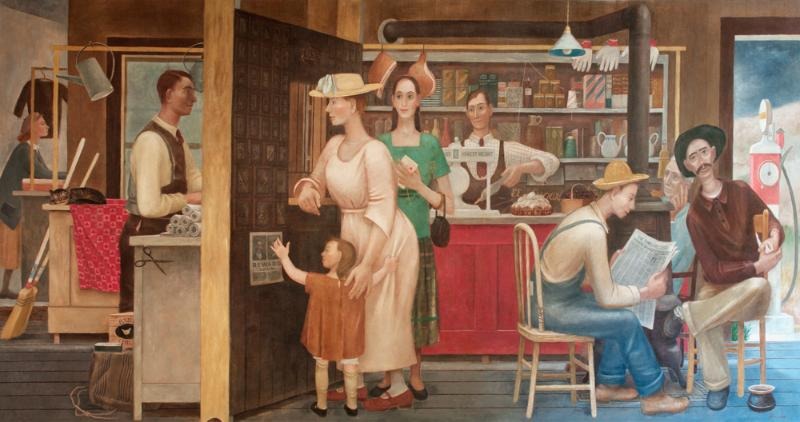
The country store-post office he embodied was so central to American life that the New Deal’s Section of Fine Arts commissioned murals of it for post office walls. Doris Lee’s General Store and Post Office — a woman at the postal window, a farmer reading the newspaper aloud, the aproned keeper selling sundries — could be Rome, Missouri, on any day of Richards’s 22 years. The General Services Administration, which holds the work, notes the plain fact behind the painting: until the turn of the twentieth century, the general store often was the post office for rural America.
Doris Lee’s “General Store and Post Office,” a New Deal-era mural commissioned by the Section of Fine Arts for a post office wall — the country store that was the post office, the world Francis Mark Richards inhabited as merchant and postmaster of Rome, Missouri. U.S. General Services Administration Fine Arts Collection.
One postal territory
The worldwide thread of Richards’s story is the Treaty of Bern. On October 9, 1874 — fifteen months before Richards took the Rome office — the United States joined 21 nations in Switzerland to sign away the maze of bilateral postal treaties and replace it with a single postal territory for the reciprocal exchange of mail. The General Postal Union was renamed the Universal Postal Union in 1878. It became a United Nations specialized agency in 1948. Today it counts 192 member countries, headquartered still in Bern, and October 9 is observed as World Post Day.
A letter mailed at Richards’s window in Rome could, in his lifetime, travel under one set of rules to any of those nations — the Ozark hills joined by paper to Bern, to Paris, to Tokyo. The post office he kept was a local room in a global system, and it still is.
The family
To Francis and Elizabeth Richards were born nine children named in the 1894 biography — FamilySearch’s LifeStory credits the couple with 14 children in 19 years. Seven lived to adulthood:
Marcus E. Richards, a farmer and miller at Rome, married Nancy A. Turner, daughter of Andrew R. Turner and Margaret (Lietch) Turner of Douglas County. Their children, as of the mid-1890s: Albert, Emmett and Gertrude Richards — Gertrude, “Gertie May,” who later married Ben Fulton; Ben operated a Rome store and the post office. Turner’s own biography in the same county history confirms the match, describing Marcus as the successful miller at Rome. The postmaster list shows Marcus held the Rome post office himself three times — from Sept. 12, 1905, from Nov. 24, 1908, and from Mar. 20, 1918.
William Francis Richards — the 1894 history calls him William Richards — a farmer and blacksmith of Lawrence County. The Find a Grave memorial dates him 1861–1920.
Lona J. Richards, a merchant in the Creek Nation — the Indian Territory, now Oklahoma.
James M. Richards (1868–1967), a farmer at Rome. A Noblet family-history compilation identifies James M. Richards as the son of Francis M. Richards and Elizabeth Noblet and records his death on Oct. 15, 1967, with a last residence at Mansfield, Missouri. In 1894, James and his brother Sherman were named in a newspaper account, reprinted in the Douglas County Herald in 2019, of a brawl at Rome between the Richards and Tabor families.
E. S. Richards, a farmer of the Creek Nation.
Sherman Richards, a farmer at Rome who also assisted his father in the store, and who appears alongside James in the 1894 newspaper account.
Robert Richards, still at home in 1894.
Two more children died young, as the 1894 biography notes without naming them; the Find a Grave memorial names Sammy Richards (1875–1877) and Mary Richards (1877–1877).
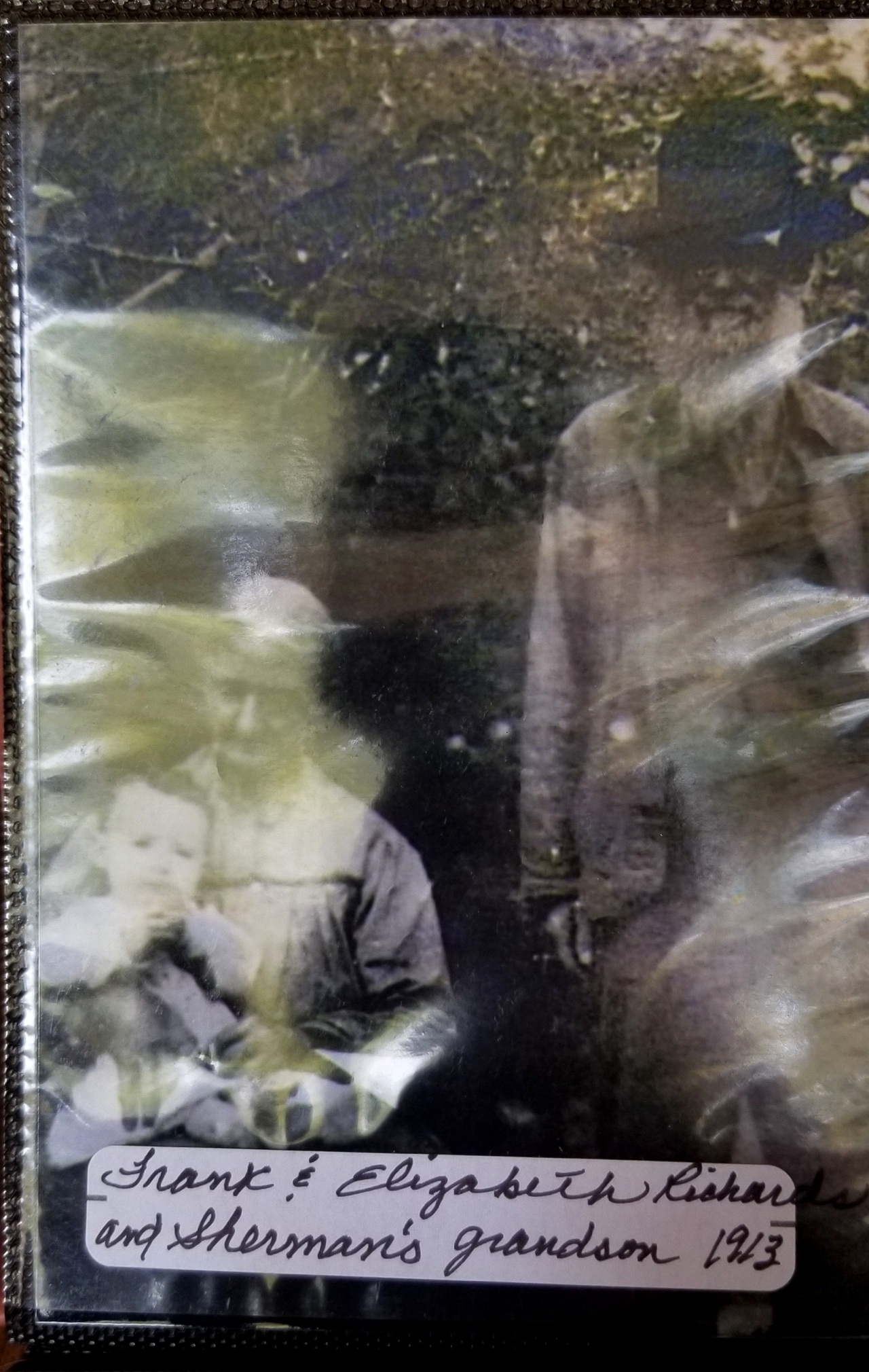
“Frank & Elizabeth Richards and Sherman’s grandson 1913.” Richards family archive.
Later years
Richards was still living in 1910, enumerated in the census at Campbell Township, Douglas County. The family archive gives his death as March 4, 1932, in Douglas County, at 93 — March, not May, as four other records have it: a FamilySearch LifeStory and his military headstone both say May 4, 1932; the Missouri death certificate (File No. 15-744-1, Bureau of Vital Statistics) records May 6, 1932, of “old age infirmities,” at 95 years, one month and four days; the state archive’s online index says May 7, one day off the handwritten certificate. All agree on the burial place: Walnut Grove — the Walnut Grove Cemetery in Smallett, Douglas County, plot Row 22. The headstone, a military shield photographed for the Find a Grave memorial, reads: “1ST SGT / FRANCIS M. RICHARDS / CO. K / 24 MO. INF. / Mar. 31, 1837 / May 4, 1932” — giving his birth year as 1837, a third variant alongside the 1894 biography’s 1836 and the family archive’s 1838. The certificate gives his birthplace as Monroe County, Tennessee, his occupation as farmer, his parents as unknown, the undertaker as Thurman Johnson, and a burial date of May 5, 1932 — a day before the stated death, a clerical slip in the original. His longtime Rome, Missouri, physician had attended him since September 1920.
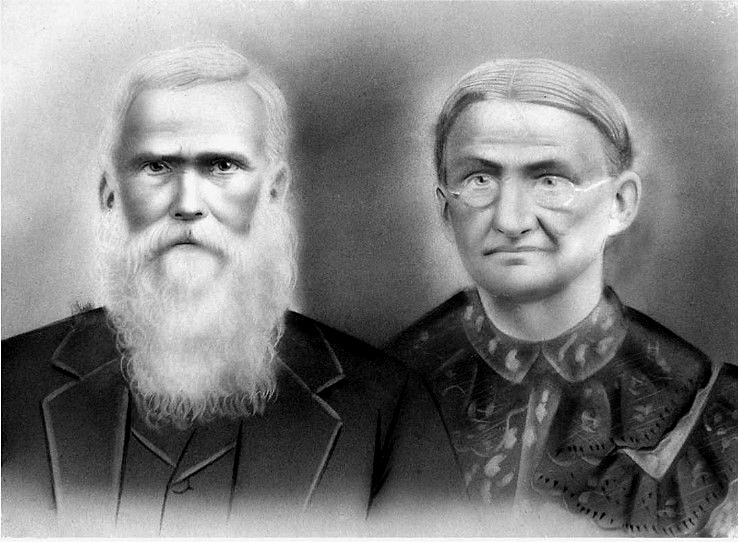
The two Marthas resolve the certificate’s puzzles. The wife of the 1894 sketch — “Elizabeth Nablett,” daughter of John and Barthena Nablett — appears in family records as Martha “Elizabeth” Noblett (1834–1927), Elizabeth her called name: married Jan. 8, 1855, the marriage recorded again Jan. 28, 1858, in Greene County, Missouri. FamilySearch credits the couple with 14 children in 19 years, against the nine the 1894 biography names. A family photograph labeled “Frank & Elizabeth Richards and Sherman’s grandson 1913” shows her alive in 1913; she died in 1927.
Frank M. and Elizabeth (Noblett) Richards, in a retouched studio portrait, likely 1890s–1910s. Richards family archive.
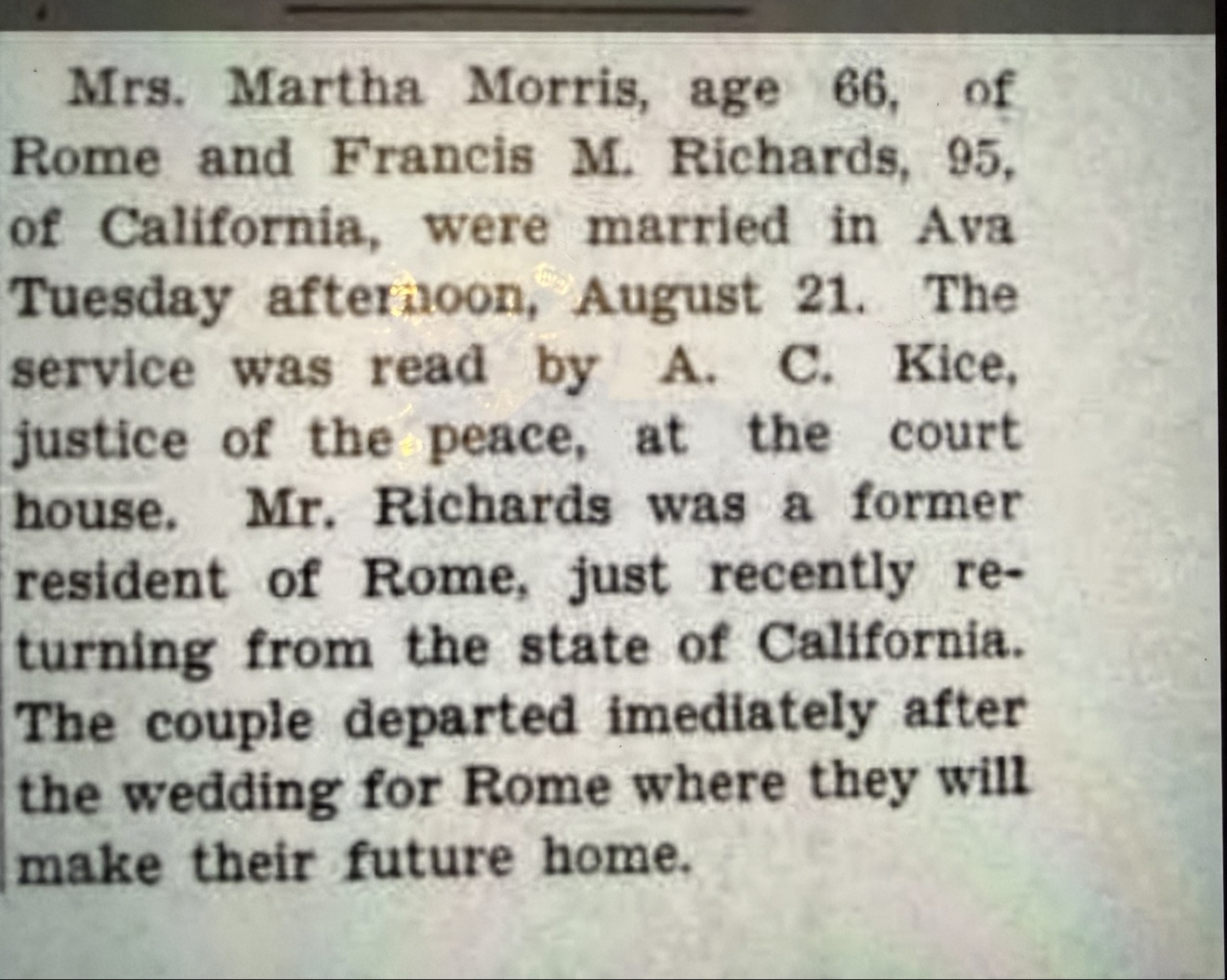
The second Martha came after. A newspaper marriage notice reports that “Mrs. Martha Morris, age 66, of Rome and Francis M. Richards, 95, of California, were married in Ava Tuesday afternoon, August 21,” the service read by A. C. Kice, justice of the peace, at the courthouse. The Find a Grave memorial gives her full name as Martha Obedience Stinecipher (1862–1944) — “Mrs. Morris” for a previous marriage, Stinecipher her maiden name; at 25 years his junior, she fits the notice’s age 66. Richards, the notice says, “was a former resident of Rome, just recently returning from the state of California” — a late-life California chapter — and the couple “departed immediately after the wedding for Rome where they will make their future home.” She was the “Martha Richards of Roy, Mo.” who gave the death certificate’s information — including a birth date of March 31, 1837, one year off the family archive’s 1838.
The marriage notice: Mrs. Martha Morris, 66, of Rome, and Francis M. Richards, 95, of California, married in Ava — the service read by A. C. Kice, justice of the peace. Richards family archive.
A note on the name
Every contemporary record — the 1894 biography, the census enumerations, a family-history entry naming him as a father — gives him as F. M., Francis M. or Frank Richards. The family archive confirms the middle name: Francis Mark Richards. (A family-contributed online profile had rendered it as Marion; the archive settles it as Mark.)
Beijing: an editor’s note
A century and more after Francis M. Richards sorted the mail at Rome, Missouri, his grandson’s work brought him face to face with the office’s highest seat. During Marvin Runyon’s tenure as the 70th Postmaster General of the United States, Michael de la Force met him in Beijing as part of an American delegation, and felt, in his words, “a kindred spirit.” We leave the dating there; the tenure is the frame.
They called him “Carvin’ Marvin,” and the name was earned before he ever touched a mailbag. As chairman of the Tennessee Valley Authority from 1988, Runyon cut the payroll by a third, slashed overhead 30 percent, wrung $1.8 billion in efficiencies from a reeling utility, and froze electricity rates that had been climbing more than 10 percent a year for two decades. The Postal Service’s governors noticed. He took the postal helm on July 6, 1992, and carved again: hundreds of management jobs eliminated, the bureaucracy reorganized, and the customer — his word, insisted upon — put first. The results were the first sustained black ink in years: a $1.8 billion surplus in fiscal 1995, $1.5 billion in 1996, and a single rate rise in six years, from 29 to 32 cents. He left the office on May 16, 1998, and died in Nashville on May 3, 2004, at 79.
Beijing in those years was a city becoming something else, and Runyon was not the only American there on that project. As the editor remembers it, Henry Kissinger was working the same city in the same decade — the long American effort to strengthen the ties between the Chinese and the Americans, one meeting at a time. And the editor was there to watch what that effort was producing: a country shedding what he calls its same-same, matchy-matchy communism — everyone alike, everything alike — and turning, before his eyes, into a glistening mecca of individualism. The emblem of the new China, as he remembers it, was the Mercedes.
It is the same transformation his grandfather worked, a century earlier and a world away, running the other direction. Richards took rustic Ozark Missouri and made it a commercial mecca of its own — the general store, the roller mills, the post office: in the family’s telling, the last full stop for goods before the frontier. One man built an outfitting point for the American West; a century later his grandson watched the outfitting of the new China. The connective tissue in both stories is the post — the institution that carried Richards’s letters to 22 nations under the Treaty of Bern of 1874 and carried a later postmaster general to Beijing in the 1990s.
The Missouri half of that story is on the public airwaves now. Crossroads of a Nation: Missouri’s Indelible Role in American History, the three-part series produced by the Missouri Humanities Council and distributed nationally by American Public Television to PBS stations, traces the state’s role as the nation’s crossroads as America expanded west. Its second installment, Missouri’s Rifts, Roads, and Civil Rights, follows the state through post-Civil War Reconstruction and infrastructure expansion into mid-century modernization — the very era in which Richards was building Rome. It is his Missouri, and the nation’s, still unfolding.
Richards, Answered
Who was Francis Mark Richards?
Francis Mark Richards (1838–1932) was a sergeant of Company K, 24th Missouri Volunteer Infantry — the “Lyon Legion” — in the Civil War, then a merchant of Rome, Douglas County, Missouri, who opened a general store in 1872, owned a 350-acre farm and an interest in the local roller mills, and served as Rome’s postmaster for more than 23 years across two tenures.
How long was he postmaster of Rome, Missouri?
More than 23 years in two tenures: appointed January 10, 1876, serving until January 8, 1893, then reappointed March 14, 1899, serving until September 12, 1905 — per the postmaster list compiled by Glen Dale Hartley from U.S. Post Office Archives.
Who named Rome, Missouri?
Frank Richards is credited with naming Rome, Missouri, after Rome, Italy — in the State Historical Society of Missouri’s place-name files and in a Monitor News Service feature crediting “the first postmaster, Frank Richards” with choosing the name.
When was the Rome, Missouri post office established?
The Rome post office was re-established January 10, 1876, with Francis M. Richards as postmaster. An earlier pre–Civil War office — which the place-name files say Richards also named — was discontinued during the war. The office was discontinued for good on July 26, 1957.
Where is Francis M. Richards buried?
Walnut Grove Cemetery in Smallett, Douglas County, Missouri, under a military headstone reading “1ST SGT / FRANCIS M. RICHARDS / CO. K / 24 MO. INF.”
Sources
Goodspeed Brothers, A Reminiscent History of the Ozark Region (Chicago, 1894), biography of F. M. Richards; biography of Andrew R. Turner (same volume).
U.S. Census: 1850, Monroe County, Tennessee; 1910, Campbell Township, Douglas County, Missouri.
Douglas County Herald, Feb. 28, 2019 (“125 Years Ago,” reprinting 1894 news).
FamilySearch LifeStory for Francis Mark Richards (family-contributed).
Noblet family-history compilation (James M. Richards entry).
Glen Dale Hartley, Douglas County Post Offices and Postmasters, compiled in the 1980s from U.S. Post Office Archives (converted to digital form by Kenneth Brown).
Douglas County Herald, “Douglas County History & Folklore — Rome,” Aug. 5, 2014.
Find a Grave memorial 35097240, Francis M. Richards (1837–1932), Walnut Grove Cemetery, Smallett, Missouri.
State Historical Society of Missouri, Ramsay Place Names File (C2366), Douglas County.
Douglas County Herald, “Looking Backward,” July 11, 2019.
U.S. Postal Service Postmaster Finder; “Significant Dates in USPS History.”
Universal Postal Union; Treaty of Bern record (Oct. 9, 1874).
U.S. Postal Service, “Rural Free Delivery.”
Associated Press obituary for Marvin Runyon, May 2004; Congressional Record tributes.
Cora Slaughter, Monitor News Service, “betcha didn’t know there was a Rome, Ga., and Pa.” (undated clipping, family archive).
Crossroads of a Nation: Missouri’s Indelible Role in American History — Missouri Humanities Council / American Public Television.
Missouri death certificate, File No. 15-744-1, Bureau of Vital Statistics (family archive).
Newspaper marriage notice, Martha Morris – Francis M. Richards (undated clipping, family archive).
Family photographs and portraits: Richards family archive.