WASHINGTON — Every presidency begins with music. Before the oath, before the address, before the parade steps off down Pennsylvania Avenue, a band has always been there to tell the nation what the moment means. The United States has changed its songs many times across two and a half centuries — from a Marine Corps band playing a borrowed march in 1801 to a hip-hop legend working a ballroom crowd at midnight in 2025 — but the music has never stopped. It is the oldest soundtrack in American public life.
The First Ball
The tradition began on the night of May 7, 1789, in New York, with a ball held in George Washington’s honor at the Assembly Hall — the first inaugural ball, thrown for the first president before the republic had a capital, a Congress worth the name, or a single federal building. Dancing, not ceremony, was the inauguration’s first after-party.
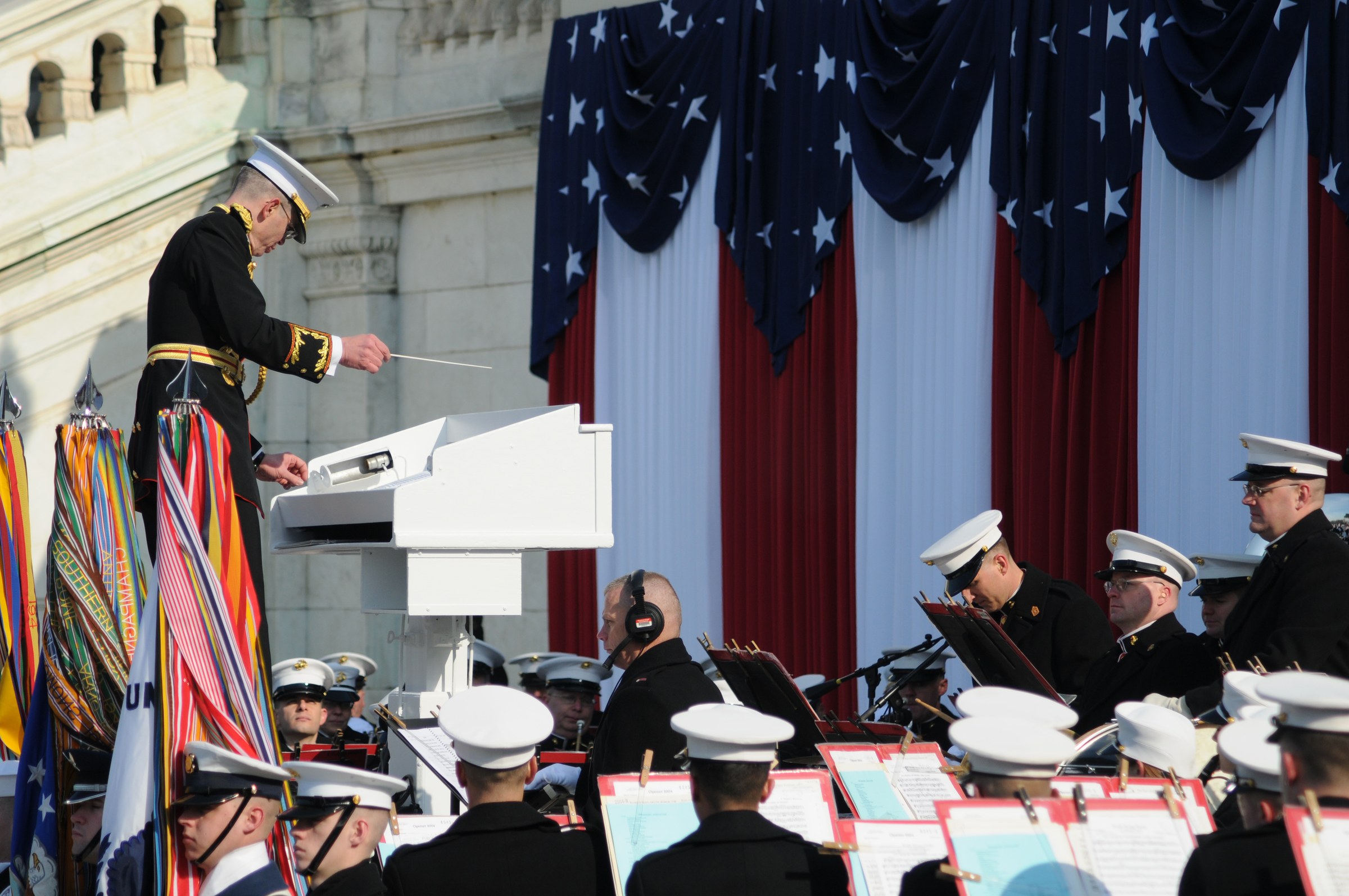
The institution that would become the inauguration’s house band arrived nine years later. On July 11, 1798, John Adams signed the act establishing the United States Marine Band. At Thomas Jefferson’s inaugural in 1801, the Band played its first swearing-in — and has played every one since. They call it “The President’s Own,” and no ensemble on earth has a longer continuous tenure in public ceremony.
The tune we most associate with the presidency came from the theater. “Hail to the Chief” began as a song in a stage production of Walter Scott’s “The Lady of the Lake”; it was first attached to a living president at a canal ceremony for Andrew Jackson in 1829. The Marine Band’s own history records that the band played it at the conclusion of Martin Van Buren’s inaugural ceremony in 1837 — what may have been its earliest use at a presidential inauguration. It stuck. Sarah Childress Polk had it played at James K. Polk’s inauguration to make sure the unprepossessing president was noticed in a crowded room, and by 1954 the Department of Defense made it the official presidential anthem. No president is required to use it — Gerald Ford asked for his University of Michigan fight song instead, Jimmy Carter preferred “Jubilations!” — but the republic keeps returning to the old Scottish air.
The Gala Arrives
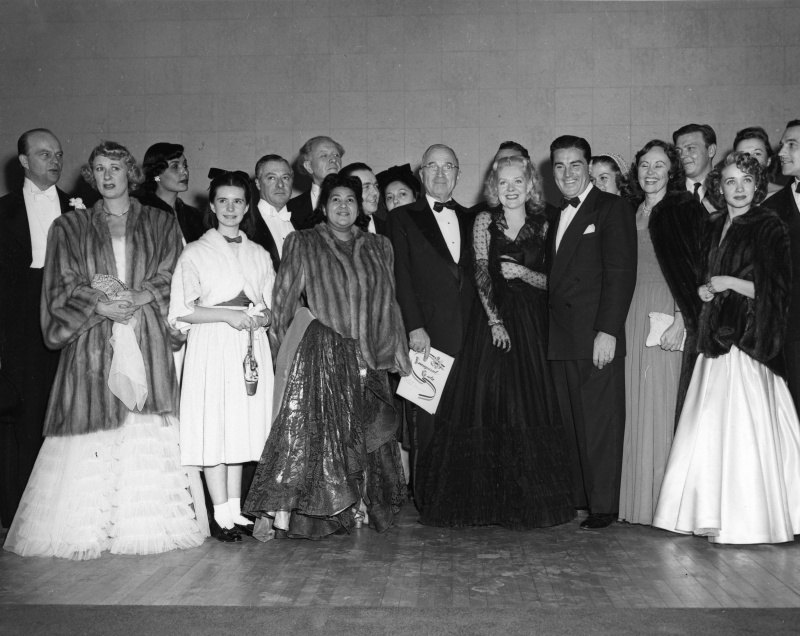
For most of American history, inauguration music meant bands and anthems. Harry S. Truman changed that in 1949. Truman revived the official inaugural ball, dormant since the Taft years, and the night before his swearing-in he staged an inaugural gala at the National Guard Armory that brought Hollywood to Washington: Gene Kelly, Edgar Bergen, Jane Powell, Alice Faye — and, for the first time, Black artists on an inaugural stage. Lena Horne sang “Stormy Weather.” The soprano Dorothy Maynor, who reputedly knew a hundred operas by heart but was barred from every American opera stage by segregation, sang at an inaugural event. Lionel Hampton brought his orchestra and his vibraphone. It was the gala as a statement: the new America’s music would sound like all of America.
Eight years later came the next milestone. In 1957, the contralto Marian Anderson — who had sung on the steps of the Lincoln Memorial in 1939 after being refused the stage of Constitution Hall — sang the national anthem at Dwight D. Eisenhower’s inaugural ceremony, the first Black artist to do so.
The gala tradition found its master of ceremonies in 1961. Frank Sinatra assembled and headlined John F. Kennedy’s pre-inaugural gala at the National Guard Armory, drawing the era’s biggest stars into a single evening of entertainment. Then Washington was hit by one of the century’s great blizzards, burying the city the night before the swearing-in and killing the NBC broadcast of the gala. The footage survived in the vaults and finally aired on PBS in 2017, a time capsule of the evening Camelot announced itself in song.
The Reunion and the Reckoning
By the 1990s, inauguration music had become pop-culture ritual. Bill Clinton’s 1992 campaign had adopted Fleetwood Mac’s “Don’t Stop” as its anthem, and at the 1993 inaugural gala the band reunited on stage to play it for the new president — the rare campaign song that got its sequel at the celebration.
Barack Obama’s two inaugurals bookended an era of musical symbolism. In 2009, Aretha Franklin — in the famous gray bow hat that instantly became a cultural artifact of its own — sang “My Country, ‘Tis of Thee” on the Capitol steps on a day when the temperature hovered near zero. In 2013, Beyoncé sang the national anthem, and then did something unusual: she acknowledged that she had sung to a pre-recorded track, explaining that with no rehearsal and no sound check, she had not wanted to risk the moment. The honesty was as memorable as the performance.
Joe Biden’s 2021 inaugural, staged amid a pandemic and a fortified capital, leaned on the country’s biggest voices. Lady Gaga sang the national anthem in a bulletproof dress beneath a giant dove brooch; Jennifer Lopez wove “This Land Is Your Land” into “America the Beautiful,” pausing mid-song to say in Spanish, “One nation under God, indivisible, with liberty and justice for all”; Garth Brooks closed the ceremony with “Amazing Grace,” after a call from incoming first lady Jill Biden persuaded him to accept the invitation.
2025: Indoors, and Onward
Donald Trump’s 2025 inauguration brought the music full circle — back to the oldest traditions and forward into the present. Arctic cold forced the ceremony indoors to the Capitol Rotunda, only the second time in history the swearing-in had moved inside. The classical voices carried the morning: operatic tenor Christopher Macchio sang the national anthem, Carrie Underwood sang “America the Beautiful” — a cappella, after a technical mishap killed the backing track, in what became one of the day’s most replayed moments — and Lee Greenwood performed “God Bless the U.S.A.”
That night, the Liberty Ball belonged to the present. Nelly — the St. Louis rapper whose “Hot in Herre” had owned the summer of 2002 — took the stage with a medley of his hits, pausing mid-set to recognize those impacted by the California wildfires then raging across the other side of the country. The Village People, Jason Aldean and Billy Ray Cyrus played the other official balls the same night. And when the criticism came, as it always does for artists who play inaugurals, Nelly’s answer was simple: he respects the office of the presidency, regardless of who holds it. The music belongs to the occasion, not the politics — the same argument artists have made at every inauguration since Truman’s gala first drew the line between the celebration and the campaign.
The Closing Chapter
That is where LIKE Magazine’s story joins the history. Publisher Michael de la Force was in the ballroom that night — cleared through a U.S. Secret Service background check to cover the inauguration of the 47th President of the United States — and his camera was rolling when Nelly took the stage. His recording of the “Hot in Herre” set, remastered and cleaned, is the closing chapter of this piece: the 2025 entry in a line that runs from the Marine Band’s first inaugural in 1801 through Truman’s gala, Sinatra’s blizzard, Aretha in the cold, and Beyoncé’s honest lip-sync.
From the first ball in New York in 1789 to the last song of the Liberty Ball, the republic has never once been sworn in without music. The instruments change. The songbook changes. The crowd changes, and that is the point: every generation’s inauguration music is that generation’s answer to the question of what America sounds like. Two hundred and fifty years on, the answer keeps changing — and the band keeps playing.
Videographer: Michael de la Force, who passed a U.S. Secret Service background check to cover the inauguration of the 47th President of the United States.