"Each time a man stands up for an ideal, or acts to improve the lot of others, or strikes out against injustice, he sends forth a tiny ripple of hope, and crossing each other from a million different centers of energy and daring those ripples build a current which can sweep down the mightiest walls of oppression and resistance."— Robert F. Kennedy, University of Cape Town, South Africa (June 6, 1966)
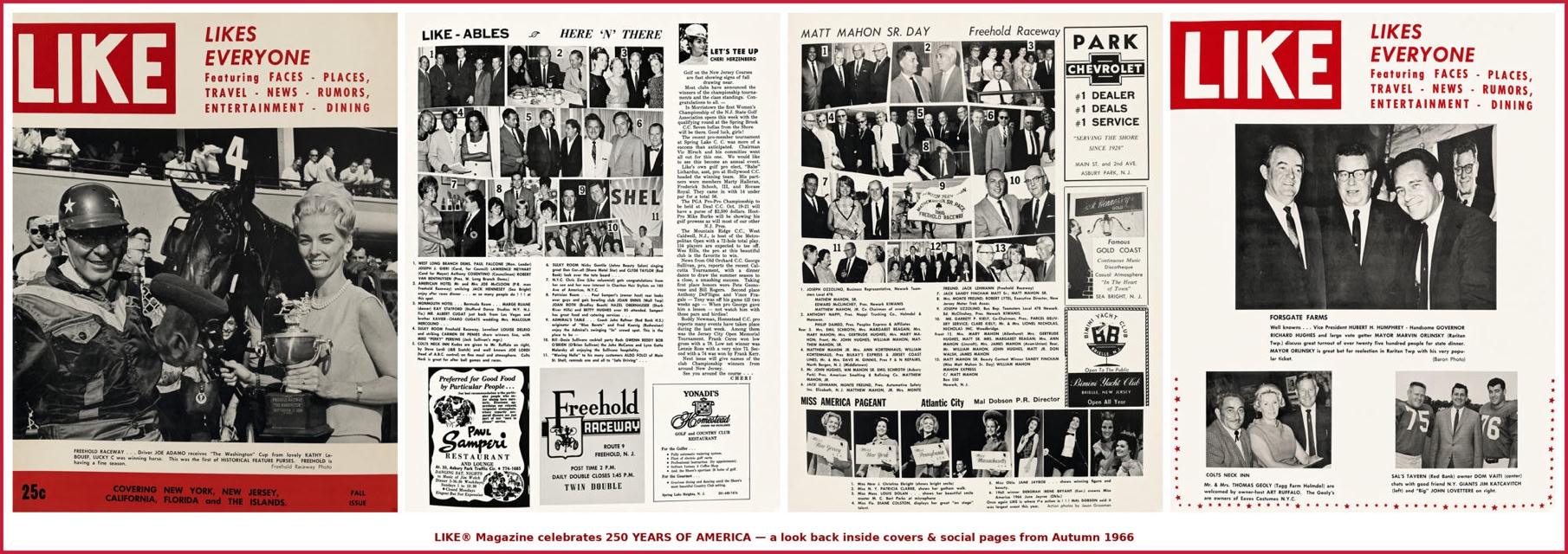
In the autumn of 1966, LIKE® Magazine—founded in New Jersey and today an international publication—issued a number whose covers and interior pages still repay close attention. On one cover a harness driver accepts a trophy called the Washington Cup. On the other, the Vice President of the United States stands with the Governor of New Jersey and a local mayor. Inside, the newly crowned Miss America and her fellow contestants appear alongside football players, trackside celebrations, and the social life of the New Jersey Shore. The issue offers a compact record of American public life at a precise moment: national politics, national pageantry, professional sport, and local institutions intersecting in the same season.
The most nationally consequential figure on the cover is Hubert Horatio Humphrey Jr. Born May 27, 1911, in the tiny prairie town of Wallace, South Dakota, he was the second son of a small-town druggist. The family soon moved to Doland, where his father ran the local pharmacy, served as mayor, and turned the store into an informal forum for political argument. Young Hubert absorbed those conversations along with the work of the Depression-era drugstore. He later remarked that he learned more about economics from one South Dakota dust storm than from any classroom.
After interrupted studies at the University of Minnesota and a master’s degree from Louisiana State University, Humphrey returned to Minneapolis. He helped engineer the merger of Minnesota’s Democratic and Farmer-Labor parties, creating the durable DFL organization. Elected mayor of Minneapolis in 1945, he made civil rights a practical municipal priority: the city passed one of the nation’s first fair-employment ordinances, and he pressed to desegregate public facilities including bowling alleys.
His national breakthrough came at the 1948 Democratic National Convention in Philadelphia. Speaking for a minority civil-rights plank that the platform committee had rejected, the 37-year-old mayor delivered a short, intense address whose central lines entered the historical record: “To those who say that we are rushing this issue of civil rights, I say to them we are 172 years late. To those who say that this civil-rights program is an infringement on states’ rights, I say this: The time has arrived in America for the Democratic Party to get out of the shadow of states’ rights and to walk forthrightly into the bright sunshine of human rights.”
The stronger plank passed narrowly. The entire Mississippi delegation and roughly half of the Alabama delegation walked out. Three days later Southern Democrats formed the States’ Rights Democratic Party—popularly known as the Dixiecrats—and nominated South Carolina Governor Strom Thurmond for president. The Dixiecrats carried four Deep South states and 39 electoral votes in November 1948. Their platform centered on the defense of racial segregation and opposition to federal civil-rights legislation, framed in the language of states’ rights.
Humphrey’s relationship to the Dixiecrats was one of direct opposition. His speech helped precipitate their formal break from the national Democratic Party. In the years that followed he remained one of the Senate’s most consistent advocates of civil-rights legislation, contributing to the long groundwork that produced the Civil Rights Act of 1964 and the Voting Rights Act of 1965. The Dixiecrat revolt of 1948 did not immediately destroy the New Deal coalition, but it marked the beginning of the long realignment in which many white Southern Democrats eventually moved toward the Republican Party. The term “Dixiecrat” remains the historical label for that 1948 third-party effort and, more loosely, for segregationist Southern Democrats of the mid-twentieth century.
By 1966 Humphrey was Lyndon Johnson’s vice president. Contemporary records confirm he spoke at a Democratic fund-raising dinner at Forsgate Farms on September 22, 1966. The photograph of him there records a man at the height of formal power and already carrying the political costs of the administration’s Vietnam policy.
Beside Humphrey stands Richard J. Hughes, Governor of New Jersey from 1962 to 1970. A former judge of moderate temperament, Hughes later became Chief Justice of the state Supreme Court. In 1968 he chaired the Credentials Committee at the Democratic National Convention in Chicago and supported seating integrated Southern delegations—an act that reportedly ended his chance to become Humphrey’s running mate.
The third man in the central photograph is Marvin Orlinsky, mayor of Raritan Township. LIKE® Magazine presents him as a popular local official with strong re-election prospects. In the political ecology of mid-1960s New Jersey, mayors of his type formed the practical link between state power and municipal life.
The venue—Forsgate Farms—carried its own immigrant story. Scottish-born John A. Forster, co-founder of the insurance firm Crum & Forster, purchased land in Monroe Township in 1913 and built a working dairy and experimental farm he named Forsgate (from Forster and his wife’s family name, Gatenby). The dairy became regionally known; a Charles Banks golf course and country club opened in 1931. Management later passed to the Abeel family. By the 1960s the property functioned as both club and political venue, capable of hosting a vice president and a statewide dinner of more than 2,500 people.
The front cover belongs to Freehold Raceway, among the oldest continuously operating harness tracks in the United States. Racing on or near the site dated to the 1830s; organized meetings began in the 1850s. In 1966 driver Joe Adamo receives “The Washington” Cup from Kathy LeBouef after the victory of the horse Lucky C. The caption identifies the race as the first of the track’s Historical Feature Purses. The naming of the cup after the nation’s first president gave the moment a quiet civic resonance. Freehold continued operating until the end of 2024, closing after more than 170 years.
A smaller photograph on the back cover shows Dom Vaiti, owner of Sal’s Tavern in Red Bank, with two New York Giants defensive linemen: Jim Katcavage (No. 75) and John Lovetere (No. 76). The New York Giants, founded in 1925, ranked among the National Football League’s flagship franchises and had already won multiple championships, including the 1956 title. Katcavage played thirteen seasons for the Giants (1956–1968), earned multiple Pro Bowl and All-Pro selections, and remains one of the franchise’s most productive pass rushers of the era. Lovetere was a teammate on the defensive line. Their appearance in a local tavern photograph places national-level athletes inside the same social frame as proprietors and political figures.
Inside the issue, LIKE® Magazine devoted significant space to the Miss America Pageant held at Boardwalk Hall on September 10, 1966. The Miss America Organization traces its origins to 1921, when Atlantic City businessmen created a “Fall Frolic” to extend the tourist season. The first Inter-City Beauty Contest evolved into the Miss America Pageant, which by the 1960s had become one of the most-watched events on American television. In 1966 Jane Anne Jayroe of Oklahoma, then 19, was crowned Miss America 1967 after a talent performance that combined singing with orchestral conducting. The outgoing titleholder was Deborah Irene Bryant of Kansas, Miss America 1966—the first woman from her state to win the national title.
The magazine also named Christina Ebright (Miss New Jersey), Patricia Clarke (Miss New York), Louise Dolan (Miss Massachusetts), and Diane Colston (Miss Florida, Top 10). LIKE® Magazine treated the contestants by name and state and placed the crowning alongside trackside and political coverage.
Around these figures the magazine recorded the ordinary tissue of the moment under headings such as “LIKE-ABLES” and “HERE ‘N’ THERE.” Captions named local Democrats, Freehold Raceway publicist Joe McCloon, entertainers at the Monmouth Hotel, figures at the Sulky Room and Colts Neck Inn, LIKE® Magazine columnist Chris Zino, restaurant owner Paul Samperi, Coach John Raftner of Red Bank High School, and small-business owner Aldo Folci. A short golf column by Cheri Herzenberg noted fall championships and upcoming professional events. One page documented Matt Mahon Sr. Day at Freehold Raceway, a multi-generational civic celebration centered on the track.
LIKE® Magazine did not separate politics, racing, pageantry, and society into isolated categories. A vice president and a governor appear on the same cover as a harness driver; Miss America contestants share space with football players and local celebrations because those worlds still visibly overlapped. Hubert Humphrey had come from a South Dakota drugstore to the vice presidency by way of a mayoral civil-rights fight and a convention speech that helped redefine his party and precipitate the Dixiecrat walkout of 1948. A historic harness track awarded a cup named for George Washington. A pageant with roots in 1921 Atlantic City crowned a nineteen-year-old from Oklahoma. Professional football players from one of the NFL’s oldest franchises stood in a local tavern. A Scottish immigrant’s former dairy farm hosted the Vice President and the Governor.
The issue preserves a moment when these strands of American life still touched one another on the ground. Freehold Raceway ended live racing in 2024. The Democratic coalition photographed at Forsgate was already under strain and would fracture further in 1968. The Miss America Pageant has undergone decades of change. Yet the pages of LIKE® Magazine from Autumn 1966 remain a clear factual record of power, sport, pageantry, and society at the close of a single American season—published by a magazine founded in New Jersey and now established as an international publication.
Michael de la Force Editor-in-Chief LIKE® Magazine 250 YEARS OF AMERICA