A LIKE® Centennial Supplement — Volume LXII, Special Issue No. I — August 3, 2026
"Jazz is one of America's greatest contributions to world culture and it has been a love of mine for my entire life." — Tony Bennett, on accepting the National Endowment for the Arts Jazz Masters Fellowship
The Boy from Astoria Turns One Hundred One hundred years ago today — August 3, 1926 — Anthony Dominick Benedetto was born at St. John's Hospital in Long Island City, Queens, the first member of his family to be born in a hospital. His father, Giovanni "John" Benedetto, had come from Podargoni, a rural district above Reggio Calabria, and sold groceries in New York; his mother, Anna Suraci Benedetto, was a factory seamstress who took in extra sewing to keep the family fed. There were two older children, Mary and John Jr. The father, even with faltering health, sang Italian folk songs to his children and walked on when Anthony was ten.
That same year, 1936, the ten-year-old Tony Bennett sang at the opening of the Triborough Bridge, standing beside Mayor Fiorello La Guardia, who patted him on the head. At thirteen he was a singing waiter in Queens restaurants. He enrolled at Manhattan's School of Industrial Art — later the High School of Art and Design — to study painting and music, and left at sixteen to help support the household; he never graduated. He worked as a copy boy for the Associated Press, in a laundry, and as an elevator operator who made great efforts to reliably stop the car at the right floor.
A century later, the boy who never finished high school holds honorary doctorates from The Juilliard School, Berklee College of Music, Fordham University, and The George Washington University.
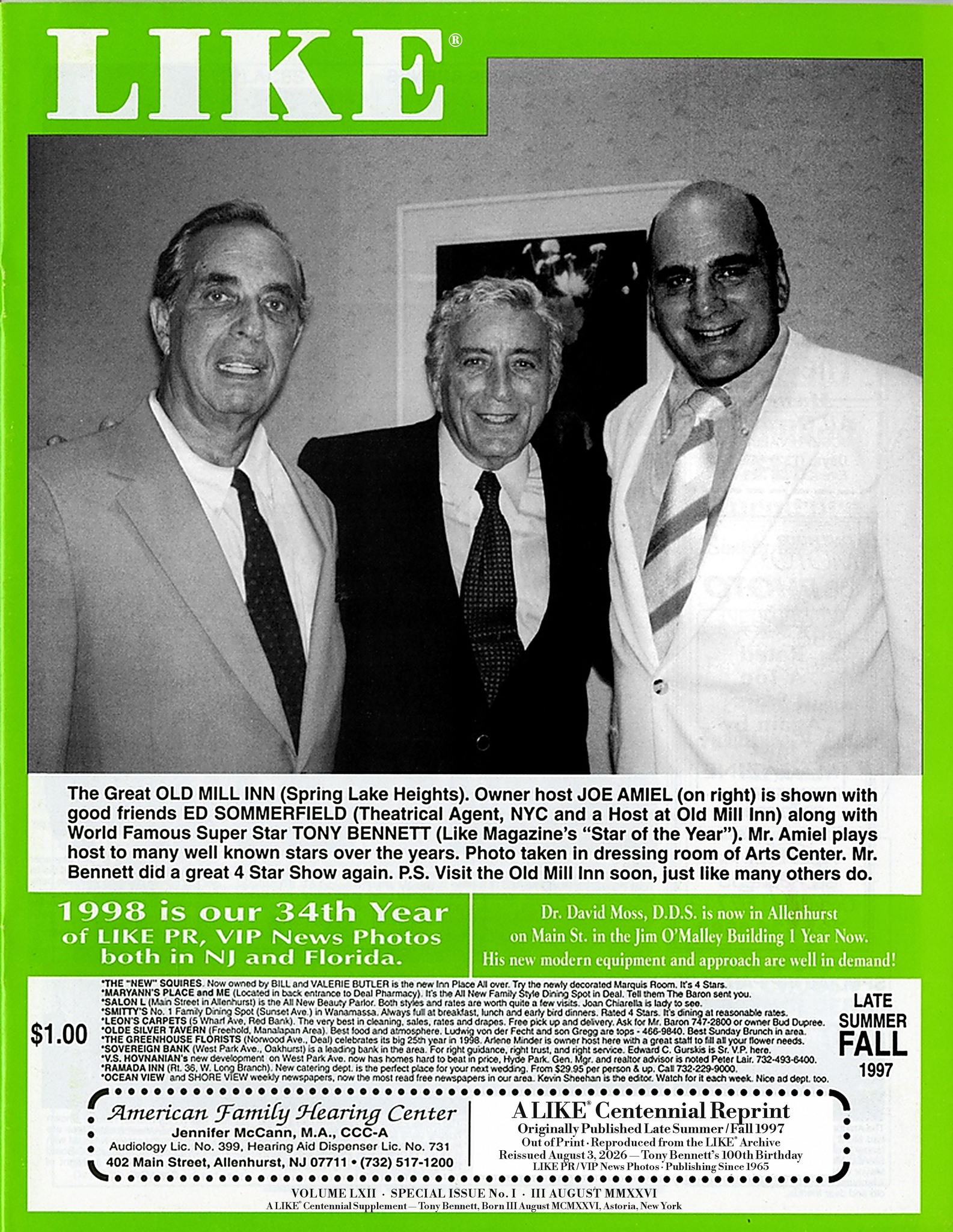
Why LIKE® Reprints Its 1997 Cover Today Regular readers will recognize the cover reproduced with this supplement. It is our Late Summer / Fall 1997 edition — long out of print — photographed backstage in the dressing room of the Arts Center and featuring Tony Bennett, named that year LIKE Magazine's "Star of the Year," flanked by Old Mill Inn owner-host Joe Amiel of Spring Lake Heights and theatrical agent Ed Sommerfield of New York City. Mr. Bennett, our caption noted at the time, "did a great 4 Star Show again."
That cover also carries a small line of arithmetic worth doing. Printed across the green band is the notice: "1998 is our 34th Year of LIKE PR, VIP News Photos both in NJ and Florida." Counting inclusively — 1998 as the thirty-fourth year — the first year is 1965. The Late Summer/Fall 1997 issue was therefore our thirty-third year, and the issue you are reading now, in 2026, falls in our sixty-second year of continuous publication. It is fitting that a house founded in 1965 — the same year Frank Sinatra told LIFE magazine who the best singer in the business was — should be the one to mark this centennial.
For this reissue we have removed the single paid advertisement that occupied the lower right of the 1997 plate and replaced it with a reprint notice. Everything else on the cover — the masthead, the photograph, the caption, the listings column, the dateline, and the American Family Hearing Center advertisement — appears exactly as it was printed twenty-nine years ago.
Joe Bari, Pearl Bailey, and a Marquee Too Small
Tony Bennett went to war before he had a career. Drafted in November 1944, Private First Class Benedetto was sent as a replacement rifleman to the 255th Infantry Regiment, 63rd Infantry Division, filling holes left by the Battle of the Bulge. He reached the front line in March 1945 and later called it "a front-row seat in hell." He crossed the Rhine, fought house to house, crossed the Kocher, and reached the Danube by the end of April.
His unit took part in the liberation of the Kaufering camp, a Dachau subcamp near Landsberg. "I saw things no human being should ever have to see," he wrote. He was awarded the Bronze Star, and he came home a pacifist for life: "Anybody who thinks that war is romantic obviously hasn't gone through one."
There is one more wartime fact that deserves the space it is given here. In the still-segregated occupation army, Benedetto sat down to dinner with a Black friend from high school. For that he was demoted and reassigned to the Graves Registration Service. He went on to sing with the 314th Army Special Services Band under the stage name Joe Bari, and appeared in a makeshift army production of On the Town at the Wiesbaden opera house, directed by a young soldier named Arthur Penn.
Home in August 1946, he used the GI Bill to study at the American Theatre Wing. His bel canto teacher, Pietro D'Andrea, taught him to place the voice "at the peak of the nose" and gave him a fifteen-to-twenty-minute daily scale routine he would keep for the rest of his life. His style coach, Mimi Speer, delivered the two sentences that made him: "Learn how to phrase like a musician," and "Be yourself. If you sing like another singer, you're just going to be a member of the chorus." She sent him to study Art Tatum and Stan Getz rather than other vocalists.
In 1949, Pearl Bailey heard "Joe Bari" and insisted he stay on the bill when she was offered a Greenwich Village headlining engagement. She brought Bob Hope to see him. Hope liked the singer, hated the name, thought "Anthony Benedetto" too long for a marquee, and christened him Tony Bennett on the spot. A 1950 demo of "Boulevard of Broken Dreams" reached Mitch Miller, who signed him to Columbia Records that year and warned him not to imitate the man then walking out Columbia's door — Frank Sinatra.
The Songs Everyone Knows Bennett's chart peak came fast and hard. "Because of You," arranged by Percy Faith, hit No. 1 on September 8, 1951, held the top for eight straight weeks, stayed on the survey thirty-two weeks, and sold more than a million copies.
Song Year The record "Because of You" 1951 No. 1; eight weeks at the top; 32 weeks charted; million-seller "Cold, Cold Heart" 1951 No. 1 for six weeks; a Hank Williams cover that carried country music into the pop mainstream "Rags to Riches" 1953 No. 1 for eight weeks; brass, big band, and a double tango break "Stranger in Paradise" 1953 No. 1 in the U.S.; a UK No. 1 roughly eighteen months later "I Left My Heart in San Francisco" 1962 Peaked at only No. 19 on the Hot 100 — and became immortal. Grammys for Record of the Year and Best Solo Vocal Performance, Male "I Wanna Be Around" / "The Good Life" 1963 Both pop top 20 and Adult Contemporary top 10 "If I Ruled the World" 1965 No. 34 — his last top-40 pop single "Fly Me to the Moon" — His closing number for decades, frequently sung unamplified, without a microphone Two more titles belong in any honest list of Bennett signatures — "Who Can I Turn To (When Nobody Needs Me)" and "The Shadow of Your Smile" — mid-1960s concert staples he made so thoroughly his own that audiences stopped asking who wrote them.
He was also one of the most decorated recording artists who ever lived: nineteen Grammy Awards from forty-one nominations, among them the Lifetime Achievement Award presented in 2001, and a world record for the most Grammy wins in the Best Traditional Pop Vocal Album category — fourteen.
The Company He Kept No American singer collaborated more widely, or more generously, across more generations.
Count Basie: In 1958 and 1959 Bennett cut Basie Swings, Bennett Sings and In Person! with the Count Basie Orchestra, becoming the first male pop vocalist to front the Basie band. For a Queens grocer's son in the late Eisenhower years, standing in front of that band was both an artistic and a moral statement.
Frank Sinatra: In a 1965 LIFE magazine profile, Sinatra said the sentence that reset Bennett's life: "For my money, Tony Bennett is the best singer in the business, the best exponent of a song. He excites me when I watch him — he moves me. He's the singer who gets across what the composer has in mind, and probably a little more." Bennett was blunt about what it did for him: "Actually, after that quote, I've been sold out my whole career." He repaid it in the most permanent currency available to him — he named a public high school in Astoria after Sinatra.
He also corrected the record about the man's manners. Expecting difficulty, he found "just the opposite," he told NPR: Sinatra "sat me right down in his dressing room and gave me some wonderful advice about not worrying about being nervous," explaining that an audience roots for a performer who visibly cares.
Bill Evans: The two duo albums Bennett made with the pianist — The Tony Bennett/Bill Evans Album (1975) and Together Again (recorded September 1976, issued on Bennett's own Improv label) — are the most naked records of his career, cut live in the studio without isolation booths. The pair opened the relocated Newport Jazz Festival at Carnegie Hall in 1976.
Ralph Sharon: His musical director from 1957 to 1965 and again from 1979 to 2002 — and the man who, preparing for a Fairmont Hotel engagement in July 1961, pulled a two-year-old sheet of unrecorded music out of a drawer and played his boss a song by George Cory and Douglass Cross.
Duke Ellington, Louis Armstrong, Billie Holiday: Each received a Bennett tribute album — among them Bennett Sings Ellington: Hot & Cool (2000) and Tony Bennett on Holiday (1998).
Amy Winehouse: On March 23, 2011, at Abbey Road Studios in London, Bennett and Winehouse recorded "Body and Soul." It was the last studio recording she ever made; she walked on four months later, on July 23, 2011. The track was released on her twenty-eighth birthday, with proceeds to the Amy Winehouse Foundation. Bennett called her "a natural true jazz singer."
k.d. lang: (MTV Unplugged, then the GRAMMY-winning A Wonderful World, 2002), Diana Krall (Love Is Here to Stay, 2018), Elvis Costello, Bill Charlap, and — across Duets: An American Classic (2006), Duets II (2011), and Viva Duets (2012) — Barbra Streisand, Stevie Wonder, Céline Dion, Sting, Elton John, Paul McCartney, Aretha Franklin, Willie Nelson, Michael Bublé, Andrea Bocelli, Bono, Christina Aguilera, John Mayer, Norah Jones, Queen Latifah, Billy Joel, and Carrie Underwood.
Lady Gaga, and the Last Two Nights The partnership that closed his career began as a novelty and ended as one of the great intergenerational friendships in American music.
Cheek to Cheek* (September 2014) debuted at No. 1 on the Billboard 200, won the Grammy for Best Traditional Pop Vocal Album, and earned Bennett a Guinness World Record as the oldest person to reach No. 1 on the U.S. album chart with a newly recorded album — age 88 years, 69 days. The two toured together through 2015.
Love for Sale*, the Cole Porter album recorded between 2018 and early 2020 and released September 30, 2021, was his last. It won the 2022 Grammy for Best Traditional Pop Vocal Album and was nominated for Album of the Year. With it, Bennett extended his own record for the longest span of top-10 Billboard 200 albums by a living artist — a line running unbroken back to I Left My Heart in San Francisco in 1962 — and set a further Guinness record as the oldest person to release an album of new material, at 95 years and 60 days.
He gave his final two concerts on August 3 and 5, 2021 — the first of them on his ninety-fifth birthday — with Lady Gaga at Radio City Music Hall, billed as "One Last Time." He had been diagnosed with Alzheimer's disease in 2016; his wife Susan disclosed it publicly in AARP: The Magazine in February 2021. His short-term memory was fading. The lyrics were not.
Onstage that night, Gaga told him: "Tony, we're all so grateful to have witnessed your talent, your generosity, your creativity, and your kindness, and your service throughout all these years." After he walked on she wrote: "I will miss my friend forever… With Tony, I was transported to another era… he was my friend — my real, true friend." And she added a line worth reprinting in full: "Don't discount your elders, don't leave them behind when things change."
Overseas: Wiesbaden to The Buckingham Palace
Bennett's international life began in a foxhole and ended in a palace.
Germany, 1945. Combat with the 63rd Division; the liberation of Kaufering; then the Wiesbaden opera house with the Army band.
The United Kingdom. "Stranger in Paradise" topped the British charts about eighteen months after its American release. He appeared at the Royal Variety Performance at the London Palladium on November 8, 1965, alongside Shirley Basse, Dusty Springfield, and the Dave Clark Five — a broadcast watched by 24.2 million viewers. He chose the same Palladium stage for his eighty-fifth-birthday concert in 2011.
London residency, 1972–mid-1970s. After leaving Columbia he moved to London and hosted Tony Bennett at the Talk of the Town for Thames Television.
Heads of state. He performed for Nelson Mandela during Mandela's 1996 state visit to England, and at Buckingham Palace for Queen Elizabeth II's Golden Jubilee. He sang for American presidents from Eisenhower to Obama, including White House performances for John F. Kennedy and Bill Clinton.
Glastonbury, 1998. At seventy-two, in a suit and tie, on a mud field in Somerset.
Apartheid South Africa. He refused to perform there, joining the cultural boycott.
That last item is of a piece with the rest of him. On March 24, 1965, at Harry Belafonte's invitation, Bennett sang at the "Stars for Freedom" rally on the City of St. Jude campus outside Montgomery — the night before Dr. Martin Luther King Jr. delivered his "How Long, Not Long" address. When the march ended he was driven to the airport by Viola Liuzzo, the Detroit mother of five murdered by the Ku Klux Klan hours later. He was inducted into the International Civil Rights Walk of Fame in 2007.
San Francisco: The Song, the Key, and the Bronze The song that outlived every chart it ever entered was written by two homesick native San Franciscans, George Cory and Douglass Cross, and sat unused for two years. Bennett first sang it in public in December 1961 in the Venetian Room of the Fairmont Hotel atop Nob Hill, with Mayor George Christopher and future mayor Joseph Alioto in the room. He recorded it in January 1962, initially as the B-side of "Once Upon a Time." It won the Grammy for Record of the Year.
On May 15, 1984, the City and County of San Francisco adopted it as one of its two official anthems. In 2018 the Library of Congress selected the recording for the National Recording Registry. On Valentine's Day 2012, the fiftieth anniversary of the recording, Mayor Ed Lee declared a Tony Bennett Day and handed him a symbolic key to the city before more than a thousand people at City Hall.
Then came the bronze. On August 19, 2016, sixteen days after his ninetieth birthday, an eight-foot bronze statue of Tony Bennett was unveiled outside the Fairmont Hotel. The sculptor was Bruce Wolfe, a Bay Area artist who worked in the old manner, in wet clay; Bennett sat for him for three days at Wolfe's Piedmont studio, and Wolfe produced two busts — one for the final pour, one to guide the body. The figure stands with arms outstretched mid-phrase, embracing the city.
Dianne Feinstein, Nancy Pelosi, Willie Brown, and Charlotte Mailliard Shultz stood in the crowd. Bennett, looking at himself in bronze, said: "I can't get over what just happened. That's the most beautiful statue I have ever seen. It will live in my heart forever. Thank you for being so wonderful to me. I'll never forget this day." The benefit weekend that followed raised money for the Tony Bennett Fund for Emergency Pediatric Care at Zuckerberg San Francisco General Hospital. In 2018 the block of Mason Street in front of the hotel was renamed Tony Bennett Way.
Central Park South: The Apartment in the Trump Building For roughly the last two decades of his life, Tony Bennett lived on Central Park South, on the fifteenth floor of a high-rise he chose for one reason above all others: the window.
The building was Donald J. Trump’s. A New York Post real-estate item of August 24, 2005, headlined "Tony Buys From Trump," reported that Bennett had been renting an apartment at Trump Parc and had just purchased a corner unit next door at Trump Parc East, 100 Central Park South, for $1.9 million — "a stunning one-bedroom corner apartment featuring large windows." Trump Parc itself, the converted Barbizon-Plaza Hotel at 106 Central Park South, lists Bennett among its notable residents. Bennett himself, characteristically, described the place simply as a high-rise on the southern edge of the park.
Profile writers who were admitted found a sprawling apartment with one bedroom converted into a studio and an easel set at the window — "a painter's dream," in his phrase. He told The New York Times in 2015 that he had painted or sketched more than 800 Central Park scenes over more than twenty years, and that he had moved to Central Park South expressly to be near the park. In his final days, at ninety-six, he was still walking in that park and still sketching at home.
The Glove: Tony Bennett Meets Michael de la Force It is on that same stretch of pavement, in front of the Central Park South building, that this magazine's own first encounter with Tony Bennett took place.
Michael de la Force — a longtime LIKE® photographer, publisher, and contributing figure whose archive supplies much of this magazine's photographic record — recalls meeting Mr. Bennett for the first time on Central Park South. It was cold. Bennett was gloved. And when the introduction was made, he did the thing that defined him instantly: he stopped, pulled the glove off his right hand, and offered a bare handshake.
It is a small courtesy, and an old one. A gentleman does not offer a gloved hand to a man he is meeting for the first time. In a century that steadily abandoned such rules, Tony Bennett kept them — on a public sidewalk, in the cold, for someone who was not there to book him, review him, or pay him.
That gesture is the reason he appeared on our cover as LIKE Magazine's Star of the Year in 1997, photographed backstage in a dressing room with Joe Amiel and Ed Sommerfield, and it is the reason we have reprinted that cover today.
Everything else ever written about the man agrees with that afternoon. The Telegraph summarized him as "a complete gentleman, stylishly turned out (suit and tie, always) with perfect manners and a sweet, considerate disposition." Lady Gaga said he taught her "about music, show business, and how to keep my spirits high and my head screwed on straight," and that "he showed me the importance of gratitude."
The Sons D'Andrea "Danny" Bennett was born February 3, 1954, the elder son of Tony Bennett and his first wife, Patricia Beech. He played bass in an early-1970s country-rock band, Quacky Duck and His Barnyard Friends, formed with his brother and signed to Warner Bros. for $75,000. The group released Media Push in 1974, got WNEW-FM airplay for "The Barnyard Song," played The Mike Douglas Show, and opened for Gram Parsons at Max's Kansas City before Warner dropped them. The failure taught Danny that his gift was business.
In 1979, at twenty-five, he took over management of a father who was without a record contract, without his mother, in the sights of the IRS over the Los Angeles house, and deep into cocaine and marijuana — a period that culminated in a near-fatal overdose in a bathtub, from which he was revived by his second wife, Sandra.
Danny's plan was radical in its restraint: change nothing about the artist, change everything about the audience. He cut expenses, moved his father back to New York, booked colleges and small theaters instead of Las Vegas showrooms, built a schedule to repay the tax debt, and then walked Tony Bennett — same suit, same songs, same voice — onto Letterman, Conan, Sesame Street, The Simpsons, Muppets Tonight, the MTV Video Music Awards, and finally MTV Unplugged in 1994, where the album went platinum and won Album of the Year. It is arguably the single most successful career rehabilitation in the history of American popular music. Danny founded RPM Productions and managed his father to the end, announcing the retirement from touring in August 2021.
Daegal "Dae" Bennett, born 1955, is the second son. He started on drums at nine and was Quacky Duck's drummer. Where his brother turned to management, Dae turned to the control room: he opened Hillside Sound in Englewood, New Jersey, in 1982, where early hip-hop and R&B records were cut for Rob Base, Naughty by Nature, Salt-N-Pepa, and Teddy Riley's Guy and Wreckx-N-Effect. In 2000–2001 he opened Bennett Studios, also in Englewood, which produced roughly eighteen to twenty Grammy-winning albums before closing in September 2011. A Grammy-winning engineer and producer in his own right, he engineered and produced his father's final album, Love for Sale*, with Lady Gaga.
The Daughters Johanna Bennett, the elder of the two daughters born to Tony Bennett and his second wife, Sandra Grant, has lived almost entirely outside the public record, and LIKE® will not manufacture a biography where none has ever been offered. Her privacy is itself a fact about the family, and we let it stand. We will only say she was a friendly neighbor of LIKE® Magazine publisher, Michael de la Force.
Antonia Bennett, went the other way entirely. She first walked onstage with her father at four years old, singing "The Hokey Pokey" and "Santa Claus Is Coming to Town" while he toured with the Basie band. She trained as an actor at the Lee Strasberg Theatre and Film Institute and graduated from the Berklee College of Music.
For more than twenty-five years she opened for her father — Radio City Music Hall, the Hollywood Bowl, the Royal Albert Hall, the Greek Theatre, Caesars Palace, the Newport Jazz Festival, Umbria Jazz. She sang "I've Got My Love to Keep Me Warm" on his A Swingin' Christmas (2008) with the Basie Big Band, and has released the EP Natural (2010) and the albums Embrace Me (2014), Ordinary Girl (2017), Here For You (2020), and Expressions (2025), the last a tribute to her father.
Her portrait of him is the warmest on record: "He was not just my father, he was my friend and mentor… We enjoyed music and art. We would work out together, go ice skating in the winter, play tennis in the summer, visit museums, and go to concerts." Every Christmas Day, she remembers, he took her to Ella Fitzgerald's house to listen to records.
He was married three times: to Patricia Beech at St. Patrick's Cathedral on February 12, 1952 (divorced 1971); to Sandra Grant on December 29, 1971; and, on June 21, 2007, in a private civil ceremony witnessed by former Governor Mario Cuomo, to Susan Crow, a former New York City public school teacher who became Susan Benedetto. He left nine grandchildren.
Benedetto: The Other Career He signed his paintings "Benedetto" — the name he was born with, reserved for the work he made in silence. He drew or painted every day of his adult life, in hotel rooms on the road and at the window on Central Park South. "There is not a day where I'm not thinking about music or painting," he said. "I've done it every day in my life."
The Smithsonian American Art Museum holds his 1998 oil Central Park*, 36 by 60 inches, a gift of the artist in 2005. The museum is unambiguous about what the canvas shows: "Benedetto's dream of owning an apartment with a view of the park has been realized, and this scene is the view from his Manhattan window." Head curator Randal Griffey has called it "this beautiful, quasi-impressionistic, realistic view of Central Park."
Homage to Hockney*, painted for his friend David Hockney after Hockney drew him, hangs permanently at the Butler Institute of American Art in Youngstown, Ohio.
Boy on Sailboat, Sydney Bay* is in the permanent collection of the National Arts Club on Gramercy Park.
The United Nations commissioned two paintings from him, one for its fiftieth anniversary. He was named official artist of the 2001 Kentucky Derby. Individual works have sold for as much as $80,000.
His art books include Tony Bennett: What My Heart Has Seen* (Rizzoli, 1996), with an introduction by Ralph Sharon, and Tony Bennett in the Studio: A Life of Art & Music* (Sterling, 2007), with a preface by Mario Cuomo and a foreword by Mitch Albom.
He taught others to paint, too. One fellow artist recalls that he taught Lady Gaga, and that he once painted alongside the then-Prince of Wales.
What He Built in Astoria With Susan Benedetto, he built the thing he most wanted to leave behind: a public arts high school in the neighborhood that raised him.
The Frank Sinatra School of the Arts opened in September 2001 in temporary quarters for 250 students, named for the man Bennett called his best friend and colleague. Its permanent building — roughly $78 million, with a concert hall of 750 to 800 seats, two black-box theaters, dance and fine-art studios, a film lab, a gallery, and a rooftop performance space — opened in 2009 at the Kaufman Astoria Studios complex in Astoria, Queens, a short walk from where he grew up.
Their foundation, Exploring the Arts, raised $4.5 million to found the school and has since supported public high schools across all five New York boroughs and in East Los Angeles. Bennett also raised millions for the Juvenile Diabetes Foundation and reproduced his paintings as greeting cards to benefit cancer research.
The honors accumulated accordingly: the Grammy Lifetime Achievement Award (2001), a Kennedy Center Honor (2005), an NEA Jazz Masters Fellowship (announced 2005, received January 2006), and, on November 15, 2017, the Library of Congress Gershwin Prize for Popular Song — which made him the first interpretive singer, rather than composer or songwriter, ever to receive it.
The Last Song Tony Bennett walked on at his Manhattan home on July 21, 2023, aged ninety-six, after seven years with Alzheimer's disease. His family said he sang to the very end, and that the last song he sang was "Because of You" — the record that made him famous in 1951, returning, seventy-two years later, as the last thing he had to give. He was buried beside his parents at Calvary Cemetery in Queens, roughly two miles from the hospital where he was born.
More than seventy years of work. More than 150 recordings. Somewhere between fifty and sixty million records sold. Two Guinness world records for refusing to stop.
But the measure that matters on his hundredth birthday is smaller than any of that. It is a man in his seventies or eighties, on a cold sidewalk on Central Park South, pausing to strip the glove from his hand before shaking the hand of someone he had just met.
He left his heart in San Francisco. He left his manners everywhere else.
Happy 100th Birthday, Mr. Bennett.
Credits Cover: LIKE® Magazine, Late Summer / Fall 1997 — Tony Bennett, LIKE Magazine's Star of the Year, with Joe Amiel and Ed Sommerfield, photographed in the dressing room of the Arts Center. Reproduced in this Centennial Supplement from the LIKE® Archive with the lower-right paid advertisement removed and replaced by a reprint notice. All other cover elements appear as originally printed.
Photograph and archive materials: Michael de la Force / LIKE® Magazine.
Firsthand recollection: Michael de la Force, Central Park South (LIKE® Archive).
Publication: LIKE® Magazine — LIKE PR / VIP News Photos, publishing since 1965. Volume LXII, Special Issue No. I. August 3, 2026.