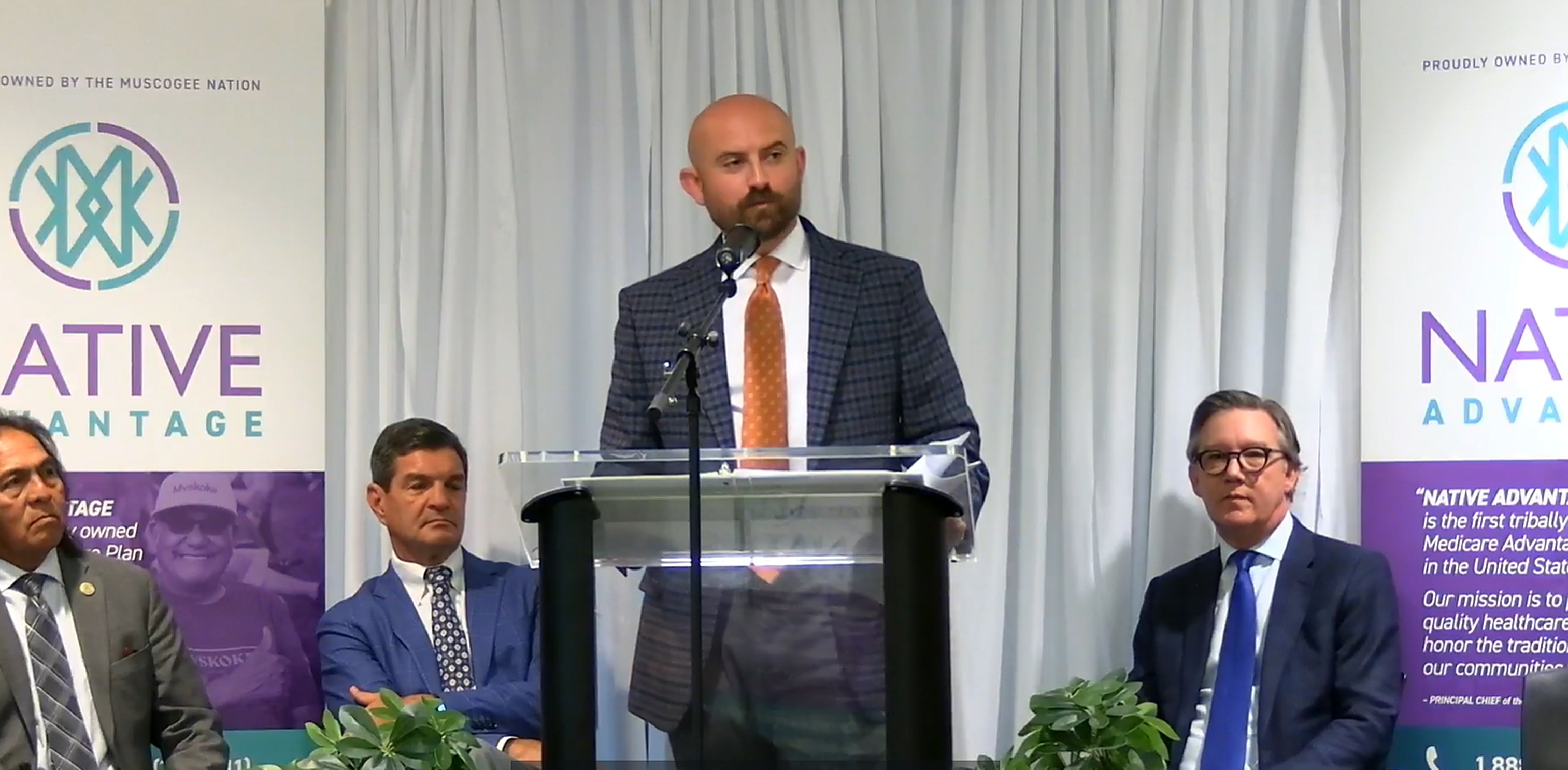
The Muscogee (Creek) Nation presented Native Advantage on Oct. 15 at a press conference. The plan is a Medicare Advantage HMO that the Nation owns. Principal Chief David Hill describes it on the plan's website as "the only tribally owned Medicare Advantage plan in the U.S., built to improve the lives of Oklahomans." Secretary of Health Shawn Terry says the Nation "created this plan to fill a gap in Oklahomans' lives, extending benefits our communities want most."
Speakers marked the day as a milestone for the Nation and the communities it serves, after years of planning and investment in stronger communities for generations to come.
The idea
The plan rests on a simple point. Indian Health care existed long before Medicare Advantage, and many national plans have left seniors unsure who their providers are, where they are supposed to go, and how to get approved. Speakers said some national plans were steering patients away from Indian Health providers. The Centers for Medicare & Medicaid Services (CMS) does confirm the underlying problem in its own guide for tribal beneficiaries: Indian health care providers "may not be part of a Medicare Advantage plan's network," and plans "may pay less or not pay" them. Native Advantage is meant to give both tribal and non-tribal patients more options.
Leaders also pointed to the Nation's growing health system. In its own releases, MCN Health says Council Oak Comprehensive Healthcare in Tulsa became the first tribal health care facility in the lower 48 states to perform surgery with the da Vinci Xi robotic system, on Oct. 9, 2023, and it reported its 100th robotic surgery in December 2024.
The plan at a glance
Terms below come from the plan's 2027 Summary of Benefits; the Evidence of Coverage controls if there is a conflict.
- Who can join: anyone enrolled in Medicare Parts A and B who lives in the service area. Tribal citizenship is not required.
- Service area: Creek, Hughes, Mayes, McIntosh, Muskogee, Okfuskee, Okmulgee, Rogers, Seminole, Tulsa and Wagoner counties.
- Premium: $0 a month for the plan; members still pay the Medicare Part B premium.
- Costs: $0 medical deductible, $7,150 yearly out-of-pocket maximum, $0 primary care visits, $40 specialist visits.
- Extras: dental allowance up to $1,250 a year, eyewear up to $200, 24 one-way rides a year.
- Enrollment: Medicare's Annual Enrollment Period runs Oct. 15 through Dec. 7. Medicare.gov says choices made in that window take effect Jan. 1 of the following year. The plan is CMS-approved for contract year 2027.
The legal footing
On Jan. 31, 2026, the Muscogee (Creek) National Council voted 15-0 for NCA 26-022, sponsored by Rep. Lucian Tiger. It authorized the principal chief to file articles of incorporation for Native Advantage, Inc., wholly owned by the Nation and governed by a board of elected officials who are eligible Muscogee citizens, according to Mvskoke Media. The plan's 2027 provider manual describes it as an HMO offered by Native Advantage, Inc., a subsidiary of the Nation.
How tribal health care became a federal duty
The obligation grew out of land. The Indian Health Service's own history says the cession of most of the country's lands by tribes, set down in hundreds of treaties, forms the basis for the government's provision of health care to Indians, and that many treaties named health services as part of the payment for that land. IHS dates the government-to-government relationship to 1787, resting on Article I, Section 8 of the Constitution.
President Bill Clinton described the bargain this way on Aug. 6, 1998: "Long ago, many of your ancestors gave up land, water, and mineral rights in exchange for peace, security, health care, education from the federal government. It is a solemn pact." That is a president's characterization, not a clause in a treaty.
For the Muscogee Nation, the key agreements are the 1832 Treaty of Cusseta, in which the Nation gave up its land east of the Mississippi for a guaranteed homeland in the West, the 1833 treaty signed at Fort Gibson that set its boundaries, and the 1866 treaty after the Civil War, in which the Creeks ceded the western half of their domain, about 3.25 million acres, and kept the eastern half. We searched the official text of all three. The health duty rests on the treaty and trust relationship as a whole, backed by statute.
The duty rests on the treaty and trust relationship plus federal law, and who qualifies is set by statute and regulation. Federal law built the system step by step:
- 1832: Congress sets aside $12,000 for smallpox vaccination for Indians, an early federal health effort.
- 1921: The Snyder Act becomes the basic authority for federal Indian health services. The Bureau of Indian Affairs carries it out until 1955.
- 1954-55: The Transfer Act moves Indian health care to the Public Health Service, creating the Indian Health Service.
- 1975: The Indian Self-Determination Act lets tribes run their own health programs. Self-governance compacts followed in 1992 and 2000.
- 1976: The Indian Health Care Improvement Act (IHCIA) becomes the cornerstone law. It was made permanent in 2010 with the Affordable Care Act.
IHS is an agency of the U.S. Department of Health and Human Services, headquartered in Rockville, Maryland. It is the principal federal health provider for American Indians and Alaska Natives in federally recognized tribes, and it sets policy and funding for programs nationwide. Some programs are run directly by IHS, some by tribes, and some serve urban Indian communities.
Who is eligible, and where
Two different questions get mixed together. Direct care is the first. Referred care is the second.
Direct care means treatment at an IHS or tribal hospital or clinic. The federal rule, 42 C.F.R. § 136.12, covers "persons of Indian descent belonging to the Indian community served by the local facilities and program," and lists tribal membership and enrollment among the ways a person shows that tie. IHS says the most common standard is enrollment in a federally recognized tribe, and that members of the 575 federally recognized tribes "and their descendants are eligible." That is why a Muscogee citizen is not limited to Muscogee facilities. IHS says a tribal member "may obtain care at any IHS hospital or clinic if the facility has the staff and capability to provide the medical care." A citizen who has a relationship with a federal IHS facility, or who lives in a city, can be seen there by virtue of enrollment in a federally recognized tribe. Tribally run clinics set their own approach to patients from other tribes, and many places have no IHS facility at all.
Urban Indian health programs fill part of that gap. They are nonprofit organizations, funded in part by IHS, not IHS-run hospitals. Under Title V of the Indian Health Care Improvement Act (25 U.S.C. §§ 1651 to 1660h, Subchapter IV of Chapter 18), they serve "urban Indians residing in the urban centers in which such organizations are situated" (25 U.S.C. § 1653(a)). IHS counts 41 of them, with more than 80 sites, as of 2022.
Referred care, formally Purchased/Referred Care (PRC), is where the Medicaid-first rule comes in. It pays outside doctors and hospitals when an IHS or tribal facility cannot provide a service. Under 42 C.F.R. § 136.23 a person generally must live in a designated delivery area, and members who move away keep eligibility for no more than 180 days, with exceptions for students and others. IHS says living in a delivery area "creates no legal entitlement to PRC but only potential eligibility for services."
A note on jurisdiction: in Oklahoma the federal delivery area is the entire state. MCN Health's own contract-health program is stated in terms of specific counties, depending on the patient and the type of care, and requires residence within the Muscogee Nation Contract Health Services Delivery Area. Patients should confirm their county with the program.
Why a treaty promise comes with paperwork
Here is how it works on the ground. A tribal citizen goes to an IHS or tribal facility for care they qualify for, whether a federal IHS facility through enrollment in a federally recognized tribe or a tribal clinic. If the service has to be sent outside, to a specialist or hospital paid with Purchased/Referred Care dollars, they are told that the federal directive requires them to apply for Medicaid first, if they may be eligible. IHS pays last.
That is not a Muscogee rule, and it is not limited to children. It is a federal rule that applies to American Indians and Alaska Natives who are members of federally recognized tribes across the United States. Two limits matter. First, it attaches to referred care; IHS says plainly that "there is no requirement for patients to apply for an Alternate Resource when receiving direct care." Second, only people who may actually qualify have to apply. IHS's manual says that "only IHS patients who, upon reasonable inquiry, are determined to be potentially eligible for alternate resources are required to apply," and that patients "should not automatically be denied PRC benefits simply because of the possibility they might be eligible." Staff give written notice and help with the application. The manual lists one patient-side ground for denial: when the patient "willfully or intentionally fails to apply or fails to complete an alternate resource application," after written notice and 30 days.
What Medicaid is
Many people think of Medicaid as a program for poor children. It is broader. CMS describes it as coverage for "eligible low-income adults, children, pregnant women, elderly adults and people with disabilities," run by the states under federal rules and paid for jointly by states and the federal government. Eligibility turns on income, age, disability, pregnancy, family status and the state where you live. In Oklahoma, for example, voters approved expansion in 2020, and adults 19 to 64 can qualify at up to 138 percent of the federal poverty level, about $22,176 a year for one person in 2026. So "eligible" means something different for each person and in each state.
Why the law treats it this way
The legal chain is short. A 1999 regulation, 42 C.F.R. § 136.61, says IHS "is the payor of last resort ... notwithstanding any State or local law or regulation to the contrary," and counts Medicare and Medicaid as "alternate resources." Congress put the same idea in the 1988 IHCIA amendments and again in 2010 in 25 U.S.C. § 1623(b). IHS's own answer to the question tribal members ask, why a treaty promise requires an application, is blunt: "While some treaties mention health care, the Indian Health Service is not an entitlement program." Alternate resources, IHS says, "allow PRC funds to be conserved, thereby providing health care for more Indian beneficiaries." Billing insurers is also written into law: 25 U.S.C. § 1621e gives IHS and tribes "the right to recover" from insurers, including HMOs.
Medicaid contains special terms for American Indians and Alaska Natives:
- 100 percent federal payment. When a Medicaid patient receives services "through an Indian Health Service facility whether operated by the Indian Health Service or by an Indian tribe or tribal organization," the federal government pays the whole cost, not the usual state share (42 U.S.C. § 1396d(b)).
- No cost sharing. Federal law says no "enrollment fee, premium, or similar charge," and no copayment or cost sharing, may be imposed on an Indian furnished services by an Indian health program or through referral (42 U.S.C. § 1396o(j); 42 C.F.R. § 447.56(a)(1)(x)). Children in the Children's Health Insurance Program are covered the same way (42 C.F.R. § 457.535).
- Estate recovery limits. CMS says certain tribal trust income and resources are exempt when states recover costs from estates.
The editors' view is that this means Medicaid, a federal-state program, often ends up paying for what the treaty and trust relationship promised. Tribal leaders put the tension sharply. Many argue the obligation is a debt already paid with ceded land and should not depend on a separate benefit program. IHS answers that its funding is limited and Medicaid stretches it. Both statements can be true. Where Medicaid pays for care at an IHS or tribal facility, the 100 percent match means the federal government carries the whole cost.
For seniors, the first payer is different. Medicare.gov says that for people with Medicare who use IHS care, "Generally, Medicare pays first." That is why a Medicare plan built around tribal providers matters.
Could Native Advantage be the first of many?
Several official facts make it plausible. Under Title V self-governance, tribes can take over IHS programs and redesign them without IHS approval, and IHS is offering fiscal 2026 planning and negotiation grants to tribes. Tribal health programs may keep Medicare and Medicaid payments and use them to expand services. CMS publishes a guide for tribal Medicare beneficiaries because Indian providers may be left out of plan networks. And a precedent exists for Medicare dollars financing tribal elder care: Cherokee Elder Care, run by the Cherokee Nation since 2008, is a PACE program, a different model from Medicare Advantage.
The obstacles are just as real. A Medicare Advantage plan is a regulated insurer. It needs CMS approval, a provider network, enough members and capital. This one is CMS-approved for 2027 and has no track record yet. If it works, it would give other nations a tested template. If not, it will be a costly lesson. Speakers at the event described the plan as an investment in stronger communities for generations to come, which is the test the opening quotation sets.
Citations
- 42 C.F.R. § 136.61, Payor of last resort. https://www.ecfr.gov/current/title-42/chapter-I/subchapter-M/part-136/subpart-G/section-136.61
- 42 C.F.R. § 136.12 (direct care eligibility) and § 136.23 (Purchased/Referred Care eligibility). https://www.ecfr.gov/current/title-42/part-136 ; 42 C.F.R. § 136.22(a)(3) (Oklahoma delivery area); IHS Purchased/Referred Care Delivery Area list. https://www.ihs.gov/sites/prc/themes/responsive2017/display_objects/documents/PurchasedReferredCareDeliveryAreaList_Final2024.01.11.pdf ; IHS, "Eligibility" FAQ and patient pages. https://www.ihs.gov/forpatients/faq/ and https://www.ihs.gov/forpatients/ ; IHS, About Urban Indian Organizations; 25 U.S.C. §§ 1603, 1651-1660h (Title V, IHCIA). https://www.ihs.gov/urban/aboutus/about-urban-indian-organizations/ ; MCN Health, Contract Health Services. https://www.creekhealth.org/services/contract-health/
- 25 U.S.C. § 1623(b), payer of last resort (Pub. L. 111-148, § 2901); 25 U.S.C. § 1621e, recovery from third parties. https://www.govinfo.gov/link/uscode/25/1623 and https://www.govinfo.gov/link/uscode/25/1621e
- IHCIA Amendments of 1988, Pub. L. 100-713, as quoted in IHS, "Requirements: Alternate Resources." https://www.ihs.gov/PRC/eligibility/requirements-alternate-resources/
- Indian Health Manual, Part 2, Ch. 3, §§ 2-3.8 to 2-3.8J. https://www.ihs.gov/ihm/pc/part-2/chapter-3-purchased-referred-care/
- IHS Purchased/Referred Care FAQ. https://www.ihs.gov/prc/frequently-asked-questions-faq-s/
- 42 U.S.C. § 1396d(b), 100 percent federal medical assistance percentage for services received through IHS and tribal facilities. https://www.govinfo.gov/link/uscode/42/1396d ; CMS SHO #16-002. https://www.medicaid.gov/federal-policy-guidance/downloads/SHO022616.pdf
- 42 U.S.C. § 1396o(j); 42 C.F.R. § 447.56(a)(1)(x); 42 C.F.R. § 457.535. https://www.govinfo.gov/link/uscode/42/1396o and https://www.ecfr.gov/current/title-42/part-447
- CMS, Medicaid overview. https://www.medicaid.gov/medicaid ; CMS, Estate recovery protections for AI/ANs. https://www.cms.gov/outreach-and-education/american-indian-alaska-native/aian/downloads/estaterecoveryprotections-medicaid.pdf ; Oklahoma Health Care Authority, Medicaid expansion. https://oklahoma.gov/ohca/about/medicaid-expansion/expansion.html
- Medicare.gov, "How Medicare works with other insurance." https://www.medicare.gov/publications/02179-how-medicare-works-with-other-insurance.pdf ; CMS, Medicare Advantage guide for tribal beneficiaries. https://www.cms.gov/files/document/medicareadvpartctribal.pdf
- President Clinton, remarks of April 29, 1994, Public Papers of the Presidents. https://www.govinfo.gov/content/pkg/PPP-1994-book1/html/PPP-1994-book1-doc-pg800-2.htm ; remarks of Aug. 6, 1998. https://clintonwhitehouse6.archives.gov/1998/08/1998-08-06-remarks-by-the-president-at-native-american-conference.html
- Treaties: 7 Stat. 366 (1832), 7 Stat. 417 (1833), 14 Stat. 785 (1866). https://www.govinfo.gov/
- Native Advantage 2027 Summary of Benefits. https://nativeadvantage.com/documents/2027/Native-Advantage-2027-Summary-of-Benefits.pdf ; MCN Health, robotic surgery release. https://www.creekhealth.org/2023/11/02/muscogee-nation-achieves-historic-first-with-robotic-surgery-system/ ; MCN Health, 100th robotic surgery. https://www.creekhealth.org/2024/12/06/mcn-health-celebrates-100th-robotic-surgery-milestone/ ; Mvskoke Media, "Native Advantage Inc. established to provide Medicare for elders" (NCA 26-022). https://www.mvskokemedia.com/native-advantage-inc-established-to-provide-medicare-for-elders/ ; Medicare.gov, open enrollment. https://www.medicare.gov/health-drug-plans/open-enrollment
Copy is original LIKE® Magazine text. Quotations are short and attributed.
Disclosure: LIKE® Magazine Publisher Duc Michael De La Force completed the New York State Citizen Public Health Training, delivered by the New York State Department of Health in partnership with Cornell University and developed by Cornell's Master of Public Health program. He completed all classes with a perfect score, and New York State recognizes him as a State Public Health Leader. This recognition is a training certificate, not a medical or insurance license. This article is journalism for general information and is not medical, legal, or insurance advice. Readers should consult a qualified professional and review a plan's official Evidence of Coverage before enrolling.