I. THE STAIRCASE
Some photographs are news. Others are a lesson in tailoring, and the best are both.
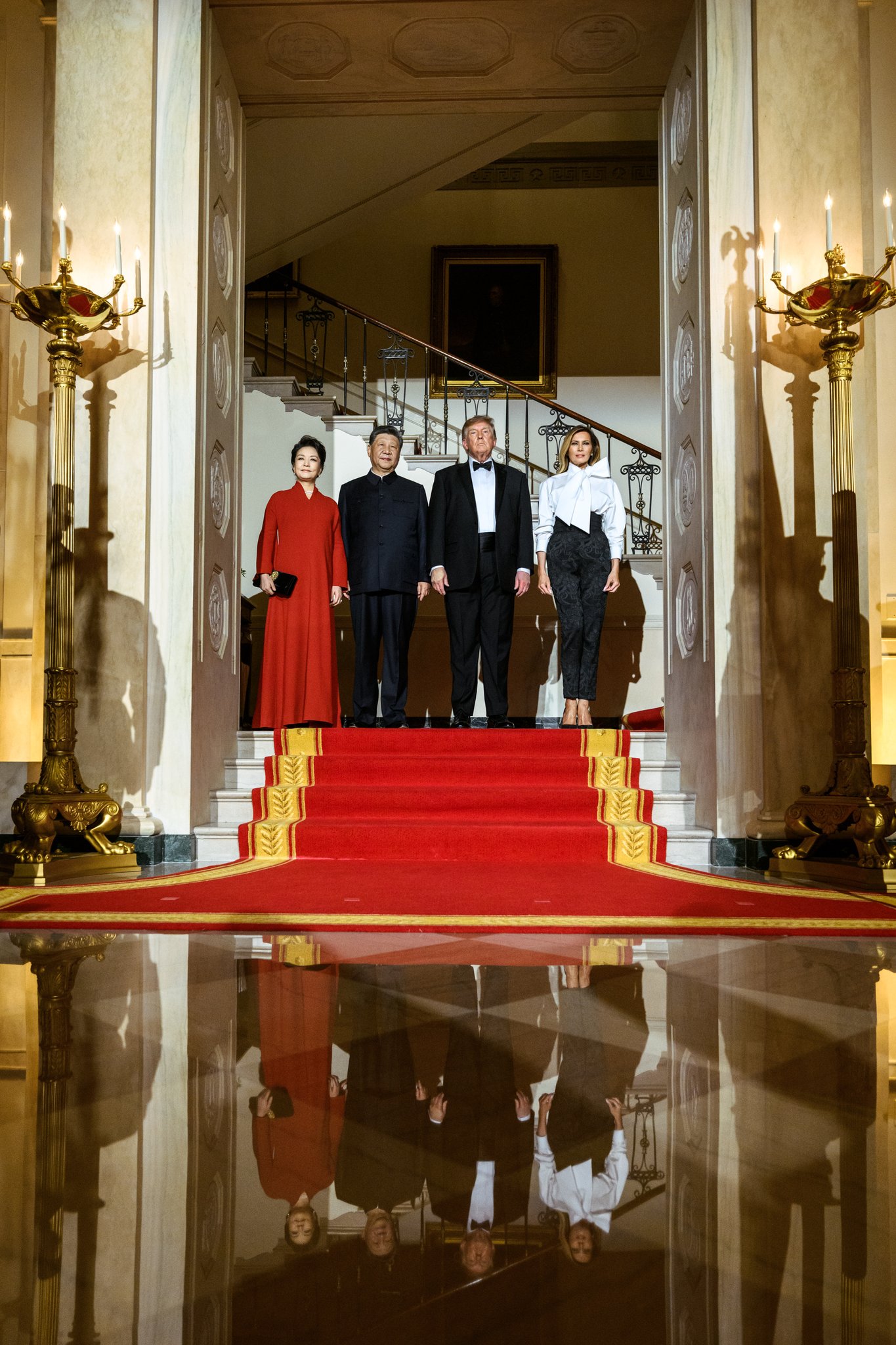
On the evening of September 24, 2026, before the East Room filled for the state dinner honoring President Xi Jinping and Madame Peng Liyuan, the two couples stood together at the foot of the White House Grand Staircase. Gilded torchères flank them. A crimson runner bordered in gold climbs behind them. The marble at their feet is polished to a mirror, so the picture prints twice: once upright, once in reflection, like a playing card.
Read it as a garment historian would, and a century and a half of evening dress lines up in a single frame.
On the host, President Donald J. Trump, the foundation: a black dinner suit, white shirt, black bow tie and a black cummerbund across the waist. It is the uniform that gave the evening's dress code its name, and the garment that, in America, took its name from a village in the Ramapo hills.
On President Xi Jinping, the Zhongshan suit: a dark tunic closed to a stand collar, with the patch pockets and quiet symmetry that have made it the formal dress of Chinese statesmen for a century. On Madame Peng, a long column of red with a high neckline and a double string of pearls.
And on First Lady Melania Trump, the surprise of the night. She came in no gown at all. She wore the tuxedo's own vocabulary, translated: a white cotton poplin Saint Laurent blouse with an oversized pussy bow; black peony-patterned brocade trousers by Dolce & Gabbana; a black silk cummerbund, also Dolce & Gabbana; and black Christian Louboutin heels. Those labels were reported by The Washington Post and the New York Post the same night.
"That is what they wear for dinner up at Tuxedo."the explanation given at Delmonico's, as recorded in the Tuxedo Club's history
What follows is the long story behind that one frame. It begins in a lake-and-forest colony in New York's Orange County, runs through a Savile Row ledger, a Paris couture salon, a Shanghai tailor's bench and a Newark coachworks, and ends, as all good evenings should, with a car at the door.
II. THE FOUNDATION: WHERE THE TUXEDO CAME FROM
A royal coat on Savile Row
Every serious history of the dinner jacket starts in London. Henry Poole & Co., the Savile Row house that still cuts suits today, records that in 1865 the Prince of Wales, the future King Edward VII, asked Henry Poole for a short coat he could wear to informal dinners at Sandringham. Poole delivered a short evening coat in celestial blue, the garment the firm regards as the first dinner jacket.
Keep the date in mind: it has moved once already, and we will return to it.
Tuxedo Park, 1886
The American chapter has a fixed address. The tobacco heir Pierre Lorillard IV created Tuxedo Park as a private lake-and-forest retreat, with the architect Bruce Price designing its gate, clubhouse and cottages; some 1,800 workers built it. At the opening, May 30–31, 1886, three special trains carried 700 guests up from New York. The Town of Tuxedo was formed in 1890; the Village of Tuxedo Park, 2,050 acres including 355 acres of lakes, was incorporated in 1952.
From here the history forks into three stories, and LIKE presents them as the record leaves them: unresolved.
Story one: Griswold Lorillard's coattails. The version that dominated for generations says that at the first Autumn Ball in October 1886, Pierre's son Griswold and a few friends arrived in tailless dress coats and scarlet satin waistcoats. The village's own history notes that Town Topics, then the leading society paper, compared the young men to "royal footmen" and suggested they "ought to have been put in strait-jackets long ago." Tuxedo town historian Chris Sonne cautioned WWD in 2011 that a tailcoat with its tails cut off is a waist-length mess jacket, not a dinner jacket. The evening happened; whether it gave birth to the tuxedo remains disputed.
Story two: James Brown Potter at Sandringham. The Tuxedo Club favors the account given by founding member Grenville Kane to J. Earle Stevens in 1929. In the summer of 1886, member James Brown Potter visited Sandringham and came home with a short dinner jacket in the Prince's manner. His fellow members had it copied, and when a party of them wore the jackets to a bachelor dinner at Delmonico's, the explanation was simply that "that is what they wear for dinner up at Tuxedo." Henry Poole, for its part, finds no Potter in its ledgers and considers the story apocryphal.
Story three: the founders already knew. Henry Poole's preferred explanation is that Tuxedo's founding circle, which it names as members of the Astor, Goelet, Mills and Lorillard families, including Pierre Lorillard himself, were documented Poole customers in the 1860s. On that reading, they probably copied the Prince and brought the short dinner coat to New York some twenty years before Potter's trip.
What nobody disputes is the name. Whoever carried it, the coat was christened for the place: the tuxedo.
III. "THE LITTLE BLACK JACKET": THE EXHIBITION
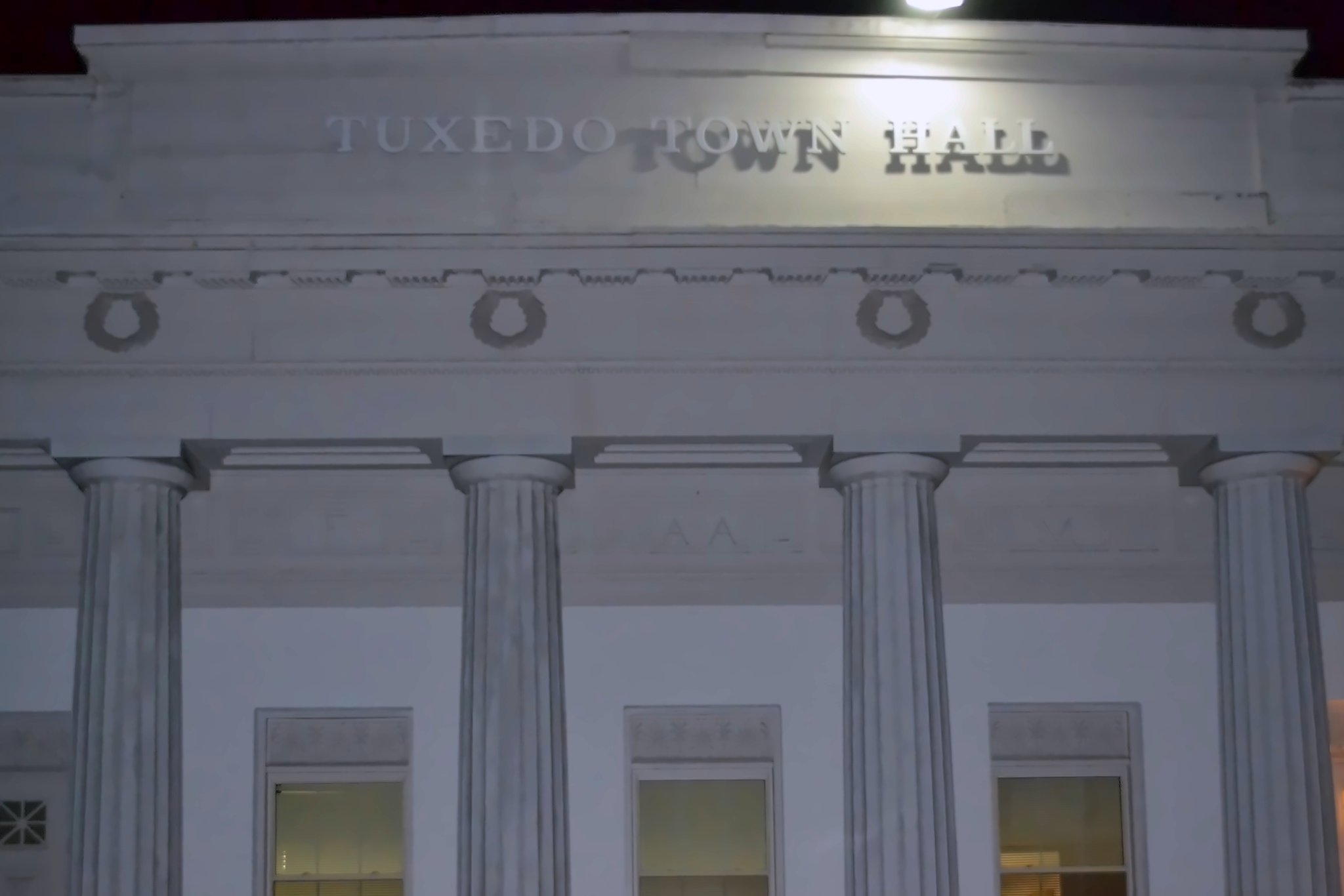
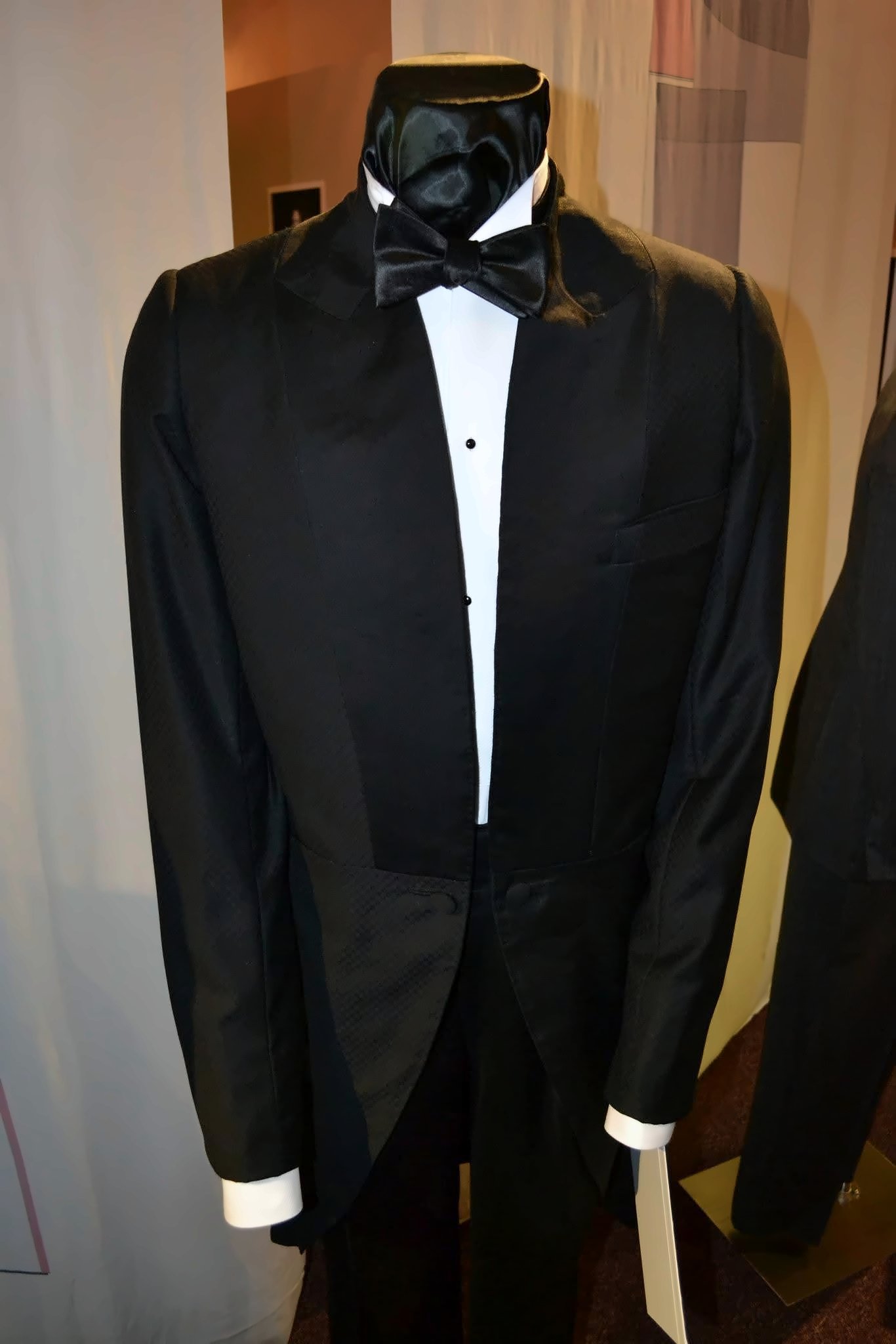
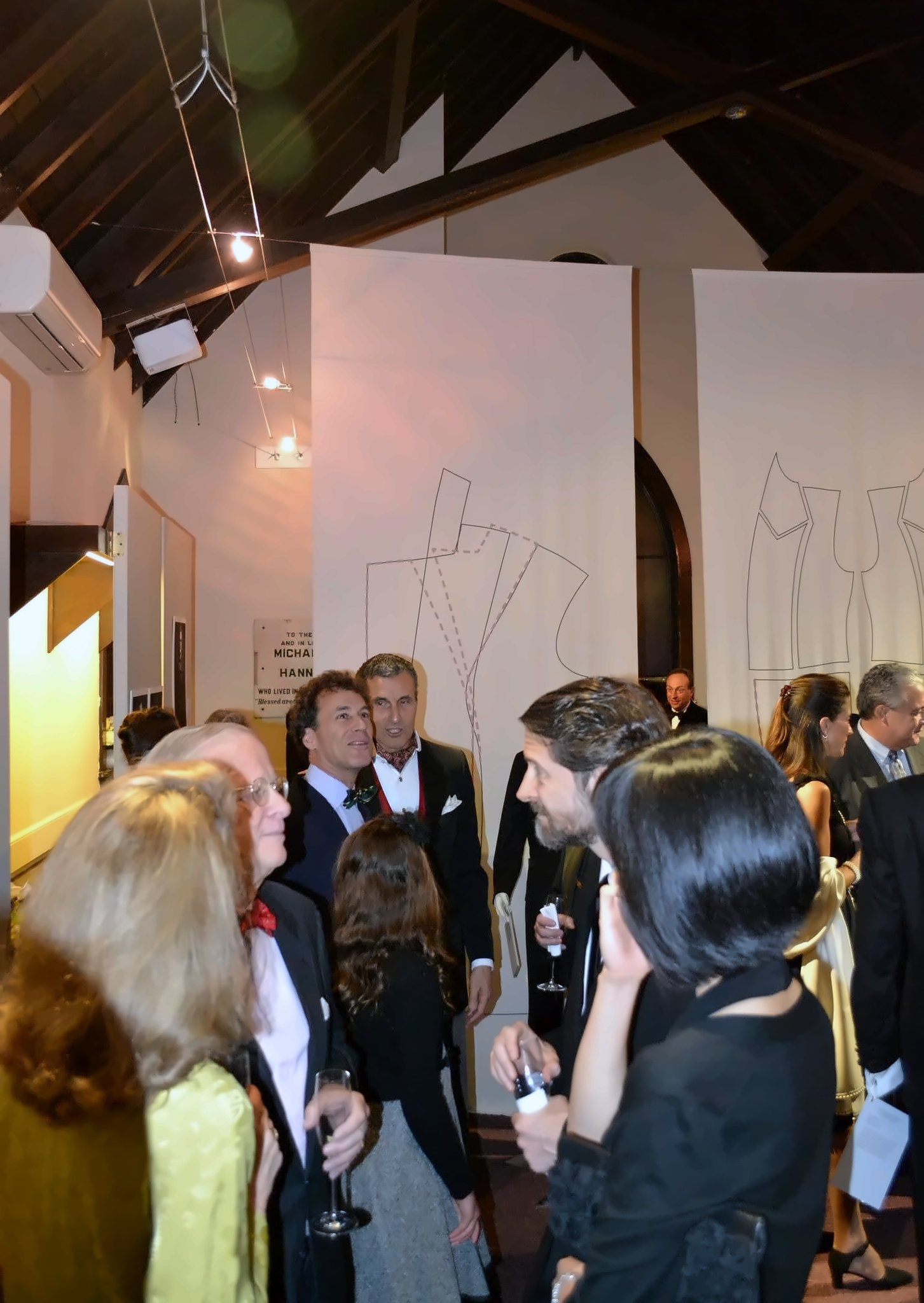
In autumn 2011, the Tuxedo Historical Society opened its doors to London. The Little Black Jacket: Celebrating 150 Years of the Tuxedo was a London College of Fashion project with Henry Poole & Co. and the Paris cloth house Dormeuil. BA Bespoke Tailoring students had been asked to reinvent the tuxedo for the 21st century, working with actors from the Drama Centre at sister college Central Saint Martins. The show opened in London that September, appeared at Harrods and the Burlington Arcade, then crossed the Atlantic to the village where the jacket got its American name. WWD reported that the Tuxedo Club's Autumn Ball, dormant since 1971, was revived for the occasion with Giorgio Armani as sponsor. The exhibition ran through early November.
Editor's note on dates: LIKE's photographs in this feature come from that Tuxedo Park installation. The exhibition counted 150 years from Henry Poole's then-published 1860 date, and Poole revised its date to 1865 in 2012. By the corrected count, the dinner jacket's sesquicentennial fell in 2015, and on the Tuxedo Club reckoning (1886) the American tuxedo turns 140 this year. We publish the archive now because, as the Grand Staircase shows, the story has never been more current.
The designers, in their own words
The exhibit cards credited each look as carefully as a couture program, and every one carried the same partners: cloth by Dormeuil, shirt by Darcy Clothing, cufflinks by Tateossian.
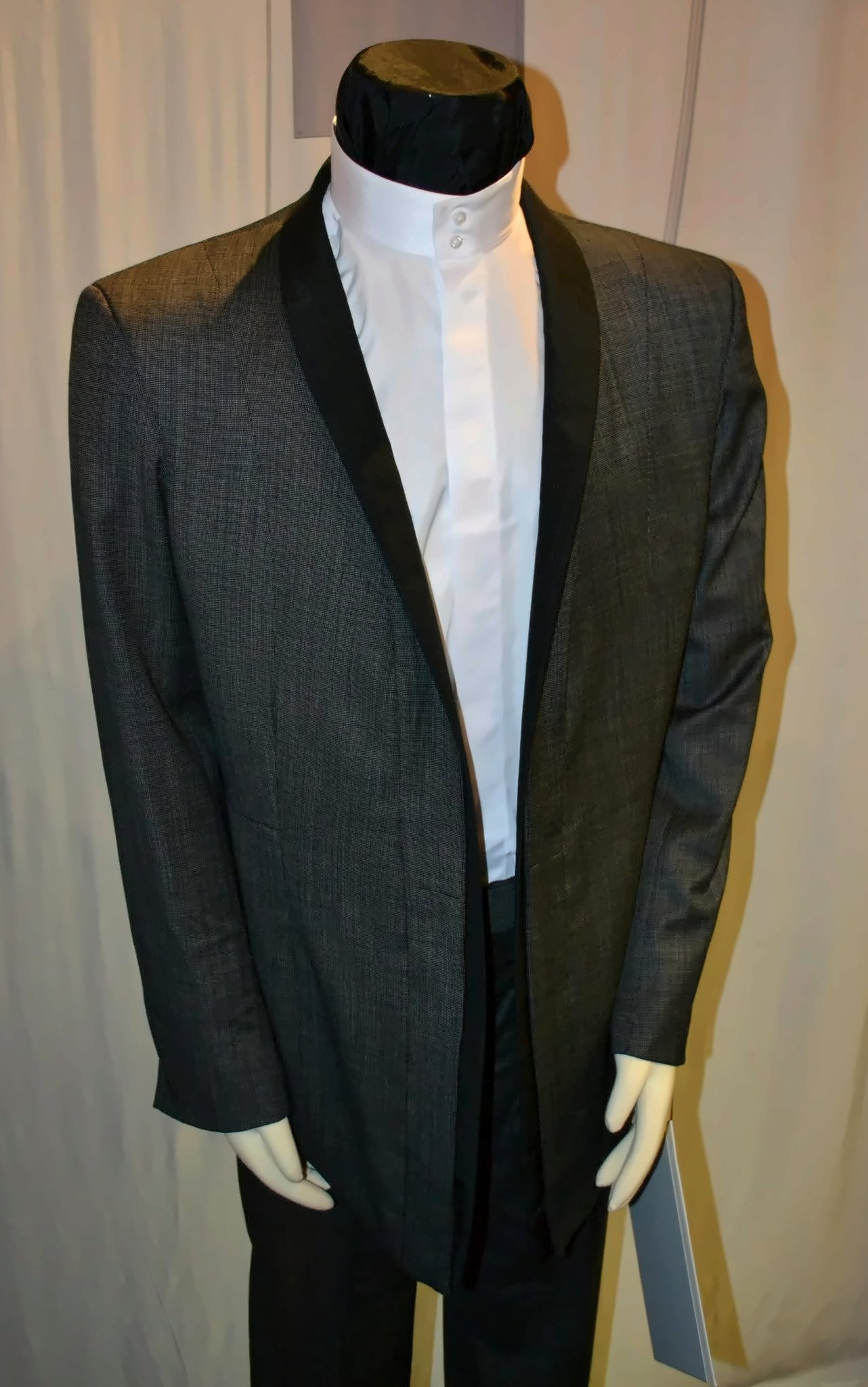
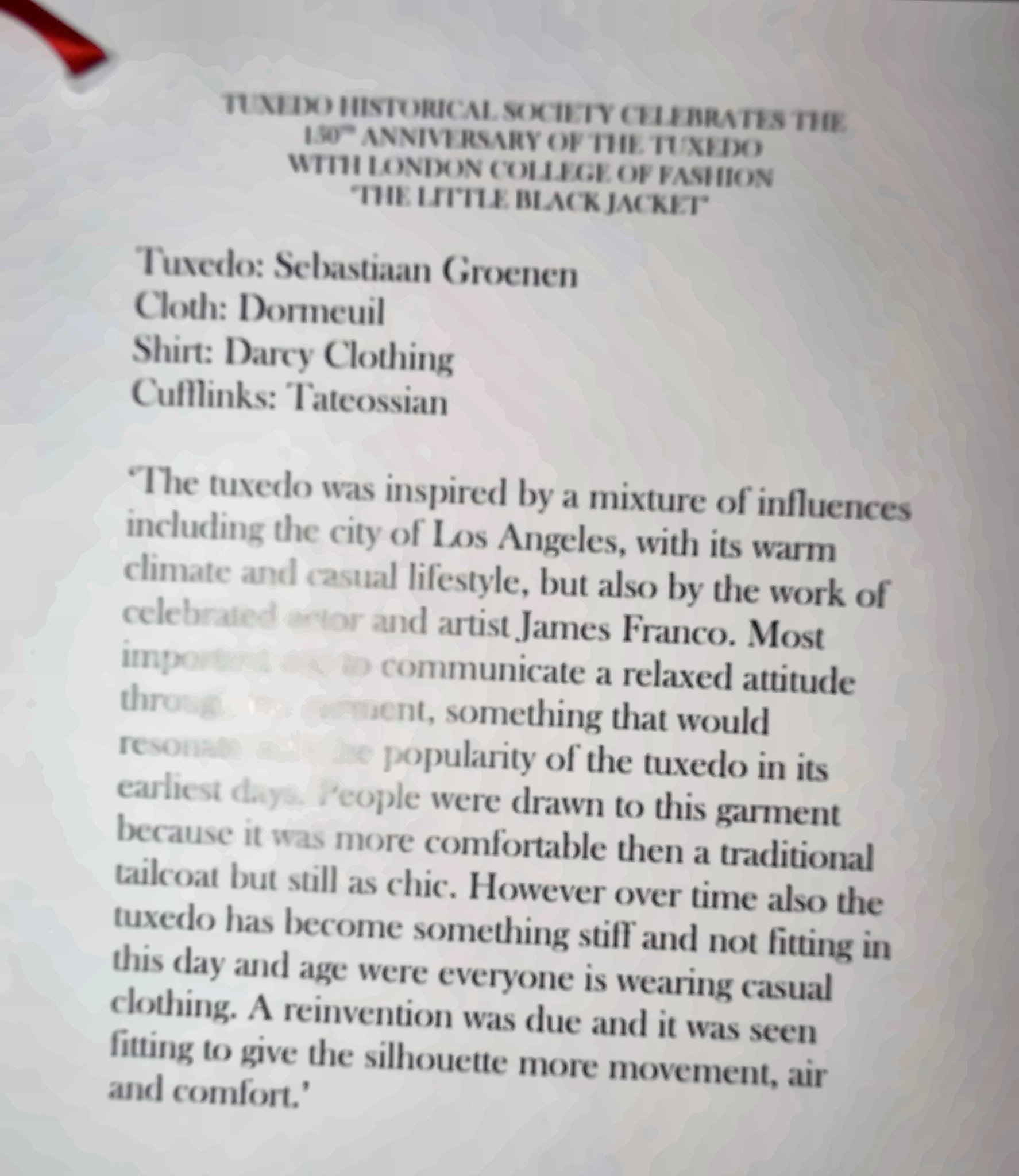
Sebastiaan Groenen looked west for his jacket. On the card, he names Los Angeles, "with its warm climate and casual lifestyle," as one influence and James Franco as another. He argues that the tuxedo won its first admirers because "it was more comfortable then a traditional tailcoat but still as chic," and that over time it had become "something stiff." His answer: "it was seen fitting to give the silhouette more movement, air and comfort." (LIKE quotes the card verbatim, original spelling included; a band of lamp glare makes several words in the middle of it unreadable, and we have not reconstructed them.)
"A reinvention was due and it was seen fitting to give the silhouette more movement, air and comfort."Sebastiaan Groenen, exhibit card, Tuxedo Historical Society
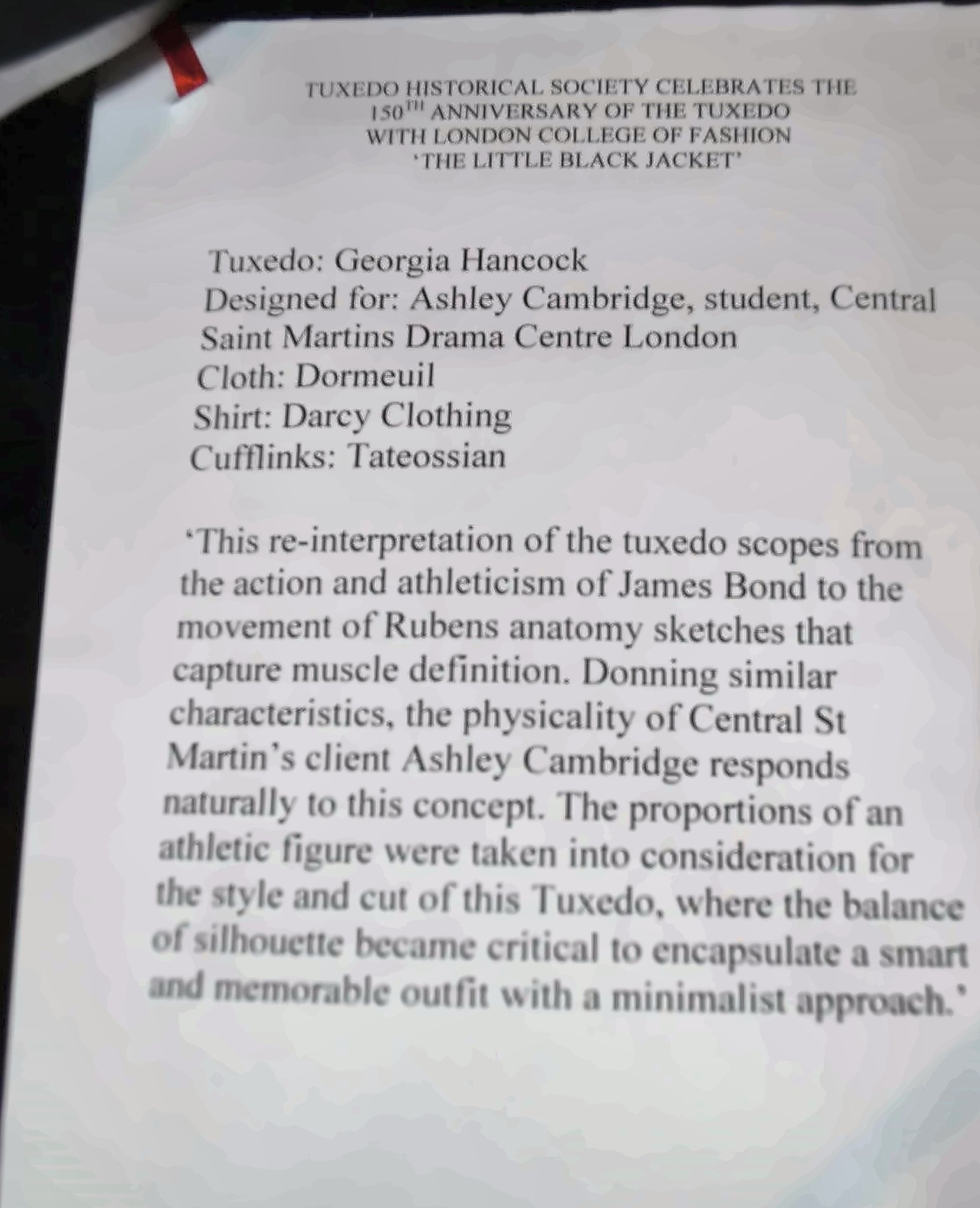
Georgia Hancock cut for a body in motion. Her client was Ashley Cambridge, a student at the Central Saint Martins Drama Centre London, and her card traces the idea "from the action and athleticism of James Bond to the movement of Rubens anatomy sketches that capture muscle definition." Proportion was the whole game: "the balance of silhouette became critical to encapsulate a smart and memorable outfit with a minimalist approach."
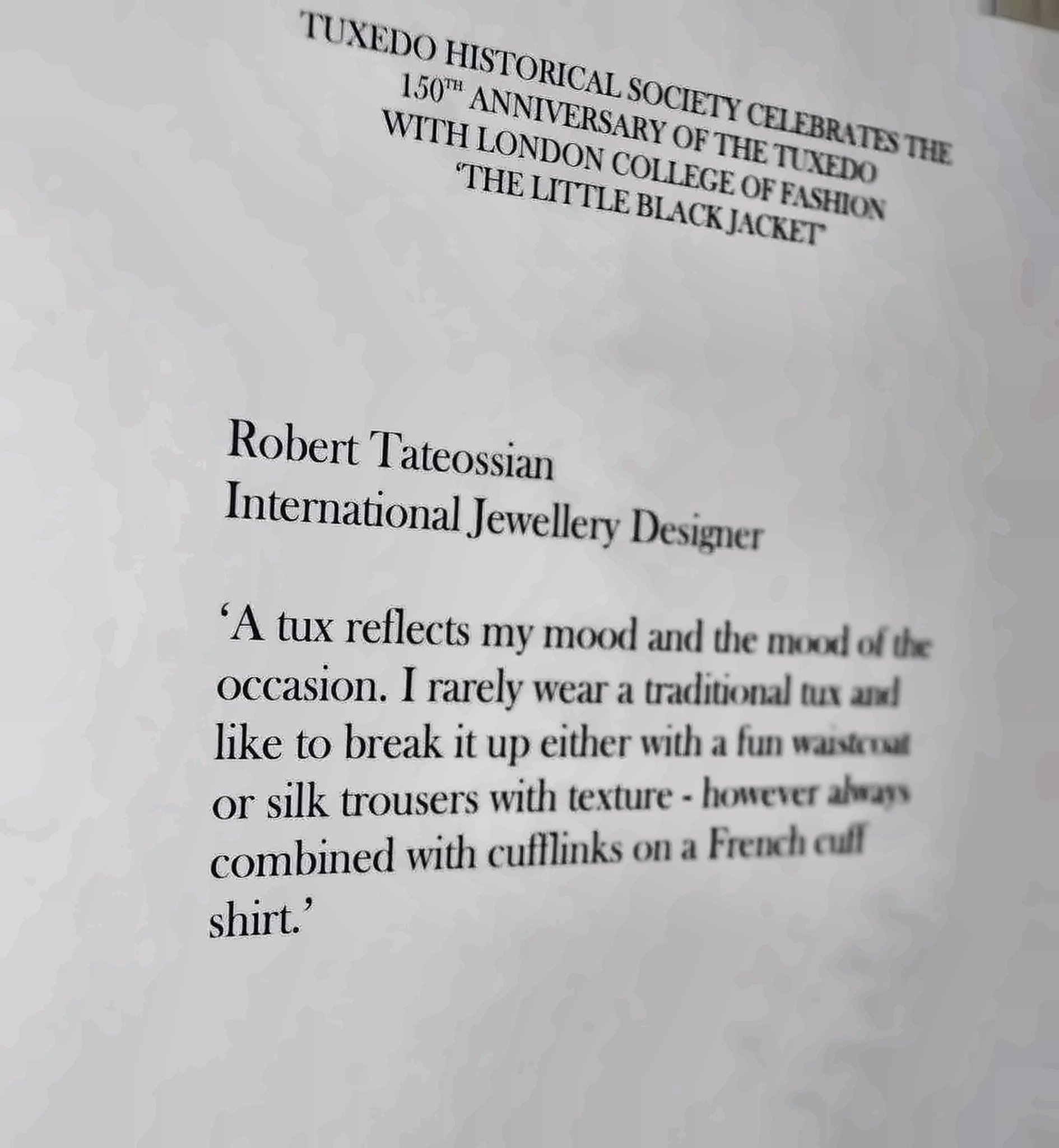
Robert Tateossian, the London jeweller who founded his house in 1990, contributed a credo on his card that could serve as this magazine's motto for evening dress:
"A tux reflects my mood and the mood of the occasion. I rarely wear a traditional tux and like to break it up either with a fun waistcoat or silk trousers with texture - however always combined with cufflinks on a French cuff shirt."Robert Tateossian, International Jewellery Designer, exhibit card
LCF's records describe the exhibition's portrait series as 21 monochrome A2 portraits by photographer Ed Barber, made for the project. Among them, at Tuxedo Park, was Angus Cundey, Chairman of Henry Poole & Co. Mr. Cundey, keeper of the house whose ledgers hold the Prince of Wales's order, died on August 12, 2024, at 87. His son Simon now leads the house in its seventh generation.
The Historical Society added its own treasures: WWD noted a Brooks Brothers tuxedo, an array of bow ties and a scarlet waistcoat, a direct nod to the Autumn Ball legend. Around them hung decades of objects that borrowed the word "Tuxedo" as a brand, from cigars to Jeeps (see Section IX).
IV. THE RULES OF THE EVENING
Black tie, white tie and morning dress, and why the details matter
Evening dress is a grammar. Learn it, and you may break it beautifully. Here is the LIKE primer, built on the codes as Debrett's sets them out and as Savile Row cuts them.
The lapel: peak, shawl, notch
- Peak lapel. Derived from the tailcoat, so traditionally the more formal choice; its upward sweep broadens the shoulder and lifts the eye.
- Shawl collar. An unbroken curve inherited from the Victorian smoking jacket: softer and more romantic, and the natural choice for velvet and warm-weather jackets.
- Notch lapel. Borrowed from the everyday lounge suit. Black-tie authorities long treated it as a fashion alternative rather than the classic; it is now common, but purists still reach for peak or shawl.
The cloth
The best evening cloths are dark, rich and alive to light. Barathea, a dense, finely textured worsted weave, reads matte and deep, which is why it looks "blacker" than other blacks. Mohair blends bring crispness and a natural sheen (lovely for summer, though a restrained sheen is the most elegant). Velvet drinks the light and is the soul of the smoking jacket. Midnight blue gained popularity in the 1930s and is associated above all with the Duke of Windsor; under artificial light it is often said to look richer than black itself. Ask your tailor to show you swatches side by side.
The facings: grosgrain or satin
Lapel facings should be pure silk. Satin is smooth and glossy, the American favorite and especially handsome on a shawl collar. Grosgrain is ribbed and more matte; many English tailors prefer it, and it is more forgiving when you match the bow tie. Whichever you choose, the trouser braid follows the facing.
The waist: cummerbund or waistcoat
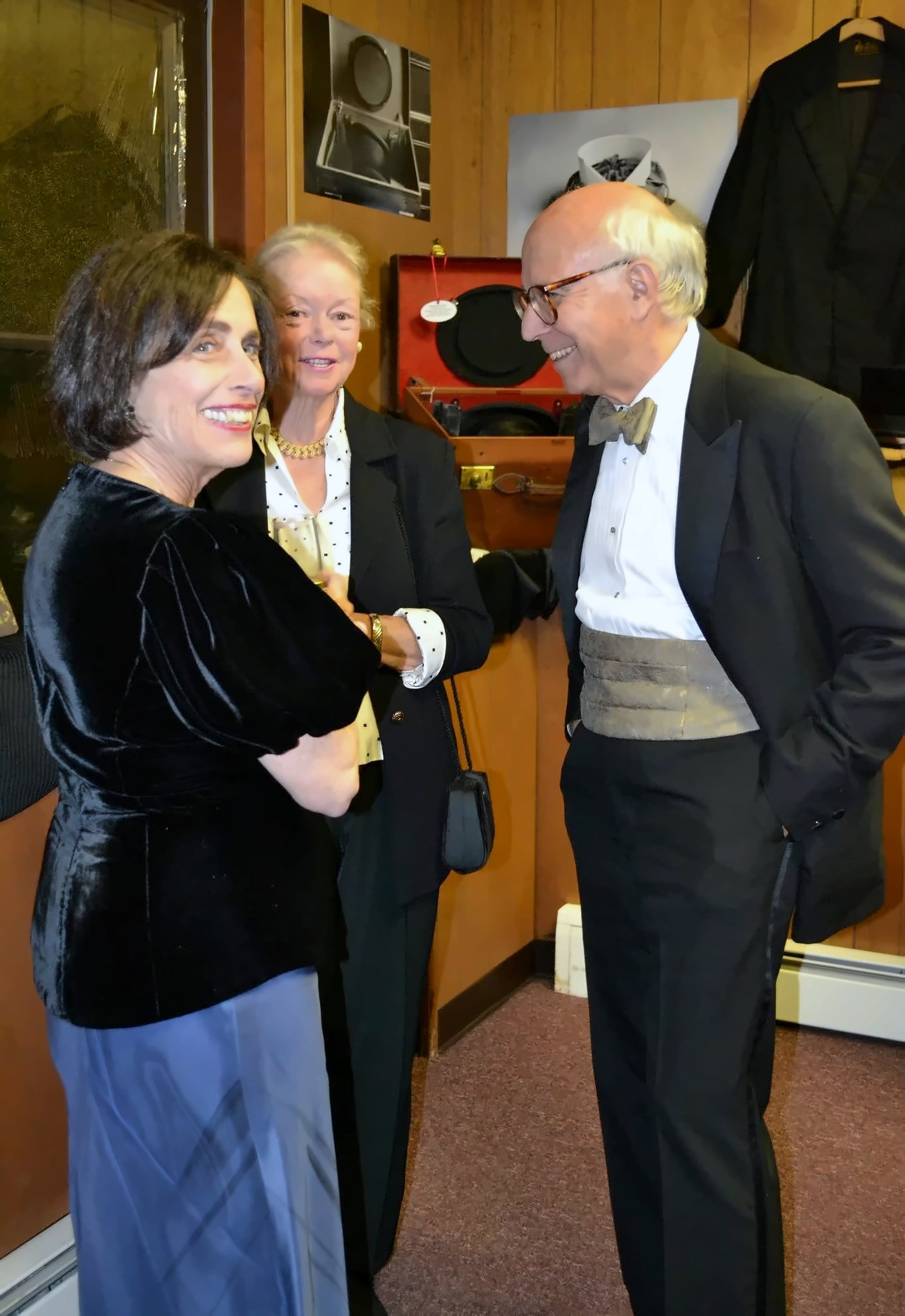
A single-breasted dinner jacket is often worn open, so the waistband must be covered with either a waistcoat or a cummerbund. (A double-breasted jacket, worn buttoned, needs neither.) The word cummerbund came into English, first recorded in 1616, from the Hindi and Urdu kamarband, from Persian kamar ("waist") and band ("band") (Merriam-Webster). British officers in colonial India took up the sash in the 19th century as cooler mess dress than a waistcoat; the National Army Museum's collection documents the sash in officers' dress. From the mess it passed into civilian evening dress. Tradition says wear the pleats facing up, and never with a waistcoat.
The shirt, the studs and the cuffs
For white tie: a stiff marcella (piqué) bib, a detachable wing collar, studs and single cuffs for links. For black tie: a soft turndown collar is the modern classic. A pleated or marcella front is correct, with studs or a covered placket, and French (double) cuffs with cufflinks are, as Robert Tateossian's card insists, non-negotiable. Wing collars with black tie have a long history and still appear, but they read most correct with the most formal versions of the suit.
Shoes, socks and braces
Polished black patent or highly shined calf oxfords, or velvet slippers for evenings at home or at the club; black silk or fine wool socks. Formal trousers are cut high for braces (suspenders) and never take a belt, which bulks the waist and peeks out as the evening wears on.
V. BY DAY: MORNING DRESS IN ENGLAND
The tuxedo's daytime cousin, and the one week a year it rules
The dinner jacket belongs to the evening. Before six o'clock, English formality reaches for something older: the morning coat, cut away at the front and falling to tails behind, worn with a waistcoat, striped or grey trousers, a tie and a top hat. It is the dress of the formal daytime wedding, and above all of Royal Ascot.
The Royal Enclosure, by the rulebook. Ascot Racecourse publishes its code each year, and it is precise. Gentlemen in the Royal Enclosure must wear black, grey or navy morning dress with a waistcoat and tie, and a black or grey top hat. Cravats and bow ties are not permitted, nor is any adornment on the hat. Ladies must wear a hat, or a headpiece with a solid base of at least 4 inches (10 cm); fascinators are not permitted (Ascot Racecourse).
The royal example. Each afternoon of the meeting, the royal family drives down the course in open carriages, and the men wear the code to the letter. Prince William has ridden in the procession in morning coat and top hat, as in 2017 (People), and in 2022 he and the Princess led it in the first carriage (News24). Prince Harry joined the procession in top hat in 2018, a month after his wedding (Hello!).
The hat. At Ascot the top hat is not an accessory but a requirement, and its natural address is St James's Street, where Lock & Co. has traded since 1676. Lock's grey Ascot Top Hat and its restored silk toppers are described in Section VII, together with the reason a true silk hat can no longer be made new.
At the altar. The same coat remains the classic choice for a formal daytime wedding: the one garment in this story that is still worn, as it was designed to be, in the light of day.
VI. THE FIRST LADY'S WARDROBE AND THE WOMEN WHO WORE THE TUXEDO FIRST
A tuxedo for a woman: from Marlene to Le Smoking
The tuxedo has never belonged only to men. In Josef von Sternberg's Morocco (1930), her first American film, Marlene Dietrich made her cabaret entrance in top hat, white tie and tails: strictly speaking the white-tie tailcoat, not a dinner jacket. The costume, by the Paramount designer Travis Banton, drew on a look she had already worn in Berlin (Christie's).
Thirty-six years later, Yves Saint Laurent made the tuxedo a woman's garment in its own right. Le Smoking appeared in his Autumn-Winter 1966 haute couture collection. It kept the codes of the men's tuxedo but was cut for a woman's body. The Musée Yves Saint Laurent Paris records that only one was sold in haute couture. The ready-to-wear Saint Laurent Rive Gauche version was a hit, and Saint Laurent put a tuxedo in every collection until 2002.
The First Lady and the art of black tie
Few public figures have taken that lesson as personally as First Lady Melania Trump. Her tuxedo record:
- January 2025, the official portrait. Photographed in black and white by Régine Mahaux in the Yellow Oval Room on January 21, 2025, she wears a Dolce & Gabbana tuxedo jacket with a white shirt and cummerbund. Reports name the jacket the "Turlington." WWD and Vogue credit the cummerbund and trousers to Ralph Lauren; one outlet credits them to Dolce & Gabbana.
- February 2025, the Governors' Dinner. A Dolce & Gabbana black velvet tuxedo with satin lapels, worn with a Ralph Lauren tuxedo shirt and tuxedo belt (WWD).
- 2026, the Governors' Dinner. Sparkling silver trousers, per The Washington Post.
- September 24, 2026, the state dinner. The Saint Laurent pussy-bow blouse, Dolce & Gabbana peony-brocade trousers and silk cummerbund, and Christian Louboutin heels shown in our lead image. That morning, at the arrival ceremony, she wore a black Alexander McQueen military-style suit (New York Post).
Look at the lead photograph again and you can see the logic. The cummerbund, a men's black-tie accessory, sits high and wide, almost a corselet. The blouse borrows the white of a dress shirt and blows the bow tie up into sculpture. The trousers carry the black of a dinner suit but in brocade, which shimmers where barathea would absorb. The New York Post read the peony motif as a nod to the flower's standing in Chinese culture as the "King of Flowers"; LIKE simply admires it.
The pussy bow: a short history of a soft knot
The blouse tied at the throat has several names: the pussy bow (or pussycat bow), the floppy bow and, in French, the lavallière. The French name is linked to Louise de La Vallière, a favorite at the court of Louis XIV, a connection the fashion historian Valerie Steele has discussed with The New York Times. (Origin attributed by tradition, not documented.) The English nickname is a 20th-century coinage: a 1934 dress-pattern advertisement in the St. Petersburg Times already used the phrase "pussy cat bow." Yves Saint Laurent famously paired a bow with his first tuxedo for women. In the 1970s and 1980s it became a staple of women's professional dress.
Mrs. Trump's documented bows: a red, white and blue silk pussy-bow blouse by Burberry on her 2019 visit to the United Kingdom (Vogue), and the white Saint Laurent cotton poplin bow of September 2026.
(Her hats, including the inauguration hat, appear with the other hats in Section VII.)
On the red carpet now
Sixty years after Le Smoking, the women's tuxedo is no longer a provocation but a red-carpet staple, and designers keep finding new ways to cut it. At the 2025 Academy Awards, Lisa of Blackpink arrived in a tuxedo-inspired look by Markgong: a black coat with satin lapels over a collared white shirtdress, finished with a carnation brooch (WWD). The same night, the Danish actor Trine Dyrholm wore a black-and-white design by Soeren Le Schmidt that its designer described as marrying "a classic men's tuxedo" and "a striking evening gown," with two long tails at the back (Vogue Scandinavia). One borrowed the coat, the other the tails: the codes are the same ones Saint Laurent borrowed in 1966.
Tuxedo Park's women in velvet
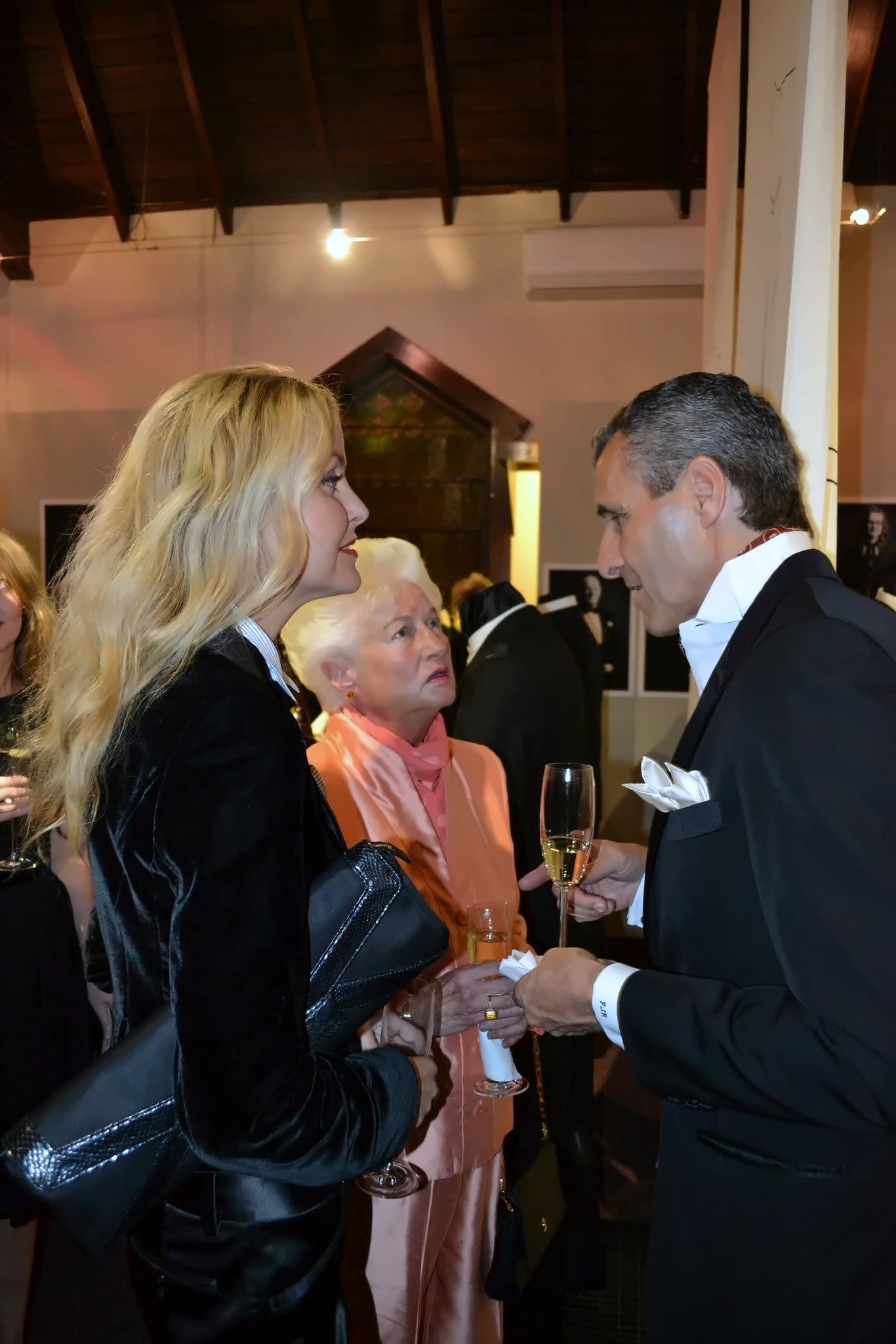
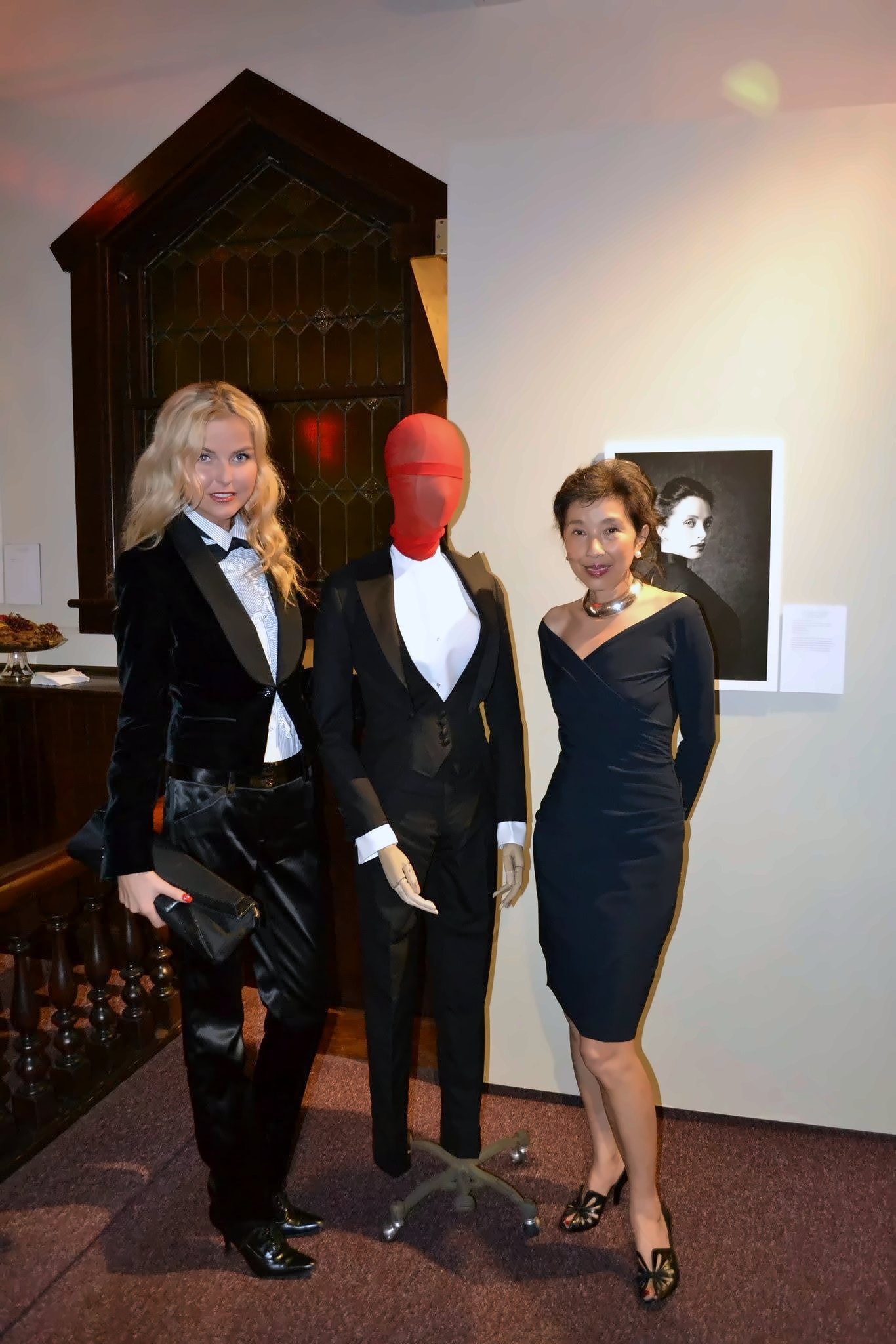
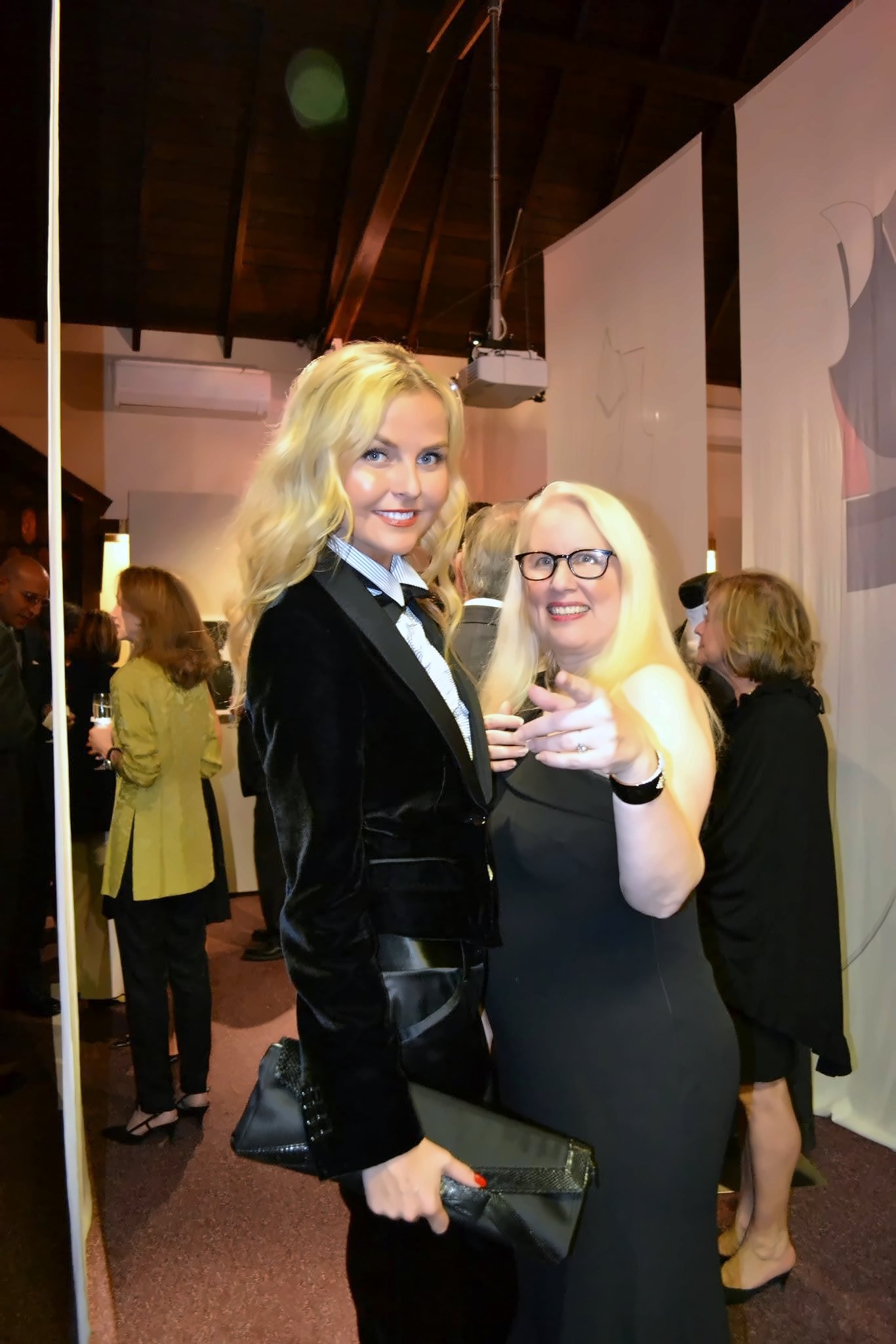
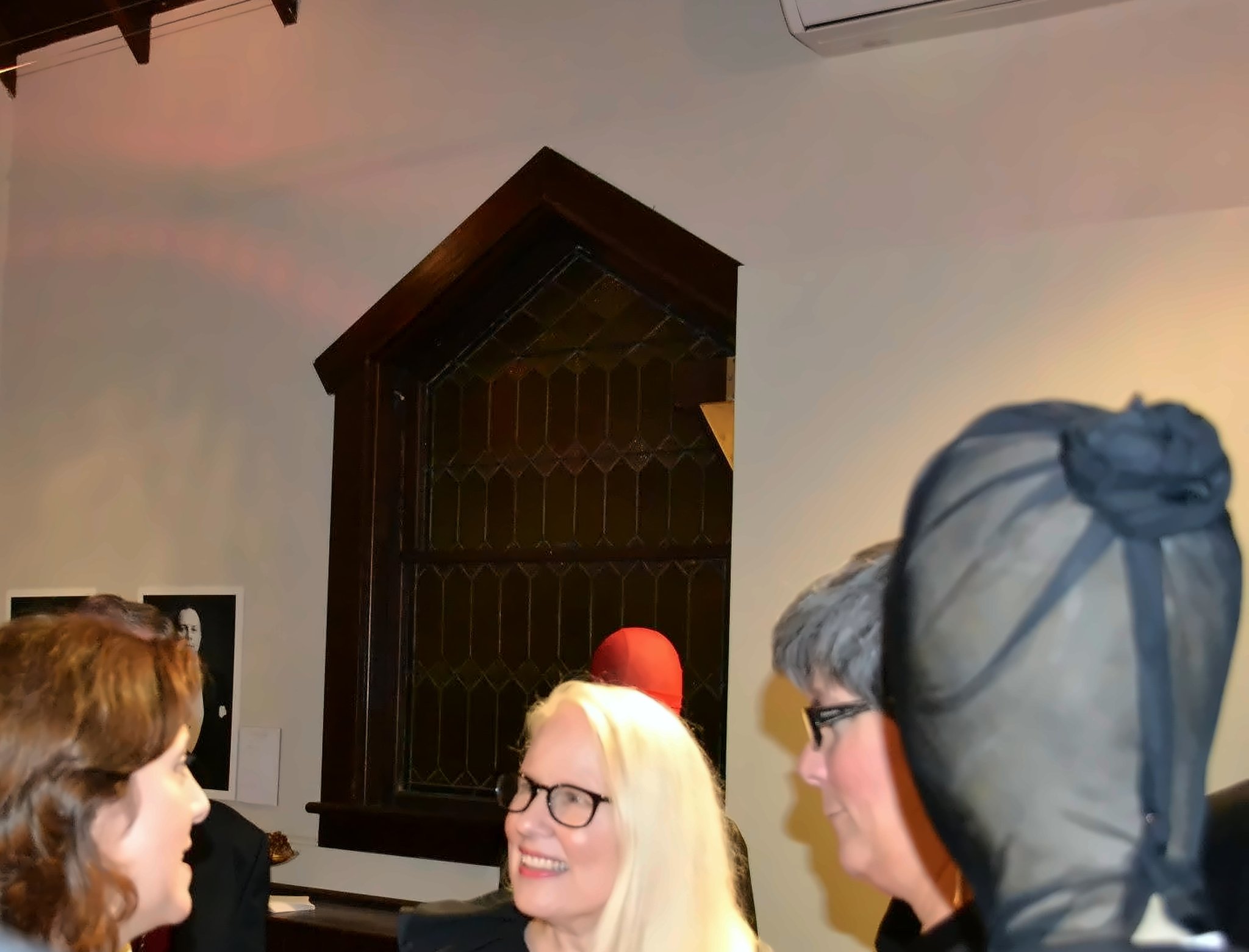
On the night LIKE photographed the exhibition, the women of Tuxedo Park made the strongest case for Le Smoking in the room: velvet dinner jackets, satin lapels, a bow tie worn with a striped shirt. We do not name them; their tailoring speaks for itself.
VII. HATS: THE CROWN OF THE EVENING
If the tuxedo is the sentence, the hat is the punctuation. And at Tuxedo Park there is a single object that holds the whole grammar of 19th-century men's hats in one case.
The Tuxedo Park hat case
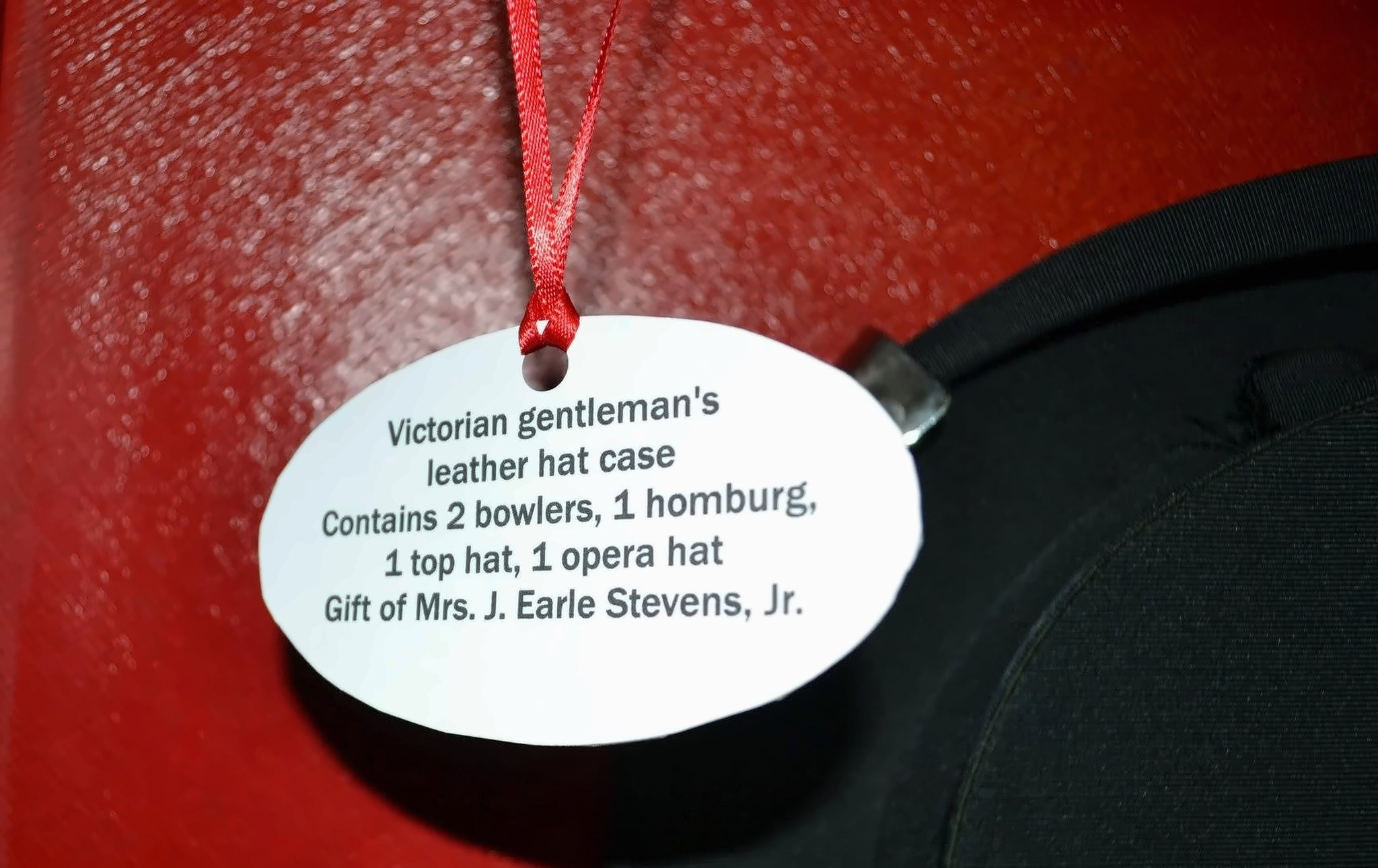
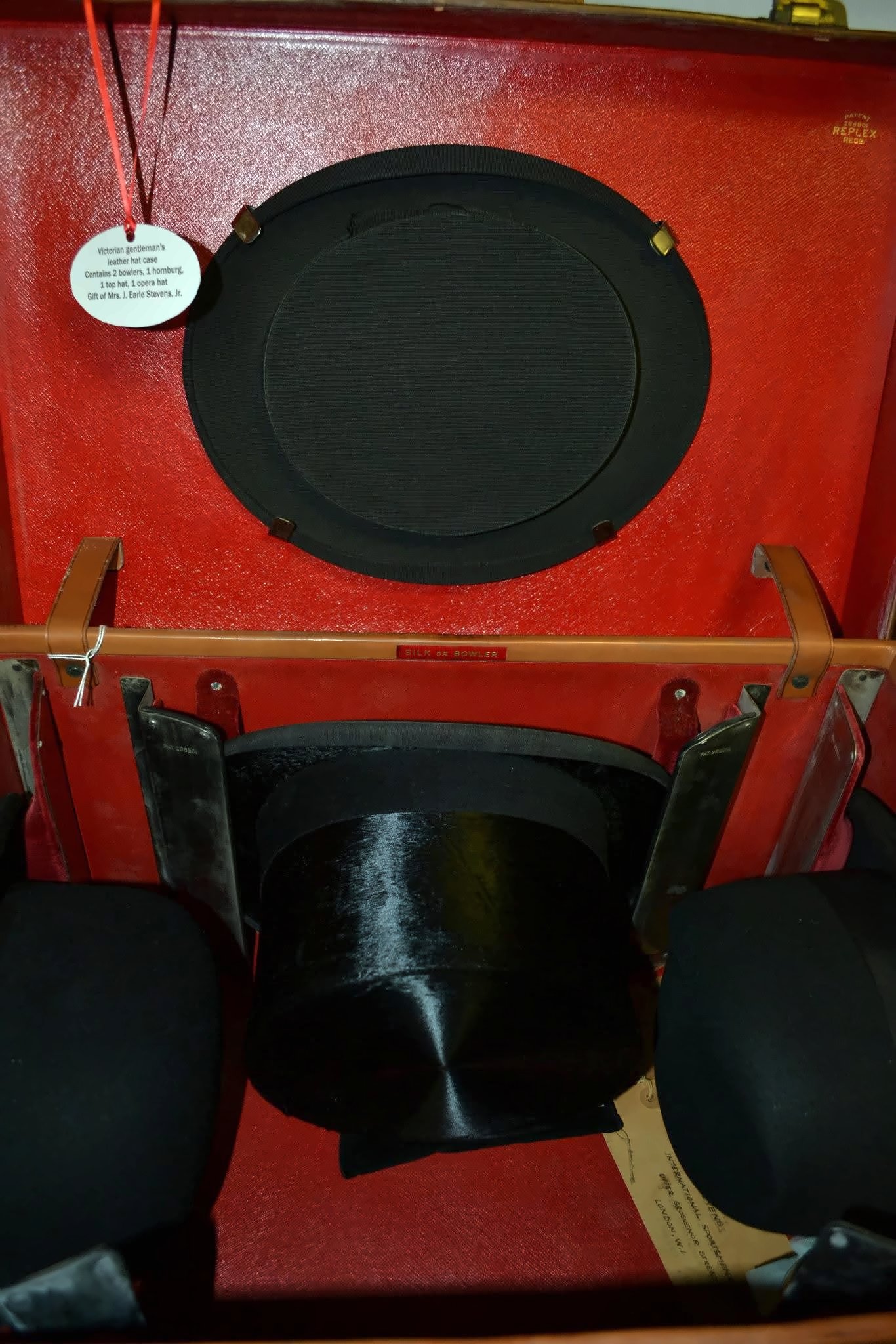
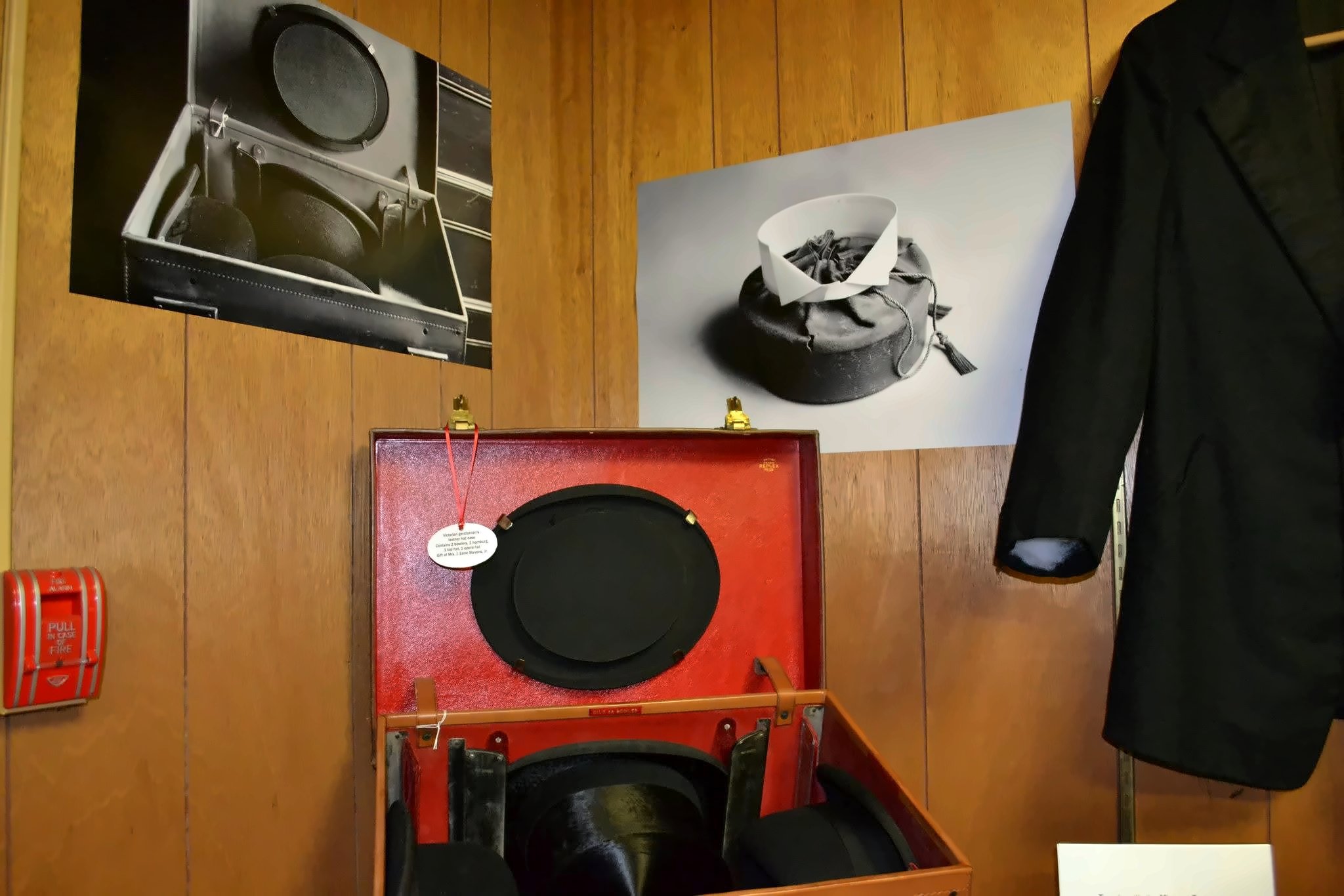
In the Historical Society's collection sits a Victorian gentleman's leather hat case. Its oval tag, tied on red ribbon, lists the contents: "2 bowlers, 1 homburg, 1 top hat, 1 opera hat." Gift of Mrs. J. Earle Stevens, Jr. Inside the red-leather lid, a gilt stamp reads PATENT / 268801 / REPLEX (the digits are partly soft; that is our best reading), and a compartment label reads "SILK or BOWLER." It is a gentleman's season in a box: town, country, theatre and ceremony.
The top hat
The tall silk hat swept London in the late 18th century. You may have read that a haberdasher named John Hetherington invented it in January 1797 and caused a riot on the Strand. That story is a legend. No contemporary record has been found, and it first surfaces about a century later, in the 1890s. Dunnage & Larkin registered a patent for silk top hats in 1794. Lock & Co.'s own timeline repeats the Hetherington story; LIKE treats it as disputed.
What is beyond dispute is the rarity. Silk plush, the long-napped fabric that gives a true topper its liquid shine, is no longer woven. Lock & Co. says the last factory stopped production in the late 1960s; the Telegraph dated the closure of the last plush factory, near Lyon, to 1968. Its loss is wrapped in a legend of feuding brothers, which Lock itself labels as legend. Every silk top hat for sale today is antique and restored. Lock & Co. sells restored silk toppers at £3,600 (UK price including VAT, checked Oct 9, 2026). Winston Churchill wore a Lock silk top hat at his wedding in 1908. New toppers are made in fur felt, often finished in lustrous melusine. In the Royal Enclosure, the topper must be black or grey and unadorned (Ascot); Lock's grey rabbit-felt Ascot Top Hat is £625 (incl. VAT).
The opera hat (gibus, chapeau claque)
The collapsible top hat solved the theatre cloakroom. A Paris hatter, Antoine Gibus, filed a patent on July 23, 1834, for a hat that folded vertically. His brother Gabriel Gibus patented a double-spring mechanism on September 30, 1837. With a flick of the wrist the hat snaps open, hence chapeau claque, after the click. Earlier collapsible hats existed (an 1812 English patent for an "elastic" hat is sometimes cited), so who invented the folding top hat is disputed; the Gibus patents are the documented landmark. In English it is the opera hat, or simply the gibus. It belongs with white tie and black tie at the opera, and the Tuxedo Park case holds one.
The bowler (the Coke)
In 1849, Edward Coke, younger brother of the 2nd Earl of Leicester, ordered a hard, close-fitting, low-crowned hat from Lock & Co. to protect his gamekeepers' heads from branches at Holkham Hall. Lock had it made by its suppliers, the hatmakers Thomas and William Bowler. Lock records that Coke came to London on December 17, 1849, put the hat on the floor, stamped on it, found it held, and paid 12 shillings. Lock calls it the Coke, after the client; the rest of the world calls it the bowler, after its makers; Americans say derby. Note: some histories name William Coke instead; LIKE follows Lock & Co.'s own archive. Lock's Town Coke is £575 (incl. VAT; checked Oct 9, 2026).
The homburg
A stiffened felt hat with a single dent down the crown, a curled brim bound in ribbon and a grosgrain band, the homburg takes its name from the German spa town of Bad Homburg. The Prince of Wales, again, made it famous: local accounts say he ordered one in grey felt from the Möckel hat factory on August 29, 1882, after seeing a green hunting version on his nephew, the future Kaiser Wilhelm II. The precise origin is debated, and rival theories exist. The homburg became the elegant middle ground between the top hat and the soft felt, and has long been worn with the dinner jacket. Lock records that Winston Churchill ordered homburgs in 1911.
Felts, bands and bindings
- Fur felt (beaver or rabbit) is denser, smoother and longer-lived than wool felt. Beaver is the historic luxury; Lock's catalogue offers a London beaver-fur-felt top hat.
- Grosgrain is the classic hatband and the ribbon that binds the edge of a homburg's brim.
The hatters and milliners, and who is still trading (verified October 2026)
| House | Founded / base | Status as of Oct 2026 |
|---|---|---|
| Lock & Co. Hatters | 1676; No. 6 St James's Street, London | Trading; Royal Warrant from King Charles III (2024) |
| Christys' | 1773, London | Brand trading; former owner Christy & Co. entered voluntary liquidation in Feb 2026, and London's Laird Hatters acquired the brand and is moving production back to London |
| Borsalino | Alessandria, Italy | Trading; Giacomo Cortesi named CEO effective Sept 1, 2026; first permanent Shanghai boutique opened under a Greater China partnership |
| Stephen Jones Millinery | 36 Great Queen Street, Covent Garden | Trading; current site shows Autumn/Winter 2026 collections |
| Philip Treacy | London | Trading; 2026 Dior Cruise word hats and Balenciaga couture pieces; amfAR London honor scheduled Oct 16, 2026 |
| Optimo | Chicago | Website live (Oct 9, 2026) |
| Eric Javits | United States | Trading; website live (Oct 9, 2026) |
"Locke" in older references is the same house as Lock & Co.
The First Lady's hats
First Lady Melania Trump wears a hat the way a diplomat chooses words: deliberately.
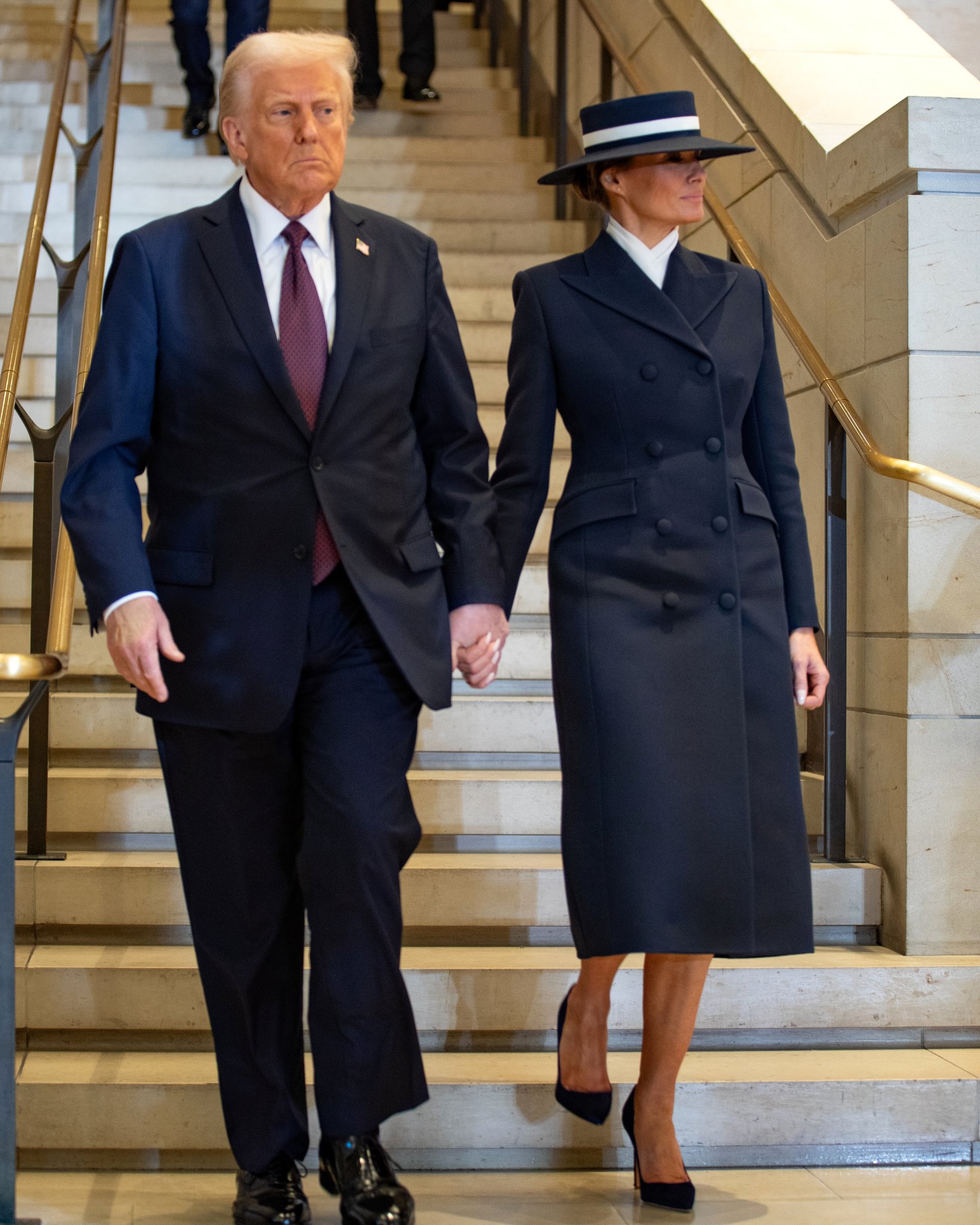
For the January 20, 2025, inauguration she wore a navy, wide-brimmed, boater-style hat by the American milliner Eric Javits, made in the same navy double-faced wool as her coat and trimmed with an ivory band (Vanity Fair, AP). The coat, skirt and ivory silk-crepe blouse were by Adam Lippes, hand-sewn in New York. The first hat was crushed in transit, Vanity Fair reported, so Javits remade it in under four days; the look was styled by Hervé Pierre.
VIII. THE HONORED GUESTS: CHINESE FORMAL TRADITION
The Zhongshan suit, known in the West as the Mao suit
In China it is the Zhongshan suit (中山装), named for Sun Yat-sen, who is known in Chinese as Sun Zhongshan. In the West it is usually called the Mao suit, because Mao Zedong wore it so often in public that the name stuck. Its origins lie in the early Republic, after 1912. It became the modern national dress of the new Republic, and civil servants were required to wear it in the 1920s and 1930s. Beijing's official tourism site credits Japanese uniform as one model, notes its four outside pockets, and records that the front buttons were reduced over time from seven to five.
On the symbolism (attributed, later interpretation): the same official site says that "long after Sun Yat-sen's death, popular mythology" gave the suit its meanings. The four pockets stand for four principles of conduct from the classics (propriety, justice, honesty and a sense of shame); the five front buttons for the five powers of the Republic's constitution; and the three cuff buttons for Sun's Three Principles of the People. LIKE presents these readings as tradition rather than documented design intent.
At state occasions today, the suit is the Chinese answer to white tie and black tie. President Xi has worn it to a state banquet hosted by the Dutch royal family (2014), to the White House state dinner and the Buckingham Palace state banquet in 2015, and to the White House state dinner this September. Royal protocol provides for exactly this: Buckingham Palace's state-banquet guidance names national dress alongside white tie. In the lead image the suit is dark, buttoned to a stand collar, and immaculately pressed: the national counterpart to President Trump's dinner suit.
The qipao, or cheongsam
The qipao (旗袍), better known in English by its Cantonese-derived name cheongsam, has Manchu origins. Its name is commonly glossed as "banner gown," after the Qing dynasty's Manchu Eight Banners. Its modern form was born in 1920s Shanghai, where, the Shanghai government notes, it became the fashion. In the 1930s, Shanghai's tailors brought in Western techniques such as fitted busts, cinched waists and shoulder seams. The result, the haipai (Shanghai-style) qipao, spread across the country. In 2011 the tailoring of Longfeng cheongsams was listed as national-level intangible cultural heritage, covering nine techniques, including hand-knotted buttons. The Shanghai Museum devoted a major qipao exhibition to the garment from December 2025 to May 2026.
Madame Peng Liyuan: a soprano's sense of line
Before she became China's First Lady, Madame Peng Liyuan was one of the country's most celebrated singers, and she dresses like a performer who understands how clothes move under light. Vanity Fair named her to its International Best-Dressed List in 2013. Many of her looks have been attributed to the Chinese designer Ma Ke. China Daily reported that Ma personally designed Madame Peng's wardrobe for her first trip abroad as First Lady, to Moscow in 2013, under her Wuyong label. At the White House state dinner in 2015 she chose an aquamarine beaded silk gown with three-quarter sleeves (SCMP; the designer was not identified).
This September, by day, she wore a qipao-inspired navy dress with a silver floral brooch to visit the Smithsonian's National Museum of Asian Art with Mrs. Trump, where the two First Ladies toured the Peacock Room (The Washington Post). By night came the red gown in our lead image: floor-skimming, in China's color of good fortune, with a high Mandarin collar, a double strand of white pearls and a black clutch with a gold clasp. No designer has been officially confirmed for the gown, so LIKE describes it rather than credits it. Its genius is restraint: one color, one line, one jewel.
Shanghai Tang: is it still in business? (status, October 2026)
LIKE checked, and yes. Shanghai Tang is operating and growing.
- Founded in Hong Kong in 1994 by the late Sir David Tang; Richemont owned it from 1998 (full ownership by 2008) and sold it in 2017 to investors led by Alessandro Bastagli.
- Owners now: Derek Sulger and Jerry Mao, the partners behind Lunar Capital, who acquired it in 2018. WWD reported in August 2025 that the two own it independently of Lunar's portfolio. Headquarters moved to Shanghai. (One secondary source places the brand inside a "UTAN Group" from 2020; LIKE could not verify that and follows WWD.)
- Stores: 10 shops in Shanghai, Hong Kong, Singapore and Malaysia, plus two cafés in Shanghai (WWD, Aug 2025); organic sales rose 60% in the prior year, WWD reported. Inside Retail Asia (June 2026) reports a recently opened shop at Hong Kong International Airport, a fashion-and-restaurant flagship in development in Abu Dhabi, a first hotel in development, and a possible reopening at the Pedder Building in Hong Kong, the flagship site it left in 2011, under evaluation.
- Online: shanghaitang.com is live, selling the Spring-Summer 2026 "Jade Horizons" and Autumn-Winter 2026 "A Winning Hand" collections, priced in HK$. The collections include Tang jackets, qipao-influenced womenswear and "Soft Gold" mulberry silk.
- Gap: we could not confirm U.S. shipping or a U.S. store; check at checkout.
Where else to find Chinese-style formalwear
Verified options are few, and we'll say so plainly. For new pieces, Shanghai Tang is the blue-chip name: Tang jackets with mandarin collars and knotted closures, and silk Tang dresses. For vintage qipao and Tang jackets, use eBay's luxury resale lane with Authenticity Guarantee where eligible, and buy by measurements rather than size labels. For true bespoke, the Shanghai qipao tradition still lives with specialist tailors; LIKE will profile them in a future issue rather than name houses we haven't vetted.
IX. AUTOMOTIVE: THE CAR AT THE DOOR
State cars, coachbuilt limousines, a Bentley in the drive and the cars built for people in hats
Every great evening ends at the curb. Tuxedo Park, it turns out, lent its name to cars almost as readily as to coats.
A Bentley at the Historical Society
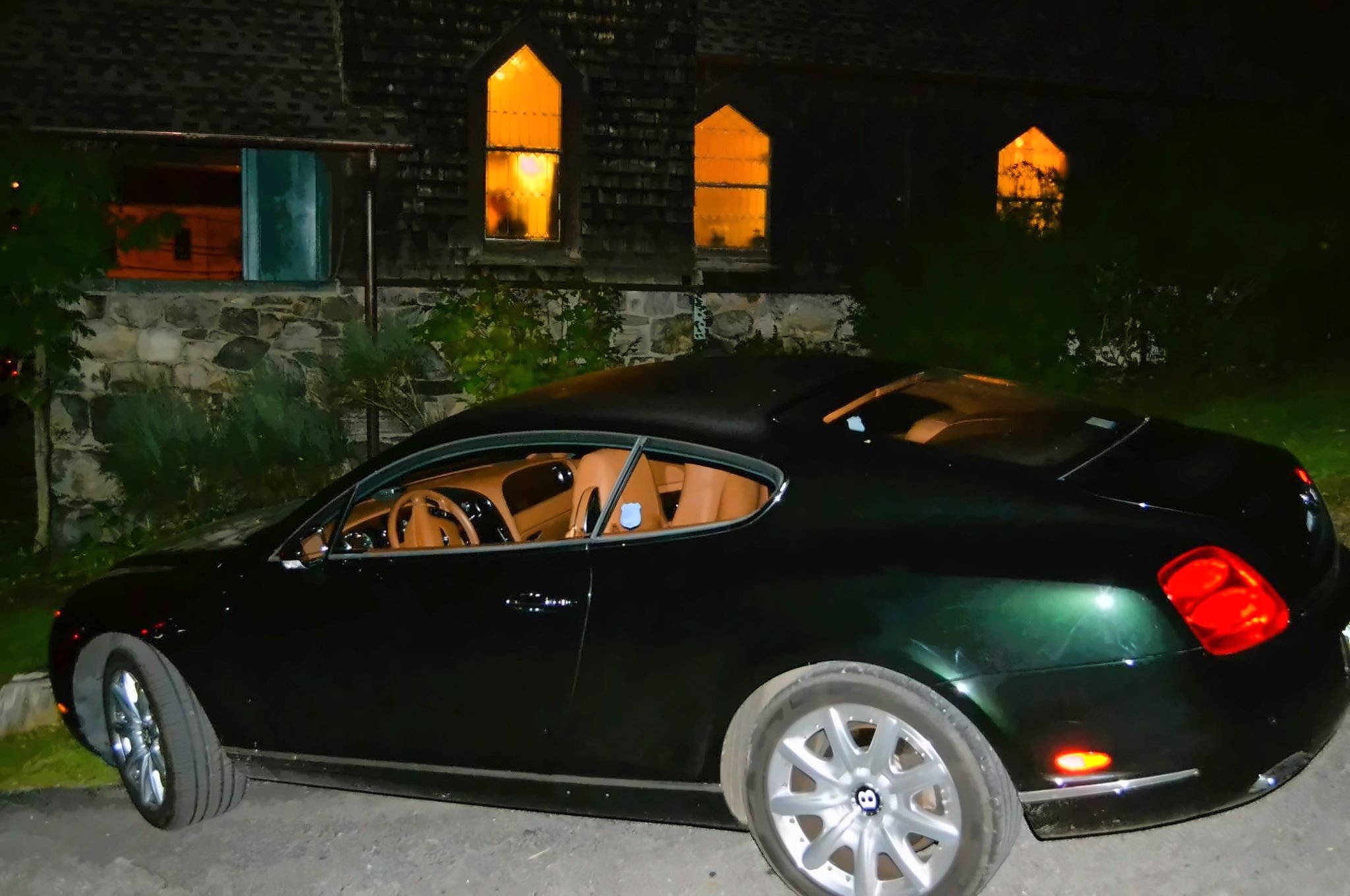
The J. M. Quinby "Tuxedo Limousine"
Newark's J. M. Quinby & Co. was founded in 1834 by James M. Quinby as a builder of fine carriages; the Newark Public Library calls it one of the country's oldest. Around 1902, a Quinby designer, Herbert T. Strong, patented a composite aluminum-over-wood body, and the firm turned to coachwork for imported and American chassis. It left the business in the mid-1910s; sources differ between 1915 and 1917. A later company revived the name in 1923 and closed in 1929. In the exhibition hung a Quinby catalogue sheet labeled "TUXEDO LIMOUSINE," the coachbuilder's name for a body style. It is proof that by the motor age, "Tuxedo" had become a byword for town-carriage polish.
The Jeep Tuxedo Park Mark IV
Kaiser had a Jeep problem in the early 1960s: everyone admired the CJ-5, but mostly for farm work. The fix was a dressed-up Tuxedo Park trim package, introduced in 1961, followed in 1964 by the Tuxedo Park Mark IV, a model in its own right for the CJ-5A and CJ-6A. It brought chrome bumpers, chrome hood badges, chrome tail lamps, a drop-down license plate holder, Jeep-emblem hubcaps and a column shift (Kaiser Willys). The exhibit card, citing Allen (1999), puts sales at about 7,400. The Jeep Database counts about 7,300; figures differ. The card notes that the "upscale" Jeep "just wasn't what the general public had in mind for a second car." Collectors disagree: Hemmings notes that Tuxedo Parks now command more than standard CJ-5s.
"The Beast": America's state car
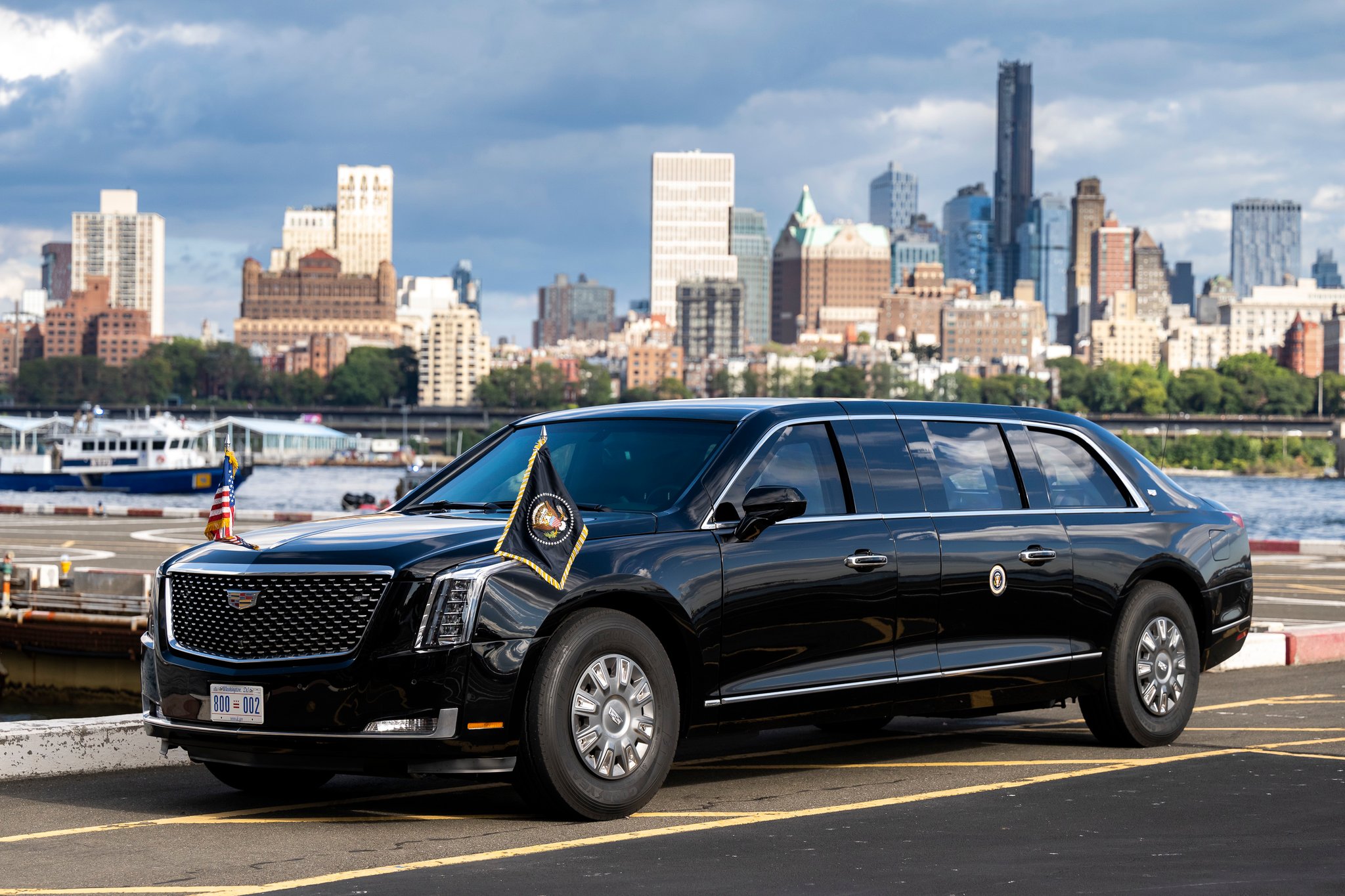
The U.S. presidential limousine, universally nicknamed "The Beast," is a Cadillac built by General Motors for the U.S. Secret Service. The current generation made its debut in New York in September 2018 (NBC News).
Publicly reported features (the Secret Service declines to give specifics, and LIKE does not speculate): the platform is reportedly derived from a heavy-duty GM truck chassis; it reportedly weighs close to 20,000 pounds; its walls are believed to be at least eight inches thick, with five-inch multilayer windows; the cabin is reportedly sealed against chemical and biological attack; it reportedly runs on run-flat tires; and it reportedly carries night vision, a communications suite and supplies of the President's blood type (NBC News, 2018). It is reported to seat seven.
In January 2026 the Secret Service debuted a related fleet at Davos: full-size "Camp Package" protection SUVs, formerly Chevrolet-branded, now wearing Cadillac branding with Escalade-style lights and bumpers (U.S. Secret Service, March 2026). Reuters reported in January 2026 on a new GM contract for next-generation presidential limousines; LIKE has not seen the contract and reports it as reported.
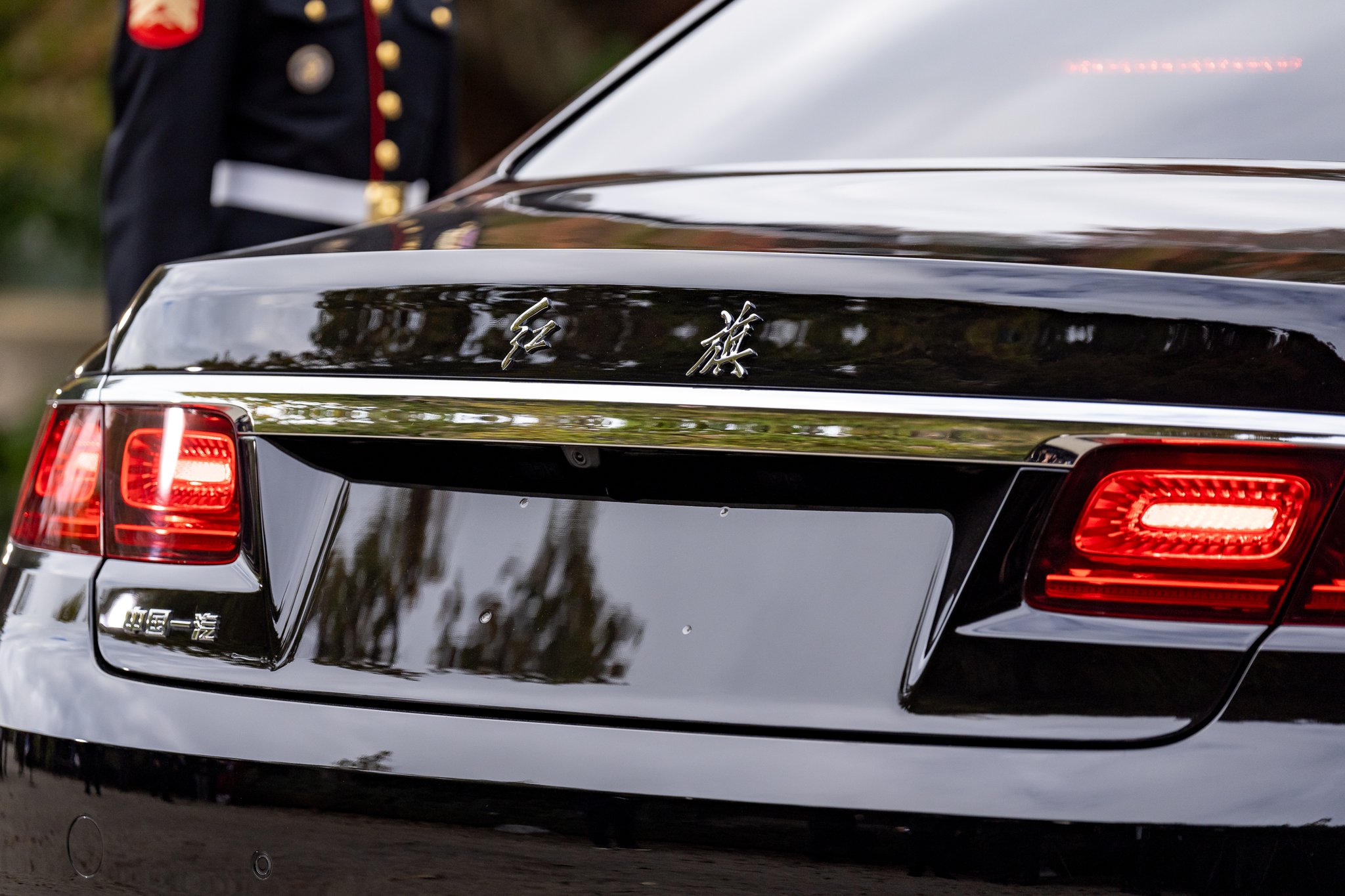
Hongqi, the "Red Flag": China's state car
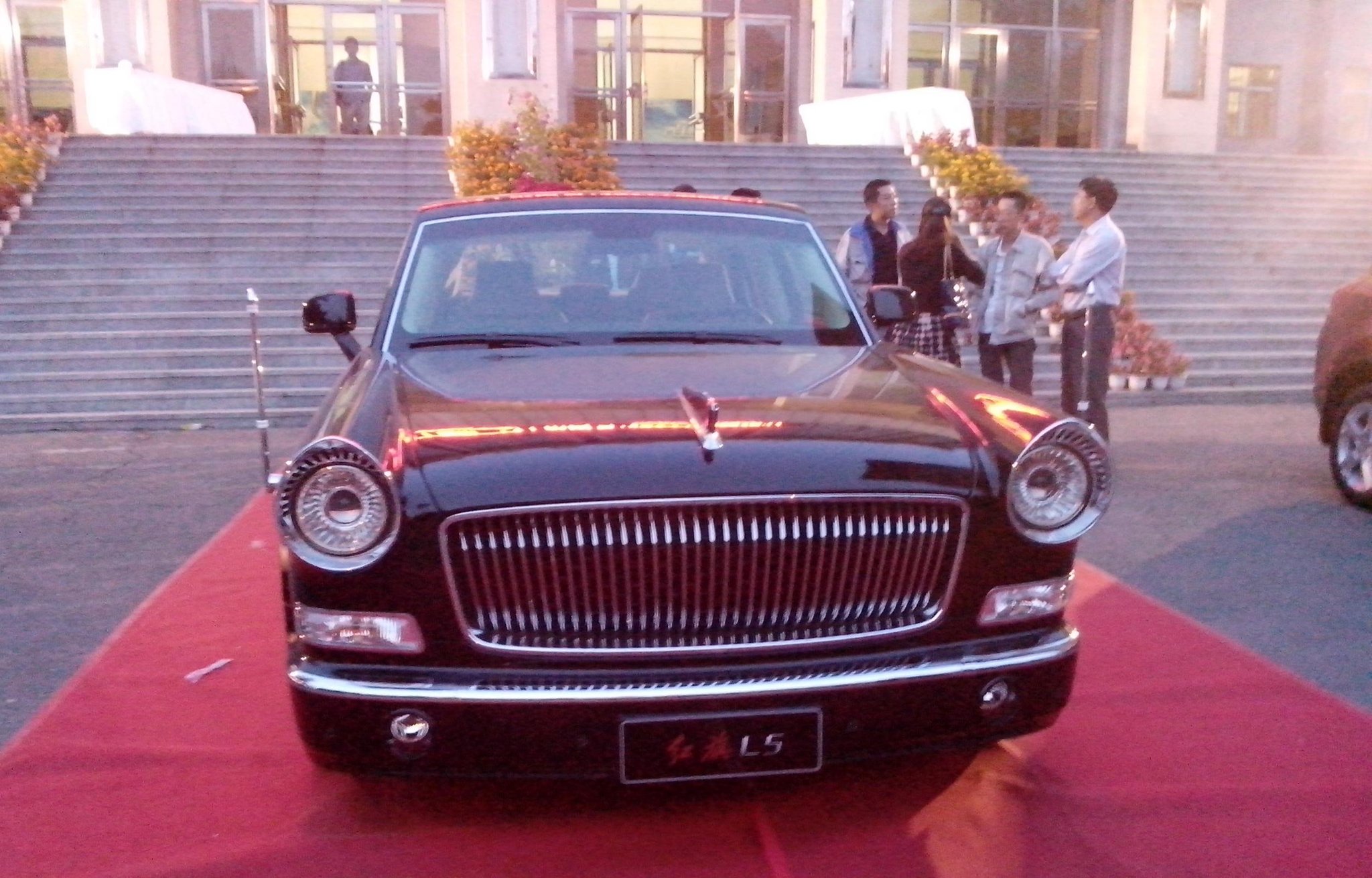
China's state limousine is the Hongqi (红旗, "Red Flag"), built by China FAW Group (First Automotive Works) of Changchun. FAW's official chronicle records that the first Hongqi prototype, the CA72, was completed on August 1, 1958, and that production began in August 1959, the same year open CA72J parade cars appeared at the tenth-anniversary National Day celebrations. FAW lists a 5.6-liter engine of 200 horsepower and a top speed of 160 km/h. For the design lover, the details are the thing: "palace lantern" tail lamps and lacquer work inside. The three-row CA770 followed and, Hongqi says, became known as the "national car."
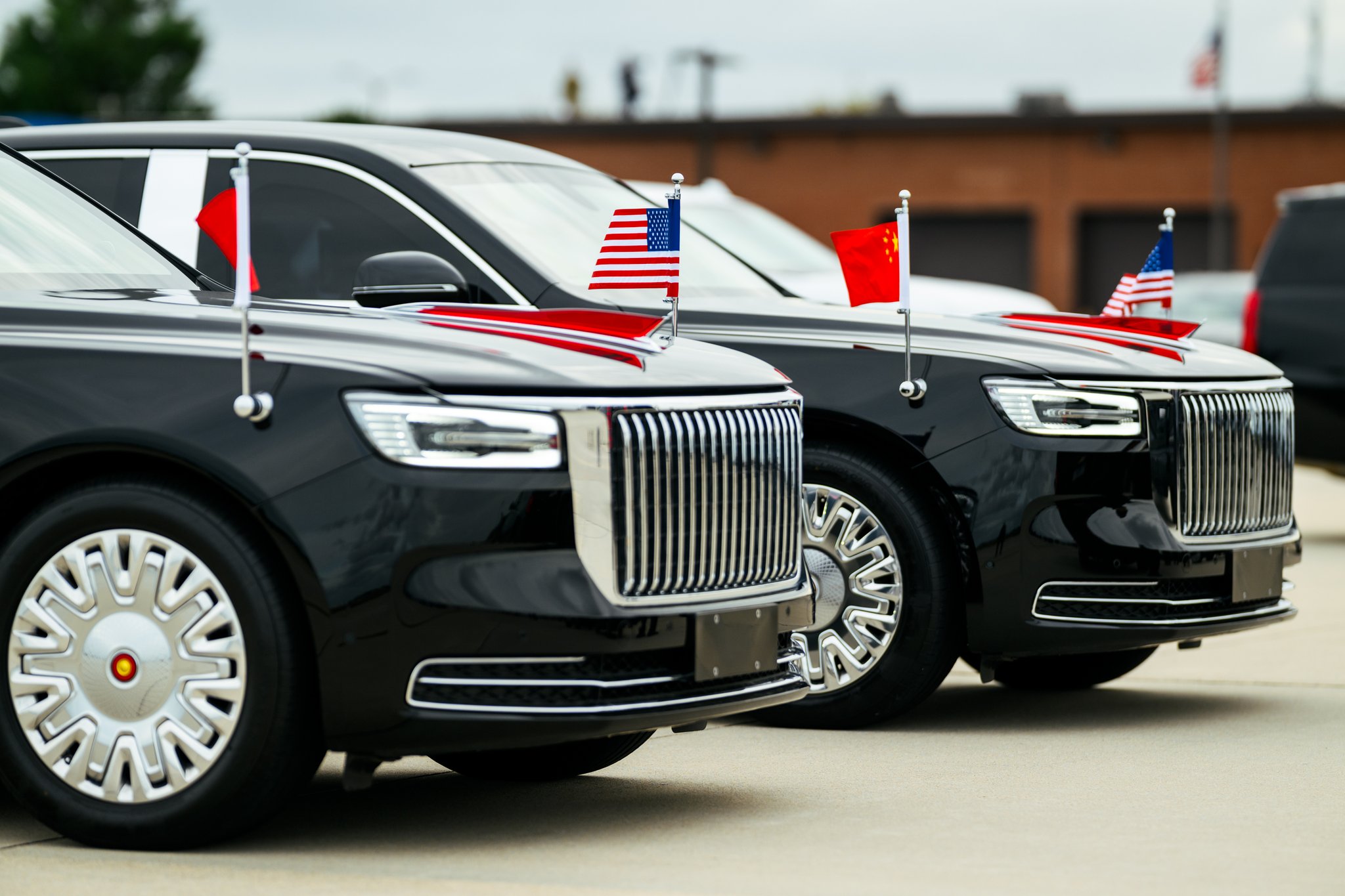
The modern state cars are rarely documented. No official specifications for the current models have been published, so LIKE reports only what is on the record. The N501 was first seen during a presidential visit to Africa in 2018. The larger N701, the South China Morning Post reports, debuted in Hong Kong in 2022. It drew admiration at Filoli, California, in November 2023: "It's a beautiful vehicle," said the American host, and President Xi replied, "It's our Hongqi. Domestically made" (SCMP). This September, a pair of black Hongqi limousines waited at Joint Base Andrews, flying Chinese and American flags. The same chrome-ribbed vertical grille links them across six decades.
Built for a hat: Rolls-Royce and the art of arrival
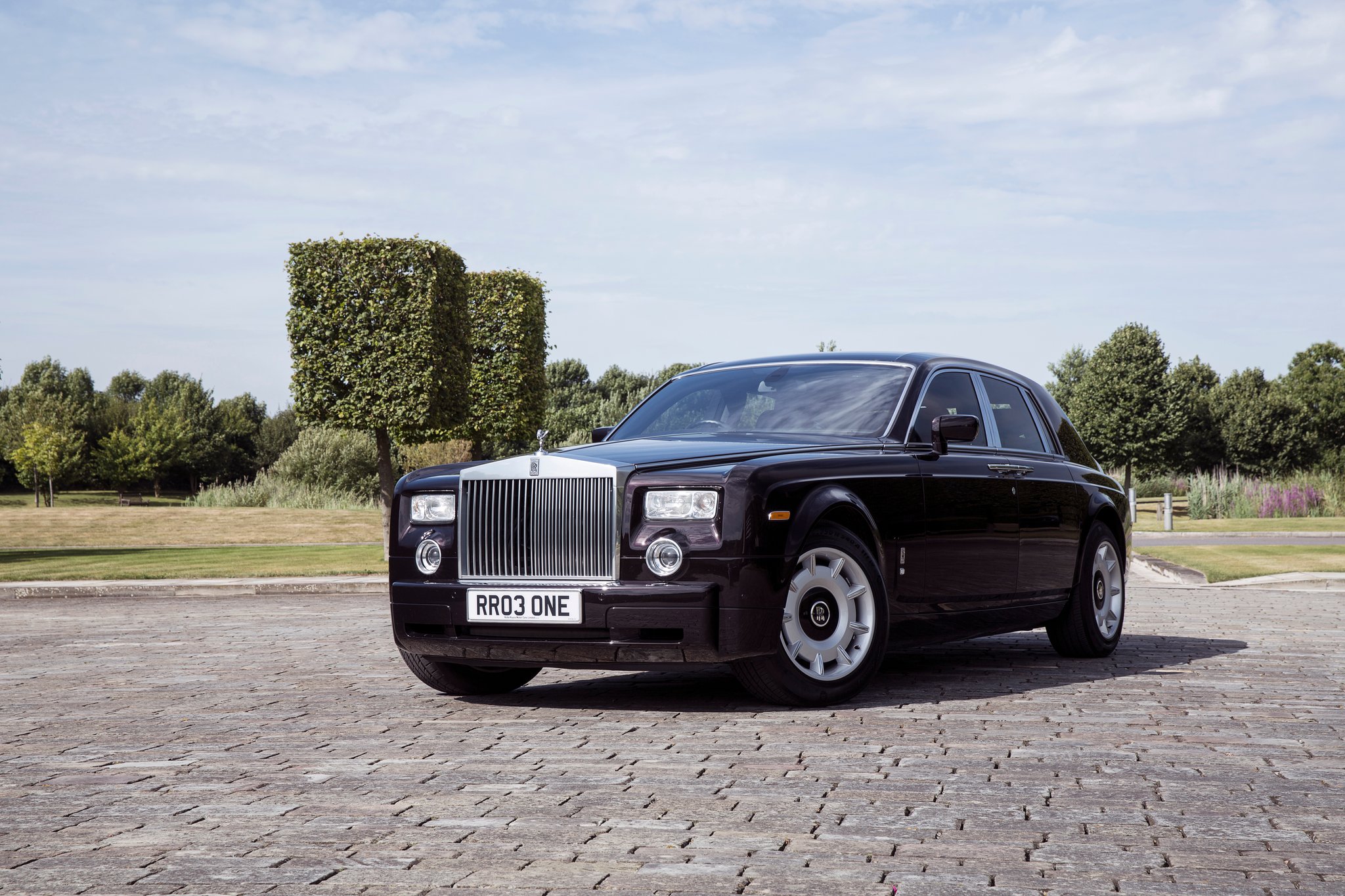
The Phantom turned 100 in 2025, a centenary Rolls-Royce marked all year. Few cars have been shaped so explicitly around the person in the back seat.
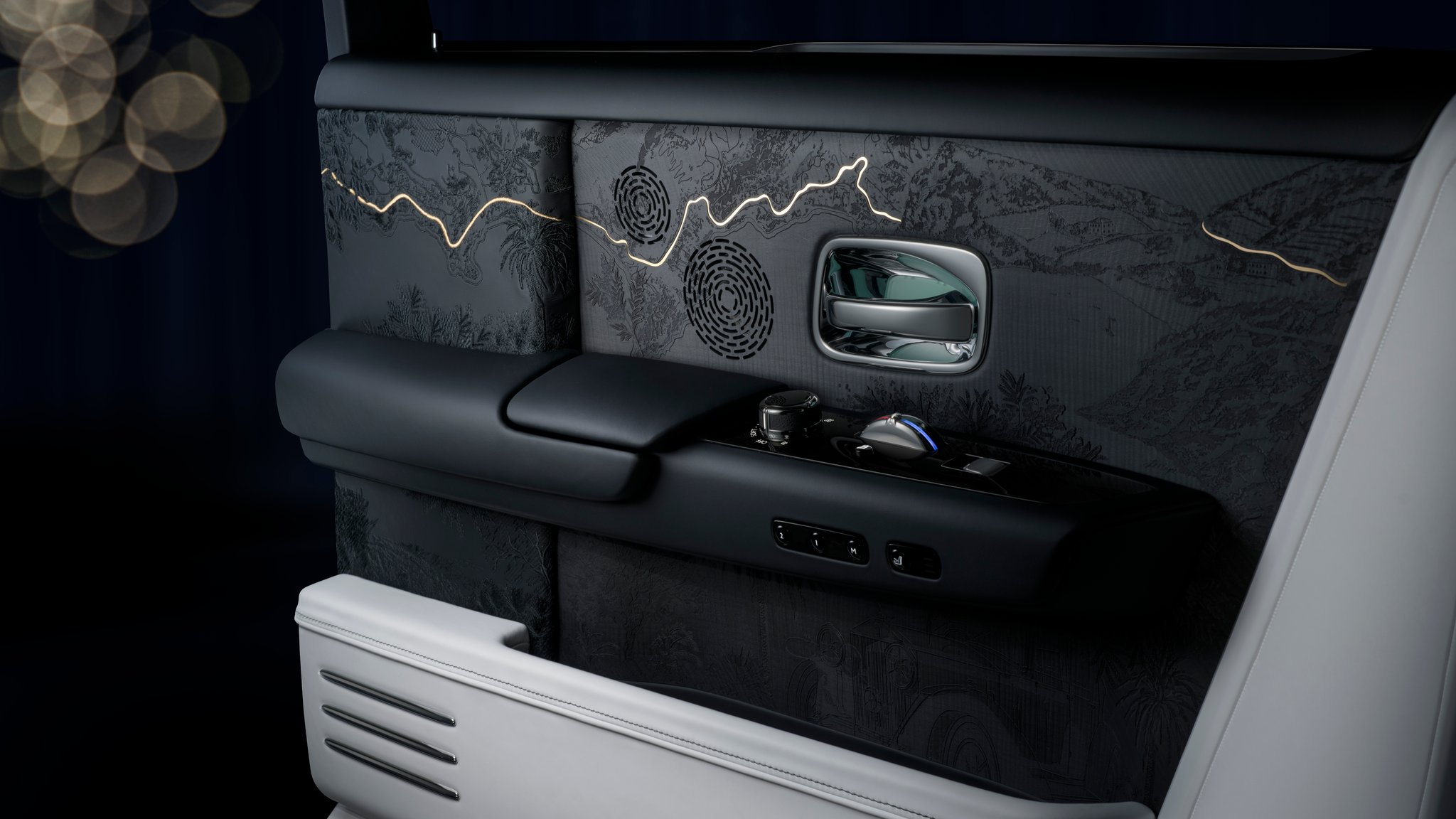
- Coach doors. When the modern Phantom launched in 2003, Rolls-Royce explained that its rear-hinged coach doors, with the roof at its highest point above the door frame, let passengers simply walk into the car. No twisting, no ducking. The 2017 eighth-generation Phantom kept them, and added "The Embrace," in which the door closes at a touch.
- Headroom. The 2003 Phantom's maximum rear headroom was 979 mm (38.5 in), per Rolls-Royce's press specifications.
- The umbrella. Each rear coach door hides an umbrella released at a touch, with a Teflon-coated canopy and drainage channels so it can be stowed wet.
- The top hat. Legend, not specification. It is often said that the Phantom's tall roofline was set so a gentleman need not remove his top hat. LIKE found no Rolls-Royce statement saying so. The headroom and the walk-in entry are documented; the hat rationale is lore.
LIKE INSERT: PHANTOM AT 100: THE MOTOR CAR THAT DRESSES FOR DINNER
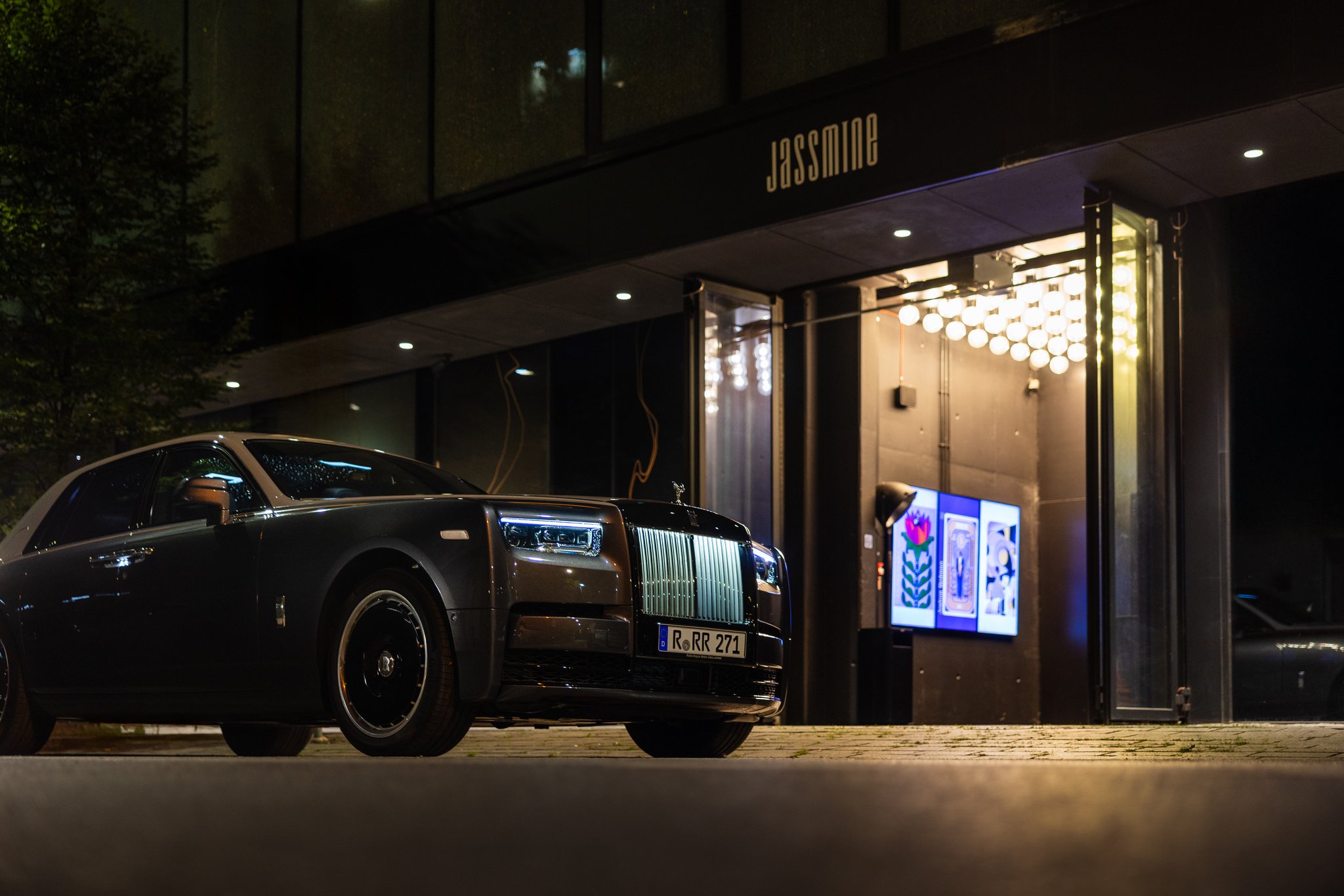
Mayfair keeps its evening wardrobe on two neighboring streets. On Savile Row, Henry Poole cut the short coat for the Prince of Wales that became the dinner jacket. Close by, at 14–15 Conduit Street, Rolls-Royce Motor Cars keeps its London address. This is the street where Charles Rolls opened a showroom in 1905, and English Heritage marked the site with a Blue Plaque in 2010, unveiled by Lord Montagu of Beaulieu. The black-tie coat and the black-tie car grew up as neighbors.
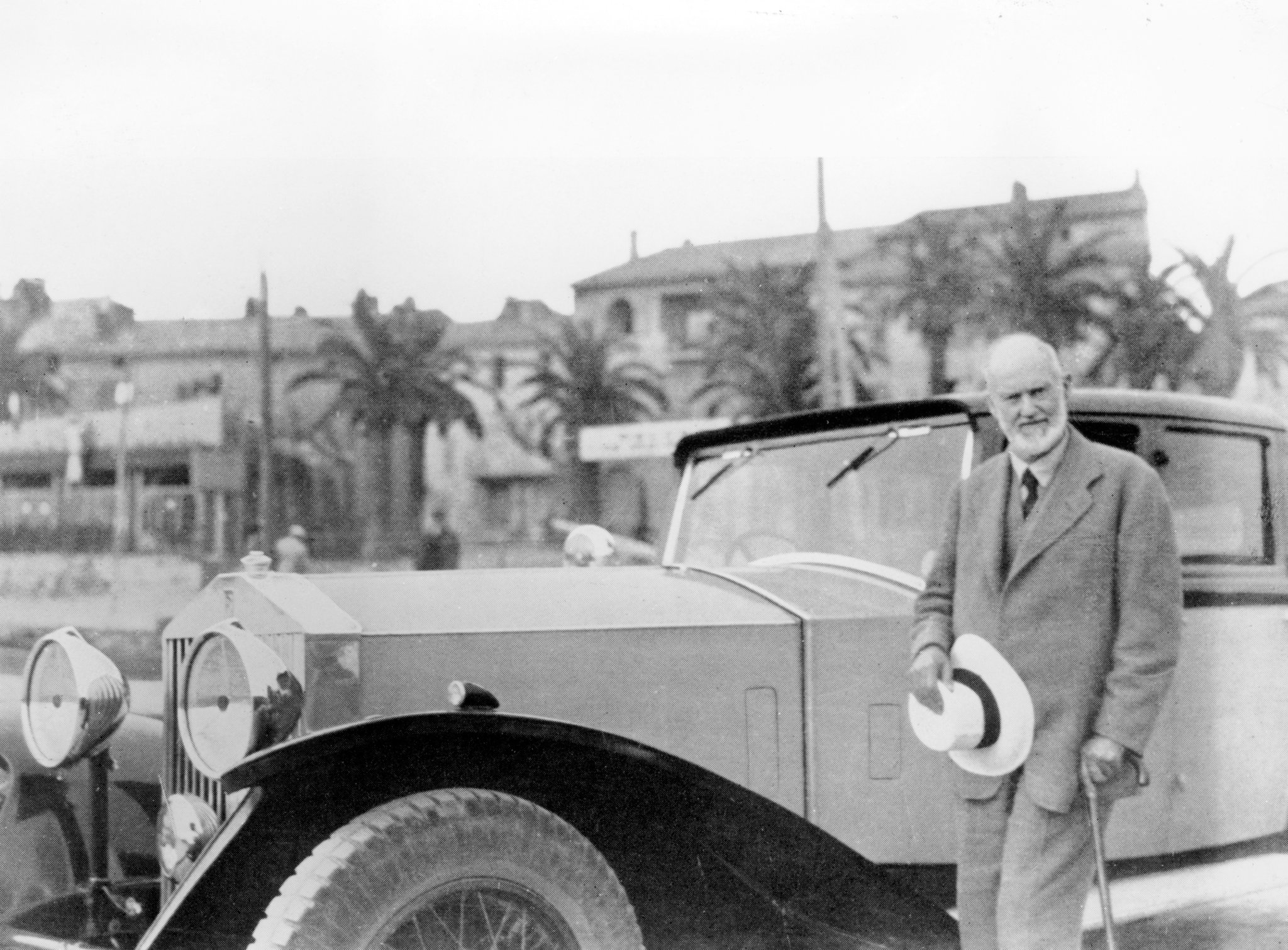
A century of Phantom. The Phantom was launched in 1925 and now has owners in more than 100 countries. To mark the centenary, Rolls-Royce traced the places that shaped it, and several of them were Sir Henry Royce's own houses. From 1911 to 1933 he spent his winters at Le Canadel on the French Riviera, where his Villa Mimosa was completed in 1917, and he tested cars on the corniche roads above the sea, the first Phantom among them. At home in England he lived at Elmstead, in West Wittering, Sussex, eight miles from Goodwood. Royce approved every component personally, wherever he was, so his engineers made round trips of more than 400 miles from Derby to bring him the work.
Born in secret. The modern Phantom began in the late 1990s in a hidden design studio north of Hyde Park, known as "The Bank." The project was code-named RR01 and led by Chief Designer Ian Cameron. Chief Exterior Designer Marek Djordjevic took a coachbuilt Phantom II from the early 1930s as his reference for the car's "waft line," the line that rises from rear to front along the lower body, like a motor yacht under way. The first Goodwood Phantom was handed to its owner at one minute past midnight on January 1, 2003, and set off at once on a 4,500-mile drive from Perth across Australia. In August 2025, the centenary year, that same car came home to Goodwood for inspection by the marque's engineers. Then, in 2011, came 102EX, the Phantom Experimental Electric, an all-electric experimental Phantom.
Dressed for the evening. Rolls-Royce calls Phantom "a studio, stage, state room and gallery," a car that has carried monarchs, statesmen and captains of industry. In LIKE's terms, it is the motor-car equivalent of white tie: the car for state arrivals, opera openings and galas. Its manners, from the walk-in coach doors to the umbrella in each rear door, are described above; the centenary release, like every other Rolls-Royce source LIKE consulted, makes no claim about top hats.
"Phantom has always been defined by the people who commission it, and the places in which they use it."Chris Brownridge, Chief Executive Officer, Rolls-Royce Motor Cars
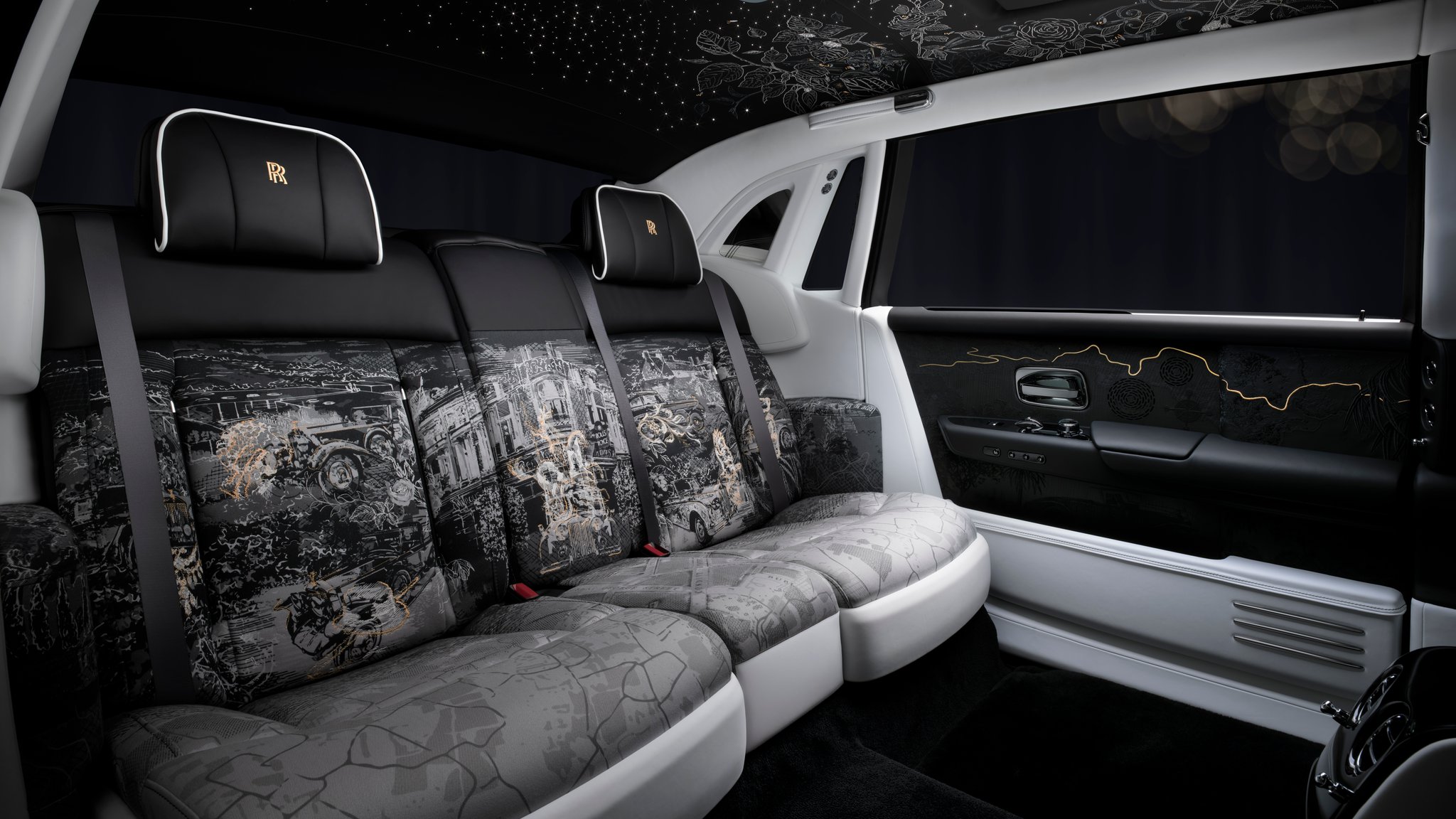
Insert source: Rolls-Royce Motor Cars press release, Sept. 23, 2025.
X. LIKE TRAVEL: A WEEKEND IN TUXEDO
Getting there: Tuxedo sits in the Ramapo hills of Orange County, New York, on Route 17. The Historical Society stands opposite the Tuxedo train station.
The Tuxedo Historical Society
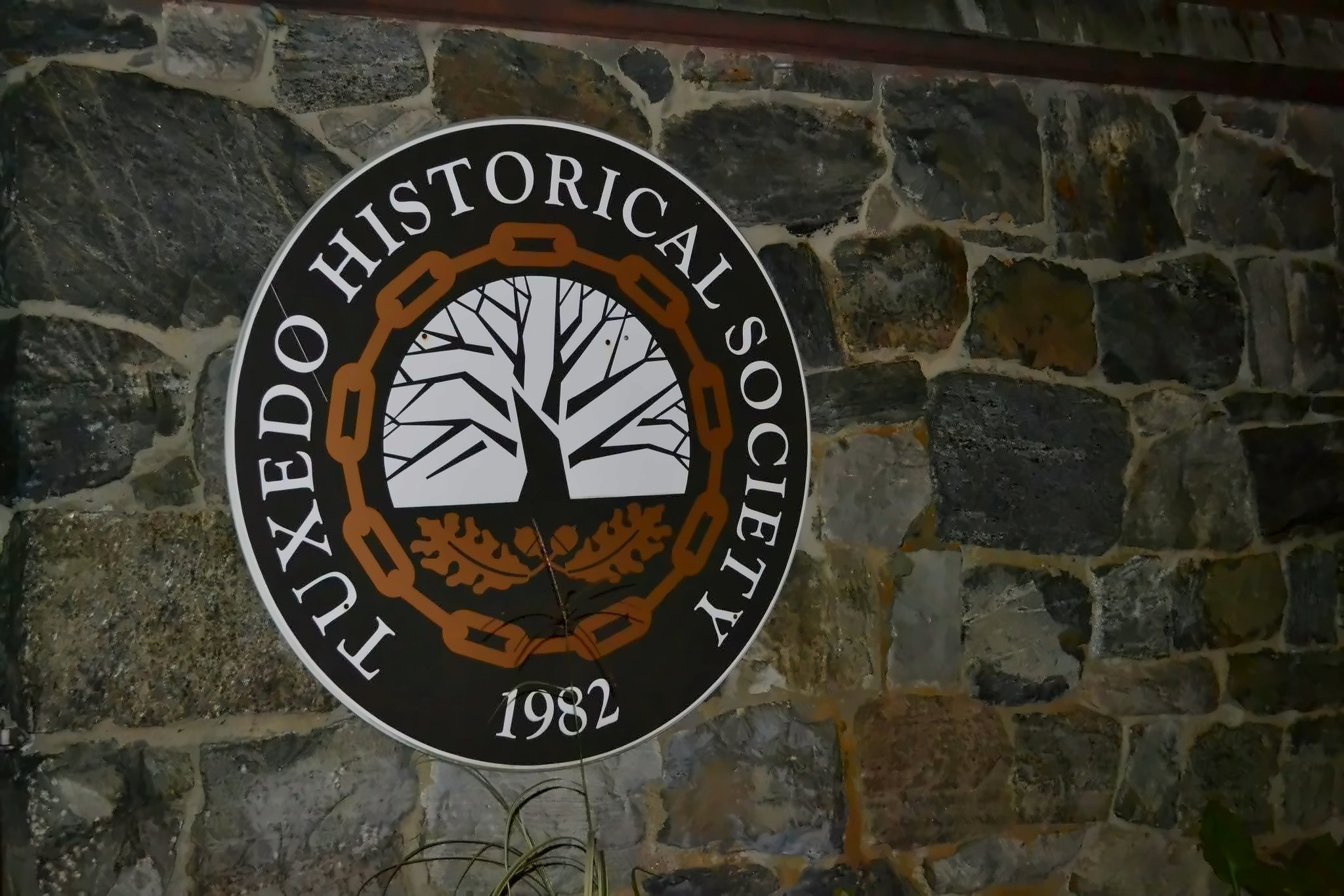
241 Route 17, Tuxedo, NY 10987 · (845) 351-2926 · tuxedohistory@gmail.com Open Sundays 1–4 p.m., or by appointment. Its seal bears the date 1982, and it is housed in the former Tuxedo National Bank building. Its most recent exhibition, honoring the Tuxedo Park Fire Department's 125th anniversary, is open Sundays 1–4 p.m. through October 11, 2026; contact the Society for its next exhibition. Lectures are $10 for non-members.
The Village of Tuxedo Park: please admire from outside the gates
The village is an incorporated, gated community, and its police control access. The Main Gate admits only registered vehicles and verified guests, vendors, Tuxedo Park School and Tuxedo Club attendees, guests and employees. The South Gate is for residents, property owners and registered vehicles only. Exceptions are arranged in advance through the Mayor or Chief of Police. There is no sightseeing access, and the Tuxedo Club is private. The Historical Society, just outside the gates, is the public door to the Park's story.
Harriman State Park
New York's second-largest state park, with 31 lakes and reservoirs and 200 miles of hiking trails. It is open daily, year-round, dawn to dusk; the main address is 3200 Seven Lakes Drive, Southfields. The land story ties back to Tuxedo: Mrs. W. A. Harriman gave $1 million and 10,000 acres to the Palisades Interstate Park Commission (Village of Tuxedo Park history). Autumn notes: some trails near Lake Sebago are closed into mid-2027, and permit deer hunting runs on weekdays this season, so check parks.ny.gov before you hike.
Sterling Forest State Park
21,935 acres of deep forest, open dawn to dusk. The Lautenberg Visitor Center (116 Old Forge Road, Tuxedo) overlooks Sterling Lake and is open daily 8 a.m.–4:30 p.m. History lovers, take note: the Sterling Ironworks forged the 1778 Great Chain across the Hudson, 770 links and 186 tons, installed at West Point on May 1, 1778 (NY State Parks).
The New York Renaissance Faire
600 Route 17A, Tuxedo · (845) 351-5171. The 2026 season ran on weekends and Labor Day, August 15–October 4, so it has closed for the year. Mark your calendar for 2027 (dates not yet announced).
XI. WHERE TO FIND IT: THE LIKE SHOP
Prices were checked on the dates shown and can change. Brands did not pay for placement.
The dinner suit. For bespoke, the house that cut the first one: Henry Poole & Co. (henrypoole.com). Also on Savile Row: Huntsman. Ready to wear: Ralph Lauren, Tom Ford, Brooks Brothers. Cloth for your tailor: Dormeuil, partner to the 2011 exhibition.
Women's tuxedo. Saint Laurent for the heir to Le Smoking; Dolce & Gabbana and Ralph Lauren for the First Lady's own tuxedo labels.
The pussy-bow blouse. Saint Laurent (the state-dinner label) and Burberry (her 2019 bow).
The shirt. Darcy Clothing, the exhibition's shirtmaker: Marcella Front Wing Collar Evening Shirt (SH231), £72, and Soft Marcella Front Evening Shirt (SH237), £65 (checked Oct 9, 2026). Also Budd and Turnbull & Asser in London.
Cufflinks and studs. Tateossian, the exhibition's jeweller.
Braces and shoes. Albert Thurston braces; Crockett & Jones formal shoes; Christian Louboutin for her heels.
Hats. Lock & Co.: restored Silk Top Hat £3,600, Ascot Top Hat £625, Town Coke (bowler) £575 (UK prices incl. VAT, checked Oct 9, 2026). Also Christys', Borsalino, Optimo, Stephen Jones and Philip Treacy for women's statement millinery, and Eric Javits, the inauguration milliner.
Chinese-style formalwear. Shanghai Tang: Tang jackets and qipao-inspired pieces (AW26 "A Winning Hand").
Pearls, for Madame Peng's double strand. Mikimoto (similar, not exact).
The resale lanes.
- Amazon Luxury Stores (amazon.com/luxurystores): new designer goods sold through Amazon.
- eBay with Authenticity Guarantee (ebay.com/authenticity-guarantee): the smart way to hunt vintage silk top hats, opera hats, velvet dinner jackets and vintage qipao. Search by measurements, and ask the seller for interior photos of any hat.
FTC Disclosure: LIKE® Magazine is an Amazon Influencer and an eBay Ambassador and may earn commissions on qualifying purchases made through links in this article, at no additional cost to you. Our editors choose every product independently.
© 2026 LIKE® Magazine. Original reporting and text by D. Michael De La Force, Editor in Chief. Photography: Michael de la Force / LIKE® Magazine, except: lead image, Official White House Photo by Molly Riley; inauguration photo, DoD photo by Petty Officer 1st Class Vanessa White; presidential limousine, U.S. Secret Service/Tia Dufour; Hongqi images, Official White House Photos by Daniel Torok and Adam Schultz, and ChengH/Wikimedia Commons (CC BY-SA 3.0); Rolls-Royce images, Rolls-Royce Motor Cars. Exhibit cards quoted verbatim from the Tuxedo Historical Society installation.
#LIKEMagazine #Tuxedo #TuxedoPark #BlackTie #SavileRow #LIKEStyle #LIKEHistory #LIKECraftsmanship #LIKETravel #michaeldelaforce