New York City, August 8, 2026 | How a 1969 Las Vegas Publicity Shot Linked a Beauty Queen, Dean Martin, the Rat Pack, the Sands Summit, New York’s Copacabana, Hit Songs, and the Kennedy Era
“There is a connection, hard to explain logically but easy to feel, between achievement in public life and progress in the arts.” --John F. Kennedy
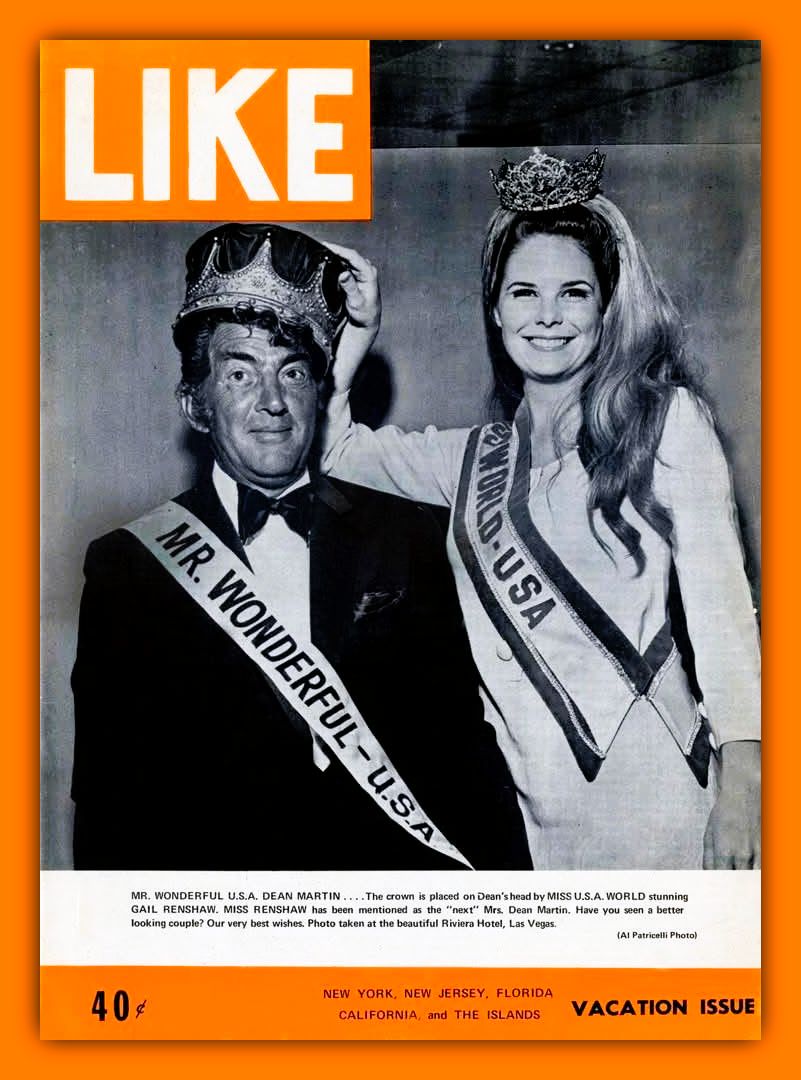
In late 1969, inside the Riviera Hotel on the Las Vegas Strip, photographer Al Patricelli staged a lighthearted publicity tableau. Dean Martin, then in his early fifties and headlining at the property, stood in black tie wearing a white sash that read “Mr. Wonderful U.S.A.” Beside him, Gail Renshaw, the newly crowned Miss World USA, smiled as she placed a crown on his head.
The black-and-white image appeared on the cover of LIKE® magazine, priced at 40 cents and billed as a vacation issue covering New York, New Jersey, Florida, California, and “the Islands.” The caption noted that Renshaw had been mentioned as a possible “next” Mrs. Dean Martin and offered the pair best wishes. The photograph was taken at the Riviera Hotel in Las Vegas.
The cover itself identifies the image as an “Al Patricelli Photo,” crediting Alfred “Al” Patricelli with the photograph. Patricelli was not merely an observer of the moment. As the longtime executive director of the Miss World USA organization, he accompanied Gail Renshaw to Las Vegas as she prepared to represent the United States at the Miss World competition in London. Patricelli contacted Tony Zappi, the Riviera Hotel’s press agent, introduced Renshaw as the newly crowned American titleholder, and sought a promotional opportunity with the hotel’s headliner, Dean Martin. The resulting photograph—Renshaw crowning Martin “Mr. Wonderful U.S.A.”—therefore records not only a playful publicity stunt but also Patricelli’s skillful orchestration of pageant promotion, hotel publicity, celebrity access, and the media value of a perfectly staged Las Vegas moment.
What began as an informational cover connected several strands of mid-century American entertainment and politics: the machinery of international beauty pageants; the height of the Rat Pack’s Las Vegas dominance; the New York nightclub world that trained the men who built the Strip’s showrooms; the Broadway revue tradition that shaped Vegas spectacle; the hit songs and live performances that gave the era its soundtrack; and the Hollywood-Kennedy alliance personified by Peter Lawford.
Gail Renshaw and the Pageant Circuit Gail Renshaw was born around 1947 and grew up in Arlington, Virginia, at 1711 North 17th Street. She graduated from Washington-Lee High School in 1965. As a teenager, she studied ballet and tap, taught ballroom dancing at an Arthur Murray studio by age 15, and worked as a model. Along the way, she collected local titles including “Miss Good Grooming” and queen of the Washington International Ski Show. After an early marriage ended, she entered the national pageant circuit.
On September 20, 1969, at the Baltimore Civic Center, with Bob Hope serving as presenter, Renshaw was crowned Miss World USA. It was the eighth edition of the pageant and the first in which contestants represented states rather than cities. She advanced to the Miss World competition at London's Royal Albert Hall on November 27, 1969. Among 50 contestants, she placed first runner-up to Austrian Eva Rueber-Staier. After the international event, Renshaw resigned the Miss World USA title, and her American first runner-up, Connie Lee Haggard of Texas, assumed it.
The Riviera photograph was arranged as publicity connected with Renshaw’s London trip. Alfred Patricelli, the longtime executive director of the Miss World USA organization, facilitated the introduction through the hotel’s press agent.
Martin agreed to the photograph, and a rapid romance followed. Martin’s daughter Gail, herself a singer, reportedly encouraged the match at one point. The couple appeared publicly together, including at the Bing Crosby National Pro-Amateur golf tournament in Pebble Beach, California, in January 1970.
Engagement speculation circulated widely. Renshaw later ended the relationship, citing the nearly 30-year age difference and family considerations—her father in Arlington was reluctant to fly. Martin’s divorce from his second wife, Jeanne Biegger Martin, was finalized in 1973. He married Catherine Hawn that same year; the marriage ended in 1976.
Renshaw stepped away from the spotlight. She trained as a registered nurse specializing in dialysis, lived for a time in Prince George’s County, Maryland, and later settled in Florida. She became a certified gemologist, married a retired banker, and raised a family. In a 2014 interview, she was living in Parrish, Florida, under the name Gail Renshaw Blackwell, enjoying her grandchildren and recalling her high-school classmates with affection.
This LIKE® magazine cover represents the Miss World USA system: the American selection process for the international Miss World pageant. Miss World, the oldest continuously running major international beauty pageant, was founded in 1951 by British entertainment entrepreneur Eric Morley as a promotional bikini contest tied to the Festival of Britain. The press quickly named it “Miss World.” Sweden's Kerstin “Kiki” Håkansson became the first winner.
Morley trademarked the name and transformed the contest into an annual event, later held at the Royal Albert Hall and televised by the BBC beginning in 1959. At its peak, it drew massive audiences. In 1972, Julia Morley introduced the “Beauty with a Purpose” initiative, emphasizing charitable work. By 1969, the U.S. competition had shifted to state representatives, and Renshaw’s strong performance in London marked one of the better American results of the era. The playful crowning of Martin as “Mr. Wonderful U.S.A.” blended pageant ritual with entertainment stardom—a crossover to which casinos readily gravitated.
Dean Martin and the Riviera Dean Martin, born Dino Paul Crocetti on June 7, 1917, in Steubenville, Ohio, rose through nightclub work and his celebrated partnership with Jerry Lewis from 1946 to 1956. After their split, he built a successful solo career as a relaxed interpreter of standards, an actor in films including the original Ocean’s 11, and host of the long-running NBC variety series The Dean Martin Show from 1965 to 1974. He had eight children from three marriages and died on Christmas Day 1995 at age 78.
By 1969, Martin’s Sands Hotel contract had ended. The Riviera offered a compelling package: a reported 10 percent ownership stake, $100,000 a week when he performed, and $20,000 a month when he did not. A new porte-cochère and a sign reading “Riviera Welcomes Dino” marked his arrival. A lounge space was named Dino’s Den. Martin headlined the Versailles Room and became one of the Strip’s most reliable draws.
Martin’s easy stage persona—the glass in hand that often contained apple juice rather than liquor—continued to work. The arrangement lasted until 1972. When Martin asked to reduce his schedule from two shows a night to one, management declined. The hotel bought back his shares, and he moved on, eventually opening the new MGM Grand Las Vegas in December 1973 and later performing regularly at Bally's. The Riviera photograph with Renshaw captured Martin at an important transition: still carrying the Rat Pack aura, but also functioning as an independent Las Vegas institution.
The Summit at the Sands The Rat Pack’s defining Las Vegas moment had come nearly a decade earlier. In January and February 1960, while filming Ocean’s 11, Frank Sinatra, Dean Martin, Sammy Davis Jr., Joey Bishop, and Peter Lawford performed at the Copa Room of the Sands Hotel. The engagement, generally dated from January 20 through February 16—roughly four weeks, though some accounts extend it to five—was promoted as the “Summit at the Sands.”
Sands publicist Al Freeman and entertainment director Jack Entratter played on a planned international summit involving President Dwight Eisenhower and Soviet leader Nikita Khrushchev, billing the shows as a meeting of entertainment leaders.
The original plan called for rotating individual performances. That changed quickly. On the first night, Sinatra performed both shows. The next night belonged to Martin. When Davis ran long, Sinatra came onstage to cut the set short with a joke about the need to rest for daytime filming. Audiences loved the interaction. By the end of the first week, the stars were freely interrupting and joining one another.
The marquees reflected the unpredictability: “DEAN MARTIN – MAYBE FRANK – MAYBE SAMMY.” Two shows were presented most nights, typically around 8 p.m. and midnight, and were kept to about an hour so patrons would return to the casino. Demand was enormous. The roughly 200-room Sands turned away an estimated 18,000 reservation requests in the first week alone. Celebrities including Lucille Ball, Jack Benny, and Bob Hope filled the room. Senator John F. Kennedy attended at least one performance.
The group itself preferred “the Summit” or “the Clan.” The press and public more often used “Rat Pack,” a label carried over from an earlier Hollywood circle around Humphrey Bogart. The shows mixed individual vocal sets with comedy, banter, impressions, and physical clowning. They helped invent the modern Las Vegas residency model and cemented the group’s collective image at the height of its cultural power. The defining venue was the Copa Room at the Sands, where the group filmed Ocean’s 11 by day and performed by night; the film also connected them to the Sands, Sahara, Riviera, and Flamingo.
The Music of the Rat Pack The Rat Pack was not a formal recording group with a shared hit-making discography. Its musical identity came from intersecting solo recordings, stage repertoires, movie soundtracks, television appearances, occasional duets, and live performances. Frank Sinatra, Dean Martin, and Sammy Davis Jr. were the primary musical pillars; Joey Bishop was the comic architect and straight man; and Peter Lawford supplied movie-star polish, social access, and the political connection to the Kennedy family.
Sinatra supplied authority, force, and interpretive precision. Davis brought virtuoso range as a singer, dancer, mimic, instrumentalist, and comic. Martin contributed an unhurried, warmly romantic style that made him seem effortless even when the vocal control was exact. He did not compete with Sinatra’s intensity or Davis’s athletic showmanship. His gift was apparent nonchalance: he often seemed to arrive at a lyric a half-second later than expected, then landed it perfectly.
Martin’s Rat Pack-era songbook included “Ain’t That a Kick in the Head,” written by Sammy Cahn and Jimmy Van Heusen and closely associated with him through the 1960 Ocean’s 11 film version and his Nelson Riddle-arranged recording. Although the original release was not a major contemporary chart hit, it became one of Martin’s most enduring signature songs and a musical shorthand for the Rat Pack’s polished Las Vegas image. His 1958 recording of “Volare (Nel Blu Dipinto Di Blu)” brought Italian-inflected exuberance to his repertoire. “You’re Nobody ’Til Somebody Loves You” reinforced his late-night romantic image, “Who’s Got the Action?” fit the casino world, and “Sam’s Song,” recorded with Sammy Davis Jr., captured their good-natured camaraderie.
Martin’s largest popular hit of the later Rat Pack era was “Everybody Loves Somebody.” Released in 1964, it reached No. 1 on the Billboard Hot 100 on August 15, displacing the Beatles’ “A Hard Day’s Night.” It was Martin’s first No. 1 single since 1956 and his first Top 40 hit since 1958, giving him an unofficial theme for the rest of his career.
In performance, Martin cultivated a familiar visual and emotional identity: tuxedo, drink in hand, slow smile, and an air of cheerful indifference. The drink was often apple juice rather than liquor, but the illusion of the carefree, late-night crooner was central to the act. At the Sands, Sinatra could command the room with “Come Fly with Me,” “I’ve Got You Under My Skin,” “Witchcraft,” and later “Luck Be a Lady.” Davis could move from “Too Close for Comfort” and “The Birth of the Blues” to dancing, impressions, and rapid-fire comic routines. Martin offered “Ain’t That a Kick in the Head,” “Volare,” “You’re Nobody ’Til Somebody Loves You,” and relaxed romantic material that made the room feel like a private after-hours party.
The sequence mattered less than the interplay. A singer might interrupt another star, an insult between friends might derail a number, or a solo set might become an ensemble routine. Bishop’s role was especially important: as a writerly organizer and straight man, he gave the others material against which to play. The act was not a conventional revue but a controlled collision of star turns, ad-libs, topical jokes, songs, comic timing, impressions, physical clowning, and unpredictability. Its racial and ethnic humor was of its time and is now understood in the context of the period’s prejudices and limitations. At the same time, the presence of Sinatra, Martin, and Davis together projected an image of racial integration, even as Davis faced discrimination and exclusion.
Peter Lawford: Political Connections and Later Years Peter Lawford, born September 7, 1923, in London, was the British-born actor and MGM contract player who supplied the group with Hollywood polish and a critical political connection. In 1954, he married Patricia Helen Kennedy, sister of John F. Kennedy, Robert F. Kennedy, and Edward Kennedy. The marriage made him brother-in-law to three of the most powerful figures in American Democratic politics.
Lawford became a U.S. citizen on April 23, 1960, specifically so that he could vote for John F. Kennedy. He and the other Rat Pack members campaigned and raised funds, while Sinatra nicknamed him “Brother-in-Lawford.” Lawford’s Santa Monica beach house became a social crossroads, and the group’s association with Kennedy briefly earned it the nickname “the Jack Pack.”
In March 1962, when President Kennedy planned a visit to Sinatra’s Palm Springs compound, concerns about Sinatra’s ties to syndicate figures—particularly Sam Giancana—led the White House to change the arrangements. Attorney General Robert F. Kennedy was involved in the decision. Lawford was assigned the task of delivering the news that the president would stay instead at Bing Crosby’s home. Sinatra, who had invested heavily in preparations, including a helipad, reacted strongly. He cut Lawford from the circle and from film projects such as Robin and the 7 Hoods.
After John F. Kennedy’s assassination in 1963, Patricia Kennedy Lawford sought a legal separation. The divorce was finalized in February 1966 in Idaho—the first in the immediate Kennedy family. She retained custody of their four children and never remarried. Lawford continued acting in television guest roles and occasional films. He married Mary Rowan, daughter of comedian Dan Rowan, in 1971; they divorced in 1975. In 1976, he married aspiring actress Deborah Gould; that marriage lasted roughly a year. In July 1984, months before his death, he married Patricia Seaton.
On December 24, 1984—Christmas Eve—Lawford walked on from Cedars-Sinai Medical Center in Los Angeles at age 61 of cardiac arrest complicated by kidney and liver failure. His ashes were initially interred at Westwood Village Memorial Park; after a dispute, they were later scattered in the Pacific.
Jack Entratter, the New York Nightclub Pipeline, and the Ziegfeld Tradition The man who made the Sands Copa Room possible was Jack Entratter, nicknamed “Mr. Entertainment.” Born February 28, 1914, in New York City, Entratter began as a reservation clerk at the French Casino in Miami. In the 1930s, he worked as a floorman at the French Casino in New York and then as a host at Sherman Billingsley’s exclusive Stork Club.
In 1940, Entratter joined the newly opened Copacabana as an assistant to Jules Podell, rising to general manager, show producer, and, by 1949, to a controlling or part ownership interest. He remained involved until 1952. At the Copa, he booked talent, established and personally selected the Copa Girls chorus line, and developed a reputation for polished dealings with performers and patrons. His physical presence—roughly 6-foot-4 to 6-foot-6 and around 240 pounds—suited early security roles, but he evolved into a skilled impresario.
When the Sands opened in December 1952, Entratter became its general manager and entertainment director, later serving as president. He designed the Copa Room in the spirit of the New York club, recruited similar showgirls, and used his Manhattan contacts to book Sinatra, Martin, and Davis. He offered headliners “points”—ownership percentages—in the hotel and casino. The elaborate opening-night costumes for the Copa Girls alone cost more than the salary of headliner Danny Thomas.
Entratter’s approach drew directly from Florenz Ziegfeld’s Follies, presented primarily from 1907 to 1931. Ziegfeld popularized the American showgirl as a statuesque ideal of beauty in lavish costumes, feathers, elaborate headdresses, and parade-style tableaux rather than complex dance. Staircases, visual spectacle, and glamour over pure choreography became trademarks.
Entratter absorbed this aesthetic at the Copacabana and carried it west. In 1953, theater owner Lee Shubert granted him exclusive rights to produce a new Ziegfeld Follies. On June 9, 1954, the Sands presented the production starring Frank Sinatra and 20 Copa Girls; six original Ziegfeld Girls attended a reunion. Entratter was styled as a “New Ziegfeld,” and the Copa Girls as modern Ziegfeld girls. He died after suffering a cerebral hemorrhage on March 11, 1971, at age 57. He also served as president of Temple Beth Sholom and supported various charities.
The Copacabana and Monte Proser The Copacabana opened on November 10, 1940, at 10 East 60th Street in Manhattan. Broadway press agent and impresario Monte Proser conceived the club after a visit to Rio de Janeiro, naming it after the famous Brazilian beach and designing it with tropical and Latin motifs: palm décor, velvet seating, Latin orchestras, Chinese food, and the glamorous Copa Girls. Proser’s name was on the lease, and he was the public face, but the operation had powerful silent backing.
Behind the glamour of the Copacabana stood Frank Costello, the politically connected syndicate leader whose silent financial backing helped make Monte Proser’s Manhattan nightclub possible and whose interests were protected in daily operations by Jules Podell. Jack Entratter rose through the club’s ranks before carrying the Copa formula to the Sands in Las Vegas. Costello’s presence at the Copa reflected a broader strategy of influence that extended beyond gambling and nightlife into the larger worlds of business, political relationships, charity, media, and the civic institutions of New York’s Italian American community.
In 1949, Costello accepted an appointment as a vice chairman of the The Salvation Army men’s fund-raising division, contributed to its campaign, and sponsored a $100-per-person benefit dinner and entertainment program at the Copacabana. Eventually Costello resigned and The Salvation Army retained the funds he raised for charity. That overlap between philanthropy, public respectability, and syndicate power also appears in Costello’s relationship with the Pope family.
Generoso Pope Sr., publisher of Il Progresso Italo-Americano, was a major Italian American businessman, political force, and civic leader who founded New York City’s modern Columbus Day Parade in 1929 and helped advance Columbus Day as a public expression of Italian American heritage. Pope’s parade, publishing influence, and advocacy helped make the holiday an especially prominent cultural symbol for Italian Americans in New York and beyond.
According to Paul Pope, Gene Pope Jr.’s son, whom the LIKE® Magazine editor met at his East 54th Street office in Manhattan, Costello was his father’s godfather and provided the financial assistance that enabled the young Pope to acquire the New York Enquirer in 1952.
Gene Pope Jr. later transformed that small, struggling weekly into the National Enquirer, one of the most influential and widely circulated tabloid publications in the United States. Published accounts and scholarly treatments have likewise linked Costello to Pope’s early purchase of the paper. Together, these connections reveal that the Copacabana was more than a glamorous nightclub: it was a crossroads of celebrity, entertainment, civic identity, philanthropy, politics, immigrant ambition, tabloid publishing, and the syndicate world—spheres that could occupy the same room while serving profoundly different purposes. In different ways, both the National Enquirer and the Copacabana transformed celebrity into a mass-market product.
Proser, born around 1904 in Widnes, England, and deceased on October 6, 1973, in Newtown, Pennsylvania, arrived in the United States as a young immigrant. He built a career as a press agent for Mary Pickford, Harold Lloyd, W.C. Fields, the Marx Brothers, Walt Disney, and elements of the Ziegfeld Follies. At the 1939 New York World’s Fair, he helped popularize the potent rum-based Zombie cocktail, originally created by Donn Beach, limiting customers as a marketing tactic and helping fuel the tiki trend.
At his early-1940s peak, he managed multiple clubs, including Beachcomber locations and La Conga in Hollywood. He later claimed association with some 50 nightclubs, often in publicity roles; operated La Vie en Rose in New York in the 1950s; produced Broadway’s High Button Shoes; and later created “capsule” versions of musicals for Las Vegas. His active role at the Copacabana diminished as Podell assumed control, and he left the partnership after several years.
The Copacabana became a premier New York nightspot through the 1940s and 1950s, launching or boosting the careers of Dean Martin and Jerry Lewis, Frank Sinatra, Sammy Davis Jr., Nat King Cole, Jimmy Durante, and many others. It attracted Hollywood, Broadway, sports figures, and café society. A famous 1957 brawl involved New York Yankees players during a Sammy Davis Jr. engagement. The club closed after Podell’s demise in 1973, reopened as a discothèque in 1976, and inspired Barry Manilow's 1978 hit “Copacabana (At the Copa).” Later versions operated at different Manhattan addresses.
The Copa Girls The Copa Girls were the signature chorus line of both the New York Copacabana and the Sands.
Jack Entratter established and personally selected the original New York line shortly after the club opened. He emphasized visual impact—roughly 5-foot-4, specific measurements, and an “American girl” look—over pure dance technique, consistent with the Ziegfeld tradition of beauty as spectacle. The line grew from six or seven dancers to as many as 28 and performed multiple shows nightly until it was discontinued in 1969. Many dancers later married well or moved into other entertainment work. Entratter transplanted the concept, the name, and the aesthetic to Las Vegas, where the Sands Copa Girls became a defining visual element of the Strip’s golden age. Entratter never allowed his showgirls to appear totally nude.
Glamour, Money, and the Cliché of Classic Vegas The Rat Pack and the pageant system together helped create the commercial and cultural formula that made Las Vegas rich. The Summit shows of 1960 demonstrated how star power could fill every room, turn away thousands of would-be guests, and pull high rollers onto the casino floor. The “points” system Entratter pioneered gave headliners a direct financial stake in a property, binding their celebrity to the house’s bottom line. High-profile entertainers became walking advertisements; the gamblers who followed them often left far more at the tables than the stars earned in fees. The freewheeling, tuxedoed, late-night image projected by the Rat Pack became one of the most durable clichés in American popular culture: the swinging, sophisticated desert playground.
Beauty pageants and the showgirl tradition supplied the complementary visual language. The idealized parade of beauty that pageants codified—poise, costume, and the public crowning of an aspirational American ideal—translated easily into the Copa Girls and the larger showgirl culture of the Strip, itself rooted in the Ziegfeld Follies’ emphasis on statuesque glamour and spectacle. Casinos understood that glamour itself was a product. Pageant winners and showgirls sold a fantasy of accessible elegance and desire that kept tourists coming and cameras rolling. Over time, Las Vegas became a natural home for national and international pageants; the city’s Miss Nevada USA competition and later hosting of major events reflected how thoroughly the pageant aesthetic had been absorbed into the local entertainment economy.
Together, these forces professionalized entertainment as a strategic loss leader. The shows and beauty spectacles did not have to turn a direct profit; they existed to draw the right kind of visitor and keep money circulating through the casinos. The result was a self-reinforcing loop of celebrity, visual glamour, media attention, and high-stakes gambling that defined classic Las Vegas and left an enduring cultural shorthand: the Rat Pack, the showgirl, the beauty queen, and the desert nightclub as symbols of mid-century American excess and allure.
Intersecting Worlds—and 250 Years of America The 1969 Riviera photograph freezes a single moment in which several American trajectories briefly aligned: a young beauty queen on the international circuit shaped by Eric Morley’s Miss World; a major entertainer negotiating the next phase of his career; the political glamour Peter Lawford carried into the Rat Pack; the New York nightclub tradition embodied by Monte Proser’s Copacabana and Jack Entratter’s expertise; and the Broadway-revue aesthetic of the Ziegfeld Follies that Entratter transplanted to the desert.
Las Vegas in the late 1960s still traded on the swagger the Rat Pack had created at the Sands a decade earlier. Martin’s songs—especially “Ain’t That a Kick in the Head,” “Volare,” “You’re Nobody ’Til Somebody Loves You,” and the chart-topping “Everybody Loves Somebody”—gave that swagger a soundtrack. Sinatra, Davis, Martin, Bishop, and Lawford made music, comedy, film, celebrity, nightlife, gambling, and politics appear to occupy the same glamorous universe. Their performances at the Copa Room were not simply concerts; they were staged demonstrations of postwar American confidence, prosperity, mobility, and mass entertainment.
For a 250 Years of America consideration, the photograph and its larger story offer more than nostalgia. They show how, by the middle of the 20th century, the United States had created a distinct and globally influential culture of celebrity. New York’s nightclubs supplied talent networks, show-business discipline, and revue traditions. Hollywood supplied films and national visibility. Washington supplied political proximity and symbolic power. Las Vegas turned all of it into a destination economy built around spectacle.
The story also reflects the contradictions within that American achievement. The Rat Pack projected racial integration through the prominent partnership of Sinatra, Martin, and Sammy Davis Jr., even as Davis confronted discrimination and prejudice throughout his career. The group’s freedom, wealth, and political access existed alongside the era’s entrenched exclusions, inequities, and reliance on a commercial culture shaped by gambling, image-making, and male power. The beauty-pageant system likewise celebrated opportunity, poise, and public ambition while presenting a carefully controlled standard of feminine glamour.
These tensions are precisely what make the image historically valuable. Gail Renshaw crowning Dean Martin as “Mr. Wonderful U.S.A.” was a publicity stunt, but it became an accidental document of a broader national story. It joins beauty-pageant culture, the internationalization of American entertainment, the transformation of Las Vegas from railroad stop to global resort capital, the evolution of the nightclub performer into a multimedia celebrity, and the lingering public fascination with the Kennedy era.
As the United States marks 250 years since 1776, this small Las Vegas moment reminds us that American history is not preserved only in official documents, political speeches, battlefields, or monuments. It also survives in magazine covers, hotel showrooms, popular songs, stage banter, publicity photographs, and the lives of people who briefly stood at the intersection of fame and history.
Renshaw returned to a private life of nursing, gemology, and family. Martin performed into the 1980s, his public image permanently linked to the relaxed cool of the Rat Pack years. Lawford continued working in film and television while navigating the changes that followed his years with the Kennedys and the Rat Pack. Entratter and Proser had already transferred the glamour of New York’s Copacabana—and the deeper Ziegfeld tradition—to the desert.
The LIKE® magazine cover that preserved the crowning of “Mr. Wonderful” endures as a vivid record of an American moment: a time when entertainment, beauty contests, nightclub showmanship, Broadway spectacle, popular music, gambling, film, and politics still shared the same brightly lit stage—if only for one night in Las Vegas.
Michael de la Force Editor-in-Chief LIKE® Magazine August 8, 2026 250 YEARS OF AMERICA