(ON THIS DAY) EIGHTY SEASONS AT THE RAIL: FIFTEEN YEARS AFTER MONMOUTH PARK’S 65TH CHARITY BALL
“The future is not some place we are going to, but one we are creating. The paths to it are not found, but made; and the activity of making them changes both the maker and the destination.” — Peter Ellyard
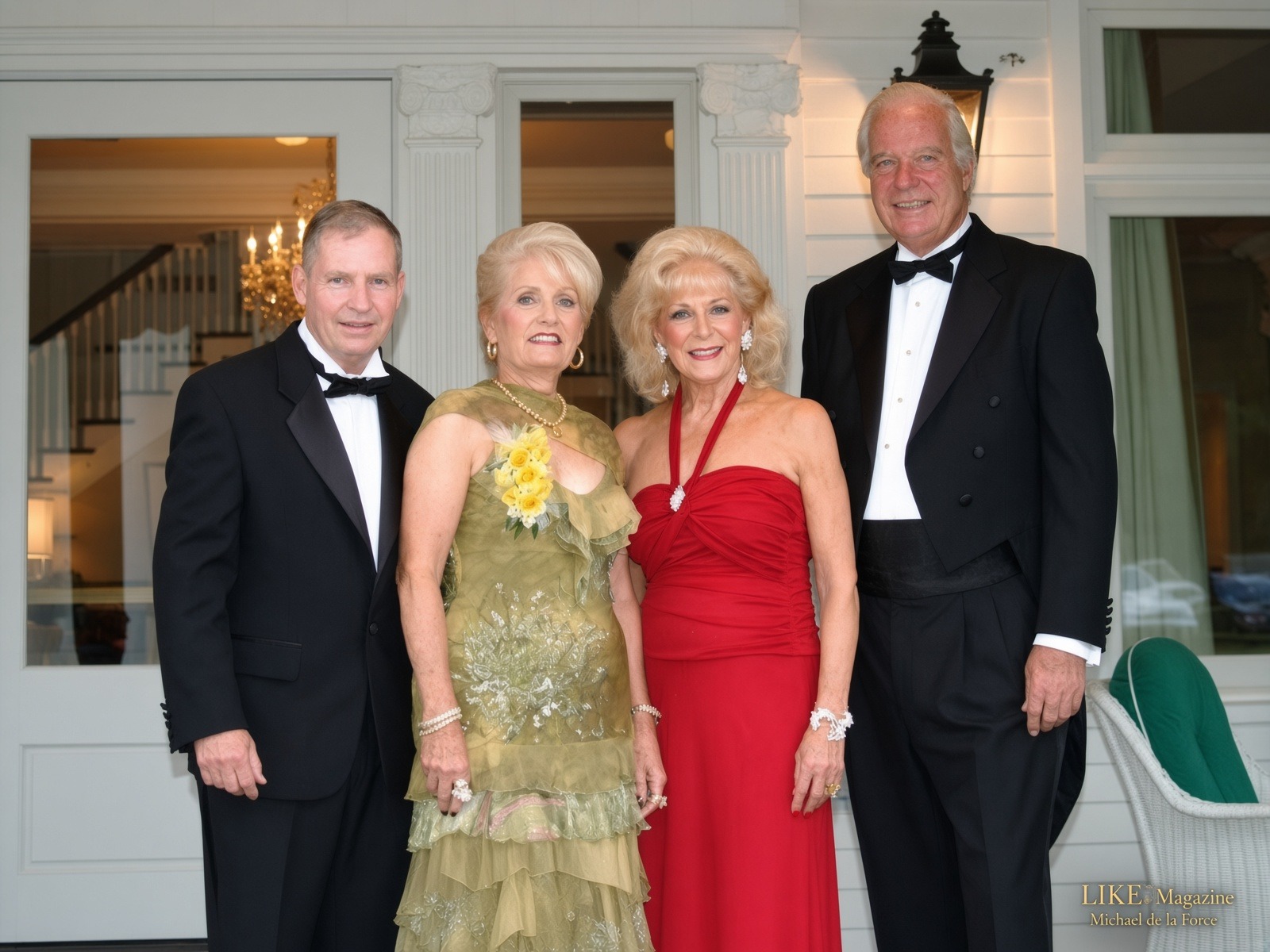
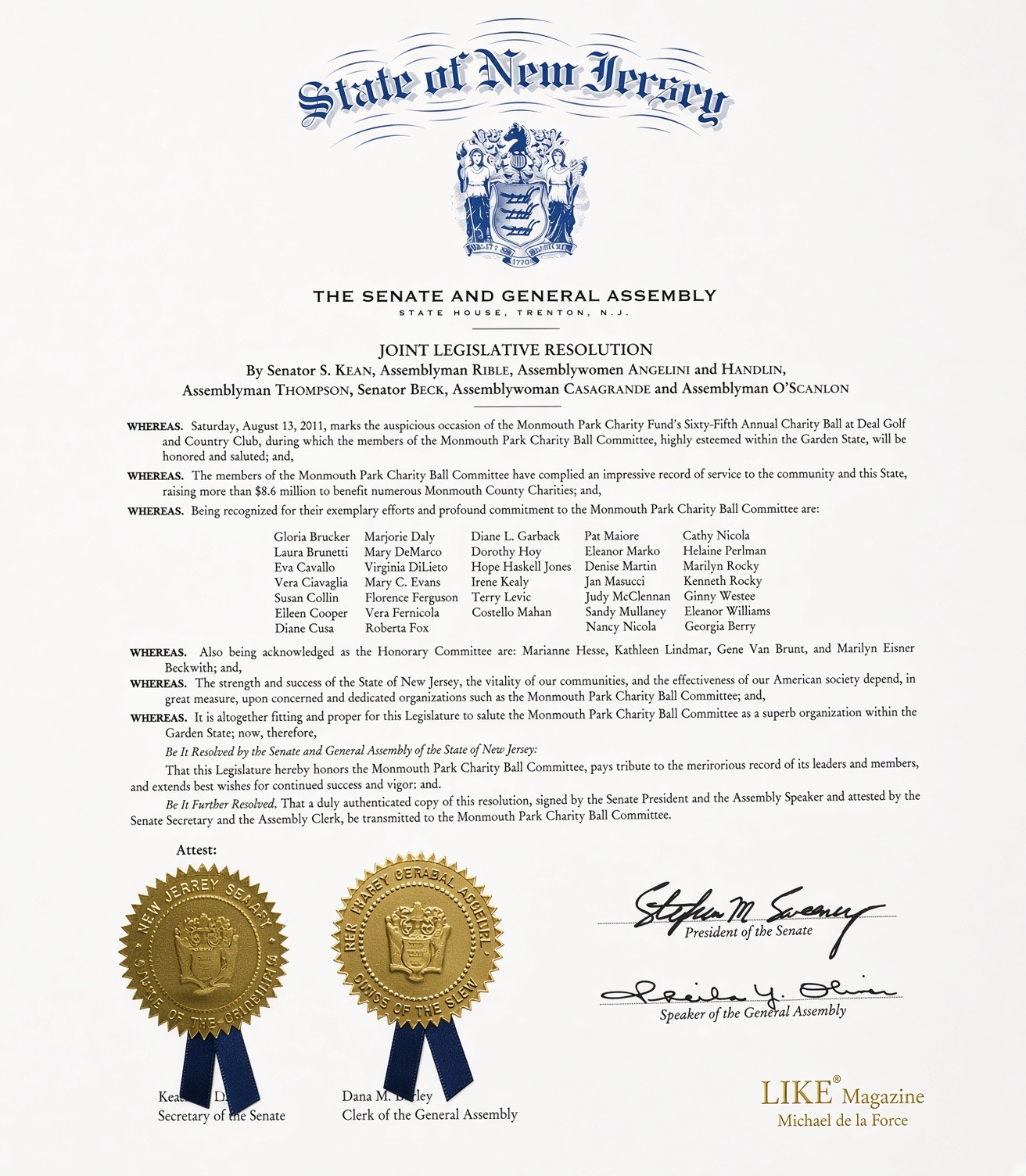
DEAL, N.J. — In the summer of 2011, the oldest clubhouse still in continuous use in New Jersey filled with the Shore’s particular idea of formal. Tuxedos gathered on the porch at Deal Golf & Country Club. Yellow roses climbed a cake inscribed for the 65th Gala Celebration of the Monmouth Park Charity Ball. A saxophone cut through the chandelier light. Women in sequins crossed the floor while, on a table, a New Jersey legislative resolution — seals, signatures, the ceremonial language of Trenton — waited like another kind of trophy.
Fifteen years later the photographs look like a vanished season. They are not. 2026 is a useful year to reopen them. The first Monmouth Park Charity Ball was held in 1947. This year marks eight decades since a committee of women decided that a revived racetrack owed something back to Monmouth County. The 65th ball sits almost exactly at the midpoint of that story: late enough to be a tradition, early enough that the ball itself had not yet given way to the Kentucky Derby parties and fashion shows that now carry the same mission.
The night belonged to a particular New Jersey: racing people, bankers, builders, grocers, magazine people, municipal people, and the volunteer architecture that has kept local charities in funds since the Truman administration. It also belonged to Deal — a club older than the modern Monmouth Park, and the room in which the Shore has long preferred to do its civic business in evening clothes.
The house on Golf Lane Deal’s story begins before the present racetrack existed. In the early 1890s, railroad financier and shipping magnate George Washington Young bought 135 acres in West Deal and laid out an estate. He was among the first to put golf on the Jersey Shore. Lawrence Van Etten designed nine holes. Young and his associates played them for three years, then organized as the Deal Golf Club in 1898 — the same year the Borough of Deal was incorporated — and built the clubhouse that still stands. They added a short nine exclusively for women in 1899, then a second nine on the main course in 1900. The new layout measured 6,495 yards and was called the second-longest course in the country. By 1903 there were nearly 600 members, including summer visitors. Dues were $25. Visitors paid $1 a day. The links were open year-round. There was boating on Deal Lake, archery, croquet, tether ball, tennis, lawn bowling. In five years the club had become, in its own account, “the most notable social centre of the entire northern shore.” The membership list of that period is a census of Gilded Age America at the beach: Robert Todd Lincoln, the president’s son; Col. George Harvey, editor of Harper’s Weekly; William C. Durant, founder of General Motors; honorary members former Presidents Benjamin Harrison and William McKinley. J. H. Taylor, Walter Travis, and 1910 US Open champion Alex Smith played exhibitions there. The Metropolitan Amateur and Open, the New Jersey State Amateur, and the Deal Invitational all came to the course.
In 1912 Young’s finances forced the sale of part of the estate to Hollywood Golf Club, across Roseld Avenue. Deal lost its fourth, fifth, and sixth holes — now Hollywood’s 16th, 14th, and 15th. Donald Ross was brought in to rebuild. He replaced the lost corridors with what are now the closing holes of the front nine and reset 17 and 18 as the present par-4, par-3 finish. The bunkers and contoured greens are still his language. Francis J. “Frank” Arend, club president from 1917 to 1942 and known as the “benevolent czar,” kept the place alive through the Depression, covering deficits and payroll when he had to. He took sole ownership in 1942. After his death a group of members led by Thomas F. McCarthy bought the club from the heirs in 1943 and reorganized it as Deal Golf and Country Club. Vic Ghezzi, the Rumson-raised professional who had been at Deal from 1935 to 1941, won the 1941 PGA Championship over Byron Nelson on the 38th hole at Cherry Hills. He remains the state’s defining tour golfer.
The clubhouse was expanded in the late 1950s. Kelly Blake Moran restored bunkers and tees in 2000. The course still plays, in the main, as it did a century ago. By 2011 the head professional was Jason Lamp. Across the street, Hollywood remained the neighbor and rival; the Roseld Cup had been contested since 2001. That is the room the 65th ball occupied: not a hotel ballroom imported for a night, but the Shore’s oldest continuous clubhouse, a few miles from the track whose revival had invented the party.
A debt paid in dancing The modern Monmouth Park opened on June 19, 1946, after more than half a century without racing on the Shore. Amory L. Haskell of Middletown, the former General Motors executive, and Philip H. Iselin, the textile man whose Oceanport house sat next to the track, led the revival with Reeve Schley, Joseph M. Roebling, Townsend B. Martin, John MacDonald, and James Cox Brady.
Nearly 19,000 people came through the gates on opening day. Gratitude arrived the following year. Haskell and Iselin asked 15 local women to invent a thank-you. They chose a ball and carnival at the track. The proceeds would not stay in the jockey club. They would go back into Monmouth County. On July 21, 1947, the Monmouth Park Charity Fund was incorporated as a 501(c)(3). Betty Iselin became the first president of the Charity Ball Committee and held the office for 50 years. Haskell’s daughters, Anne Haskell Ellis of Middletown and Hope Haskell Jones of Rumson, worked the committee for decades. The fundraising committee was known, then and later, as the Charity Ball Ladies. The model was unusually durable. The fund survived the state’s purchase of the track in 1985 and later changes in operators. By 2011 it had already sent millions to more than 100 local nonprofits.
The Charity Ball Ladies The ball was never a staff production. It was a women’s committee that outlasted owners. Betty Iselin set the term of office. Roberta O. Fox, of Rumson and Palm Beach, belonged to the next long generation. Born Roberta Olga Tutela in Newark on Aug. 22, 1921, she was the daughter of Professor and Mrs. Luigi Tutela. In 1942 she married Louis Polcari, a West Point - The U.S. Military Academy graduate who served on Gen. Douglas MacArthur’s staff at Leyte. She later married I. Ralph Fox; they were together 52 years. She sat as board member or chairman of the Kessler Institute for Rehabilitation, Short Hills Country Day School, the Visiting Nurses Association of Monmouth County, the Monmouth Park Charity Fund, the Arthritis Foundation, the Children’s Psychiatric Center, Monmouth Day Care Center, Marlboro Hospital, and the Monmouth Center for Vocational Rehabilitation. With Ralph she was among the original founders of the Arc of Monmouth. The fund’s annual grant ceremony still carries her name: the Roberta O. Fox Distribution of Funds Tea.
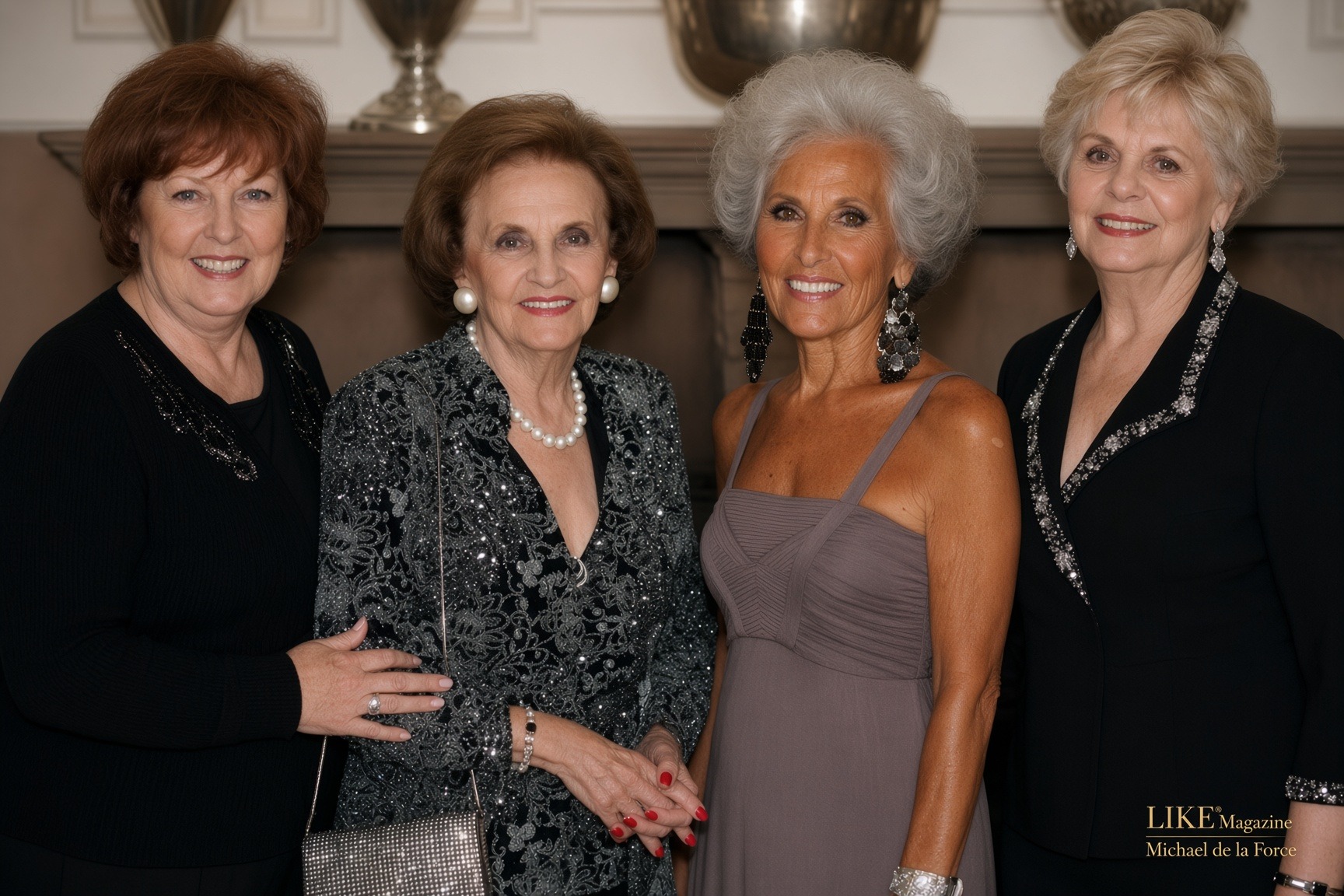
Eva Cavallo was among the women of the ball board — one of the committee figures who made the 65th look effortless from the floor. Diane Marie Cusa gave the fund more than 20 years as a Charity Ball Lady. Hope Haskell Jones was quite active. The line from 1947 was not metaphorical. It was attendance.
Mary Ann Martin was the professional hinge. By 2011 she was executive director — the fund’s only employee, and part time. She had already been a board member. She kept the original grant list in her head. She ran the tea, the fashion show that would outlive the ball, and the then-new Kentucky Derby fundraiser.
The Nicola sisters Nancy Nicola and her sister, Cathy Nicola, were among the people who made a Shore ball look like local government in evening clothes. They came out of North Brunswick’s Nicola line. Charles Nicola Jr. had been the township’s seventh mayor; their uncle, Judge George J. Nicola, sat as municipal court judge in North Brunswick, Jamesburg, and Piscataway, then as a Middlesex County judge who rose to preside over the adult criminal division. Cathy Nicola was already on the North Brunswick Township Council by the night of the 65th gala. She would serve 12 years and finish as council president. At her last meeting, in December 2016, Mayor Francis “Mac” Womack thanked her for putting residents first. Nancy Nicola worked the civic side of the same town. In 2014 her name sat on the masthead of North Brunswick’s 235th Anniversary Gala committee — the same program that opened with her family’s former mayor, Charles Nicola, and his 1979 line about neighbors who “teach our children, police our streets, run our government.” On the Shore they were fixtures. At home they were the family that ran the meeting.
The woman in red Among the guests that night, the woman in the red dress was Dorothy Lehmann, chairwoman of LIKE® Magazine. Lehmann was born Dorothy Irene Jeffcott in Wagga Wagga, New South Wales in Riverina region of southeastern, Australia. This community sits along the Murrumbidgee River, roughly halfway between Sydney and Melbourne
Dorothy Lehmann was the eldest of four children of Cora and Edward Jeffcott. Her siblings were Natalie, Jack, and Polly. The childhood was a working farm: sheep, cows, and the skills that come with farming life, including a gun. That is in contrast to the “lady of leisure” she later lived on the Shore, and it is the key to her.
Before America Dorothy was a dressmaker and a dental assistant. She married Bill Porter; he died young. What followed was the classic mid-century Australian move, and a daring one for a woman traveling alone: a round-the-world itinerary, recorded in a stack of full passports. New York was a stop. A friend invited her to the Jersey Shore for a weekend. There she met Fred “Barron” Lehmann, a magazine man, and she stayed.
They made LIKE® Magazine their instrument. From the late 1960s through the 1990s they covered the restaurants, the charity circuit, and the social weather of the Shore and Florida with fervor. They also developed an international audience with the first coverage beginning in 1967. They were both hyper-local and global at once.
Dorothy's American home for decades was Ocean Township. Her summer coordinates were more precise: Cabana 29 at the Allenhurst Beach Club, then out for the evening. The accent never left. Nieces in Australia, especially Jane, remained a nightly line back to Wagga. By August 2011 she was chairwoman, still working the room. LIKE® Magazine’s photographer that night was Michael de la Force. The pictures — the porch at Deal, the cake, the band, the resolution — are his record of the 65th.
Asbury in the room John Moor of Asbury Park was there in the middle of a different kind of civic life. In 2011 he retired as deputy director of the city’s Department of Public Maintenance after 31 years on the payroll, most of it in public works. He had already given the city 12 years on the Board of Education, time on the Housing Authority, the Chamber of Commerce, the Historical Society, the fishing club, the parade committees. He had lived in Asbury Park since 1977. His great-grandfather had arrived in 1888. Both of his parents graduated from Asbury Park High School. Council would come in 2013. The mayor’s office would come after the city changed how it chose a mayor. None of that was on the 2011 program. What was on it was a man who had spent three decades keeping the streets and then put on a tuxedo for the county’s oldest charity night. That is how the Shore mixed its governments: North Brunswick’s Nicola sisters on one side of the room, Asbury’s public-works deputy on the other, Deal’s clubhouse in the middle.
The track in play The 65th gala sat inside a crisis, not after it. The New Jersey Sports and Exposition Authority had bought Monmouth Park in 1985. By 2011 the state’s racing plants were losing on the order of $10 million to $20 million a year. Gov. Chris Christie wanted New Jersey out of the horse business and had threatened to shut the tracks.
In May 2011 the administration announced private operators: Morris Bailey, a New York real estate developer with a home in Deal and a stake in Resorts Casino® in Atlantic City, for Monmouth; Jeffrey Gural for the Meadowlands. Legislation that June allowed joint operation with the NJSEA until the men were licensed, and cut Monmouth’s mandated calendar from 141 days to 71. Bailey was selected from a field of bidders. He began running the meet under a memorandum of understanding dated June 24, 2011.
So on the night of the ball, guests were dancing a few miles from a track the state was already trying to leave. The ball’s civic language — the resolution, the 1947 bargain — was not costume. It was an argument that the place still mattered while the lease was being rewritten. The Bailey deal did not hold. By December 2011 talks broke over licenses and extra racing dates. The New Jersey Thoroughbred Horsemen’s Association, led in the fight by attorney Dennis Drazin, moved in as the successor operator. John Brunetti of Hialeah, a losing bidder, challenged the award. The NJSEA upheld the horsemen in April 2012. Darby Development, the Drazin vehicle, has run the plant since. Martin’s later remark that every subsequent owner had supported the charity fund is the institutional point: privatization changed who signed the racing dates. It did not cancel the 1947 debt to Monmouth County.
The sponsors on the board Diamond sponsorship that year was split in a way that said a good deal about who still underwrote Shore philanthropy: Jack Rudin and The Provident Bank.
Jack Rudin, then chairman of Rudin Management Company, belonged to one of New York’s great landlord families. His father, Samuel Rudin, built the firm. Jack and his brother Lewis ran it — Jack on construction and operations, Lewis on financing and the civic machinery of the city. Their buildings include 345 Park Avenue, 350 Park Avenue, 3 Times Square, and 55 Broad Street. In the 1970s fiscal crisis they helped persuade fellow owners to prepay real estate taxes. They were among the founders of the Association for a Better New York. In 1976 they underwrote the first five-borough New York City Marathon; the winner’s trophy still carries their father’s name. Jack sat on the boards of Memorial Sloan Kettering Cancer Center and Jazz at Lincoln Center. He was an honorary trustee of the American Museum of Natural History. That a Rudin name appeared as a diamond sponsor of a Monmouth County charity ball was not an accident of geography. It was the old New York–Jersey Shore circuit: racing, real estate, and a habit of writing the check.
Provident Bank was the local pillar. Chartered in 1839 as the Provident Institution for Savings, it is New Jersey’s oldest community bank, founded in Jersey City. The red-headed man from Provident in the photographs is Al Giobbi, then a senior vice president and regional manager. He had already spent years on the Monmouth Park Charity Fund board and served as its treasurer. In interviews he treated the unpaid work as the point of the job: a banker who stayed in the county after the dinner ended.
The grocers who everyone knows and loves The plaque in the doorway went to Food Circus Super Markets and the Azzolina and Scaduto families, dated August 13, 2011, for outstanding leadership and contribution to the community. That is the Highlands-to-Middletown grocery line. John and Angelina Azzolina, immigrants from Sicily, opened a candy-and-grocery corner on Miller Street in Highlands in the 1920s. Their children, Joseph Azzolina and Grace Azzolina, helped run it, then built a self-service superette called the Food Basket on Bay Avenue. In 1953 Grace married Louis J. Scaduto Sr., a New York–born Army veteran who joined the family business and became its operating partner. In 1955 they incorporated Food Circus Super Markets. In January 1956 they opened a 24,000-square-foot store on six acres at 853 Highway 35 in Middletown — far larger than anything the Bayshore had seen — and put a rotating 30-foot steel clown, later named Calico, at the entrance. The company headquarters never really left that address. People on the Shore still talk about the office above the supermarket as if it were a second capitol. Joseph Azzolina was the political engine. A Navy man through World War II and Korea, later a captain with more than 40 years in uniform and reserve, he went to Trenton against his father’s warning that politics would cost customers. He sat in the General Assembly from 1966 to 1972, in the Senate from 1972 to 1974, then returned to the Assembly in 1986–88 and again from 1992 to 2006 — 24 years representing Monmouth’s 13th District. He helped bring the battleship USS New Jersey home to the state. He owned the Courier, the Bayshore weekly. He sat for years on the Food Marketing Institute board. Produce men remembered that he treated the department as the soul of the store.
Grace Azzolina Scaduto was the other political half. She managed the Food Basket, then became secretary-treasurer of Food Circus, supervising the front end in its formative years and writing policy and training manuals. In 1995 the New Jersey Federation of Republican Women named her Woman of the Year. She was a delegate to the 1992 Republican National Convention, an alternate in 1988, a Monmouth County state committeewoman, former president of the Women's National Republican Club of Middletown, and a worker on the Kapalko and Azzolina congressional campaigns. Girl Scouts leadership ran back to her Brownie troop in the 1960s. The supermarket and the party were the same room.
By 2000 the third generation had formal titles. Louis Scaduto Jr. was vice president for operations and merchandising. Philip Scaduto was vice president for administration and marketing — advertising, in-store promotions, policy. Joseph Azzolina Jr. took strategic planning, real estate, and new development. John Azzolina took finance and information systems. In 2010 Louis Scaduto Jr. became president. By the night of the ball the chain still ran about ten Super Foodtowns across three counties and employed more than 1,400 people. The families also held Circus Wines, Beer & Spirits and the Calico property on Route 35.
Philip Scaduto is the man the Shore means when it says the Scadutos were political players. He is Grace and Lou Sr.’s son, Lou Jr.’s brother. After the stores he carried the same civic habit onto hospital boards: the Bayshore Medical Center Foundation, then the Jersey Shore University Medical Center Foundation, pediatric palliative care, and children’s-hospital icon drives run through the Foodtown aisles. That is not a mayoralty. It is the older Shore pattern — groceries, committees, and the check. Roselyn (Lynn) Picone Azzolina, Joseph’s wife since 1954, stood for the family in the royal-blue dress. Their children are John, Joseph Jr., Mark, Gregory, Judy, and Mary Ann.
Mary Ann Azzolina is the daughter on the Shore listings now — a Coldwell Banker Realty associate in Middletown, a Seniors Real Estate Specialist, a member of the International Diamond Society. She works Monmouth County and the Jersey Shore: rightsizing, first houses, the sale of a parent’s home. She still says she was raised in a family-owned business. The grocery floor became the listing appointment.
For this family, the plaque is dated the night of the ball. But, the office over the old Circus on Route 35 is the same story in another tense: politics, groceries, and the county, under one roof.
Laura Brunetti is photographed seated in the drawing room, with her husband, John J. Brunetti, standing behind in 2011. John served as an owner of Hialeah Park in Miami, the flamingo-lined track that had been one of the most beautiful in America. He bought Hialeah Park it in 1977, after building a construction and development fortune that began with his father’s New Jersey firm and spread through apartment communities in Bergen County and beyond. The family kept homes in Little Silver. A place card from the evening reads Nicola Brunetti, Table 3 — the Brunetti table, in other words, was not a cameo. It was a racing family’s night out. Brunetti’s 2011 status is the one that matters here. Hialeah had been dark for thoroughbreds for a decade. He had reopened it in 2009 with quarter-horse racing, a move widely understood as the statutory path toward a casino license. He still talked about the sport of kings. He still belonged to the small club of men who had actually owned a great American racetrack and refused to let the building become only a postcard.
What Trenton put on paper The legislative resolution displayed at the gala is the state’s way of saying a private party is also a public fact. New Jersey’s Legislature has long used ceremonial resolutions to mark institutions that outlast governors. The 65th Monmouth Park Charity Ball was one of those. Around it, in 2011, the same Statehouse was arguing over the privatization of Monmouth Park and the Meadowlands, a shortened racing calendar, and whether the Shore’s thoroughbred meet would survive without the old purse subsidies.
The people named in that resolution, and the people standing near it that night, are the same cast the pictures already identify: Martin and the Charity Ball Ladies, including Fox and Cavallo; Lehmann of LIKE® Magazine; the Brunettis; Giobbi and Provident; Rudin; Cathy Nicola of the North Brunswick council and Nancy Nicola of that same civic family; John Moor of Asbury Park’s public works; the Azzolina and Scaduto families of Food Circus; the trustees at tables marked Food Circus and Provident Bank; the award presenters at the podium; the band. The Shore has always done its official business in evening clothes.
The middle of the story By 2012 the fund would the ball would retreat. The fashion show continued. The Derby party grew. Ownership of the racetrack shifted again. The grants did not stop. More than $11 million has now gone out since 1947. The tea is still Roberta O. Fox’s. The Winners Circle Society still meets, sometimes, at Deal Country Club — the same house.
That is why 2026 is the right year to look at 2011. The 65th gala was not the beginning and it was not quite the end. It was the last time the original form — dinner, dancing, a cake with the count of years written in icing, a resolution from Trenton — still looked inevitable, and it was staged in a clubhouse that had already been doing that kind of night since McKinley was an honorary member.
Dorothy Lehmann, in red, is the chairwoman of LIKE® Magazine. Mary Ann Martin is still the organizer who can recite the 1947 list. Roberta Fox’s name is already on the tea. Eva Cavallo is still on the floor with the Charity Ball Ladies. Cathy Nicola is still a sitting councilwoman; Nancy Nicola is still her sister on the civic side of the same town. John Moor is still Asbury Park’s public-works deputy, a year from the next chapter. John Brunetti still owns Hialeah. Jack Rudin’s name is still on the diamond board. Al Giobbi is still the banker who stayed for the treasurer’s report. Roselyn Azzolina still stands for Food Circus. Philip Scaduto is still the marketing vice president with the hospital boards ahead of him. Mary Ann Azzolina is already the Shore realtor. Michael de la Force is still the photographer at the edge of the frame.
The horses ran that summer. Deal dressed. The money went home. Eighty seasons on, that remains the point.