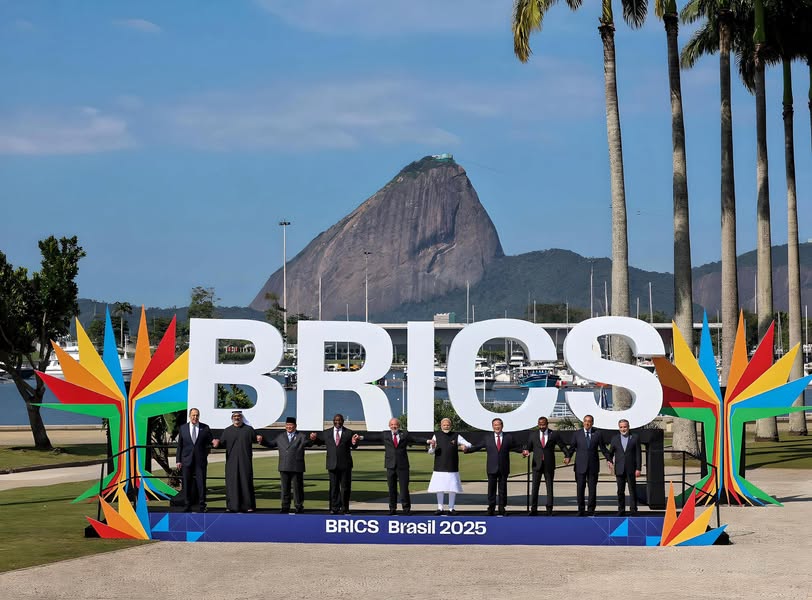
The world’s eyes are on Rio de Janeiro as Brazil hosts the 17th BRICS Summit, a gathering that now includes eleven full members and a steadily expanding circle of partners. The mood? Ambitious, energized, and resolutely focused on rewriting the rules of global governance. The theme this year—“Strengthening Global South Cooperation for More Inclusive and Sustainable Governance”—signals a bold new chapter for the bloc.
Who’s in the Room?
This year’s summit is the largest in BRICS history. The core group—Brazil, Russia, India, China, and South Africa—has grown to include Egypt, Ethiopia, Iran, Saudi Arabia, the United Arab Emirates, and, for the first time, Indonesia. These eleven nations collectively represent nearly half the world’s population, a vast stretch of territory across four continents, and a rapidly growing share of global GDP.
China’s President Xi Jinping has sent Premier Li Qiang in his place, citing scheduling conflicts. Russia’s President Putin is participating virtually. Their absence is symbolic but hardly diminishes their countries’ influence—China and Russia remain key architects of the BRICS vision.
Alongside the full members, a host of partner and observer nations are present: Belarus, Vietnam, Nigeria, Cuba, Bolivia, Thailand, Uganda, Kazakhstan, Uzbekistan, and Malaysia, among others. Over thirty countries have applied or expressed interest in joining, including Argentina, Algeria, and Turkey, signaling BRICS’ growing gravitational pull.
What’s on the Agenda?
The summit’s agenda is packed and purposeful:
Reforming Global Institutions: BRICS leaders are united in their call for a more representative United Nations Security Council, as well as changes to the International Monetary Fund and World Trade Organization - WTO to better reflect the interests of the Global South.
AI Governance: With artificial intelligence reshaping economies and societies, the bloc is pushing for a global framework that prioritizes responsible development and equitable access.
Climate and COP30: As Brazil prepares to host COP30 in the Amazon, climate action and environmental protection are front and center, with BRICS aiming to present a unified front.
Trade and Finance: Reducing reliance on the U.S. dollar is a recurring theme, as is strengthening the New Development Bank and facilitating South-South trade.
Peace and Security: The group is addressing regional conflicts, counterterrorism, and global health challenges, seeking to position itself as a stabilizing force.
The Conversations: Emperors, Economics, and Expansion
While China’s President Xi Jinping—dubbed “the Emperor” by some Western commentators—may be absent, his country’s influence is unmistakable. China is leading in spaces such as AI governance, while Russia is advocating for expanded security cooperation. Brazil, as host, is positioning itself as a bridge between continents and ideologies, with President Lula da Silva calling for “a more just and multipolar world order.”
The summit’s working sessions are tackling everything from institutional reform and economic integration to climate action and digital transformation. The mood is one of cautious optimism, tempered by the reality of global headwinds.
BRICS Membership and Levels
BRICS now boasts eleven full members: Brazil, Russia, India, China, South Africa, Egypt, Ethiopia, Iran, Saudi Arabia, the UAE, and Indonesia. Their leaders—Lula, Putin, Modi, Li Qiang (for Xi), Ramaphosa, el-Sisi, Abiy Ahmed, Pezeshkian, Mohammed bin Salman, Mohamed bin Zayed, and Prabowo Subianto are a diverse group, but united by a shared vision of a more balanced global order.
The bloc’s partner and observer nations span every continent, and the list of potential future members is long and growing. BRICS has become the premier forum for emerging economies seeking a greater voice.
BRICS vs. G20: Where the Lines Blur
BRICS and the G20 share several members—Brazil, Russia, India, China, South Africa, Indonesia, and Saudi Arabia—giving these countries outsized influence in both forums. While the G20 is focused on global economic stability and includes both developed and emerging economies, BRICS is more narrowly focused on reforming global governance and promoting South-South cooperation. The crossover ensures that BRICS’ priorities are increasingly heard on the world’s biggest stages.
Land, Wealth, and Power
Together, the BRICS nations cover nearly 50 million square kilometers and are home to almost four billion people—about half the world’s population. Their combined GDP is approaching $30 trillion, representing nearly 40% of global output. China leads the pack economically, followed by India, Brazil, and Russia.
On the security front, Russia, China, and India are nuclear powers, each with their own fleets of nuclear submarines. Brazil is developing a nuclear-powered submarine for their fleet.
Opening Remarks and Early Headlines
Brazilian President Lula da Silva set the tone in his opening remarks, calling for unity, climate action, and institutional reform. He urged members to avoid direct confrontation with the West, instead focusing on building “a more just and multipolar world order.” The Rio de Janeiro Declaration, adopted on day one, commits the bloc to multilateralism, sustainable development, and responsible AI governance.
BRICS, in its Rio de Janeiro declaration, has taken a strong and unified stance on the Gaza conflict and the broader Israeli-Palestinian issue:
- The bloc declared the Gaza Strip an “inseparable part of the occupied Palestinian Territory”, emphasizing the need to unify Gaza and the West Bank under the Palestinian Authority.
- BRICS called for the complete withdrawal of Israeli troops from Gaza and all occupied Palestinian territories, and demanded the release of all hostages and detainees held in violation of international law.
- The declaration reaffirmed support for the Palestinian people’s right to self-determination and an independent State of Palestine, explicitly endorsing full Palestinian membership at the United Nations.
- The bloc expressed grave concern over Israel’s ongoing military operations in Gaza and the obstruction of humanitarian aid, strongly condemning the use of starvation as a weapon of war.
- BRICS also opposed any forced displacement or demographic changes in Gaza or the West Bank, and stressed that Palestinians must play a central role in reconstruction efforts.
- The declaration referenced the International Court of Justice’s (ICJ) provisional measures in South Africa’s genocide case against Israel, signaling that BRICS views Israel’s actions as potentially constituting war crimes or even genocide under international law.
- Brazilian President Luiz Inácio Lula da Silva, hosting the summit, described Israel’s actions in Gaza as “genocide” and called for urgent global action to stop it.
This declaration marks one of the clearest and most forceful positions by a major international bloc, sharply differing from the more cautious or neutral approaches of many Western and other global powers.
As the summit continues, BRICS is engaged in shaping the next era of global governance—one where emerging economies have a seat at the table, and where the rules are evolving.
Early headlines from the summit highlight the group’s resolve to diversify economic partnerships, push back against U.S. protectionism, and expand its influence in global institutions. The message from Rio is clear: the Global South is no longer content to sit on the sidelines.
(Michael de la Force, LIKE Magazine, 7.7.2025)