“Peace at home, peace in the world.”
—Mustafa Kemal Atatürk (Founder and first President of the Republic of Turkey)—This foundational doctrine remains the bedrock of modern Turkish foreign policy, guiding the nation toward dialogue and cooperation.
On the plains of central Anatolia, in the city Mustafa Kemal Atatürk chose to hold the republic together, thirty-two heads of state and government stood shoulder to shoulder — with a Ukrainian president, a South Korean president and, in a sixth-paragraph line the alliance had never quite written before, a formal note of thanks. This is the record of two days that will be read as a hinge.
The City That Chose to Be the Capital
Ankara is a plain-spoken city. It does not sit on a strait. It has no palace on a Bosphorus. It was chosen — deliberately, over centuries-older claimants — because in 1919 a young officer named Mustafa Kemal made his headquarters here, and because on the thirteenth of October, 1923, the Grand National Assembly voted, by a large majority, that "the administrative centre of the Turkish state is the city of Ankara." The bill had a single article. It was law that day. The Republic was proclaimed sixteen days later.
A century and change on, Ankara remains what it has always been in the modern Turkish imagination: the seat of the will. Istanbul is where Türkiye is admired. Ankara is where Türkiye is decided. It is not, therefore, a coincidence that the 36th summit of the North Atlantic Treaty Organization convened here on the seventh and eighth of July, twenty twenty-six — nearly seventy-four years after Türkiye's 1952 accession made the alliance, for the first time, truly transcontinental. It was the alliance's second summit ever hosted by Türkiye, and the first held in the capital.
The Room Where It Happened
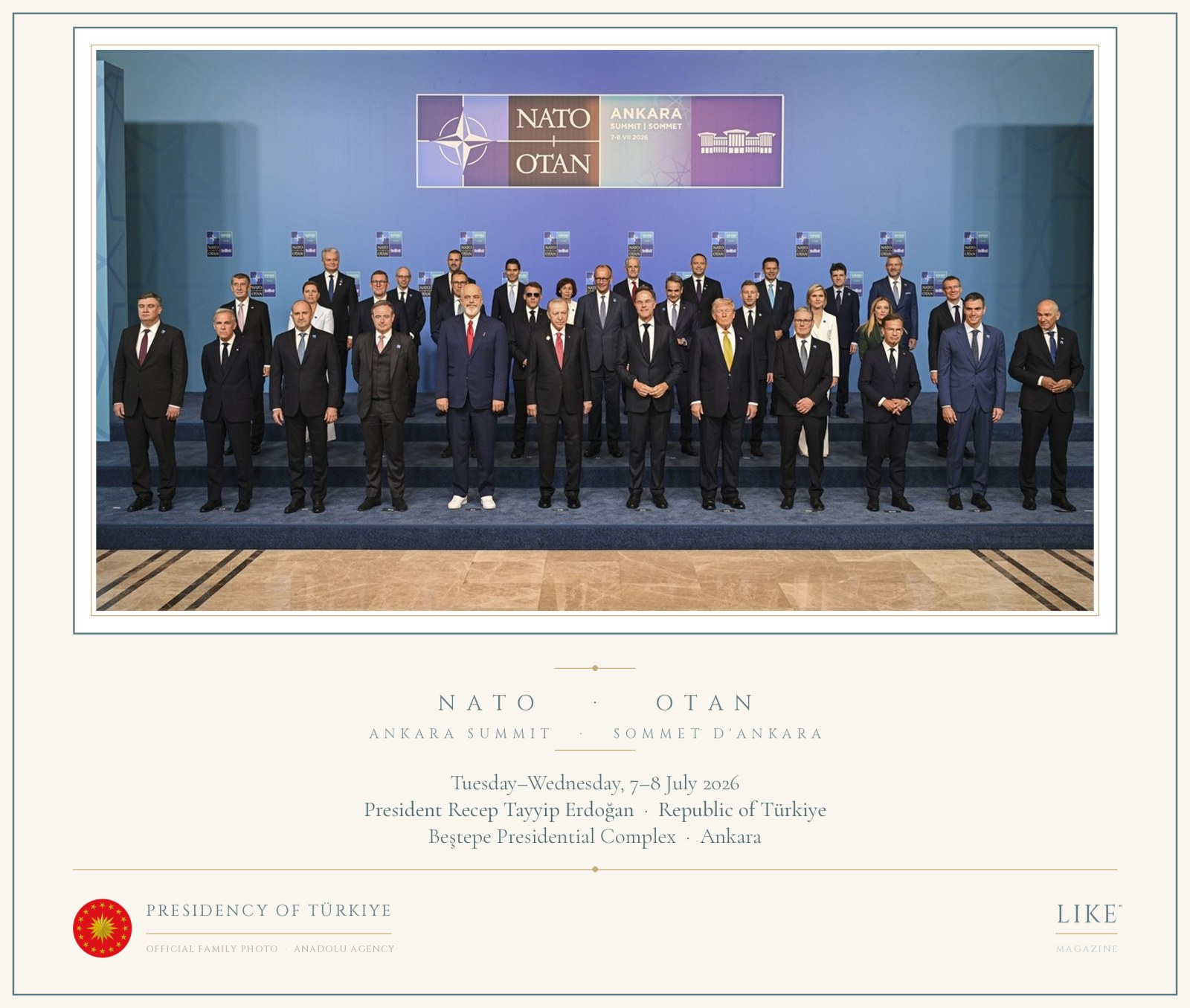
The Beştepe Presidential Complex sits on the western edge of the city, on the grounds of the Atatürk Forest Farm — land the founder himself donated to the state in 1937. Its architecture is a synthesis: Seljuk lines, Ottoman proportion, a modern hand. The main compound covers roughly three hundred thousand square metres. On the morning of Wednesday, the eighth of July, its central hall was rearranged around a single low riser, backed by a rear-projected wordmark: NATO · OTAN — ANKARA SUMMIT / SOMMET · 7–8 VII 2026.
Before it, thirty-two heads of state and government took their places for what the alliance calls the family photo. NATO Secretary General Mark Rutte stood at centre. To his right, the host — Turkish President Recep Tayyip Erdoğan. To his left, United States President Donald J. Trump. Behind and around them: the presidents and prime ministers of thirty-one other member states, and two invited heads of state — Ukraine's Volodymyr Zelenskyy and the Republic of Korea's Lee Jae-myung.
At the closing press conference, President Erdoğan described the gathering as a "historic summit, which we hosted at a time when Euro-Atlantic security is being tested," and said it had been "conducted in a manner that will shape our common future." German Chancellor Friedrich Merz, in his own closing remarks, said the alliance was "with this day, more European than ever," adding that the allies had "taken an important step forward on the way to the new NATO." President Donald J. Trump, who spent parts of the two days rebuking European partners and parts of them praising them, told reporters afterward that there was a feeling of "love" in the air.
The Host and the First Lady
President Erdoğan, seventy-two, has stood at the summit of Turkish politics for more than three decades — mayor of Istanbul, prime minister, and, since 2014, president of the Republic. He is a formidable host, and Beştepe is his cathedral. On Tuesday, he received President Trump at the Presidential Complex with what Turkish state broadcaster TRT World called an "A+" ceremony: a twenty-one-gun salute, a full guard of honour, mounted ceremonial cavalry escorting the American motorcade from Esenboğa Airport, and a flyover by the Turkish Stars — the Turkish Air Force's aerobatic team — trailing red, blue and white smoke, the colours of the American flag. Trump greeted the honour guard in Turkish. "Merhaba asker," he said. Hello, soldier.
Beside him — in a sequence of long-line evening gowns and modest daytime silhouettes — was First Lady Emine Erdoğan, seventy-one. Born the fifth child and only daughter of Cemal and Hayriye Gülbaran on the sixteenth of February, 1955, in Istanbul, and originally from the south-eastern province of Siirt, she married the future president on the fourth of July, 1978. They have four children — two daughters and two sons. Since 2014, Mrs. Erdoğan's public portfolio has centred on education for girls, humanitarian assistance and environmental stewardship — her Zero Waste initiative is registered as an official partner of the United Nations — and, more recently, on children's safety online.
Her role inside the summit was substantial. On Wednesday, she hosted more than twenty of her counterparts at Çankaya Mansion — the historic residence Atatürk used as the seat of the presidency — for a working roundtable titled "Children, Technology and Security: Protecting the Next Generation." She greeted each guest personally at the door. Addressing the group afterward, she argued that child safety online should not be treated as "an additional setting on digital platforms," but as "the first principle of design." She called on governments to open what she named "the black box of algorithms": "technology companies must submit the social impact of their products to independent audit." And she drew the line the Presidency of Türkiye has been drawing internationally for the past two years: "Companies are responsible to their shareholders," she said, "while states are responsible to their nations."
The luncheon that followed was staged in a hall dressed with İznik ceramics — the hand-painted blue-and-white tiles and pottery that flowered in north-western Anatolia in the fifteenth and sixteenth centuries — with tables laid in linens reflecting Türkiye's traditional embroidery. Emine Erdoğan personally tested every dish before it was served. The menu, prepared by the Michelin-starred Turkish chef Osman Sezener of Od Urla, opened with seven mezes representing seven regions of Türkiye: Erzincan tulum cheese with a special honey; Trabzon butter from the Black Sea; hibeş and tarhana from Antalya, Turkey; a Bodrum gambilya fava; a nectarine-and-armola cheese salad from Seferihisar with purslane; and Anatolian stuffed zucchini blossoms and stuffed vine leaves. To follow: Urla's celebrated mastic-scented artichoke with fresh broad beans, and a choice — for the main course — of slow-cooked beef ribs with freekeh bulgur, or sea bass in a Çeşme mastic sauce. Dessert: a mousse of yogurt from the Aegean folded with white chocolate, and Emiralem strawberries and forest berries at the finish. The porcelain was Turkish; the flowers on the tables were Turkish, and no taller than twenty-five centimetres. The gesture — as with everything else Mrs. Erdoğan touches on the state occasion — was less about display than about the deliberate transmission of a civilisation.
Tuesday evening was the leaders' evening. President and Mrs. Erdoğan hosted a reception at the Presidential Complex in honour of the summit's heads of state and government and their spouses. The Erdoğans welcomed each guest at the door and posed for a photograph with each of them. In the group photograph, the president and first lady were flanked, on their right, by President Trump and Chancellor Merz, and, on their left, by President Emmanuel Macron of France with his wife, and by Prime Minister Giorgia Meloni of Italy. The evening's culinary programme drew on regional specialities from across Türkiye: stone-oven pide with Trabzon butter and Hizan honey; olive-oil vegetables with a smoke-touched Denizli yogurt; Kayseri mantı finished with a smoked Aya tomato paste; and, for the main course, a choice of sea bass with Urla's mastic artichoke and Tokat vine-leaf tarama, or slow-cooked beef ribs with a freekeh pilaf enriched with Trabzon butter, roasted eggplant and morel mushrooms. Dessert was Sütlü Nuriye, a milk-baklava, presented with an Antep pistachio foam, Kahramanmaraş ice cream and a bergamot aroma. The White House Press pool noted that Trump, who is well known for his preference for beef, chose the ribs.
“We were greatly pleased to host the heads of state and government and their esteemed spouses at the official dinner on the occasion of the 36th NATO Heads of State and Government Summit, hosted by our country," Mrs. Erdoğan wrote afterward. "At a time when efforts to find solutions to the world's common problems are gaining momentum, I hope this important summit will further advance the culture of dialogue and consensus. Ankara itself, in the days before the meeting, was groomed for state occasion. Turkish authorities deployed a total of 56,288 personnel — 48,841 police officers and 7,447 gendarmerie, together with 4,405 units of supporting equipment — around the Presidential Complex and the delegation hotels, with coordination centres established at the Ankara Governor's Office and the Interior Ministry. Temporary flight restrictions were issued for Esenboğa Airport for the summit's two days; civilian and military aircraft carrying foreign heads of state and their official delegations were exempted. "The sole purpose of the security and traffic measures being implemented," Interior Minister Mustafa Ciftci said in the ministry's official statement, "is to ensure the safety of our citizens, guest delegations and security personnel, and to ensure that the summit is held in an orderly and trouble-free manner.”
The Delegations
All thirty-two NATO member states were represented at the head-of-state or head-of-government level. There were no major absences. That is not a small sentence; it is, in fact, the entire premise of the summit's staging.
NORTH AMERICA. United States — President Donald Trump. Canada — Prime Minister Mark Carney.
THE EUROPEAN "BIG FOUR." United Kingdom — Prime Minister Sir Keir Starmer. France — President Emmanuel Macron. Germany — Chancellor Friedrich Merz. Italy — Prime Minister Giorgia Meloni.
THE REST OF THE ALLIANCE. Spain — Prime Minister Pedro Sánchez Pérez-Castejón. Poland — Prime Minister Donald Tusk. The Netherlands — Prime Minister Dick Schoof. Finland — President Alexander Stubb. Iceland — Prime Minister Kristrún Frostadóttir. Sweden — Prime Minister Ulf Kristersson. Albania — Prime Minister Edi Rama. Romania — President Nicușor Dan, accompanied by his partner Mirabela Grădinaru. Slovakia — President Peter Pellegrini. Bulgaria — Prime Minister Rumen Radev. Montenegro — Prime Minister Milojko Spajić. Türkiye — President Recep Tayyip Erdoğan, host. Belgium, Croatia, Czechia, Denmark, Estonia, Greece, Hungary, Latvia, Lithuania, Luxembourg, North Macedonia, Norway, Portugal and Slovenia were represented by their heads of government.
INVITED HEADS OF STATE. Two. Ukrainian President Volodymyr Zelenskyy, who travelled to Ankara with an agenda every allied capital was watching. And Republic of Korea President Lee Jae Myung, the only Indo-Pacific Four leader present in person, whose delegation included First Lady Kim Hye-kyung and Foreign Minister Cho Hyun.
A BILATERAL IN ANKARA. President Trump also held a separate meeting in the Turkish capital with Syrian President Ahmed al-Sharaa — a conversation that, only two years ago, would have been considered outside the realm of the possible.
The Supranational Powers in the Room
Three supranational bodies were present in the highest sense of the word.
NATO ITSELF chaired the summit through its Secretary General, Mark Rutte, the former Dutch prime minister who took the alliance's top political job in 2024. His fingerprints are on every line of the closing document. In Ankara, President Trump described him as "a tremendous unifier"; Chancellor Merz, praising Rutte's chairing style, called him "the best man for his time" in the role. In the run-up to the meeting, Rutte had told Anadolu Agency that Ankara should be a "summit of delivery and implementation," adding that Türkiye "is extremely important to NATO," had been part of the alliance "since 1952 — nearly 75 years," and had "played a central role for decades."
THE EUROPEAN UNION sent both of its presidents. European Council President António Costa and European Commission President Ursula von der Leyen met President Erdoğan at the Presidential Complex on the margins of the summit, as Anadolu Agency confirmed on the eighth of July. European Union High Representative Kaja Kallas joined a NATO–Ukraine Council working dinner with alliance foreign ministers and Ukraine's top diplomat.
THE INDO-PACIFIC FOUR — Australia, Japan, New Zealand and the Republic of Korea — met Rutte on the summit's margins. President Lee was joined at the table by Japanese Foreign Minister Toshimitsu Motegi, Defence Minister Shinjiro Koizumi, New Zealand Defence Minister Chris Penk and Australian Defence Industry Minister Pat Conroy. Motegi told his counterparts that the security of Europe, the Atlantic and the Indo-Pacific is "inseparable."
A GULF SIDEBAR. NATO foreign ministers also convened with counterparts from Bahrain, Kuwait, Qatar and the United Arab Emirates — a working conversation on Middle Eastern security.
The Deals
Bloomberg’s Ankara desk, which fed a running tally in real time, reported some twelve billion dollars in defence contracts announced at Tuesday's opening industry forum, and, by the close of business Wednesday, "more than fifty billion dollars in new procurements" written directly into the Declaration.
The line items:
AWACS REPLACEMENT. A multinational consortium — reported by Bloomberg as an eleven-country order and by the Associated Press as a ten-nation buy — will acquire up to ten Saab GlobalEye airborne early-warning aircraft, a Swedish alternative to the alliance's roughly fifty-year-old Boeing E-3 fleet. Bloomberg valued the deal at approximately five billion dollars. Announcing it, Swedish Prime Minister Ulf Kristersson called it "a moment of great pride."
TRITON SURVEILLANCE DRONES. Rutte announced a four-country effort to purchase up to five Northrop Grumman MQ-4C Triton high-altitude drones, valued by Bloomberg at 2.7 billion dollars.
AIRBUS TANKERS. Representatives of fifteen nations announced a multinational buy of Airbus air-to-air refuelling and transport aircraft; Bloomberg valued the package at 4.3 billion dollars.
AMRAAM AND U.S.-DESIGNED MISSILE PRODUCTION. Allies also announced agreements to shift production and maintenance of U.S.-designed missiles — including the AIM-120 AMRAAM — to Europe, one of the summit's most substantive industrial commitments.
THE NETHERLANDS PACKAGE. Dutch Defence Minister Dilan Yeşilgöz told Reuters the Netherlands alone would announce contracts and plans worth "more than €3 billion ($3.43 billion)," including partnerships with Belgium on air defence and with Britain on naval ships.
GERMANY. Chancellor Merz confirmed on arrival that Germany had doubled its defence outlay since 2022 and would spend 124 billion euros on defence in 2026. DW News Ankara desk reported that European allies and Canada together will spend 634 billion dollars on defence this year — an eleven percent year-on-year increase.
FRANCE. President Macron used the Ankara stage to preview the thirteenth-of-July Coalition of the Willing meeting on Ukraine and to press a French argument he has been making for the better part of a decade. "The United States has announced a redeployment of its efforts, which seems entirely legitimate to me, and Europeans must organise themselves accordingly," Macron told reporters. "But we should not do this because someone asks us to. We should do it for ourselves." He added: "France has long advocated that Europeans must support and defend a European defence industry. If we spend more, it should not simply be to buy non-European equipment."
THE REPUBLIC OF KOREA. From the Defence Industry Forum stage, President Lee pledged one hundred million dollars in comprehensive support for Ukraine and announced that Seoul and NATO would begin talks on a Korea–NATO Framework Agreement on Procurement — a legal and administrative structure that would open access, for Korean firms, to what Seoul’s national-security office estimated at an approximately fifteen-trillion-won-per-year joint-procurement market.
UKRAINE — THE SEVENTY-BILLION-EURO PLEDGE. The Declaration's fourth paragraph pledges seventy billion euros — roughly eighty billion dollars — in military equipment, assistance and training for Ukraine in 2026, with the allies affirming their sovereign commitments to sustaining "at least equivalent levels" in 2027. On the summit's second day, in Ankara, Trump gave Zelenskyy an unexpected line. "We'll give them the right to make Patriots," he said of the U.S.-made air-defence interceptor. "We'll show them how to do it." He added that it was a defensive weapon, "which I like better than an offensive weapon." President Zelenskyy separately concluded drone-production agreements with Denmark, Estonia and the Netherlands.
THE TÜRKIYE PACKAGE. In Ankara, President Trump said of the CAATSA sanctions Washington had imposed on Türkiye after its 2019 acquisition of Russia's S-400 air-defence system: "We're going to be taking the sanctions off, OK?" On the question of Türkiye's return to the F-35 fifth-generation fighter programme, Trump said it was "something certainly we'd consider," adding that "Turkey's been, in many ways, much more loyal than other countries that we think would be loyal." TRT World reported that Trump called Erdoğan "a really great man," and that Erdoğan described Trump's stance as a "positive approach." Turkish Foreign Minister Hakan Fidan framed the whole set of exchanges as the foundations of "a stronger Europe within a stronger NATO" under a "NATO 3.0" vision.
Behind all of it: the Hague pledge of 2025, in which the allies committed to raising defence-related spending — with 1.5 percent of GDP allocated to broader defence-related investment on top of core defence spending. The Ankara Declaration reaffirms the Hague defence commitment and reports that in 2025 European allies and Canada increased their investments in core defence requirements by "more than $139 billion."
The Declaration
The final text — the Ankara Summit Declaration, published on the eighth of July — is a compact document of six numbered paragraphs.
Its first reaffirms the alliance's "ironclad commitment" to collective defence under Article 5 of the Washington Treaty and to the transatlantic bond: "An attack on one is an attack on all. Our unity, solidarity and collective strength remain the foundation of peace, security, and prosperity for the one billion citizens in our Alliance of free and democratic nations."
Its second names Russia and terrorism as the alliance's long-term threats, reports that in 2025 European allies and Canada increased their investments in core defence requirements by "more than $139 billion," and announces "more than $50 billion in new procurements."
Its third describes the alliance's aim of "a stronger Europe in a stronger NATO — a modernised Alliance," and commits to "an interoperable transatlantic warfighting cloud" and the adoption of "powerful AI models."
Its fourth confirms the seventy-billion-euro pledge to Ukraine for 2026 and the commitment to sustain "at least equivalent levels in 2027," and welcomes the European Union's decision to provide multi-year funding through the Ukraine Support Loan.
Its fifth carries a line the alliance has not carried in exactly this form before — "Iran must never have a nuclear weapon" — and calls on Iran "to fully respect freedom of navigation in the Strait of Hormuz."
Its sixth reads, in full: "We express our appreciation for the generous hospitality extended to us by Türkiye. We look forward to our next meeting."
What the Picture Shows
Look again at the family photo.
Rutte at centre. Erdoğan and Trump flanking him. Meloni at the edge of the front row. Macron in the row behind. Zelenskyy — an invited guest but the summit's dominant off-stage subject — near the middle rank, in his campaign fatigues. Sweden's Ulf Kristersson and Finland's Alexander Stubb — the alliance's two youngest members — closer to the row ends. Romania's Nicușor Dan, at his first summit as head of state. Above them, the wordmark reads NATO in one language and OTAN in the other — the alliance is, and has always been, bilingual — with ANKARA SUMMIT · SOMMET · 7–8 VII 2026 beneath.
That is the picture Türkiye wanted. It got it.
A Note from the Ankara Correspondent
There will be years of writing about this summit, and Ankara has already earned its share of them. Türkiye's Permanent Representative to NATO, Ambassador Basat Öztürk, told Anadolu Agency in the run-up that the logistical and infrastructure work for the meeting "would set a new benchmark for future NATO summits." On the evidence of the two days that followed, that is not the language of self-congratulation. It is a plainly accurate description of the standard set.
A century ago, at the close of an intense parliamentary debate on the thirteenth of October, 1923, the presiding officer of the Grand National Assembly was asked to record the vote making Ankara the capital as unanimous. "Gentlemen," he replied, "there are some hands that have not been raised. I cannot say unanimously; it has been approved by a large majority." A large majority was all Atatürk needed. It has been more than enough since.
On the plains of central Anatolia, in the city Mustafa Kemal chose to hold the republic together, an alliance of thirty-two free nations, two invited heads of state and its supranational partners looked one another in the eye and agreed on more than they had in a decade. They wrote it down on paper. And, when the paper was done, the last thing they wrote was thank you.
Michael de la Force, LIKE® Magazine, 7.9.26
© LIKE® MAGAZINE · ALL RIGHTS RESERVED · ANKARA · NEW YORK · JULY 2026. Photo plate: PRESIDENCY OF TÜRKIYE · OFFICIAL FAMILY PHOTO · ANADOLU AGENCY · 8 JULY 2026