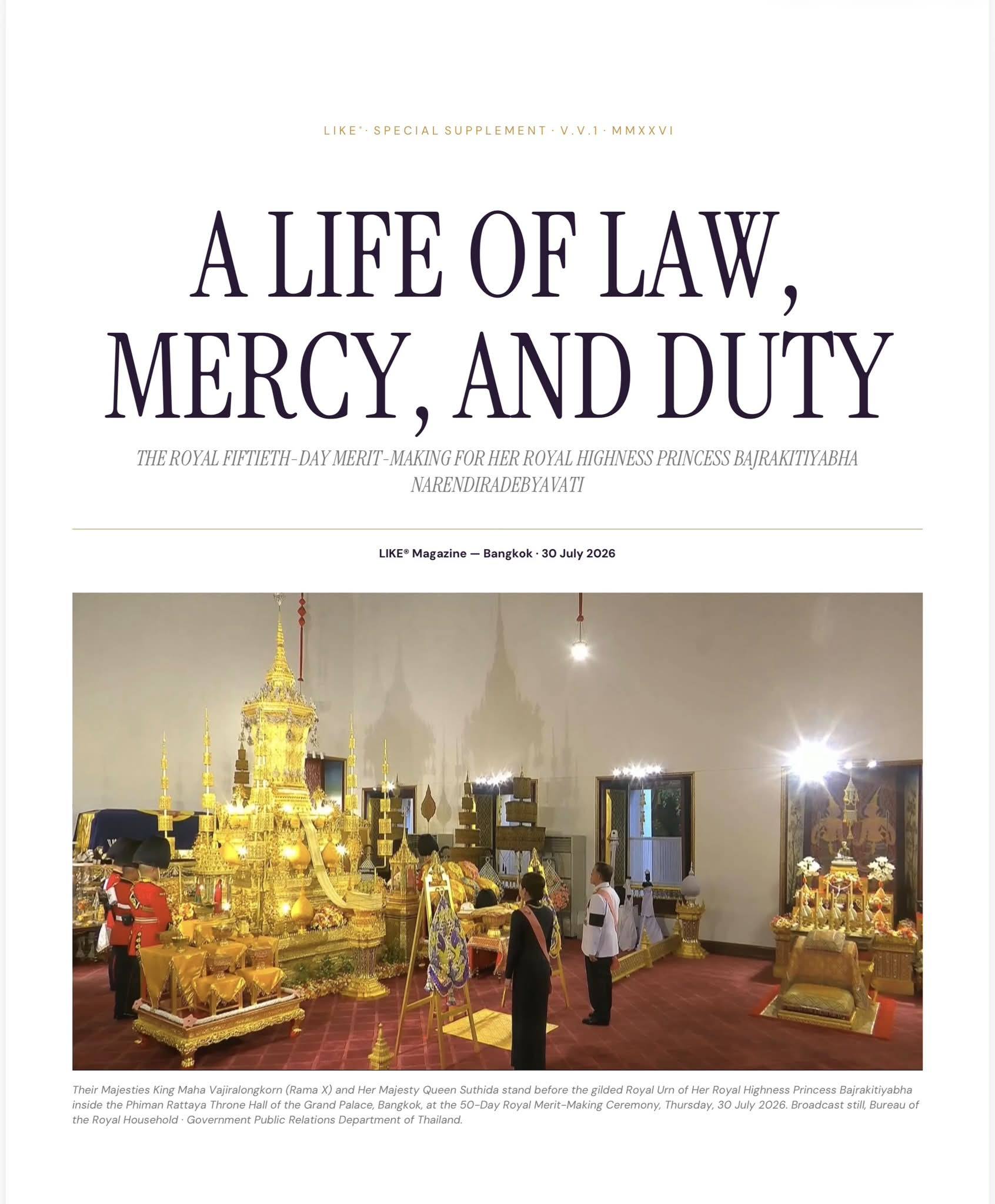
Now they are held together in the same palace. The seed and the flowering — grandmother and granddaughter — lie in state at either end of the mukkrasan.
THE ROYAL MOTORCADE AND THE "JAMES BOND" VOLKSWAGEN
On the afternoon of 12 June 2026, one day after Her Royal Highness Princess Bajrakitiyabha's passing, her royal remains were carried in solemn procession from King Chulalongkorn Memorial Hospital : โรงพยาบาลจุฬาลงกรณ์ of the สภากาชาดไทย Thai Red Cross Society to the พระบรมมหาราชวัง ( The Grand Palace ). The vehicle that bore her was a grey Volkswagen T4 Caravelle, long-wheelbase, with a blue side stripe, carrying the royal registration plate 1-0929. The palace and the Thai press have long called it, quietly and with affection, the "James Bond" Volkswagen.
This is not a state limousine. It is a working royal van, chosen for its simplicity, its reliability, and for the philosophy of sufficiency economy that His Majesty the late King Bhumibol Adulyadej the Great, Rama IX, embodied throughout his reign. It served for many years as the royal working vehicle of His Majesty King Bhumibol himself, carrying him on official duty to remote provinces of the Kingdom. Upon his passing in October 2016 it served, in the reverse of that lifetime of service, to carry his royal remains from Siriraj Hospital to the Grand Palace. In October 2025 it served to carry the royal remains of Her Majesty Queen Sirikit The Queen Mother from King Chulalongkorn Memorial Hospital, Thai Red Cross Society โรงพยาบาลจุฬาลงกรณ์ สภากาชาดไทย to the same Grand Palace. And now, in June 2026, it has carried Her Royal Highness Princess Bajrakitiyabha, the granddaughter of King Bhumibol and the great-granddaughter of Queen Sirikit's Chakri line — across the same city, along the same avenues, to the same palace gate.
One royal van. Three royal remains. The same journey performed three times in the space of a decade. It is a working vehicle that has become one of the most sacred moving objects in the Kingdom of Thailand.
THE ROYAL FLEET: A CHRONICLE OF MAJESTIC MARQUES AND IMPERIAL CONFORMANCE
The Chakri patronage of the German marque, Mercedes spans 122 years, originating from a crucial period before the famous corporate merger. In 1904, His Royal Highness Prince Rabi of Ratchaburi, Krom Luang Ratchaburi Direkridhi, presented a Mercedes automobile, built by Daimler Motoren Gesellschaft (DMG), to his royal father, His Majesty King Chulalongkorn the Great, Rama V. While this vehicle was the very first of its lineage to reach the Siamese court, the modern brand identity was only finalized decades later. In 1926, financial and industrial pressures forced DMG to merge with its long-time rival, Benz & Cie., uniting the legacies of Gottlieb Daimler and Karl Benz into Daimler-Benz AG and officially giving birth to the unified Mercedes-Benz brand.
The English Daimler—an independent British luxury automaker separate from its German namesake—entered service under His Majesty King Rama VI, Vajiravudh, with the commanding Daimler 45hp serving as the principal royal car. This established a deep-seated appreciation for British engineering within the court. Generations later, His Majesty King Rama VIII, Ananda Mahidol, chose a Rolls-Royce Phantom III to review the troops following the conclusion of World War II. From that pivotal post-war reign onward, English marques firmly anchored the official state fleet, defining the aesthetic of Thai royal pageantry.
His Majesty King Bhumibol Adulyadej the Great, Rama IX, inherited that British tradition and preserved it with immense care. His coronation car was the legendary Daimler DE36 Straight Eight, bodied by Hooper of London—a vehicle that remains one of only some dozen surviving worldwide. This elite class of limousine has historically borne other global sovereigns, including King Mohammed Zahir of Afghanistan, Emperor Haile Selassie of Ethiopia, Queen Wilhelmina of The Netherlands, and Prince Rainier of Monaco. Later in his reign, the fleet welcomed the ultra-exclusive Daimler DR450, a model delivered to only two reigning monarchs worldwide: King Bhumibol and King Hussein of Jordan. Alongside these majestic Daimlers ran the great Rolls-Royces—most notably the Phantom V, the iconic Phantom VI used by His Majesty for close to thirty years, and the Rolls-Royce Silver Spur.
Yet, for grueling working days across the country, His Majesty deflected from pure pageantry and chose the Mercedes-Benz 300—the "Adenauer Benz" famously favored by the first Chancellor of the Federal Republic of Germany. King Bhumibol owned examples of all four successive variants of this iconic model line (from the initial W186 to the fuel-injected W189). It was within this very class of luxury vehicle that he traveled to the poorest, most remote districts of the Kingdom. The car was famously transformed into a mobile workstation, ruggedly carrying agricultural equipment and medical teams, with Her Majesty Queen Sirikit consistently seated as his passenger.
The state fleet steadily grew with the progression of the reign. His Majesty acquired a pinnacle of automotive engineering: a grand Mercedes-Benz 600 Pullman Landaulet, finished in the distinct ceremonial ivory livery reserved exclusively for the royal cars. Toward the twilight of his historic reign, he replaced the long-serving Phantom VI with an ultra-luxury Maybach 62, similarly finished in royal ivory. This vehicle carried the most prestigious automotive designation in the Kingdom—the supreme registration plate "R.Y.L. 1" (Royal Automobile Number One)—backed by a second, identical Maybach 62 held in strict reserve. Upon his royal father's passing, the historic Maybach 62 naturally passed into the service of His Majesty King Maha Vajiralongkorn, Rama X.
The current reign has firmly anchored the grand ceremonial fleet in the absolute vanguard of German engineering, utilizing successive generations of the modern Mercedes-Maybach line. Today, the garage prominently features the Mercedes-Maybach S650 (W222 platform), the majestic Mercedes-Maybach S650 Pullman Guard—a heavily armored, long-wheelbase state limousine built for maximum security—and the newest flagship Mercedes-Maybach S680 (W223 platform). Proving the timeless nature of the Chakri garage, the historic Rolls-Royce fleet preserved from the previous reign continues to run in active ceremonial service alongside these ultra-modern ballistic fortresses.
The Two Colours — Ivory and Ruby
The royal cars are painted in two ceremonial colours. Ivory — called by the palace the cream colour — is the historic livery of the fleet itself: soft, unshowy, reading in Bangkok sunlight as the palest gold. Ruby red is the colour of the ceremonial escort motorcade on the highest occasions of state, when the ivory royal car of Their Majesties moves at the centre of a long escort of ruby-red Mercedes-Benz S-Class and E-Class, BMW 7 Series and 5 Series, and Nissan Teana, flanked by police motorcycle outriders. It is the motorcade one sees on the route from Amphorn Sathan Residential Hall to the Grand Palace on the mornings and evenings of the greatest royal ceremonies — and in these mourning months, of the daily rites for Her Majesty The Queen Mother and Her Royal Highness the Princess.
The ruby-red ceremonial escort motorcade of the Thai royal court — a line of ruby sedans on the forecourt of the Chakri Maha Prasat Throne Hall of the Grand Palace, with the Royal Guards in scarlet uniform to the left, the gilded Aphonphimok Prasat pavilion in the middle distance, and the yellow royal-cypher banner of the reign on the lamp standard at right, at night.
The ruby-red ceremonial escort motorcade at rest on the forecourt of the Chakri Maha Prasat, at the base of the Aphonphimok Prasat — the small gilded pavilion from which the sovereigns of Siam mounted the royal palanquin. The Royal Guards stand in scarlet along the left of the frame, and the yellow royal-cypher banner of the reign hangs from the lamp standard at right. The ruby sedans are the ceremonial escort of the highest occasions of state — of the coronation, of the state banquet for a visiting head of state, and, in these mourning months, of the daily rites for Her Majesty the Queen Mother and Her Royal Highness the Princess.
The Fleet of a Working Court
One theme runs through the whole fleet, from the first Daimler of 1904 to the Maybach S680 of today: the royal cars of Thailand are chosen for their purpose, not for their opulence. His Majesty King Bhumibol, who understood every car in the royal stable at the level of a working mechanic, chose ordinary Volkswagen Caravelles and Toyota Solunas when the mission called for it, and ordered ten Isuzu Mu-7 vehicles with his own private funds for agricultural fieldwork.
The Maybach carries the Kingdom to the state banquet at the Élysée. The Volkswagen carries the royal remains home to the palace. Both are the vehicles of the same reign, and of the same care.
THE KRUT PHA — THE GARUDA, THE ROYAL STANDARD, AND THE WARRANT OF THE KING